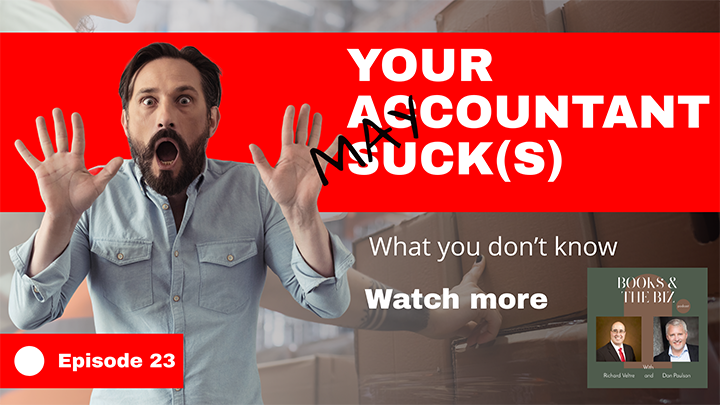
Your Accountant (MAY) Suck! How Accounting Has Changed And Its Impact On You
Books & The Biz
| Dan Paulson and Richard Veltre | Rating 0 (0) (0) |
| Launched: Jul 10, 2025 | |
| dan@invisionbusinessdevelopment.com | Season: 3 Episode: 23 |
The importance of having a reliable and efficient accountant for your business cannot be overstated. However, it is crucial to stay vigilant and take note of any changes in the services you are receiving from your accounting firm. This includes delays in receiving financial statements, an increase in errors impacting tax filings, and a lack of guidance from CPAs.
SUBSCRIBE

Episode Chapters
The importance of having a reliable and efficient accountant for your business cannot be overstated. However, it is crucial to stay vigilant and take note of any changes in the services you are receiving from your accounting firm. This includes delays in receiving financial statements, an increase in errors impacting tax filings, and a lack of guidance from CPAs.
As a business owner, a good accountant is something we all need. But have you noticed some changes in the services you are receiving from your firm?
More and more leaders are seeing statements showing up later or not at all. More mistakes are being made which has impacted some from a tax standpoint. Less guidance from CPAs while at the same time expanding services. In addition, more outsourcing overseas. AI is also starting to make a presence.
So what do you need to watch for? This episode looks at how the accounting industry has changed and what you need to do to protect your business and your money.
[00:00:00.00] - Alice
Hello. Welcome to Books in the Biz, a podcast that looks at both the financial and operational sides of success. Please welcome our hosts, Dan Paulson and Richard Veltre. Dan is the CEO of Envision Development International, and he works with leaders to increase sales profits through great cultures with solid operations. Rich is CEO of the Veltre Group and a financial strategist working with companies to manage their money more effectively. Now on to the podcast.
[00:00:44.22] - Dan Paulson
Thank you, Alice. Way to get cut off there. My goodness. Technology. Got to love it. Rich, welcome to Books and the Biz, the Thursday edition, where we get to have some fun sharing exciting stuff about accounting, of all things. Let's see what fires we start with our title here. So you and I were talking earlier this week, and actually last week, and some of it was, I think, a little spirited discussion from your behalf on your own profession. And let's just start by... So the title for those who don't see the video side of it is Accountants Suck or Accountants May Suck. There's reason for this, and there's reasons you and I both discussed, that we agree that there's been changes in the accounting profession that's affected the performance.
[00:01:40.00] - Dan Paulson
Now, you and I both know good accountants. So let's be clear, it's not that all accountants suck, but we have definitely seen a degradation in the service to our clients, and maybe in some cases, even to ourselves. Now, more so true for me, you're an accountant, so you technically, if your accountant sucks, you got a problem, buddy. I'll have to talk to you about that. But why don't you explain a little bit more about what our discussion was, and then we can maybe share some examples of where we both have been run amok by the accounting profession.
[00:02:14.13] - Rich Veltre
Yeah, I actually had somebody, either yesterday or the day before, said to me, the accounting profession is... He said it was dying. And I took that to heart, because I'm sitting there and I'm saying, I think that's probably pretty accurate.
[00:02:36.08] - Dan Paulson
Does that mean taxes are going away? Please tell me taxes are going away.
[00:02:39.25] - Rich Veltre
No, that would be great. But taxes really have nothing to do with accountants. Accountants just actually learn that stuff and help you with one aspect of what they do. But the problem that I see is that, let's see if I can get these stats right, 75,000 accountants have retired over the last couple of years. 75 % of all accountants are actually at or nearing the retirement age or the retirement age. And I think that my problem with it is it has created a quality vacuum, where quality of the work that you're doing for people, you're witnessing it go downhill. And I don't know 100 % why. I have my suspicions why. But the key factors there, the quantifiable numbers are the 75,000 accountants that are retired, 75 % being of that age, that essentially, they've gotten to the point where the people who have done the work that I've seen for years are now getting towards I'm done. They're getting towards the I'm done stage. I think the biggest examples just have come that people are getting horrible service. They're getting horrible advice. They're getting advice that they shouldn't be getting. They're getting misled. And it's leading me towards other things that have been bothering me that I've seen other people do.
[00:04:21.23] - Rich Veltre
And they'll do it to chase the single buck. They don't chase a relationship with a client. They chase a buck. And I think that when I grew up in this industry, that was something you just didn't do. Yes, there was plenty of ways that you could make an honest buck. And you could make... By giving good service, you got to make decent money. But I see what's going on now, and I'm just saying, where is this coming from? Is it coming from just everybody's retiring? Is it coming from the fact that we're lax about allowing non-qualified or inexperienced people into the profession? I'm not really sure what is the actual reason, but I've got plenty of examples. I got a ton of examples of the things just even this year, this tax season just closing. The fact that I picked up new clients and when I was looking at the returns that they got for 2023, and we were trying to accomplish 2024, I just was in shock at what I was looking at on the 2023 returns.
[00:05:29.22] - Dan Paulson
Yeah. Yeah, it's interesting because I saw that trend starting to happen actually probably a good decade ago. But I think what you're pointing out is what we're seeing across multiple industries, because I'm sure if there's people not in the accounting field listening to this, they're going, well, that's really no different thing, construction or manufacturing or machining or automotive, where we've seen this population drop of people coming into the profession and people that have actually talent in what they do. There's a reason why I didn't go into accounting, because personally, when I took accounting in college, I wasn't that good at it Over time, I learned how to read balance sheets and read PnLs, but I wasn't the type of person that could handle the details like you could in the accounting profession that would justify me getting anywhere close to a CPA. I have some very successful friends that have gotten their CPAs. They've done tax accounting. They've gone on to do other professional things related to, like what you do with more CFO work, where they're getting jobs in corporations and actually helping people figure out how to manage the money more effectively in a business.
[00:06:49.21] - Dan Paulson
But yeah, I'd be interested to hear some of what you're seeing out there. Maybe I can share a couple of situations that I've experienced, either personally or through some the connections I have.
[00:07:02.27] - Rich Veltre
Yeah, that's actually relatively easy. So take out the glasses.
[00:07:11.15] - Dan Paulson
Because we're old school today. We're going to the paper.
[00:07:14.04] - Rich Veltre
Because I'm headed towards retirement age.
[00:07:15.26] - Dan Paulson
Yeah, that too.
[00:07:18.14] - Rich Veltre
I thought I was in the 25 %. Maybe I'm in the 75 %. There you are. But I think we'll start with a couple of the easy ones. So I had someone come to me and say, can you do my taxes? How do you charge? Can you meet the fact that I was using H&R Block before? I just said H&R Block.
[00:07:43.27] - Dan Paulson
H&r Block has good accountants, too.
[00:07:46.04] - Rich Veltre
So then you match the fee.
[00:07:47.07] - Dan Paulson
Then you match the fee. So this is one particular example.
[00:07:49.09] - Rich Veltre
So yes, H&R Block actually does have decent people, but they also do have people that are just there as filler for the season. So So I'm not sure who you got. But anyway, they said, can you match the H&R Block person? And then they said, my accountant disappeared. Now, I have no idea, even to this day, what disappeared means. I mean, they just basically walked away. When I saw the tax return from the year before, they should have walked away. They should have gone and hid because the balance sheet... Okay, balance sheet means it balances, means assets equal liabilities and equity. The two just should match. These were off by $100,000. Easily. And they got filed that way. And then the depreciation on it told me a completely different story because they had bought a property in there to rehab, and they were taking bonus depreciation, which isn't usually available on property. Usually, it's less than 20-year property, not houses, et cetera, that are 27 and a half, or in commercial, real estate is 39. So they're not supposed to get it that way. So they have a problem on their 2023 tax return that it was wrong.
[00:09:06.07] - Rich Veltre
And those types of tax terms flow through to them. Personally, have to pick up the income, and their income was clearly reduced below where it should have been. Sure. That was one. Another one was a gentleman who had started a C-corporation in North Carolina. He had an accountant advise him that he should be an S-corp, which Normally, I would say that's a pretty good... If you know the client, you talk to them, that could be a very good piece of advice. But in this case, they didn't bother to check the S Corp rules, which say that a non-US citizen cannot be a shareholder in an S Corp. So this gentleman was a Canadian citizen.
[00:09:51.29] - Dan Paulson
Canadian is close enough, isn't it?
[00:09:55.26] - Rich Veltre
It's just not the way it works.
[00:09:57.11] - Dan Paulson
It's the same language unless you're in Quebec.
[00:09:59.17] - Rich Veltre
Yeah. It is not the way it works. So he's not actually able to be an S Corp shareholder. So we actually had to amend that tax return because we already knew that the S Corp election was going to fail eventually when the IRS got around to it. But that actually cost him because now he had to be a C Corp, which meant that the non-tax ability of being an S Corp was now going to cost him $6,000 at the federal level and another $1,000 at the North Carolina level. So he had a six or seven thousand dollar amended bill that I'm waiting to see if we get a notice back saying, Hey, guess what? You now owe us penalties, et cetera. But I didn't apply any penalties or interest when we filed a return. So last one was I had a client, somebody who called me up and said, I want to get you involved in helping to advise me on building a practice. He's building an architecture practice. And aside from building an architecture practice, architects love buildings. They love property. He wanted to do separately. He wanted to build something that he could live and work at.
[00:11:13.00] - Rich Veltre
So his office would be also his home. And then from there, he wanted to build and buy another property and buy another property and eventually just rehab properties. So he talked to his accountant, and his accountant basically told him, which in some cases, I would say it makes in a sense, if it's a single member LLC, you can put it to another entity. Basically, they wind up being combined. And the problem is, you don't normally do that when your architecture firm is the S-Corp, and Now you're taking the passive property that you want to buy, and you're putting it into the S Corp where the license is. And on top of that, what you wind up doing in New York City, is New York City doesn't recognize S Corp. So they treat everything as a C Corp. In so doing, he wound up increasing the New York City income to the point where he had to pay an extra $5,000 in taxes. And I said, All you really have to do is separate these two, amend your tax return, and New York City tax will go down by $5,000. The client gets $5,000 refund. Essentially, I knew this in 15 minutes.
[00:12:26.10] - Rich Veltre
The accountant's from Chicago and the accountant's saying, Well, That's not what we talked about, and that's not what I'm going to do, and I don't think that's right. And he's basically defending the work. But all I'm saying is, if he goes into the tax return, makes one change, he'll see what I'm talking about, and he'll save his client $5,000. But the ego has gotten in between him and I rather than the client. And so as much as I can tell you that the tax returns are clean, he did a good job, I want the client to stay with him as a CPA. I will happily be just an advisor, and you can do all the tax return work. But if you're not going to do it right, you are going to hear from me that this is where the problem is. I'm from the New York area. I've been aware of the New York City taxes. You're in Chicago, and you're not looking at it the way I am. And that is, you caused the taxpayer an extra $5,000 in tax that he didn't have to pay. So if I'm giving you that advice and telling you that this is where you have an issue, put down the ego for five minutes.
[00:13:40.22] - Rich Veltre
We all have them. I have one. I have a massive one. I know I have a massive one.
[00:13:45.29] - Dan Paulson
At least you're self-aware. That's good.
[00:13:48.24] - Rich Veltre
A hundred %. And I do my best to keep it quiet. But when it comes down to client service, this is where I get really riled up, that this is incorrect. And because it's incorrect, it's costing him more money. And here's the last piece. If he leaves it as is, if him and the client turn around and say, we're not going to make your changes, we're not going to make any adjustments. We're going to leave it as is. It's wrong because the loan documents say that the architect owns the property, not the architectural firm owns the property. So you You have a problem already. The second problem that you have is, eventually, if you leave it alone and you tell me that I'm crazy and you're not going to go with what I said, if you're going to turn around later on and he decides, Now's time for me to go and buy another property so I can rehab it. And he says, The only way I can do the next one, which maybe costs him more money, is to take on a partner. So he wants to take it out of the S Corp structure, distribute it out to himself.
[00:15:01.22] - Rich Veltre
Not unheard of. Can happen. Take the piece of property that's in an LLC, distribute it out. Now you take on a partner, and you can go and build off of that investment. Problem is, in S Corp, if an S Corp owns a piece of property, the distribution is taxable at fair market value. If you're an LLC, you can distribute and contribute all you want up and down.
[00:15:28.29] - Dan Paulson
Right.
[00:15:30.00] - Rich Veltre
Because it all comes out at your basis and there's no gain or loss. S Corp law says, when you distribute a property out of an S Corp, it goes out at fair market value. And because it goes out at fair market value, you recognize the tax on the distribution, which means you're paying tax to bring the basis up to fair market value. If that property goes up over the next 10 years and that's where the architect decides to distribute, done deal. He's going to pay tax. Again, all I'm getting is pushback that we're not distributing the property. No. But you don't know what the future holds. And that's where I come up and say, Guys, think about what hat you're wearing right now. You're wearing the advisory hat, not the tax return hat.
[00:16:20.01] - Dan Paulson
Well, and that to me, is probably one of the biggest challenges with much of the accounting profession. We've talked about this, too. Accountants not not only are saying they're accountants or CPAs or tax accountants anymore, they're starting to throw on the, well, I'm also a fractional CFO, and I can help you with this, but they haven't got out of the tax accounting mindset. So the problem you're bringing up is the problem I tend to see as well, where they might say they're a CFO, but they're still taking a tax account. And the only thing they're trying to bring as a CFO is really that I can save you money. I'll figure out ways to save you money. And again, it might save you money in the near term. But as you pointed out with that real estate deal, great. Saved you a couple of bucks now, and technically You're not because you don't understand New York tax law. Now push that out 5, 10 years and you could have a major tax bill that you didn't know you were going to have, and there's nothing you can do about it then. You are so well.
[00:17:28.20] - Dan Paulson
What I've seen on my end has been similar and maybe a little, probably other things that you've seen, too. But from what I've looked at the unbalanced balance sheet, yes, had a client that went through the same issue. They had X in one part, Y in another. I'm like, you know what? I'm not a CPA, but I know this ain't right. And we got to figure out why these numbers aren't balancing out or equaling each other. The bigger issue is actually I've seen on my end, because like I said, I'm not a CPA, I'm not accountant. That's not my job. However, on the operations side of things, a lot of times I ask my clients, we need to, we should be reviewing your banks or your balance sheet, your PnLs at least once a month at at the very least once a quarter. But I ideally would like you to get this information each month. And I would say three quarters of the clients I have right now are upwards of three to six months behind on receiving their balance sheets and their PnLs. And I know they've asked because I've asked them to ask, and as you know, I can be pretty persistent when I am asking for information.
[00:18:42.29] - Dan Paulson
And time and time again, yeah, I asked, it's on their list. They say they'll get it to me when they can get it to me. And to me, that right there is the biggest problem, and I think it ties into what you said, because I've asked a little bit behind the scenes, and they're like, Well, we're having difficulty hiring accountants, so we really don't have anyone to produce the financials to give to our clients. And what to me is worse is a lot of these clients are paying a monthly retainer for this stuff to happen, and they're not getting it still. So that's something to me, you really have to start asking questions about. If you're paying so much a month and you're expecting to get your balance sheets, your PnLs, maybe some cash flow statements, you might throw in some other statements as well, just for good measure. But when you're not getting that, that is hurtful. And when you start talking to clients and they say, I haven't seen anything in 10 months, and now you're getting up to the end of the year, it's like now from a tax preparation side of things, because, again, a lot of people pay extra for that, as you pointed out, what extra can we charge for?
[00:19:52.14] - Dan Paulson
Well, tax prep is one of them. And there's nothing there to do tax prep on from a business owner standpoint. I don't know where I might know roughly where my sales are. I might know roughly where I think my profit is, mainly because, again, how much money I have in the bank account. And then you come into that situation, you have a huge surprise. That, to me, is incorrect. That should not be happening. And what I see accountants trying to do to correct it is they're pushing a lot of work overseas. So no offense to anyone overseas, especially in Asia. There might be some great and so over there, but they don't have a hand on the business. They're just given numbers, and they're expected to plug those numbers into categories and then spit back reports. The other thing that we are starting to see, and I haven't decided if this is good or if this is bad yet, is AI is now coming in to fulfill, I'll call it basic accounting tactics, systems, whatever it might be, because we're, again, trying to use AI for as much as we possibly can. I don't think there's any secret on the level of shortage that there is in the CPA profession.
[00:21:10.26] - Dan Paulson
And I think they're looking at, well, if we can get ChatGPT to take these numbers and hopefully put them in the right spots, eventually we can have ChatGPT, and it's not ChatGPT, it's whatever Intuit or whoever else has come up with. They'll just do the basic accounting. And then the idea is we'll have our primary CPAs do the review and do all the important stuff. But as you pointed out, 75 % of them have retired, another 25 % are in the wings to go out. And the people coming up the ranks, if AI is doing everything or if overseas is doing everything, how are they getting any experience in this?
[00:21:49.07] - Rich Veltre
I really think that somewhere along the line, and if I have to be the guy shouting from the rooftop, I will be. Okay, But it really still comes down to training. Why is it that every time that somebody talks about shortages, they don't go back to, how are we going to train these people? Ai is coming in It's going to take everybody's job. Okay, well, people have to do something, right? Otherwise, we just created AI, and we're going to kill the whole country because nobody's going to have a job, right? Computers are going to do everything, okay? Silly media stuff. I don't listen to it. What I do listen to is Everybody tries to jump on it too fast because they think that this is going to make us so much more efficient, and I could fire all these people tomorrow, right? So they're laying off a whole bunch of people quietly behind the scenes, okay? And what are those people going to do? Somebody has to say, you're going to go and you're going to train on X, or your new company or somebody is going to have to train you to do something different.
[00:22:57.29] - Rich Veltre
I think a lot of it comes back to what What is the training going to be? Regardless, you get AI. I mean, Intuit rolled out AI in Quickbooks over the last couple of years.
[00:23:08.02] - Dan Paulson
And it's annoying as heck.
[00:23:09.22] - Rich Veltre
It is the most obnoxious launch you would think Microsoft owned Quickbooks.
[00:23:18.24] - Dan Paulson
We're throwing out a lot of names here.
[00:23:20.23] - Rich Veltre
Be careful. Yeah, I know. But here's the thing, okay? Microsoft, let me make you feel a little bit better, okay? I love Microsoft. I don't like Google products. I I am a Microsoft guy. I have Excel. I have Word. These are my programs. They have been for years. But Microsoft was the most annoying at launching updates and launching, especially around Windows.
[00:23:46.17] - Dan Paulson
Oh, I agree.
[00:23:47.02] - Rich Veltre
There were so many patches. It was because they would just release it, because it had to go out fast. And then for whatever reason, we'd get a patch every week. And it would take hours to update. They've gotten better. But that was my annoyance all the time with Microsoft. And when Quickbooks went and did this whole, here's AI and AI is involved, I'm not even sure AI is involved. Because underneath, it doesn't look any different. So what are you telling me? What is this thing going to do for me? Because you didn't train me on how to use it. And I've been a Quickbooks user since it came out.
[00:24:30.00] - Dan Paulson
Okay. Oh, by the way, Quickbooks is getting extremely expensive for their monthly online subscription. And you got to wonder, what are you getting for that price? Because I think the last jump was $10 a month. So it's not like it's going up by five bucks anymore. They're getting to the point where I'm questioning why I'm paying for this.
[00:24:50.11] - Rich Veltre
Yeah. And they also just released their enterprise level, which it used to be where QuickBooks enterprise was desktop only. And now it looks like they've gone after the QuickBooks desktop to put that online. That is not cheap.
[00:25:09.17] - Dan Paulson
Right.
[00:25:10.11] - Rich Veltre
Okay. Now, when you consider the fact that what they're going after is a lot of people who were using the QuickBooks desktop put it into a host, and that way they could say it's in the cloud. It was desktop software that somebody else had to administer for them. The problem is The administration was so expensive. I had a client that was on QuickBooks enterprise desktop. They put it in the cloud so everybody could get to it from wherever they wanted. It was 5,000 a month just to host it. So When we put them on another software, we went from $60,000 a year to $18,000 a year, and everything made sense. But now, QuickBooks is realizing that a lot of people had done that, and now they don't want to keep losing So they've gone out and they put it all onto their own cloud. But it's not cheap. Are they more like the $1,500 a month that we were able to get for the client that we had? Yeah, that's probably similar. That's still a lot of money.
[00:26:15.16] - Dan Paulson
That is, yeah. Well, and I look at a business like mine that's fairly small. You look at how much you use the product and what you need the product for. And it's not going to be long before it's $100 a month. Well, when I first started my business way back a long time ago, for about $100 to $150, you could get the full suite of Quickbooks on your computer. You buy a desk, you download it, and it worked just fine. So it's interesting to see where we're getting to and how far it's going. And now, again, the quality of what you're getting isn't improving. It might not... You're lucky if it's not changing, you're not going backwards. But I think there's a number of cases where it is starting to backslide a little bit. Now, we could sit here forever and talk about things in a negative light. But as you mentioned, and as I mentioned, we all know good accountants, and I think we know what to look for in those good accountants. You as the CFO professional, what would you tell people, business owners, specifically, to start looking for if they're seeing any of these issues around accounting that they think that need to be addressed?
[00:27:33.02] - Dan Paulson
What would you tell them to change or what? I would tell them.
[00:27:36.07] - Rich Veltre
Yeah, my biggest push right now is to tell people, look, you need the expertise And you need to make sure that you're getting the expertise. A couple of the suggestions I heard even from other people. If you're not meeting or talking to your accountant once a quarter, that's a red flag. If you're a You're a business owner and you're running a bit, look, if you're a 1040 client, you're just doing your individual taxes, no, you should not be paying for your CPA to talk to you.
[00:28:08.23] - Dan Paulson
That's more like a once a year type thing.
[00:28:10.22] - Rich Veltre
Yeah. So more than likely, that's not something you need. If you're a business owner, you should be talking to your accountant once a quarter. Even if it's just an uptake conversation, you should be hearing from them. You should be reaching out to them. There should be a conversation. Number two, make sure you know what that accountant is doing for you. If they're charging you $500 a month or $200 a month or $1,000 a month, what are they doing for that $1,000 a month? Look, this isn't just a, this is my fee and that's it. This is, what's the value? If I'm not giving you value and I'm charging you $1,000 a month, fire me. I don't belong there. If it's a financing arrangement because your tax return cost you a and you want to do it over a monthly basis, that's a different story. But if you're actually looking for advice and that's a part of what you're paying for, make sure you're getting it. And if they say that they're sending you financial I have no idea how many times I've asked people, show me what your financials are, and they give me a PnL.
[00:29:22.05] - Rich Veltre
I'm like, that's one. That's one financial, okay? And nine times out of 10, the problem is on the balance sheet. And you're not giving me a a balance sheet because you're not looking at it. If you don't know what you're looking at, make them explain it. If it costs you an extra hour to have them explain it, pay the extra hour, okay? That's not where you want to cheapen out your services that you're getting. If they can explain it, or they don't explain it, or there's a number on there that suddenly looks like, hey, you didn't look at this before you went over it with me, because that's how it'll come out. It'll be pretty embarrassing if they're looking at a balance sheet for the first time on the phone with you, and then they can't explain what's in there. That's a problem. But the problem is, those are the problems you want to actually get. You want to see if that's what the problem is. If you're not getting what your value is supposed to be, then you shouldn't be paying for it.
[00:30:16.10] - Dan Paulson
So that's a good point there, Rich. And this is where I will add on to what you were saying, because a lot of times you're talking to the CPA that's a partner level because it's their job to get new business or it's their job to keep the clients. Ask who's doing the work and ask what follow up is done with that work, because in most cases, it's like a law firm. The lawyer, he goes to court to litigate or he reviews the final document. But usually there's somebody who's a junior that's actually doing the heavy lifting because that guy has moved into a partner role. It's the same thing with accounting. So your partner isn't always hands on with your taxes. It's somebody else, and then they're doing a review. And if they're not doing a detailed review or explaining their process for their checks and balances, that can be another red flag to me, because that comes back to your point where now he sees the documents for the first time, and maybe he does realize something's wrong Or maybe he doesn't realize something's wrong, and it's because he hasn't looked at before.
[00:31:20.12] - Rich Veltre
I had a new prospect that called also, and I was going over the numbers, and he said, I really just need a new relationship because I'm paying monthly to get my books, which I do all the books, so I don't know what I'm paying monthly for. And then he said, They gave me estimated taxes for every quarter, so I paid all those. And at the end of the year, they call and they say, Oh, by the way, you owe $30,000 with your taxes. And when he asked why, because he's been paying the quarters, he doesn't get an answer. And then they call back and say, Yeah, we I got it wrong. It's actually $37,000.
[00:32:02.13] - Dan Paulson
Oh, great.
[00:32:04.09] - Rich Veltre
So that's the type of example that if that's what you're getting, that's not the partnership type mentality that I would expect you to be getting from your accountant. If your accountant is just aloof and collecting money and often la la land somewhere, time to bring them back a little bit. Like, explain to me what's going on here. We had a pretty big tax law come out on Friday. I think this is going to be a big test because people are going to say, how does that affect me? Where's your accountant? Is he answering you? Does he know?
[00:32:42.22] - Dan Paulson
Yeah, you're right on with that. I think we're going to see how that is. And this is, again, I think is a good flag for a lot of people. So did your accountant contact you on this? Did they send you at least an email explaining, here's what's coming through, here's how it could potentially impact you. Even that is something better than nothing. But often we don't hear a lot from those folks, because after May 15th, or excuse me, well, it May 15th, between April and May, they drop off the planet until you get into that September range, where now all the deferred filing is coming due, and they've got to handle that. We're getting long here, Rich, so I want to wrap it up. But I think if you could... One thing that we might be able to help people with is that 20 questions. So maybe if you could explain the 20 questions and some of the stuff that we cover, especially on the finance side, that can go a long way to help with the tax situation when it comes to looking at your financials.
[00:33:51.10] - Rich Veltre
Yeah. So if you haven't heard, Dan and I are offering a 20 questions. We meet together and we go for 20 questions. And with those 20 questions, we basically do an overview of your business. And 10 of those questions are operations, and 10 of those questions are financial. And most of what we talked about here are in the 20 questions if you think about it. We've asked, what do your numbers look like? Are you getting them on time? Are you getting them in a way that you're confident, that you're comfortable, that the numbers actually tell what's actually happening in the business? These are the type of things that we want people to realize that if there's a red flag to be found, we'll probably give you a little push in those 20 questions to say, we need to do a little bit of exploration here. If you don't want to do it or you think it's something that you can work with your other accountant on, that's fine. We'll basically give you the questions, have you asked them. If you're not comfortable with it, go back to your professional and you can do it. You want us to help you, we can talk about that.
[00:34:57.26] - Rich Veltre
But I think the first part of is, if you haven't thought about doing the 20 questions with us, we're offering it. It's on our nickel. We're scheduling them out now, and we're scheduling them out so that people who think there might be something to look for can use the 20 questions as something that they can get down to the root of the problem if there's a problem. Or maybe they just walk away and say, you know what? That was great. But I'm happy with the 20 questions and the 20 answers. So if that's the case, good for you. And we'll keep in touch. And if it comes up later on, we can do it again.
[00:35:32.22] - Dan Paulson
That's right. And you know what? We're about halfway through the year. Actually, we're a little over halfway through the year now. So if you wanted to do a quick review and you're not getting it from your accountant, guess what, guys? As Rich said, it's on our dime, so you don't have to worry about paying anything for this. It doesn't take that long. It's probably about 45 minutes, maybe an hour to answer the questions. It really depends how verbose the other The person we're talking with is, but in most cases we can get through it in a half hour to 40 minutes. It will give you a simple report. It's going to be easy to review. We're working on the format of that right now, but I would strongly encourage people to check that out. So Rich, if they want to do a 20 questions and they don't like talking to me, but they want to talk to you, what's the best way for them to get a hold of you?
[00:36:21.11] - Rich Veltre
Best way is always by email, and I'm at rich@xcxo.net.
[00:36:25.10] - Dan Paulson
All right. And if for some reason you don't want to talk to Rich, you want to talk to me instead, I'm I'm welcome to take your call or take your email. In this case, I'll give you my email. It's dan@xcxo.net. Rich, this has been a spirited discussion by, I think, both of us. I think we've highlighted a lot of issues. Again, there's a lot of good accountants out there. Don't get me wrong, but there are changes happening in the industry, and as business owners, you need to be aware of it. So Rich, we'll be talking again next week. Have a great weekend. All right. You, too.
[00:36:59.12] - Bob
Want to boost your sales and profits but need the talent to help you grow? Xcxo is a one-of-a-kind platform to find skilled fractional executives to help develop your team into a high-performance powerhouse. Fractional leadership is a great choice when you consider the average executive the average executive-level candidate can cost you hundreds of thousands of dollars in salaries, benefits, and incentives. Xcxo finds you the executive and utilizes their talents to build your team's experience, all for a fraction of the cost of a full-time C-suite leader. Contact XCXO today to fill the gaps in your leadership team. Visit xcxo. Net to learn more.