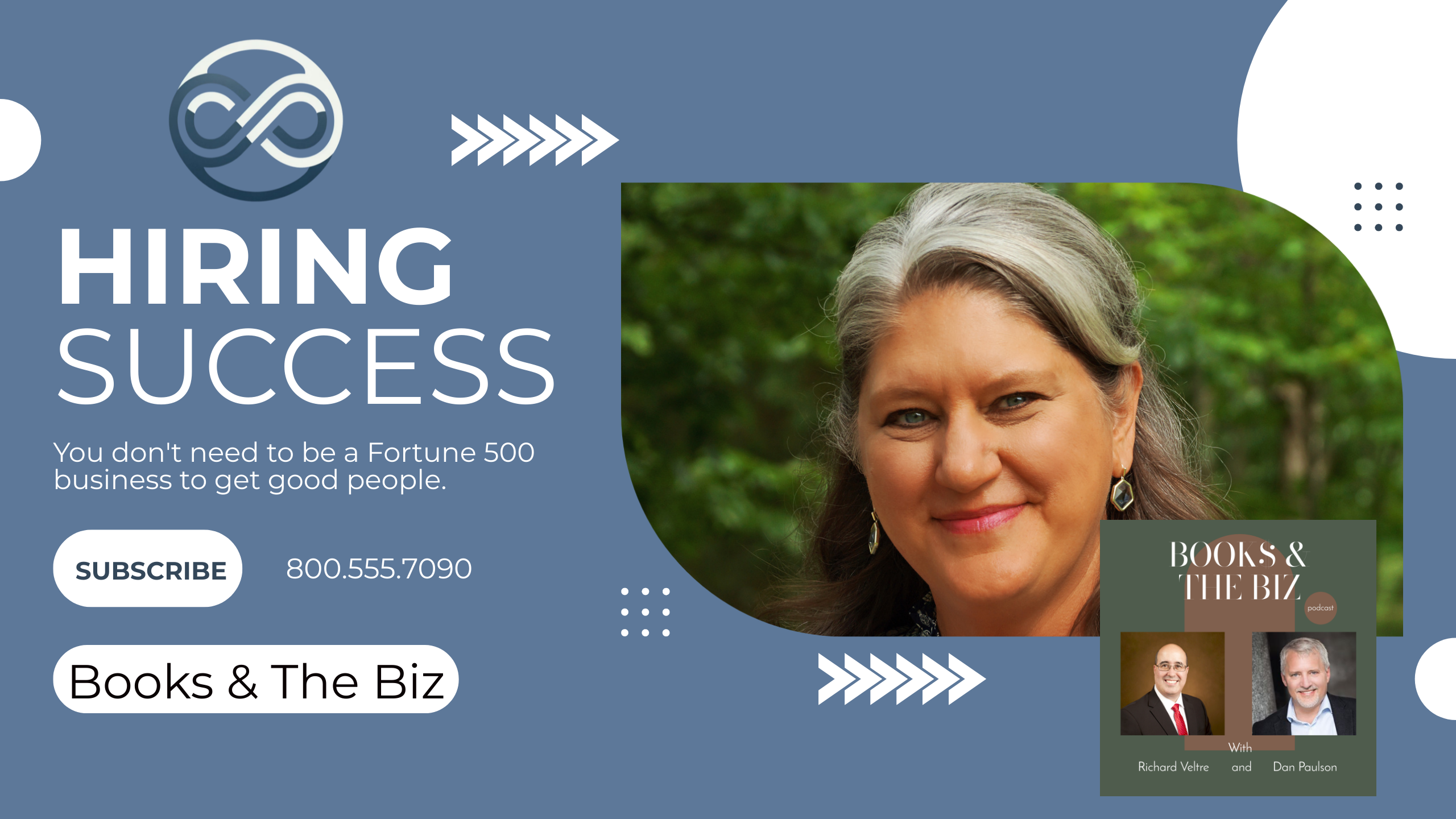
Competing With Corporate - HR Success With Shelly Dretzka
Books & The Biz
| Dan Paulson and Richard Veltre | Rating 0 (0) (0) |
| Launched: Jul 17, 2025 | |
| dan@invisionbusinessdevelopment.com | Season: 3 Episode: 24 |
In this episode, Shelly Dretzka, owner of aHRrow, discusses the importance of a people-first approach in HR consulting for small businesses. With 25 years of experience in HR, she emphasizes the need for leaders to prioritize hiring and retaining talent in order to build successful performance cultures.
SUBSCRIBE

Episode Chapters
In this episode, Shelly Dretzka, owner of aHRrow, discusses the importance of a people-first approach in HR consulting for small businesses. With 25 years of experience in HR, she emphasizes the need for leaders to prioritize hiring and retaining talent in order to build successful performance cultures.
Talk to most business owners and they will tell you that hiring and retaining talent is tough. What you probably don't realize is you can be highly competitive getting good people. It's all on your approach. In this episode, we will talk with Shelly Dretzka, owner of aHRrow.
About Shelly: After 25 years on the “inside” of HR—navigating everything from high-stakes employee relations to building performance cultures—I took the leap during the pandemic to launch aHRrow, a people-first HR consulting firm for small businesses with less than 100 employees. Bringing multiple decades of HR experience, positivity, and energy, I partner with leaders who are ready to grow, delegate, or simply step away from daily HR headaches.
[00:00:00.00] - Alice
Hello. Welcome to Books in the Biz, a podcast that looks at both the financial and operational sides of success. Please welcome our hosts, Dan Paulson and Richard Veltre. Dan is the CEO of Envision Development International, and he works with leaders to increase sales and profits through great cultures with solid operations. Rich is CEO of the Veltre Group and a financial strategist working with companies to manage their money more effectively. Now on to the podcast.
[00:00:44.05] - Dan Paulson
Hello and Welcome to the next exciting episode of Books and the Biz. I am here with Rich Veltry. Rich, how are you doing today?
[00:00:51.27] - Rich Veltre
Doing very well. Very well.
[00:00:53.13] - Dan Paulson
How are you? A lovely day. I am doing wonderfully, and we have a guest this week. So, Shelle Dretszka. Hey. You own a company called Aero. I got to say that right, because I keep getting stuck on the HR you threw in the middle there. But you own a company called Aero, which, of course, I mentioned the HR. You specialize in HR services for different size businesses, small to I'd say small size businesses under 100 employees, correct?
[00:01:18.17] - Shelly Dretzka
You got it. Yeah, we really focus on the headcount, so under 100 employees, correct?
[00:01:22.25] - Dan Paulson
We had this discussion before camera. We focus on headcount, we focus on revenue, and tried to get that all right now, but you deal with a lot of issues that I think both Rich and I tend to run into. And as we were talking previous to this, one of the challenges that I think most, I would even say up to medium-sized businesses tend to have, is they have their own mindset on what it takes to hire and retain employees. And I hear it, and you mentioned this, that's why I thought this would be a good topic, is they will say, the owners or the executives will say, well, we can't compete with X because we don't provide wide services or we don't have wide benefits. We basically are stuck doing what we're doing. And I thought your conversation was interesting in that there is more to hiring and retaining people than just, can you provide health insurance? You got it. So I wanted to open it up to you. First of all, could you explain a little bit more about your company? I have done probably an okay job with it, but you can always do better.
[00:02:28.08] - Dan Paulson
So we'll start there and then we'll dig into the subject matter.
[00:02:31.11] - Shelly Dretzka
Yeah. So thanks for having me, guys. Hello to the audience. So I have been in the HR space for decades. I like to say, check that box now. I don't say the years, I say a couple of decades. This is the fifth year of Aero. So I was on the inside. I've been in the corporate. I've been in that decision making desk with executives and board of directors in 2020. What a fabulous year that was. My position was eliminated when I was a VP of HR at a local community bank. And I hit the ground running with Aero, HR fractional services. I knew about consulting, learned about this fractional space that's out there. A lot of accountants love to use the fractional space. It's also been known as outsourcing or consulting or contracting. So all of those things is what we do at Aero. We do have a team. It's just not me anymore in our fifth year. And we go into those small businesses. Again, we have that joke about we talk about belly buttons and head counts versus dollars in the door. Those are companies that don't usually have people doing HR, so they have no one doing it or they have the wrong person doing it.
[00:03:40.05] - Shelly Dretzka
So that's where we come in because we're the right people. We know what we're doing. We're very experienced. Like I'll say, we're fun to work with, right? We're not the typical HR people. We're not HR police. So we go in and we partner with those business owners and those decision makers and help them get their HR stuff done, right? Get rid of those HR headaches. A lot of it's compliance, some really basic things policies, procedures, handbooks. But it also goes into attracting, retaining an engagement with their employees through a recruitment process and a stay process. And I do, to your point, we hear all the time from clients, we don't have that budget. We can't compete with the big guys. We don't have the people. We don't have the time. We're all wearing multiple hats, right? We hear that a ton in small businesses. I'm wearing multiple hats. When am I going to have time to do that? I got to get sales in the door. I got to keep the machines running. The And the last thing you ask them where your priorities are with HR, and it ends up pretty low on their list, which is really hard then to keep the sales going and keep the machines going if you don't have the people to help you do that.
[00:04:41.04] - Shelly Dretzka
So that's where we can step in and bring really, really great value. And we talk about, right, do they have the budget for this? And I'm just making sure my battery's in there. Sorry, guys. There we are. We're still back on. Sorry, sorry. So that's where we can come in and say, you You don't have to be the big guy. You don't need the big budget. You need us. You need our expertise, and you need us in front of you. If I want to start with the recruiting process, how to attract people is getting the right job posting out there. Sometimes we don't have the time. They've got a really sloppy job description, and they just throw it. So in the recruiting world, we used to call that post and pray, right? Throw it out there, and let's see who we get. And then let's complain about, We're not getting good people. We're not getting the right people. Will you put something horrible out there. It's sales. We're marketing for candidates, right?
[00:05:35.17] - Dan Paulson
So that's one of the things that I notice about most job posting is they post the tasks that the individual is going to have to do. And in most cases, the job is self-descriptive. But you're doing, I think you're going to get into here, there's more to it that's a marketing component that you have to sell the opportunity to the employee. Otherwise, why would you sell a list of tasks and why would that employee want to just do those tasks, right?
[00:06:02.12] - Shelly Dretzka
Yeah. That job description is really the what, right? So if you can just talk about a receptionist, answer the phones, greet guests, open the mail. Cool. We all know what a receptionist does, right? So are we just going to go hire anyone off the street that can check those boxes of those tasks? No. So what we want to go after is the who. Who is the type of person we want to go after? What does their personality look like? Let's tell them what their day is going to look like. Are you answering five phone calls or are you answering 100? Is Is it just that one UPS guy coming up or is it a revolving door? Tell them what their day is going to look like and what type of person they need to be. That's way more attractive than you're going to sit behind the desk and you're answering the phone and open the mail. Just seems very monotone, right? So getting that job posting out there, I love starting with a traction statements of why do they want to come work for us, right? What is something spectacular about what you do or what they're going to be able to do for you in that organization?
[00:06:59.02] - Shelly Dretzka
So I stay away from a lot of the what, because, again, if you can be a receptionist, we know you can do all those things, or engineer or whatever, right? Even a CMO. You know what they do. We want to talk about who that person is. What's unique to the small business is they really get to define who that is. In the corporate world, we got red tape and bureaucracy, and they're like, Oh, we don't hire for personality. Oh, we don't hire, right? So you get to tell the world how it is or why it's so great to work at your organization and why you should come work here and the who that they're looking for. So that's a huge first step is just differentiating yourself with that job posting, right? As they're scrolling through and they're looking at a lot of job postings on Indeed or wherever they're looking, LinkedIn, If there's that statement, that punch, that pow, they're going to be like, oh, I want to keep reading this one, and I'm going to hopefully hit that apply button. So that's just a little something different that we partner with them. We ask a lot of questions.
[00:07:55.27] - Shelly Dretzka
I joke throughout the entire process, owners and decision makers, they got a lot going on up here, right? Right. We joke about the napkins, right? Everyone makes their own notes on napkins and Post-it notes. What we get to do is go in and partner with them, pull all that stuff out, pull it out of their brain, get it off the napkins, get it off the Post-it notes, and really make a really strong HR culture for them.
[00:08:16.04] - Dan Paulson
Good.
[00:08:16.14] - Shelly Dretzka
That's one of the things we're attracting.
[00:08:18.29] - Dan Paulson
Nice. I've got one question for you, then I'm going to turn it over to Rich because I'm sure he's got a bunch. One of the challenges, because you and I both live in Wisconsin, Rich is out in Jersey. So he's got some larger populations to work with. But one of the challenges that I see, especially when it comes to small businesses and manufacturing and construction, is we're typically working in smaller towns, smaller towns with smaller populations away from the bigger cities with bigger populations. Now you end up with the situation where how do you attract people to come work for you when you're dealing, A, with a limited population, and B, now, as we've been talking about those limited resources, what What do you do to pull somebody from maybe the bigger towns to come out and work in a town of maybe a couple of hundred to a couple of thousand?
[00:09:08.04] - Shelly Dretzka
Right. I think, again, when you're posting, it's talking about why it's so great about your town and things that you're giving to them. But I think the other thing is being proactive. And now we're going to be sourcing, and we're going to go after those other individuals. And we're going to get in front of them and tell them about the opportunities you have at your organization. And it might not be today, and it usually isn't today, right? That they're like, Absolutely. I want to talk to you. I'm not happy. But you stay in front of them, and you let them know, and make sure they're getting updates about you, because that day is going to come at that big company in that big city where they're sick of the traffic. I mean, I used to go downtown. So I'm in Maguanago. So I could go downtown, fight traffic, park a couple of blocks away, and get to my desk, right? Door to door, 45 5 minutes to an hour. For three years, I drove to West Bend, pretty far away from Maguanago. Door to door, 50 minutes to an hour. Now, which one did I rather want to deal with, right?
[00:10:11.25] - Shelly Dretzka
The traffic, the parking, all that horrible stuff where I could just go straight up, no traffic, pull in a parking lot. So that's a simple thing to say. Think about that commute time you're having in the big city stuff versus changing directions, going north instead of east or whatever the case may be. So just thinking of it in those ways, I I think is helpful to pull those people from the bigger cities.
[00:10:33.20] - Dan Paulson
Good. And for those of you who don't know where McQuinnago is, you might as well just say Milwaukee area. Got it. That make it easier. Because I'm pretty sure Rich is going McQuinnago What the hell is Miquanago? We do have a lot of Indian names out here, Rich. You're going to have to get used to it.
[00:10:50.26] - Rich Veltre
I lived in Succa Asana for 20 years. I mean, come on.
[00:10:54.26] - Shelly Dretzka
Man, that beats Miquanago. I love it.
[00:10:57.17] - Dan Paulson
There you go. Well, Rich, I'll turn it over to I'm sure you got some questions related to the finance side of stuff.
[00:11:03.06] - Rich Veltre
Yeah, I think, HR always is an interesting thing because it's different from what I have really dealt with. I'll use an example, I guess, to lead me into the questions of how do we get people to understand what you would do? I went to work for a little while with a company that was importing stainless steel tubing. And I would equity firm had come in, bought the whole thing. I was just filling the gap until the new guy could start. And the funny part was everybody asked at one point about HR. So what about HR? And the owner who had sold this company for $100 million and had 16 plus people, his answer was, we don't have any HR issues. I mean, that was the end of the conversation. That was it. And I'm sitting there and I'm like, well, I wish I knew a little a bit more about HR, because the first thing I would say is, I don't know anybody who could say that with 16 employees existing, that you're trying to grow the business, move into a bigger building, shift all these people over to a bigger building, and you're saying there's nothing you have to deal with on the HR side?
[00:12:19.22] - Rich Veltre
And I think that's the part that throws me off. So I'm glad you also brought up the fractional part, because I think it's really important for people to see the fractional definition, because what seems to have gone on, at least on the finance side, you mentioned that all these accountants all say fractional. They all offer it. I don't even think they know what that's supposed to mean. It's supposed to be fractional leadership. Fractional was never about sending a bookkeeper in and doing 35 hours instead of 40 and say, well, it's fractional. It's seven eighths of the week. So do you see the same thing on the HR side, where it's, how do you go across and tell these people, like my guy who said, oh, we don't have any HR issues. Yeah, you probably have more than you know because you haven't done anything with it.
[00:13:11.14] - Shelly Dretzka
Right. Yeah. So with those, we're It's like the what's keeping you up at night question, right? Or what's giving you a headache? And you start really asking the right questions, and then you start hearing the people issues, right? They may be thinking, I don't have people knocking on my door complaining about working here. End of story. I don't have HR issues. But are you attracting the right people? Are you losing people? Are you watching the trends of why people are leaving? Are there things that are rising to you? I mean, someone at that level, someone's not going to go complain or probably report a harassment thing to the top of the guy, right? So instead, it's quietly festering, probably affecting other people. They're leaving. And then the time he's going to hear about that is when he gets the note from the attorney, right? So he hasn't heard attorneys yet, right? So everything must be good, but he just doesn't know what he doesn't know that's bubbling up underneath that. So it's having that conversation and saying, okay, and it doesn't have to be issues either. It could be good stuff. How do we keep the good stuff going?
[00:14:13.06] - Shelly Dretzka
Sometimes it can be on cruise control, but it takes effort to keep a good culture and keep structure and policies and procedures going forward. And a ton of HR is also risk mitigation. So if I hear, I haven't heard from an attorney, haven't been sued, I'll be like, Yet. What are you doing? And then I ask the question, Cool. What are you doing? What are your processes and procedures to make sure we are compliant? We are legal. We do have a safe work environment. Well, nothing. It's just working. Well, good. So we're on wishes, looks, and prayers. All right, let's see how long that works for you. And then when the attorney comes and we've got a lawsuit, how do we defend that? So a lot of risk mitigation. And I never want to go in with fear. I mean, there's a lot of government regulations we have to watch, too. Flsa is Fair Labor Standard Act. Are you paying your people right? Are you paying an hourly person versus a salary person? Are you paying them properly? Are you paying over time right? You start thinking about those things. You hear like, well, my employees aren't complaining about it.
[00:15:18.20] - Shelly Dretzka
I'm like, well, they're not complaining to you about it. Can we talk to your supervisors? Can we talk to your employees? I'm a huge fan of stay conversations. I go into some clients, they do exit interviews. Okay, we're asking questions a little too much, a little too late. The person is off the door. They're either just going through it quickly because they just want to leave or they're disgruntled, and then you're just getting a dump, right? So I love stay conversations. Let's talk to your current employees. Let's talk to your supervisors. Why are they here? What gets them here every morning? What would make them want to leave? So having those conversations with that third party. And I think that fractional, Rich, I'm coming back to that, having that outside view, because when you're inside HR, I've done it, right? Where, Oh, there's HR. Hr is in the office today. Oh, my gosh, for the past five years, I can't tell me how many times, Oh, my gosh, HR is here. When are you guys coming back in? I look behind me, I'm like, oh, Gosh, you're really excited to see me? This is super awesome.
[00:16:18.13] - Shelly Dretzka
So we're seen as a partner. We're seen as a resource. We're there to help them, both sides of the coin, the ownership, the management, as well as the employees. So that's really how I get over that. Yeah, we don't have HR issues here. Asking the right questions and getting down to, you do have these HR issues, and here's how we can address them, or here's some things that could be bubbling up, and let's get ahead of that, be proactive and mitigate that risk for you.
[00:16:46.10] - Dan Paulson
Okay. That's a great way to approach it. Now, one thing I want to touch on, because I found it interesting, Rich, that you actually hadn't had to deal with a lot of HR issues, because typically when I see a company that, I would say, is little larger bigger than small, and they don't have an HR person, it's typically the controller, CFO, whoever's in charge of the finances, or it's the lawyer. That seems to be where HR falls, and it's heavily into the compliance issue, not into anything else. Just make sure the paperwork is filled out right. Make sure we don't get sued. Make sure we let somebody go. We got all our ducks covered, so that way we don't end up all spend all our time in the local labor labor loss situation. I guess, how do you deal with that? How often, Sherry, are you brought in when there is somebody who now instead of Rich's example, there is no HR problem, there is somebody else handling HR But they might be handling it more from either, again, a financial side of things or a legal side of things, but either way, more of a clinical side of this is just a job, this is just a task, this is just making sure we don't get our butt soon.
[00:17:58.29] - Shelly Dretzka
Yeah, yeah. Keep We're in the wheels on the bus, we call that. So I walk into that a lot. So when I talked about at the beginning, no one doing it or the wrong person doing it, small businesses, very common story. I walk in, male business owner, guess who's doing the payroll? It's his wife, it's his daughter. It's someone who said, okay, honey, I'm here to help make this business happen. How can I help you? And they step up and they start doing it. So they start doing payroll because we have to pay our people. They get people onboarded. They do the basics, right? They maybe are doing I-9s, getting their tax forms in. And then they go, oh, now we've got more people. We've got some HR stuff we got to deal with. We've got some people making some complaints, or maybe we got to do some recruiting. And that owner looks to that spouse or to that child and says, guess what? You got a new hat to wear. You're now HR. And that spouse or that employee, that's not even related, of course, in small business, right? They put the hat on.
[00:18:53.25] - Shelly Dretzka
They're loyal. They're team players. They're going to do it. Cool. I'll take that on. So notice they started in the financial The people part, which is usually how they're pretty wired, right? And then they get thrown the people part, and they be grudgingly.
[00:19:06.22] - Dan Paulson
Oh, they're begrudgingly. They're probably doing the payroll is why they got taught.
[00:19:10.05] - Shelly Dretzka
Yeah. And maybe some general ledger, some basic, right? Basic accounting stuff, because they usually are outsourcing the CPA and all that other fun stuff. So when we talk to potential clients and we walk, we're like, who's doing your HR? And they say who the person is or that person raises their hand. Hey, it's me who's doing it. And I'm like, cool. Do you like doing it? And they're like, no. So chances are they're not doing it well. They're not happy doing it. So that's where we can step in and be like, hey, would you like to take someone else in on that? Like someone who actually knows what they're doing, and we really enjoy doing it. It's our passion. We love it. And we're going to know what we're doing and keep you compliant and even bring all the other fun stuff. That's why I call it up the bus. Let's start talking strategy. Let's start talking attracting and retaining the right people. So walking in, yes, it is usually in these small All businesses, it is the wrong person sitting there. And I will tell you, eight out of 10 times, that person doesn't want to be doing it.
[00:20:07.10] - Shelly Dretzka
Sometimes they love it. They went and they took their courses and they love it, and maybe it's a path they want to be on. But I'll talk to an owner or the decision maker, and they'll be like, Oh, I don't know. And I'm like, Can you go ask that person if they'd like you to talk to us? And they're like, Yes, please. Yes, please get this off my desk. Find another resource. I don't like this. I just talked to another one, a daughter who was in the sales. Her mom stated to an employee who referred us, and it was the same thing. My mom put me in this, and I'll do this for her because I love her, and I want this company to succeed. But I really rather be back in sales. So if If you can get in front of... If you can get Shelle in front of my mom, that would be awesome. Get HR off my desk. So that's that cool stuff where we come in and bring that value. And maybe that daughter hasn't told her mom that, right? Because she's just a good team player and a good daughter and wants to help out.
[00:21:00.16] - Shelly Dretzka
Those are some spaces we really go in and bring that real value. We put the right people in the right seats on the bus.
[00:21:08.06] - Dan Paulson
Excellent. So we're getting towards the end of our time here. But one of the things I wanted you to do, Sherry, as we talked about, there's the Fortune 500, and of course, they got all sorts of money to throw at things. Most business owners just don't have that. Maybe if you could give us either the steps that a company should follow or maybe the five points that a company should look at that would help them compete with the guys who have the unlimited budgets and the unlimited resources, and the unlimited benefits, really understand what they can do to compete at that level.
[00:21:44.26] - Shelly Dretzka
Yeah. So I think what comes with all that unlimited budget and unlimited resources also comes with bureaucracy, and red tape, and multi-layers of approval, and lack of decision-making, right? So turn that around and say, okay, here's the good stuff we have. We may not have that cash, but here's what we have. We can make fast decisions. We can give people different things, autotomy, flexibility, different benefits. So first of all, taking off that stigma of we can't do anything because we don't have the money. Let's look at it positively, what we can do. And then getting the right people on your team internally or through consulting or fractional that can help you get that stuff have done the right way and at a decent price. We don't offer benefits because they're too expensive. Okay, well, there's other options for that. There's great benefit brokers that work with Iqras, and they work with small businesses, but they don't know about those things, right? So again, having someone like me or a great consultant that says, Hey, I've got someone I can introduce you to, or 401k's are so expensive. They're really not if you're talking to the right people.
[00:22:57.06] - Shelly Dretzka
So just getting those right options in front of them and Educating themselves. So a lot of the people on my bench, a lot of the people in my support group, like I like to call them, that I can make introductions to my clients, work with small businesses to educate them. These are things you can do. You don't need Fortune 500 budgets. We can do this. And this will differentiate you as well because you've taken that step and you're open to that opportunity. So I think that's one thing is talking to the right people in those areas and realizing you don't need those budgets and recognizing The awesome flexibility and lack of red tape you have to make. I'm talking to the decision maker. Maybe in a nonprofit, they got to take it to their board, but they're much flatter organizations and can make those decisions sooner. Partnering with the right people is really what's huge, and someone who will know your culture and will do right by you going forward. So it's not about the budget, it's about the people.
[00:23:57.21] - Dan Paulson
Excellent. Great. Thank Thank you. Sherry, thanks for participating. I think this is going to be an eye opener for some people, because I know there are a number of businesses out there that, as you point out, have the wrong person doing the job. And it's mainly because, again, the owner doesn't want to do that job, and they know they need somebody in in there because, again, they want to avoid getting sued. So appreciate having you on. Hopefully we can have you back because there's multiple HR subjects. I think we could go on for probably hours talking about different issues that you probably see at an HR level that most companies experience that you might be able to provide some help on.
[00:24:31.14] - Shelly Dretzka
And a couple of fun stories along the way, too.
[00:24:33.26] - Dan Paulson
Excellent. Very good. Hey, Rich, I'm going to, as we exit out of here, we've been working on that whole 20 questions thing. So I'm going to let you talk about the 20 questions because you got that pretty well dialed in. So why don't you tell people what we're doing to help them out and maybe help uncover some things that Shelle can help them out with as well?
[00:24:55.00] - Rich Veltre
Yeah, I think we've been putting it out there to everyone that on our nickel, we will spend an hour and work with business owners to go through 20 key questions, 10 operational, 10 financial, and essentially try to get to a point where we can lead you to things that you should know about your business, and maybe you don't. So we've devised 20 questions. We keep refining them a little bit just so that we can keep getting more and more dialed in to what we want to actually get out of the process. So if you haven't given us a call or reached out to us on other ways to sign up for a 20 questions session, feel free to do so. You can give me an email at rich@xcxo.net or Dan...
[00:25:44.14] - Dan Paulson
we're going to dan@xcxo.net. And by the way, these are not going to be free forever. So keep in mind, like Rich said, we are dialing in the questions. We're fine-tuning the process. Once we get it figured out, there's probably going to be, it'll still be a nominal fee, but there's going to be something to get skin in the game for the business owner. But that's pretty much it. Well, Rich, again, as always, it's great to see you. Thank you. Shelle, thank you again. Like I said, we like to have you on again because there's all sorts of HR issues to talk about. I'm happy to call somebody else in so I don't have to deal with them all. But right now, we're going to let Bob take it away and explain a little bit more about XCXO. So take it away, Bob.
[00:26:30.06] - Bob
Want to boost your sales and profits but need the talent to help you grow? Xcxo is a one-of-a-kind platform to find skilled fractional executives to help develop your team into a high-performance powerhouse. Fractional leadership is a great choice when you consider the average executive-level candidate can cost you hundreds of thousands of dollars in salaries, benefits, and incentives. Xcxo finds you the executive and utilizes their talents to build your team's experience, all for a fraction of the cost of a full-time Contact XCXO today to fill the gaps in your leadership team. Visit xcxo.net to learn more.
[00:27:08.23] - Shelly Dretzka
aHRrow: Please contact Shelly at www.HRWisconsin.com or call 414.852.7772