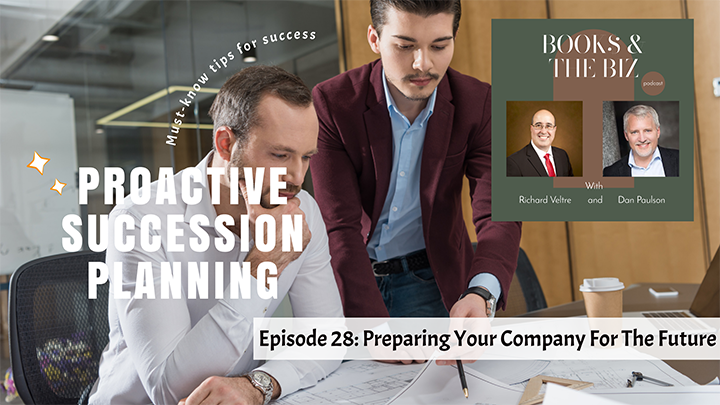
Could You Be Losing Millions? Proactive Planning Matters
Books & The Biz
| Dan Paulson and Richard Veltre | Rating 0 (0) (0) |
| Launched: Aug 13, 2025 | |
| dan@invisionbusinessdevelopment.com | Season: 3 Episode: 28 |
Could You Be Losing Millions? Proactive Planning Matters
In today's discussion, we delve into the crucial topic of succession planning and its impact on your financial future. The article from The Economic Times emphasizes the necessity of thorough planning to achieve desired outcomes. Rich and I stress the potential consequences of neglecting this important aspect of financial management, urging our audience to take proactive steps towards securing their retirement goals.

SHARE EPISODE
SUBSCRIBE
Episode Chapters
In today's discussion, we delve into the crucial topic of succession planning and its impact on your financial future. The article from The Economic Times emphasizes the necessity of thorough planning to achieve desired outcomes. Rich and I stress the potential consequences of neglecting this important aspect of financial management, urging our audience to take proactive steps towards securing their retirement goals.
In today's discussion, we delve into the crucial topic of succession planning and its impact on your financial future. The article from The Economic Times emphasizes the necessity of thorough planning to achieve desired outcomes. Rich and I stress the potential consequences of neglecting this important aspect of financial management, urging our audience to take proactive steps towards securing their retirement goals.
Today we talk about why being proactive in your succession planning can make the difference between retiring comfortably and falling short on your investment goals.
A 2024 article from The Economic Times highlights the importance of proper planning, and the fact that it is a detailed process to get the results you want.
Rich and I highlight what that lack of planning could cost you not only tomorrow, but today!
Please like, share, and subscribe.
[00:00:00.00] - Alice
Hello. Welcome to Books in the Biz, a podcast that looks at both the financial and operational sides of success. Please welcome our hosts, Dan Paulson and Richard Veltre. Dan is the CEO of Envision Development International, and he works with leaders to increase sales sales and profits through great cultures with solid operations. Rich is CEO of the Veltre Group and a financial strategist working with companies to manage their money more effectively. Now on to the podcast.
[00:00:44.07] - Dan Paulson
Hello and welcome to Books and the Biz. We are back for another exciting episode. Rich, how are you doing today?
[00:00:50.26] - Rich Veltre
I'm doing well, Dan. How are you?
[00:00:53.09] - Dan Paulson
I am doing wonderfully. You are so reserved and calm in all this. You're getting hit with the weather that we I had. So build an Ark, get a boat. We had a lot of rain here in Wisconsin, so you're now getting set up for that. But anyway, as we start our new episode this week, you and I had a chance to briefly talk beforehand, and I brought up an article, which I'm going to pull up here for our viewing folks to see, actually put out by the Economic Times. And of course, the moment I do that, it shows an ad pop-up. Wonderful. Anyway, what I thought was interesting about this article is we're starting to hear a lot more about succession planning for business owners. You and I have been talking about this for a number of years, but really, I would say within the last six months to a year, maybe you can allude to what you've been seeing, too, is more and more business owners are starting to get a a little concerned what's going to happen when they no longer want to or need to work, and what's going to happen to their business.
[00:02:08.08] - Dan Paulson
And what I found interesting, this article was actually written in October of 2024. It's called active succession planning is key to ensure smooth leadership transitions. And we're going to talk a lot about that smooth leadership transition part, because I don't know about you, but I still hear from a number of business owners that want to retire in six months or less, and they haven't even thought through how that is going to happen. So why don't you give me some of your thoughts on this article? I thought you had a few good points here that you had alluded to when we talked earlier, and I agree with your points. So why don't you start off there?
[00:02:51.08] - Rich Veltre
I think that the article is really good at showing people the ways that it doesn't allow you to gloss over the at the top. There's been so many times over the past years that people have said, oh, we came to an idea on the back of an envelope, and we came up with a plan of how this is all going to go. And I think that the status of what's going on in the current economy does not really allow for that glossed-over, back-of-the-envelop approach. What is happening is if you're in the mode to actually sell the business, You really have to be looking at the business in the details. You have to be somewhat more in the weeds. You have to be able to say, these are the processes that work. These are the things that we've done. These are the people that we're fostering. These are the leaders that we're building. So that when I'm not here anymore, the leaders will still be taking on exactly what we've been doing in the past. So the people who will still be dealing with the business after I'm gone are going to get the same thing they got before or better, right?
[00:04:05.03] - Dan Paulson
Well, ideally, yes, better. It would be great.
[00:04:08.01] - Rich Veltre
Better, it would be great. But I think at least the problem really becomes that shock is not a good thing, right? So if people are trying to deal with your business, and you're no longer there, and they didn't know you were leaving, that's shock. They don't like that. That, unfortunately, becomes an issue. And then if they come across it and all the people that work for you are also in shock, now they're dealing with double shock. And double shock really is not a good idea when you're talking about success. Discussion planning. So that was my first take, was really you're diving into the details because you want to be able to say this is the detail that really matters. These are the pieces that count. And And there's other benefits, I think, that I saw in the article, that when you go into these details, if there are details you weren't looking at before, there are ways for you to get a hold or handle on what those details are. And you should wind up getting more profit out of the business because you're looking at the details that might not have been working or might have been having an effect on you and you hadn't looked at them before.
[00:05:26.22] - Rich Veltre
So now you get everything organized. You're basically setting yourself up for either a sale or a transition to internal management that's going to take over for you. That leads to more profit while you're still an owner. Those key metrics or pieces that are going to benefit you currently from making the changes. And then once you ultimately leave, it could benefit you a second time.
[00:05:52.11] - Dan Paulson
Yeah, I think a lot of what you pointed out there is stuff that most owners don't realize. What I What I see is when owners go to sell their business or they want to call it quits, they've reached a point of frustration or just exhaustion where they no longer want to do what they're doing now. What I typically see is owners that do too much anyway, they should be letting that go. So succession planning forces that let go phase to happen if it's done properly, and it schedules it out over time. So it allows you to build systems and put projects or processes in place that will help minimize that, oh, crap moment that your customers and your employees are going to have. If you all of a sudden walk in one day and say, oh, by the way, I'm not going to be here tomorrow. In fact, I'm not going to be here any day after that either. And you've got to figure this all out. Your new owner is coming in, and he's going to run this from now on. I have not seen a situation where anyone's been really comfortable with that.
[00:07:00.00] - Dan Paulson
We are creatures of habit, and we do not like change. And I think this is especially true in the business world. I mean, how many times have you and I talked to a business owner, where they just they want everything to stay exactly the same. They just wanted everything to change to make it better, but they don't want to change anything. And that's, I think, where a lot of the frustration comes in with your existing clients, when they all of a sudden find out that the owner who's been there, who who you could pick up the phone and call, is no longer going to be around anymore.
[00:07:35.18] - Rich Veltre
Yeah, I think that the other... You're right. It's never a good scenario. I've never seen one that actually has worked. Never seen one where, Hey, guess what? This was a great benefit. This worked fabulously. No, you don't hear that story. I think that a slow and methodical planned-out succession plan or planned-out a approach to the six-section plan. You may not know right away. You may have to go search for somebody to buy the business from you if that's the way you're going to go. You may be evaluating whether or not one of your children could take over the business. You may not know that, but at least have the plan for how you're going to approach it. And I think the biggest one that I get out of everything that we're talking about is something that you've been saying forever, is that you got to foster the next leader. You have to foster people within your business. I mean, it really comes down to the people, if you ask me. I can't turn around and say, you know what? I'm going to get rid of my business tomorrow. I'm just going to turn it all over to AI, right?
[00:08:45.04] - Rich Veltre
And I'm nuts. And there's going to be articles about me. Look at this guy. He's absolutely out of his mind. I really think it comes down to, who are the people that are going to be here so I can continue to get what I need from the business? Meaning your customers, meaning your employees. People want to still work. People still have to work. So they don't want big disruptions coming about. So I think the really big piece of this comes down to the individuals.
[00:09:15.11] - Dan Paulson
Well, and here's something on the individual side that I think often gets overlooked, and we're starting to see it with some of the clients that we've been working with. It's not just that the owner is 55 to 65 or maybe even older, it's that half the staff is about the same age as the owner. And what I'm hearing from the owner, they're already aware that when they leave, there's going to be an exodus of a bunch of other people that are about the same retirement age that are also planning on leaving as well because they don't want to deal with the change. So now you also have, and this is why this planning is so important and why it needs to be done in a methodical level, because you could end up in a situation where, Hey, I'm getting ready for my retirement. I'm going to be out of here in two years. And you have 10 people stand up and say, Well, hey, as you're planning your retirement, that's probably when we're going to plan ours as well. So now you have all these people you need to replace or the new owner needs to replace if you haven't already started that process.
[00:10:20.05] - Dan Paulson
And to me, that affects value. And since there's what, 78 % of businesses transferring hands in the next decade. And of those businesses, a big percentage of people are accounting on that for part of their retirement, at least part of their retirement. Some of them are counting on it for their entire retirement funds. So when you calculate that in and then you figure, okay, now a third and a half of my workforce is going to be gone as well. That's not going to play well when you come to put a value on that company and you go to a broker because that's where most of them are going to go. And I'll talk about brokers in a minute. But that broker is going to look at it and they're going to do their valuation. They're going to say, well, you're worth X. And X is going to be a much smaller number than what you're thinking you're going to be worth. Because you got to look at most brokers. There's a handful of exceptions. We've had a few of them on our podcast here to talk about their process and how theirs are different. But I like in a lot of brokers to like real estate agents.
[00:11:24.10] - Dan Paulson
They see a property, they list a property. If the property sells, they're happy, they make commission, they go on to the next one. So they're typically looking for what I would call a paper. They're looking for businesses that are going to maximize that sale because they get a higher % or they get a higher dollar amount out of that commission because obviously the value is higher. For the stuff that needs to be a work in progress, if you will, they're going to discount that, sell it on the cheap, and you're going to reap the benefits of that as well. You're not going to see the money that you would expect to see off of what might be a good business. It's just no longer turnkey. It's no longer self-sufficient. It's solely reliant on you. And by the way, the 10 or 12 other employees that you have that are also going to leave the same time you do. New owner is going to look at that and say, well, if I got to replace all these people and I got to put in all these systems, I'm willing to pay a much, much lower value for that company.
[00:12:25.12] - Rich Veltre
Yeah, and I'm so glad you're talking about value, because even today, I was hearing that a lot of smaller businesses are going through processes where they're selling to someone who's using the SBA to actually borrow the funds to come and buy your business. And what I heard someone say today was, the The SBA is not allowing you to add back salaries that you paid to family members. And I know you're going to raise your eyebrows a little bit with one of the clients we're working on. Everybody in there is not only are they the same age, the ones that aren't the same age, a lot of them have the the same last name.
[00:13:01.02] - Dan Paulson
And that's a problem, too.
[00:13:04.07] - Rich Veltre
So the SBA is not allowing you to add that back. So had you not gone ahead and actually done some of the planning ahead of time and figured out what those values are, you're going to get somewhat surprised by what someone is able to actually offer you, because their offer is limited to what funds they can borrow. So if the SBA does not allow them to add back family members, that will either not continue on, or we're getting a salary, but aren't necessarily necessary in the business. The future plan looks better than the current value. So the people doing the buying are running up against the wall already. That, how am I going to pay for this guy? Because he's got all these family members on the books, and the SBA won't allow me to show them as not necessary. So they can't offer you the dollar amounts you're asking for, because the multiples on a lower a profit, based on you paying your family members. And I literally just heard that today. I was literally looking at it saying, wow, what an amazing chain of events. Because I'm sitting there saying, I would have added that back in a heartbeat and said, I'm not going to pay for that.
[00:14:18.15] - Rich Veltre
I'm not going to pay those people going forward. So my future value is better than my current value. And that causes me a rift, and a possibility of not getting the loan.
[00:14:30.06] - Dan Paulson
Well, and how many companies out there have family members who are involved in the business? There's a lot, a whole lot. So that's a major change that I don't think people realize are going to drastically affect that value proposition when it comes to sale time. It's going to probably lead to, if they can sell the business, if it's good enough, to more creative ways to finance that eventually. So if you can't do it all through SBA, it It could be more of a structured buy-out, maybe an earnout of some sort. So there's a lot of different variables here that you now have to consider that really, even last year, you didn't have to worry about so much.
[00:15:13.29] - Rich Veltre
And you don't want to worry about that on a reactive basis as you're in a deal. You want to worry about that proactively. Think about already, how do I put this into play now? Because I need to be aware of it. I need to plan for it. I need to say, I might not get the same offer that I was looking for? How does that affect whether or not you're going to say yes or no at the end of the day to sign off on that deal? So it's a proactive issue. It's one that you really have to be dealing with now.
[00:15:45.12] - Dan Paulson
Yeah. There's so much that goes on in business continuity. And we're talking primarily about succession. But even if you think about bringing in new partners or updating a product or a service or taking on new products or services. There's a lot that happens. It's not always as easy as just flipping a switch and making it go as some would like you to believe. But there is so much complexity that's now coming into succession because gone are the days where you had a kid because usually it was dad passed it off to son or daughter. There was a basic agreed upon on price for that business. And there was usually some internal finance loan that would happen where, okay, you agree to pay me so much per month or I collect a salary for so many years, and then you eventually own this company. We're seeing fewer and fewer children get involved in the business. They don't want that responsibility, and they don't want that level of work. So we're seeing a lot of businesses go out to the market. I think a lot more than we have in the past. Now you're competing against other similar type businesses that have better systems in place, that are run better, that were planned for an exit, that are going to command more money and going to be more attractive to the buyers that have the money to pay that because they know they can buy the business and it can turn profit relatively quickly, where they have to look at a company that doesn't have all this stuff in place and have to figure out, okay, how am I going to implement all this stuff?
[00:17:28.17] - Dan Paulson
And I could be losing money me for a year, two years, maybe longer, if I buy it at this premium price. So I'm going to force that discount and maybe I just buy it as parts, and maybe I just buy a customer list, the blue sky, they call it. And that's really what I run it off of. And I know that because I'm paying a smaller percentage for that, that I can just basically rebuild the company the way I want. And that's how I'm going to make the profit on it. And to For me, that's what we're going to see a lot of these businesses fall into, is that trap of, well, I'm hoping I'm going to get a couple of million dollars for this, and you might get three quarters of a million. Then you got to pay taxes on that. You really don't have enough to retire on. Yeah.
[00:18:17.02] - Rich Veltre
And again, that just leads you right back to that proactive versus reactive. Get away from the idea that you're just going to get into a deal, and it's going to be sitting on the table, and you're going to have a pen in your hand, and you're going to be like, Do I sign it? Do I not sign it? And if you were proactive, you were ready for it. So you know whether you're going to sign it or not, because you've already planned out, okay, I can't get this any better than I've already gotten it, or this is the way it is, and I'm just going to have to deal with that. Much better to know that how many years before you actually want to pull the trigger on that signing. It's just one of those things that I wouldn't I want to sign under duress because I just got to the end and I'm like, oh. It's like you built your business for however many years you ran it. You got to the point where you're ready to sell it. And then all of a sudden, because of your circumstances, you didn't want to plan, you didn't want to do your succession.
[00:19:16.04] - Rich Veltre
And then all of a sudden, you go and you sign a deal that's not the capstone. It's the capstone minus however much you just lost from what you wanted out of the business to what you actually got. So I think I think it's prudent for people to absolutely 100 % sit down and think about this now. You don't have to have everything nailed down, but you do have to have some degree of a plan and some degree of an idea of what's going to happen.
[00:19:45.10] - Dan Paulson
Yeah. And I'm glad you brought that up because we all have the idea that we control our destiny. And what we can quickly find out is, while we might be able to control it to a certain extent, there's a lot of outside forces that might change the rules on us, and all of a sudden force us into a situation where maybe we can no longer work, maybe we have a debilitating disease, or maybe we are afflicted with some illness or physical condition that no longer allows us to run the company anymore. Well, if you don't have people in place to take that over, all of a sudden your company now becomes worthless, less the value of any property or equipment because you are the guy running the show or you are the gal running the show. So I appreciate you bringing that up because I think that's the big stickler that we all think to a certain degree we're invincible until all of a sudden we're not. And usually when we find that out, we find it out too late, and then there's nothing we can do about it. So kudos to you for bringing that up.
[00:20:53.17] - Dan Paulson
We do a lot with this. We do a lot where we can inform people, either They're at low cost or no cost, where they're at in the situation. What's the best way to get a hold of you to talk more about this?
[00:21:09.11] - Rich Veltre
Send me an email at rich@xcxo.net.
[00:21:11.17] - Dan Paulson
And you can send me an email at dan@cxco.net. We would love to talk to you. We are currently doing our 20 questions thing, and for a short period of time, I think we've only got a couple spots left. We're going to be doing that free of charge. As Rich likes to say, we'll do it on our nickel. Well, we're starting to figure out the system here. So pretty soon it won't be on our nickel, but it will still be affordable. But there is going to be an investment made to get that information. So please consider contacting us. Sign up for one of those a lot of spots, and we will talk to you soon. Rich, thanks again. I appreciate it. As always, your insights are wonderful, and we will talk to you next week.
[00:21:55.20] - Rich Veltre
Sounds good. Talk to you then.
[00:21:59.02] - Bob
Want to boost your sales and profits but need the talent to help you grow? Xcxo is a one-of-a-kind platform to find skilled fractional executives to help develop your team into a high-performance powerhouse. Fractional leadership is a great choice when you consider the average executive-level candidate can cost you hundreds of thousands of dollars in salaries, benefits, and incentives. Xcxo finds you the executive and utilizes their talents to build your team's experience, all for a fraction of the cost of a full-time C-suite leader. Contact XCXO today to fill the gaps in your leadership team. Visit xcxo. Net to learn more.