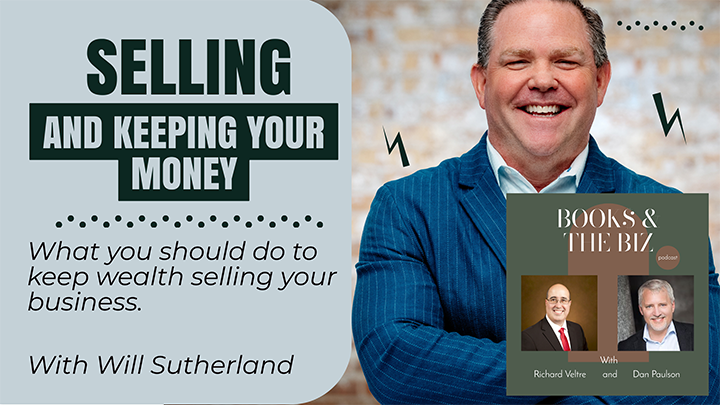
Keeping Your Money - With Will Sutherland
Books & The Biz
| Dan Paulson and Richard Veltre | Rating 0 (0) (0) |
| Launched: Aug 28, 2025 | |
| dan@invisionbusinessdevelopment.com | Season: 3 Episode: 29 |
Keeping Your Money - With Will Sutherland
Will Sutherland, CEO and President of Three Pillars Wealth Management, emphasizes the importance of planning for business owners who have sold their company for a significant amount. He believes that proper planning is essential to ensure that as much of the windfall stays with the owner as possible.

SHARE EPISODE
SUBSCRIBE
Episode Chapters
Will Sutherland, CEO and President of Three Pillars Wealth Management, emphasizes the importance of planning for business owners who have sold their company for a significant amount. He believes that proper planning is essential to ensure that as much of the windfall stays with the owner as possible.
Will Sutherland, CEO and President of Three Pillars Wealth Management, emphasizes the importance of planning for business owners who have sold their company for a significant amount. He believes that proper planning is essential to ensure that as much of the windfall stays with the owner as possible.
So you sold your company for a huge multiple - Now what?
Private sales, PE, and VC money can leave business owners with a huge windfall, but it also can have serious tax implications that could take a lot of that money out of your pocket.
Today we bring in Will Sutherland, CEO and President of Three Pillars Wealth Management who believe in educating his clients on the critical importance of planning, especially when there could be a sudden inflow of cash that requires special handling to make sure as much as possible stays with you. Will shares his experience with owners who sell and what they need to do to set themselves up as they prepare to exit their company.
[00:00:15.14] - Alice
Hello. Welcome to Books in the Biz, a podcast that looks at both the financial and operational sides of success. Please welcome our hosts, Dan Paulson and Richard Veltre. Dan is the CEO of Envision Development International, and he works with leaders to increase sales and profits through great cultures with solid operations. Rich is CEO of the Veltre Group and a financial strategist working with companies to manage their money more effectively. Now on to the podcast.
[00:00:46.23] - Dan Paulson
Hello, and welcome to another exciting episode of Books in the Business. Rich, how are you doing this week?
[00:00:52.17] - Rich Veltre
Doing very well.
[00:00:53.24] - Dan Paulson
So at the time of this recording, we're getting into September. You are probably getting ready for fall tax season because now tax season is more than just once a year. How's that going?
[00:01:05.17] - Speaker 3
Same as always.
[00:01:06.22] - Dan Paulson
Same as always. That's what I figured. And we have a guest with us today, Will Sutherland. Welcome aboard.
[00:01:14.17] - Will Sutherland
Hello, everybody.
[00:01:16.01] - Dan Paulson
Well, just to explain our premise today, Will. So Rich and I have been talking, and we've been working with companies on succession and succession planning and all this stuff. And I don't remember, maybe you do, Rich, what triggered this, but I think we were talking about somebody getting a massive windfall off the sale of their business, and how they prevent the government from taxing that away. I think I had asked you, okay, Rich, taxation question, is this a you thing, or is this a wealth manager thing?
[00:01:47.00] - Will Sutherland
I think we had a lot of conversation around qualified small business stock, and we had something else, I think. And then all of a sudden it was like, what do you do after the fact? And I said, that Not really what I have, not really when they usually call me. So after the fact, let's find out. So that's when Will's name came up.
[00:02:09.10] - Dan Paulson
There you go. So, Will, we brought you in to enlighten us or give us the bad news or whatever it might be. Feel free to share anyway. But essentially, that's what the conversation is going to be about today. So we're looking at companies, business owners who have now reached that point in their life. They are looking to sell their business. If there's something they can do beforehand, what could they do if they are in that stage where the equity firm or the private investor, whatever came in, offered them this big chunk of money, and now they took it, now they're sitting there with the check, what the heck do you do?
[00:02:43.27] - Rich Veltre
Good question.
[00:02:45.22] - Dan Paulson
Is that the end of the podcast? Are we done?
[00:02:48.19] - Rich Veltre
Thanks for having me today, guys. So it's a great question, Dan and Rich. And again, thanks for having me on.
[00:02:56.25] - Dan Paulson
I got all your information up on the screen. We will definitely I'll read that off to the listening audience afterwards, but I'll just put that up here so we can look at that for a little bit, because it's such a handsome picture of you anyway.
[00:03:07.27] - Rich Veltre
Yeah, it's back when I was young.
[00:03:09.19] - Will Sutherland
I have way more gray hair than you, man. Don't even talk to me about you.
[00:03:13.29] - Rich Veltre
I'm just happy I have any. There you go. Yeah, for the time being.
[00:03:18.10] - Will Sutherland
I'll keep quiet.
[00:03:19.28] - Will Sutherland
Yeah, we've got stages here. Now, but to initially talk to that question, Dan, I think what I'm seeing with clients that I work with in the business world, they have a decent amount of business related work in Northern Illinois, in the Rockford area around there. And a lot of family-owned businesses, a lot of multi-generational family-owned businesses that I've been working with. And I think the question is, the business was set up a certain way with that first generation. And what we're finding is There's all these jokes about the third generation ruining family businesses. But there is some legitimacy there that the later generations may not want what that first or second generation wanted. And there's almost zero planning that goes into that thought. They come to me and say, hey, we're getting ready to sell the business. What should we do? And first of all, I say, let's go find a good CPA and a good lawyer and a good business coach and all these other things. And then my next question is, so what time frame are we looking at? Well, next week. And you're like, okay, well, everything I just said, wipe out because none of that's going to help.
[00:04:42.22] - Will Sutherland
So I think that there's so many just beginning questions that you guys have more answers to than I do. And you guys are the front of the helicopter, which I used to find in the army. I mean, you guys are leading the way And helping people prepare. That's the biggest fault that I see right now is, I mean, I'm not talking little preparation. I'm talking no preparation. And I think the reason being, you guys, is fear. It's all fear-based. And I think there's also this elusive undertow in the business industry these days, where learning and being able to trust your professionals is becoming harder and harder. So I think finding the right people that you have that comfort level with, that they understand who you are. They're not trying to make a dollar off of you. They're trying to make a dollar for you. And in toll, then they make money as well. So I think those are some of the things in the beginning of the conversation, just talking about preparation. We talk to most people and say, at a minimum, if you could start planning this three years out, that would be great.
[00:05:58.28] - Rich Veltre
Best case scenario, we should probably be at more like a five year time frame. As most of your at the table understand that when you're going through a business valuation, the standard used to be three years retroactively. Now there's some movement towards five years.
[00:06:15.11] - Will Sutherland
Right. So it was part of the COVID stuff, because COVID threw a lot of things in a tizy.
[00:06:23.02] - Will Sutherland
Yeah, I mean, I don't know if COVID was the catalyst to this. I think it was already there.
[00:06:28.16] - Dan Paulson
Okay.
[00:06:29.11] - Will Sutherland
I I don't think it made that much of a difference in my world or what I've seen. I think what COVID did, if anything, is it stalled sellers from being able to sell their business. So we had a gentleman who had an HVAC firm. He was, at the time I met him, he was about 63, 64. Relatively speaking, he wanted to be done by 65. We're like, well, this is going to get challenging. Had I met him at 60, I think it would have been a better situation had you guys met him at 60. But what happened was COVID jumped in there and now all of a sudden, he's looking to sell his business at 68 or 70. And I'm sure you guys are seeing the same thing. There's an age gap. There's a pretty significant age gap right now from where people used to sell their businesses to where they're selling them now. And I think COVID was definitely a catalyst to that. It We created this weird bubble of 2-3 years where none of that happened. And now people are scrambling. So now we're talking distressed asset sales and things that you're like, oh, this is not good.
[00:07:45.29] - Will Sutherland
We're selling companies purely for the inventory and what they have and then walking away as opposed to selling it for a multiple. So, yeah, I mean, I think those are some of the things in the beginning to answer your question. It's just pure lack of planning.
[00:08:02.04] - Will Sutherland
Yeah. And I'm in some ways glad to hear or at least get the same information from you that we've both been preaching about. I'm sure Rich could jump in on this, too. But we have been talking a lot about that three to five year window is really critical. I don't know what percentage you're seeing of businesses that are saying, well, I want to sell next week, versus the ones that are trying to say, hey, I'm a couple of years out, but I need to start figuring this I'd say 70 % want to sell. Want to sell right now. Yeah.
[00:08:34.10] - Dan Paulson
Yeah.
[00:08:35.01] - Will Sutherland
Yeah. That's pretty close to what I'm experiencing. I've been doing some work with some of the local economic development areas, and they are... I've been preaching about this for Well, probably as long as you know me, so at least 10 to 15 years, we've been talking about succession planning, how you need to do it. And in the past, it was just like, I'm not going to worry about that now. I got plenty of years ahead of me. And now we're getting to that point where it's like, oh, crap, who's going to buy this thing? And you said something that I commonly say, which is most companies are going to be liquidated for basically their assets of pennies on the dollar versus being sold at a multiple because they haven't done that planning. So I'm glad to hear you're reinforcing that. But that, to me, is probably one of the bigger challenges. One of the other things that I heard you mention that I thought was interesting is don't know who to trust when it comes to professionals. Tell me more about that. What What are you experiencing or what are you hearing from your clients as to why that is?
[00:09:34.22] - Rich Veltre
I think it does lend back to the age gap. So these folks that wanted to sell their business at 63, now they're 68 to 70. And in a lot of cases, their trusted professionals have already retired. And so their CPA, their lawyer, their financial planner, many of these people I'm working with, I inherited from buying a business down in that area that had these people as clients. Got it. So I'm second generation. And I tell everyone, I think minimum, absolute minimum, whatever the story is in life, it be a birth, a death, a marriage, any of these things, there's a three year window to get comfortable with anything. And so no matter who your professional is, it's going to take you three years to get to the point where you go, I think Dan is actually telling me what I need to hear. And so I think there's that hesitancy because I've only known you for a year or two. Am I really going to give you all the information or I'm going to hold back some of those gems? And I think that's a big piece of it. The other side of it, I think, is that the level of professionalism in all of our personal areas has gone down.
[00:10:55.28] - Rich Veltre
I think so many of the newer mid-aged professionals that have come up, they've been taught pretty much all sales tactics and very little implementation of anything. Their companies will say, well, you don't need to know that. Just bring the client back to us and then we'll take care of it. Well, you don't know my client. You don't know their children. You don't know their family. You don't know their dog's name.
[00:11:23.25] - Dan Paulson
Right.
[00:11:25.20] - Rich Veltre
And so that lends back to that trust piece. So now all of a sudden they're in front of three different sets of people that they don't know. And I mean, I think the other piece of it, too, and Richard, maybe you could probably speak to this better than I, is I have found it extremely hard to find CPAs that understand this. Other than just basic tax processing, many of the people come out and they might go to a large tax firm, do some auditing, go out into a smaller and then do some small business, some personal. But they all have this mindset and no offense to your profession, but they all have this mindset of looking backwards, of looking at, hey, this is what happens. So this is what we're going to do just for now, not What are we doing five years from now? And so those are some of the things that I'm just seeing. And that makes me sound really arrogant, but relatively... Yeah, I mean, I don't know, Richard. I mean, how do you feel about that?
[00:12:29.13] - Rich Veltre
I I feel spot on with that. So 20 years ago, you started doing a little bit of... Just so you know, because we haven't talked that much. I was a Pricewaterhouse guy. So I was there, Pricewaterhouse, when they merged with Cooper's to become one of the biggest firms in the world. And the mentality was different. The training was different. The push was different. So when you go and you start working with smaller firms, you can see the difference, and you can see the focus on billable hours. And unfortunately, that translates. And believe me, I went through all of the training and all of the licensing and all the things that I'm not supposed to do. I'm not supposed to bash my fellow professional. But the problem that I have with that is they need a bashing. They need a little kick in the tail because the client is the focus, not the billable hour.
[00:13:28.17] - Will Sutherland
Absolutely.
[00:13:29.19] - Rich Veltre
When you get back to that client focus and you start realizing this is what the client needs, if it's expensive, tell them it's expensive. If they choose not to do it, no problem. But if they need it, you tell them that they need it. And so when you're coming down to this sale process, you need to tell people, look, do it in real language, right? There's so many people out there saying, well, we're going to sell your business. We're going to get you all this money, and it's going to be fabulous, and you're going to be... And you have no way of knowing that that person is actually going to do it for you. But here's the kicker. If the owner thinks it's worth $2 million, but he's only taking home $100,000 a year, there's no one out there that's going to pay them a... What is that? I don't even know the numbers. Is that a 20 multiple? No one's going to pay them a 20 multiple because he thinks it's worth 2 million bucks, but he's only showing them 100,000. There's the planning that you need the two or three years to do, because if you want 2 million, you have to support the 2 million.
[00:14:30.17] - Will Sutherland
So how do we get you there? That's what Dan and I have been preaching for. And I think even in our approach, sometimes I wonder, are we getting across to people that you think it's worth this, the numbers are saying this, and you need someone to help you make them match? Either you're going to wind up coming down a little bit or make your numbers show that you can support something that's a bit higher. But either way, it's not going to happen tomorrow. If it happens tomorrow, You're not going to get anywhere near $2 million. So that comes the reality that people need to hear.
[00:15:07.16] - Will Sutherland
And even in my industry, specifically, we have mystified it with big words and acronyms. So people don't understand. It's like the army. We talk in a completely different language. And so that's one of the things that I'm moving forward. We're going to try to build a very educational stance on understanding the words used, things like EBITDA. I mean, you're not going to find hardly any small business owner that has any clue what that means. And I mean, you got to break it down letter by letter. I just did this last week. Really interesting firm down in Rockford. They make professional athletic jerseys policies. And I mean for everybody, like NFL, NHL, college football. Really, really cool family story, just rags to riches. I mean, they built this thing from the ground up. But why would they have any understanding what EBITDA means. And in that case, we're just trying to create a transition or a succession plan to their children. Still tax involved. And that's what we're talking to them about. It's like, listen, you can't just gift it. I mean, no matter how much you want to or you can't just die and they get it.
[00:16:35.01] - Will Sutherland
They're having those mindsets. And you're like, no, the government is still going to take their chunk. And I think those are the things that people need, like you said, just really transparent, forthright education on. And there's a lot of upfront work that the three of us will do and not get paid a dime for to do that. But you'll build the trust and you'll build the clientele and you'll get the right things done. But that's the one thing that I struggle with is you get to your point, you'll have other folks come in and start throwing up big terms and basis points and all this other stuff. And these poor people just nod their head because they're thinking, well, I don't want to look like I don't know this. So it's almost embarrassing. I've had a couple of different clients where I've stopped and said, I'm sorry, I just used a bunch of acronyms Do you know what those mean? And one of them was like, oh, thank you so much. I have no idea what you're talking about, Will.
[00:17:39.10] - Dan Paulson
Well, at least you recognize that because a lot of those guys, they just keep throwing them out, just either assuming they know or, again, burying them in supposed knowledge, I think, to confuse people.
[00:17:51.28] - Will Sutherland
And again, that just goes back to you have to have your trusted partners, that whole ring of a business coach, a lawyer, a CPA, a financial guy, an insurance person, and not any one of them can do what the other people do. I always tell people, I'm smart enough in all of those categories to really do damage. I mean, it's the thing where I work with these people and I learn from them. My job is to help quarterback much of this. But that being said, they each have individual specialties that I have no clue what they're doing. That's why we trust them. Is that there can be no one person in that scenario that gets it all.
[00:18:35.19] - Dan Paulson
Yeah, we would agree on that end, too, which is why we've been building up the stuff that we're doing with XCXO, really to help with that. Will, question for you. So you talked a lot about all the other stuff that you don't do, but when you look at it from a financial wealth building approach, maybe explain your process or explain a process that really people should look at because a lot of what you focus on is planning, and wealth building is planning. And even without us in the room, you still have a process that you would like your clients to follow. What would that be?
[00:19:15.28] - Will Sutherland
At the very beginning, if I'm lucky enough to catch them at three to five years beforehand, working with somebody like you guys. But, Dan, you brought this to me in the past and I've just used it myself again recently. But finding a a simple book like Vivid Vision and understanding what is your vision, what is it that you want to happen, both professionally but also personally? Because until we understand what that vision looks like, I'm shooting a shotgun pattern, and you want me shooting rifle rounds. So our process is really to start building that. If we get the chance, farther back and understand as we get closer and closer to that sale, are there things that we're doing in the process? Are we managing the P&L, the balance sheet? Are we in the right, and this again, Richard, this is more your world, but are we in the right entity? I just ran into somebody the other day that's there, a C-Corp owned by an S-Corp, and I'm like, I have no idea what you're doing. But hey, Let's go learn. But understanding some of those things and then being able to get to where you're getting to, Dan, where all of a sudden the trigger does get pulled and now there is a transfer of wealth.
[00:20:29.07] - Will Sutherland
And at at that point in time, we should have done our homework and understood by the time we got there, we understand what their income needs are, we understand what their liquidity needs are. We understand ultimately from that one to three, I always say one to three years is about the max that we can plan for somebody. Anything after that is unicorns and fairy dust. But we do. We plan out to everyone dying at age 95 and having hundreds of millions of dollars to pass on to their beneficiaries. But that being said, it's getting into that process of that three years before before the sale and then three years after the sale, really understanding cash flow at that point in time, I think, is probably one of the most important pieces of this. And then the other ones, the liquidity, the growth, the other things then come into play. But until I understand their cash flow needs, I'm out there flapping in the wind. And that's where we dive in and look at different... We use different software platforms to help them dive in and log in their expenses or be able to understand where their expenses are going, where their growth ratios are, all the things that go along with that.
[00:21:34.10] - Will Sutherland
But I always tell people at the end of the day, my job is simple. It's money in, money out. And we've got to figure out what that is first. Then I can tell you all the other things that we might be talking about using different investment vehicles, using different estate planning vehicles, all the things that now mitigate what we're talking about today really is how much the government's going to get. But that's it's a soup to nuts process. I am not an investment adviser by any stretch of the imagination. The investments are the tools we use to implement the plan we put together.
[00:22:09.18] - Dan Paulson
Got it. Excellent. Good. Well, why don't you tell us a little bit, because we didn't get into your background a little bit, so I'm going to pull your bio up again for those who are watching. But why don't you explain that to us a little bit? How did you get into this? Because I know you from a previous life, and that's how we met. And then all of a sudden, he, now you're a financial adviser.
[00:22:34.09] - Will Sutherland
Yeah, I mean, purely by accident. It was a midlife crisis. You know my background. I spent some time in the military, had the best low paying job ever being a helicopter pilot, and got into the airlines right after that because that was the dream. And then 9/11, picked me out of the airlines. And as you know, I fell into a job backwards in medical sales with a friend from the army, helped me get that job because I needed a paycheck. And I did that job for five or six years. And that was an arena at the time, you could make a significant amount of income. But it was a situation where I'm always, I was always tertiary. I was in the back of the room helping the tech put together instruments and implants. And I was never the prime mover. And unfortunately, I'm a little bit too type A ADHD. So a friend of mine at the time was working at a big warehouse, R. W. Baird, and asked me if I'd like to come and work there with him. I really hadn't thought about it. But after some super long deliberation of about two weeks, I asked Janey, Hey, would you be okay if I stop making three or $400,000 a year?
[00:23:49.13] - Will Sutherland
And I might make 30 in the first year, maybe. And bless her soul, she went along for the ride. And then I got in and found out what I didn't know. It was really a situation of, wow, this is not what I thought it was. I thought this was going to be about investment management and all these other things. And no, I mean, all they teach you is sales. Go get in front of people, get their assets, bring them in, and we'll show you how to manage them. Didn't love that. That model didn't love that. So I jumped out and moved into one farther step out, worked for an IAR as a larger insurance company, Mass Mutual. Still a situation where they were trying to get me to sell my whole life and annuities and things that I may not have had the use for or the greatest belief in. And then finally decided to break off and just do it on my own. So that's when I started 3 Pillars, what's, 15 years ago. Started my own RAA and started building to where we're at. And then I just launched Aneter's Capital, an investment company last year.
[00:24:55.10] - Will Sutherland
So, yeah.
[00:24:57.14] - Dan Paulson
Well, good. Well, again, thank you for joining us on this. So to get a hold of you, what's the best way to do so, Will?
[00:25:05.08] - Will Sutherland
Either through my email, which is W Sutherland at threepillarswm. Com, which is on, obviously on the bio there, or just give us a call at as a way 352-71-25 and set up a time to talk. I always tell people there is no commitment. I'm not going to sell you a thing, probably ever. It'll become apparent what you want and what you need. But really everything with us starts with a conversation. We want to get to know you and we want you to get to know us and figure out is there any... I always tell people, if I can't leave the room leaving you better than when I met you, then we shouldn't be doing anything together. At that point in time, it doesn't make any sense. So that's my goal in every meeting or every interaction is like, did I just, and again, it doesn't have to be work, doesn't have to be anything. It's just did I leave that situation better than when I entered it?
[00:26:01.14] - Dan Paulson
That's awesome. That's great. Kind of in line with some of the stuff that we do here. So definitely appreciate that. Absolutely. Well, thank you for joining us. We appreciate having you on and hopefully you're back. Thank you for having me. Back. Well, love to have you back again. I think what you do is in line with what we do. And if you come up with anything that is of interest to us, let us know. We'd be happy to have you on again.
[00:26:21.29] - Will Sutherland
I think a great conversation, Dan, in the future would be to talk about private equity. It's an area that I've developed quite an acumen, and it's an area that people know nothing about, and everybody can participate in it. They just don't know it.
[00:26:35.04] - Dan Paulson
Got it. No, that sounds like a good one. So we will plan on that. Well, thanks again, and we will see you next time, all right?
[00:26:42.11] - Rich Veltre
All right. Thanks, guys. Have a great day.
[00:26:44.17] - Dan Paulson
You, too.
[00:26:46.03] - Bob
Want to boost your sales and profits but need the talent to help you grow? Xcxo is a one-of-a-kind platform to find skilled fractional executives to help develop your team into a high-performance powerhouse. Fractional leadership is a great choice when you consider the average executive-level candidate can cost you hundreds of thousands of dollars in salaries, benefits, and incentives. Xcxo finds you the executive and utilizes their talents to build your team's experience, all for a fraction of the cost of a full-time C-suite leader. Contact XCXO today to fill the gaps in your leadership team. Visit xcxo. Net to learn more.