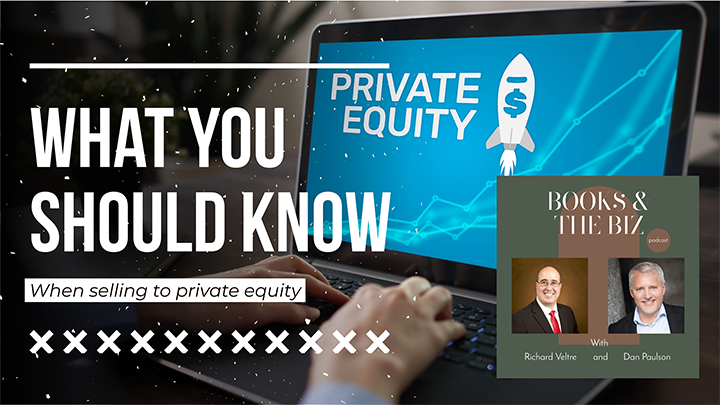
Private Equity: The Good, The Bad, And The Ugly
Books & The Biz
| Dan Paulson and Richard Veltre | Rating 0 (0) (0) |
| Launched: Sep 11, 2025 | |
| dan@invisionbusinessdevelopment.com | Season: 3 Episode: 31 |
Private Equity: The Good, The Bad, And The Ugly
The Risks and Rewards of Selling to Private Equity Private equity can be a lucrative option for business owners looking to sell their company. However, it's important to carefully consider the risks and rewards involved in such a transaction. Join us as we discuss the potential pitfalls and benefits of selling your business to a PE firm, and how to navigate this complex process successfully.

SHARE EPISODE
SUBSCRIBE
Episode Chapters
The Risks and Rewards of Selling to Private Equity Private equity can be a lucrative option for business owners looking to sell their company. However, it's important to carefully consider the risks and rewards involved in such a transaction. Join us as we discuss the potential pitfalls and benefits of selling your business to a PE firm, and how to navigate this complex process successfully.
The Risks and Rewards of Selling to Private Equity Private equity can be a lucrative option for business owners looking to sell their company. However, it's important to carefully consider the risks and rewards involved in such a transaction. Join us as we discuss the potential pitfalls and benefits of selling your business to a PE firm, and how to navigate this complex process successfully.
Are you looking to sell your business?
Maybe you've had private equity come knocking on your door. Some industries are seeing PE firms flashing incredible numbers for valuations that can be quite attractive as a business owner. But what should you watch for?
As they say in business, "buyer beware". There are some great and reputable PE firms out there. Depending on your situation, selling to a PE may be the best thing for you to do, and can provide a great return. Others may turn out to be something else, and those sky high valuations fall far short when the deal finally ends.
Today's Books & The Biz shares our experience and what to watch for when crafting your exit through Private Equity. Join us for an informative episode that could save you millions!
[00:00:00.00] - Alice
Hello. Welcome to Books in the Biz, a podcast that looks at both the financial and operational sides of success. Please welcome our hosts, Dan Paulson and Richard Veltre. Dan is the CEO of Envision Development International, and he works with leaders to increase sales sales and profits through great cultures with solid operations. Rich is CEO of the Veltre Group and a financial strategist working with companies to manage their money more effectively. Now on to Podcast.
[00:00:42.29] - Dan Paulson
Welcome back to Books in the Biz. Rich, how are you doing today?
[00:00:47.07] - Rich Veltre
I'm good, Dan. How are you?
[00:00:49.26] - Dan Paulson
I'm good. I'm good. As of this recording, you are barely surviving getting the last bit of tax work done for those late filers. Hope it's not, quote unquote, taxing you too much. There's my dad joke for the day.
[00:01:05.01] - Rich Veltre
That was a good one. That was a good one. I'll remember that.
[00:01:09.14] - Dan Paulson
Good accounting humor. Goes a long way. Anyway, we were talking actually about some other clients and stuff earlier this week. And of course, we talked to Will Sutherland, I think it was two weeks ago. And one of the issue, I guess not really issue, but One of the things that popped up was private equity. A lot more discussion about private equity. And I know a couple of clients that I have that are trying to work through the private equity thing. And we'll talk a little bit more in detail about this. But I'm finding some pretty, I'll call it robust offers coming through for people that are looking to sell their business and private equity is knocking on the door and promising some pretty big dollars. However, and a big however here is when you start digging into the numbers, all may not be what it seems. So I'm going to be interested in our discussion today on is private equity a good thing, a bad thing or an ugly thing? And when maybe we should consider it. So you on the finance side, I'm sure I know you've dealt with startups before, but have you had much dealings with private equity in the past?
[00:02:24.29] - Rich Veltre
Yes, very much so I have. A lot of my CFO type clients have always been, backed by private equity, some degree of virtual venture capital, but for the most part, they were private equity firms that owned the entities that I would do work for. So, yes, the long answer to your question is yes.
[00:02:54.07] - Dan Paulson
Well, that's a good answer. So here's one of the things I guess I would like you to maybe break down is, since you have some direct work with the private equity companies as a third party coming in, talk about that process a little bit. What's it like to work with a private equity company and what's been your experience so far dealing with them? And share as much as you can. I know there's probably some limitations on what you can share, but I'd like to get your feedback on that.
[00:03:22.23] - Rich Veltre
I think, look, there's a lot of good and bad. I'd say we're right down the 50/50 lines. Some of them are really great, some of them are not so great. Some of them are not so great for reasons that belong to the company that they invested in. And some of them are great just because it was a good fit. It really made sense. And they were able to grow with the private equity investment, and they couldn't have grown that way if they didn't have it. So I think way back when, as early as my dealings with the orthopedic shoe company, we had a great private equity relationship. The private equity firm was the one that brought me in because they just said we need somebody to help in a turnaround process. To take an operating company that had gone against what the original investment was for, and it didn't have anything to do with me. It had to do with the management team that they had bought, that they brought in when they bought the company. And And we did turn that company around. It took us four years to do it. I think it was longer than they really wanted to be invested in it.
[00:04:37.10] - Rich Veltre
But we turned it around because we turned the business strategy around. They were in a wholesale environment and holding on to a lot of inventory and then had a problem getting more inventory. So the realistic switch was to take them into online retail. At the time, it was a very profitable venture to go into online retail. And once they did that, they improved their margins and turned the company around by increased margins. I've worked with others where the private equity firm was a relatively small or new private equity firm, and they didn't know what they were doing. They didn't have a good, clear plan of how they wanted things to go, and then it floundered very quickly. There are other guys that are a big deal, a lot of money behind them, a lot of ability to turn a company into something new. But I think there's there's criticisms on all three levels, on all the three that I just mentioned. Not entirely of the private equity firm, but also the fact that everything for me lately has come down to communication. Tell me what you're looking for, and I'll tell you what I can give you.
[00:06:00.18] - Rich Veltre
And if they match, we're good. If they don't match, don't keep going anyway. Put the brakes on and say, this is why it doesn't work.
[00:06:11.17] - Dan Paulson
So I guess here's the situation that prompted this question when we talked last week about it. I have a client, an individual, well, actually a couple that have a pretty successful business, and they're in the construction industry. Construction, as we know, has been going gangbusters for a number of years, really since probably 2010. Things have really bounced back and been going pretty strong, at least here in the Midwest. Anyway, they've taken a company, they've built it from scratch, and now are doing relatively well, or actually they're fairly successful, and they've been growing by leaps and bounds. So needless to say, that's gotten a lot of private equity people to knock on the door. And the things they're hearing, which Which always puts flags up for me, is they're promising 90 day close. They're promising that there'll be a multiple of cash coming back, pretty significant, tens of millions of dollars in valuation. But when I start reading the not so fine print because they haven't actually got a letter of intent or anything yet, there's really three parts to the deal. And maybe you can elaborate on more of this, too. So what I'm typically seeing in the private equity experience that I have is there's the cash out, the hard money.
[00:07:41.04] - Dan Paulson
There's then the, I'll call it earn out, which is if you meet certain requirements or certain metrics, then you'll get this other bump in cash. And then there's the final piece, which is the equity piece, which is the, you'll get X % of the private equity fund. And then when we sell at that 10 times multiple, because that's what most of them market to, you will have not only the money we promised you, but you'll have even possibly tens of millions of dollars more than that. And I always get a little concerned when there's all these different things, but you have to meet certain requirements to get the money out, because they're always talking about, well, and I'm just going to throw numbers out here, this is a $20 million valuation. Okay, great. But you're not getting $20 million. You're getting like $6 million up front. You're getting, if you meet these three requirements over the next year, you'll get another $3 million, and then the rest of it is tied up into equity in the private equity firm. Again, the idea is that you're going to sell in five years. In most cases, in this particular case, anyway, what they're promising is that owner can stay on.
[00:08:54.26] - Dan Paulson
Basically, they turn into an employee in their own company, and they manage their business. And my question, and maybe this is where you can elaborate more. So you talk about cash infusion. Do you really see the private equity kick in more in cash after the buyout is made, where they're investing in the business? Or is the business then expected to make certain changes to align with the other companies they've already purchased? And that comes out of that business's pocket? Because then I'm looking at going, well, if you got to manage your own company and you've got to to pay for the resources, the changes that you knew you probably had to make anyway, does private equity make sense?
[00:09:40.12] - Rich Veltre
I think it's a fabulous question because it elaborate to people that if you're selling to PE, these are the details you need to know. You need to understand how that's going. If a private equity company is coming in and they're buying 100 % of your entity, and you're just going to work there, You're not responsible. You shouldn't be responsible to have to be putting money back. Now, there's probably some mechanisms in there. As far as your first 90 days, you have a working capital peg. You have a working capital expectation that the company has to keep a certain amount of cash in the bank after the closing. And that could adjust your purchase price because it could say that the company needs more cash, and it's coming out of your pocket because you said you wouldn't need that cash And now you do. Now, once you get past that working capital adjustment, which usually it's somewhere in the vicinity of a 90 day after close adjustment, once you get past that, I can't imagine that it's your responsibility. Aside from that, everything's a two way street. And a lot of times, when you're the owner of a company and you sell it to private equity, you just assume that you're the target, so you don't have a say.
[00:10:59.05] - Rich Veltre
But if if the private equity firm isn't a very good fit, you should be evaluating them for their ability to take care of your company afterwards, because you're on the hook for a part of your payout being part of the expected- Future sale. The expected return on the company. If the company is expected to still make certain dollars going forward in order for you to hit your next metrics, You have to make sure that they still have the cash to be able to pay you for that. Or the company is making enough that you know that it'll be able to pay you for that. And if it's not, then maybe it's not a very good deal up front. The private equity firms that I have worked with, if they're larger, they tend to have very good banking relationships. They tend to have very good credit lines that they can get in place. And it's one of the first things they generally do, is that there's a credit line that if we need to pull on that, we can pull on that to make sure that the company does what it's supposed to be able to do.
[00:12:08.13] - Rich Veltre
Worst thing that can happen is you sell out to a private equity firm and none of these things are put in place. And then when the company needs cash, it doesn't know where to look. So the smaller player, you just want to watch out for them. You want to know who's buying your firm. Do they have the ability? Are they going to put this in? Is this part of the plan? So that we know that in three months after the close, if we were off a little bit and we need cash, is there a credit line there? Is there additional cash available to be pulled? If you've got guys that are essentially taking in an SPA loan and they're buying a smaller entity, how likely is it that three months after close, they have the ability to put a line of credit in That allows the company to keep functioning without you having to kick back in? Because the likelihood of you kicking back in is probably zero. If they also don't have the ability to put cash in, then the company gets damaged.
[00:13:14.00] - Dan Paulson
Right.
[00:13:14.23] - Rich Veltre
So I think that's an evaluation on the seller's part to say, will this private equity firm be the right fit to take care of us or take care of this company as we move forward? Because the The fact of the matter is, every company needs cash. It's like a baby needs a bottle. You got to be able to feed it. If you can't feed it, then the company is going to sit there and struggle. And when it's struggling, it gets harder.
[00:13:42.16] - Dan Paulson
Right. Yeah. I guess One of the things in the situation that I brought up or the example I brought up that raised a flag for me, and again, I'll be interested in your thoughts on this as well. So there's an earn-out piece. So Again, there's three different buckets. One you get paid directly for, one's an earn-out, one is equity. So that earnout piece, there's basically three metrics that the company has to meet or the business owner has to meet in order to get that money paid in. I'm like, well, how is that going to work? Because he's telling me, well, we've already hit two of those three metrics, so I have no problem with that. But one of the things I see private equity companies, the reason they want that 10 multiple, and they're trying to get that in five years, is their whole goal is efficiency. Get that profit margin up so that they can show growth that way. So that way, when the next larger firm comes in to buy out that group, it is that 10 multiple, and that's what they're basing it on. And you're a new company, you just got by a PE firm, and now they're saying, well, you need to change your CRM, for example, or you need to implement, you need to get your inventory your margins down to this level, or you need to get your payroll down to this number.
[00:15:05.02] - Dan Paulson
And if you don't hit those marks, then what are you going to do? So are you going to get that money then? Possibly not. So there's things you really have to look at, in my opinion, on the earnout side of things. And as you point out, there's really good PE firms, and there's ones that aren't as good. And what I tend to see with the ones that aren't as good is in the fine print, when you finally sign off on the deal, even though they've laid out the metrics that you need to get that earnout piece, they've also put caveats in there that you may not realize that then throw that number off. And now you're in a situation where you're expecting, we'll say, 2 to 3 million dollars more coming in 12 months. And then that 12 months comes by. It's like, well, you didn't hit the goal because you had to buy a CRM that lowered your profit margins below that number. And here's your situation I mean, have you experienced anything like that? Or what would you tell people to look for when there is that earnout piece involved?
[00:16:06.14] - Rich Veltre
I haven't seen a lot of earnouts because on the smaller deals side, if a lot of them are using the SBA, they don't like earnouts. They like seller notes, but they don't like earnouts. So at that point, you wind up having a seller note, so you have payments. So you're really looking at, will the company be able to pay me my seller note once it starts and once it continues and how long it's supposed to stretch for. The earnouts are a little bit harder because a lot of times the buyer becomes enamored with the offer and not necessarily with the person making the offer. But I think that's the warning sign. You have to make sure that you're comfortable with the intent of the person making the offer.
[00:16:58.17] - Dan Paulson
Yeah. I am seeing I'm seeing a lot of, I will call them obscene numbers being thrown around out there, not in this particular situation. But I've seen other ones where the multiple is well above what the market rate is because they're trying to acquire these companies. And to me, that seems like a concerning issue as well.
[00:17:20.16] - Rich Veltre
Yeah, I think that is a big concern because who can afford it? Right. I mean, these people are debt financing. For the most part, they're debt financing the acquisition of your company. If you're the owner, and they're giving you a massive multiple, you have to sit back and question why. And if the why is because you believe in the same expected growth of the company that they expect with their cash infusion, then maybe you're okay. But if they're doing it, and you're not really sure why, look in the fine print, as you said, and see, are there there are plenty of mechanisms for them to not pay you the multiple? So if the multiple is there at, oh, we're going to give you a 12 multiple. Wow, that's incredible. Why? On my shoe company, 12 multiple was because they had gone online retail, and the profit margins coming out were so good that they were paying off debt. They were making distributions. I mean, it just became one of those things where the turnaround should have put them in the ground. And the turnaround was good enough that they were able to pay back the private equity firm that had originally invested before they were able to sell to the next one.
[00:18:41.14] - Rich Veltre
So the numbers just showed we're on a skyrocket here. We're going crazy. So the 11 or 12 multiple that they ultimately got in the sale made sense, because the company itself was able to pay back everything that it was supposed to pay back. So if you believed in that plan, you would have been on the right track. You would have actually seen that we believe in this plan as well. And the company would have essentially been able to hit every target. So if there was an earn out in their acquisition plan, then you were good to go. Because it was legitimate, it was attainable, and there was no smoke and mirrors. There was no hidden agenda.
[00:19:34.28] - Dan Paulson
Yeah. And that's really, to me, a key thing to watch out for, is what is that agenda? Because any time you're selling your business and They're telling you, we're going to pay you X, but X comes with these caveats. Caveat one is the CERNP piece. Caveat two is the sale of the private equity company to a larger firm, and you have a percentage of equity in that PE now. But you pointed out something good that I don't think a lot of people realize when they're dealing with private equity or a lot, I will say smaller businesses that maybe haven't had to do this in the past, is it's all debt finance. Now you brought up, they might be using SBA loans to finance the purchase of that business. There's also other debt financing where it doesn't involve SBA loans. Maybe the company that they're purchasing is larger than that $5 million cutoff. Well, where are they getting that They're obviously getting that money from other private investors who have significant cash assets that they are reinvesting, hoping to get a higher rate return on that money than if they've invested in the stock market, right?
[00:20:44.28] - Rich Veltre
Oh, absolutely. 100 %. And SBA is a good small business tool, but it only goes up to $5 million worth of debt. Right. Okay. Which means at $5 million worth of debt, if somebody's giving you a five multiple, you can't be a business that's making over a million dollars.
[00:21:05.11] - Dan Paulson
Right.
[00:21:06.00] - Rich Veltre
Right? So essentially, you could wind up past that five million, which at that point, you're dealing with a different lender, with different reporting requirements, with different ways they have to go around the... Not around, but different ways they have to go through their processes. You, as the operating company, you're taking on all of that requirement. You're taking on everything, the reporting, the calculation of whether or not you're actually in good standing. You're responsible for default clauses or debt service ratios on that debt. So be prepared. The first time you do it, it's a learning experience. On top of that, it's a learning experience every time because you have to deal with it's a different lender. And they all have different requirements. They all They all have different expectations and they all have different attitudes.
[00:22:03.11] - Dan Paulson
Now, what if it's a private investor or a group of private investors? Because that's what I'm seeing with some of these PE firms is, again, it's wealthy individuals who are putting their money in. They bought into the idea of buying certain companies in a certain industry and conglomerating them and then turning around and flipping the group as a whole. What have you seen as far as what their expectations of return are? Because that's going to be different than a bank's. And what I've seen is, they want a double digit rate of return easily, but how high of that rate could they go? And also you as the business that's selling into that entity, which master gets served first? Well, to me, it's going to be the guy that put the money in to buy you out, is going to be taken care of before you are.
[00:22:55.26] - Rich Veltre
Yeah, usually that is the case. Usually the investor has to be the person who's getting paid first, your second, at best, your second. At best, yeah. But again, where does the bank fall in? I think that's deal by deal. I think that for the most part, they're getting to the size of the money that they're giving you or offering you because they're basically telling the bank, Don't worry, we'll make sure you get paid back. So it depends. I mean, the bigger the firm, I guarantee you they have already looked at the split between what they're putting in in their own cash and what they're borrowing. They have 100 % looked at the ratio between debt and equity. And they want to put really as small of an equity as possible into the deal without them putting everything at such a high risk that they have to worry about it. Because the biggest thing that you could worry about is the debt usually winds up having a security interest in the company. So your equity winds up being subject to the debt with the ability for the debtor or the lender to essentially come in and say, well, we let you borrow all this money based on the assets.
[00:24:26.14] - Rich Veltre
They're all secured. If you don't pay us, we come after the assets.
[00:24:32.26] - Dan Paulson
Right. And that's typically why it's never an all-cash deal. It's usually some conglomeration of different things to get you to that magic number that they're throwing out at you. But really, you're not getting that number right away. You're getting that if the stars align and all these things go right. Yeah.
[00:24:53.20] - Rich Veltre
And the good investors, the good private equity firms are essentially, like I said, looking at it from a standpoint of if we only put 60 % cash into the deal, we have a significant portion of equity that's in there. The company should be able to handle the 60 % debt because we're not putting We're not putting it in as 80 % debt or 90 % debt. The really small deals, you're getting those 90 % debt because the guy behind it doesn't necessarily have all the money, which is why he's using the SBA and why he's essentially setting up the deal to use SBA finance because SBA will approve him.
[00:25:39.23] - Dan Paulson
Right.
[00:25:40.14] - Rich Veltre
They're not approving him based on the fact that he has a whole bunch of cash. They're approving him on the expectations that he doesn't. So that's why he has to go to the US government, who has decided to back small business, small business acquisitions. Right. So when you're dealing with bigger firms, terms, and they're outside of the SBA block, you have the ability to say, Hey, guys, let's put 40 % or 50 % of our money into this. The 50 % seems like it's conservative, but 50 % debt at that point, we can handle it. If there's a slight downturn in the market, do they expect it? It really just comes down to the deal itself. And they start to decide, do we want to put in that much money at risk risk. Because the calculations really come down to our risk tolerance, meaning the investors risk tolerance. So they don't want to put too much inequity in because that's their money. They'll borrow, and then worst case scenario, they won't be happy if they have to put money in, but they would be able to put some money in to cover the debt if something was to go massively wrong.
[00:26:56.17] - Rich Veltre
The intention of the bigger guys is to say, We're not going to let it go massively wrong, which is where you, as the seller, becomes the scapegoat. If they can't pay you based on the original deal because the company hasn't performed, they don't consider that their fault. They consider that your fault.
[00:27:14.04] - Dan Paulson
Right. So here's the negative side of being the employee in your own company, where in the past, maybe you had control over certain things. Well, in some ways, that private equity now has control over making certain decisions that maybe you wouldn't have made. That might affect your personal customer service, might affect your ability to retain employees, could be a number of reasons. And you really have limited control or limited say over what can be done there, because there's going to be certain things. They're just going to say, this is what you need to do in order to align with the other companies we've purchased. Software being the thing that pops out to me, a CRM or some inventory management system might be required to be put in place that you then have to follow through. I've also seen certain situations where they say, well, your payroll is too high. Now, reduce your payroll by 20 % across the board. And oh, by the way, now you need to get 20 % more profit out of the people you still have retained. So there's all these issues you need to look at. And I like what you said, where you really need to do your research and not get enamored with the big numbers they're throwing at you, because that seems to be what hooks a lot of people.
[00:28:29.04] - Dan Paulson
It's an emotional And they're going, oh, my God, I'm going to have more money than I ever needed, and I'm going to be able to take care of my kids, and my grandkids, and everything else. That's a lot of what I hear. And yes, if everything goes right, if it's a good company, if it hits all the right metrics, and that five year window they always talk about, because it seems like five to seven years is the most they ever want to hang on to something. If they can turn that as a 10 multiple in that amount of time, you're golden. And there's a lot of times that doesn't happen. So you really have to be very careful about who you choose to make your bed with, if you will.
[00:29:09.26] - Rich Veltre
Yeah, 100 %. I mean, the shoe company, the private equity firm, was already in there two or three years when I got there, and I was there for four. So you were at the end of what they would have normally even wanted to hold on to. And I'm sure that the expectation was, we're going to be able to turn this into something even bigger. You a lot quicker than they did. It wound up being okay, but I think it was one of those things where it was if you calculated the return over the seven years or eight years that they actually held it, the first three or four years were not very good. So the last four years being explosive was good enough to negate the negatives of the first three or four years. And then we ultimately got to a, I'll call it good, a good ending, where instead of it being the excellent ending that they wanted to invest in, it wound up being just good.
[00:30:08.03] - Dan Paulson
Yeah. Because usually, they want to use that money for other things at that four to five year window. That's why they wanted to sell this off.
[00:30:15.01] - Rich Veltre
Yeah. It was getting to the point where they were considering, should we just close the doors? It had gone down so much. They were just like, if it keeps going down, there's no- Cut our losses and get out.
[00:30:27.03] - Dan Paulson
Yeah. Yeah.
[00:30:28.08] - Rich Veltre
So the ugly conversations we're having behind closed doors. Luckily, things started to show that, hey, wait a minute, just hang on to it. And then over the next four years, they got their money back.
[00:30:41.01] - Dan Paulson
Right. So as you're looking at this, what advice would you give a business owner that is getting courted by a private equity company? What questions should they be asking and what information should they be looking for to know if this is going to be a potentially good deal for them or not?
[00:30:59.15] - Rich Veltre
I think I think you have to get out of the short term and look at the long term and say, especially if they're going to keep you in for a few years. To me, anything over a year is long term. You And again, you can never 100 % tell, but there's always the chance that you pick somebody who's smiling and it's all roses, it's all fabulous. And then inside that first year, they're just like, we don't need you anymore. So they find a way to get rid of you.
[00:31:32.22] - Dan Paulson
And do they have to continue paying you after that? Let's say they agreed to pay you for the next three years salary. If they let you go?
[00:31:41.29] - Rich Veltre
It depends.
[00:31:45.01] - Dan Paulson
Because I always see the with cause version in there. So to me, with cause is also very broad.
[00:31:52.17] - Rich Veltre
Yeah, again- With cause for who? It really comes down to that relationship, right? You have to expect that if you If you're at the point of 90 %, I'm sure they're not going to get rid of me. And I have a particular involvement that they still want. And it's going to take more than a year for them to extract all the information that's inside me before they could say, We don't need you anymore. That with cause is tough, because it's the unknown. You have to get to the point of comfort that you believe that they're going to honor their word. I've seen it a few times, where they don't honor their word.
[00:32:41.23] - Dan Paulson
I have, too.
[00:32:43.08] - Rich Veltre
Yeah. And it's not It's not pretty, but unfortunately, I have to say it's not uncommon. They don't really want you around. I don't care how much they want to shake your hand and say you're great and you're wonderful. They don't want you around because you have a different opinion than they do. The biggest thing I would tell people is, don't forget, they run the business by numbers. They don't run it by people. They don't run it by relationships. They generally run it by numbers. They're only successful if they hit their numbers. So it really comes down to understand who's buying you, understand at least as much as you can possibly understand what their plan is. And if it aligns with you, then look at the numbers. At least that's how I feel about it.
[00:33:42.12] - Dan Paulson
Yeah. No, I agree with you on that. I would also tell people, if private equity is interested in you that much, there's many good signs that come out of that, but there's also signs that maybe there's a different approach you can take. So other things I would tell people to look at is instead of using private equity money, maybe you do private sale. If you really want to get out, and as you pointed out, there's that long term stick around where basically they have you run your own company In most cases, if you do a private sale, you can still get one to two years where you can act as a consultant, and you can get that negotiated in a price, and you can negotiate that in a way where you get paid. If they say, sick After six months, they're sick of you. They don't want you around anymore because they want to do different things. You still get paid. You made a hole on that. You can also then get all the money that the company is valued at up front or structured in a way to make sure that you get it, not having to meet certain criteria, or if the private equity sells, then you'll get your equity back out of that, and that will hopefully be a multiple.
[00:34:56.20] - Dan Paulson
Now, the numbers are going to be different. You're probably not going to see these sky high numbers that they're quoting you. At the same time, that money is guaranteed. So that's something to consider. One thing is the operations guy. I always tell people, can you get this company to run on its own without your needed involvement, or with very limited involvement for you, where it now turns into a revenue stream that can take care of you for as long as you choose to keep it around. That's another option, because some of these companies, if you put the right management team in place or the right people in place, it can run on its own, and you're just there to make sure it's doing what it needs to do. But pretty much it takes care of itself. And I would say one of the other options that you could start looking at, and not necessarily an ESOP, but an employee option. Could the employees somehow buy you out? Now, maybe it is a full on ESOP, Employee Stock Option program, or maybe it's some derivative thereof, turning it into an LLC where you can sell member shares and things like that.
[00:36:03.06] - Dan Paulson
There are multiple options that you can do to get that cash if you want. I just don't want to see companies get quoted such a huge number, and then they find out after the fact that they're locked into something that they don't like in a relationship with somebody they don't like. And then pretty soon they're looking at their own company being kicked out, and now they're stuck. There's a reason they call them Sharks. Shark Tank didn't get the name just because it sounded cool. These people deal with, as you pointed out, they deal with the numbers. If the numbers work great, if the numbers don't work, they make changes and they don't really care how you feel about it. They don't care how it affects you. It's all there to get the profits that they need.
[00:36:46.17] - Rich Veltre
Yeah, that's right. The shark thing is definitely a good point. They're not called that for nothing.
[00:36:53.08] - Dan Paulson
So we got to keep that in mind. Well, Rich, this has been a good conversation. I appreciate your insight on this. You've obviously had a lot of experience with it, and I think that's helpful for those who are considering private equity as an option. We're not saying it's a bad option. As you pointed out, it might be the best deal you could ever get if you fall in with the right group, the right people, and they take care of you. You also got to watch out for the other people, though, that maybe don't have the funds or the resources, or maybe have a different alternative motive than what they tell you. So you really do have to be careful and weigh your decisions, accordingly. And I think that's really what we need to tell everybody.
[00:37:34.11] - Rich Veltre
Totally agree. 100 %.
[00:37:36.10] - Dan Paulson
Well, sounds good. Well, Rich, thanks a lot. And we will talk to you again next week.
[00:37:40.19] - Rich Veltre
All right. Sounds good.
[00:37:41.25] - Dan Paulson
See you. All right. Bob, take it away.
[00:37:44.28] - Bob
Want to boost your sales and profits but need the talent to help you grow? Xcxo is a one-of-a-kind platform to find skilled fractional executives to help develop your team into a high-performance powerhouse. Fractional leadership is a great choice when you consider the average average executive-level candidate can cost you hundreds of thousands of dollars in salaries, benefits, and incentives. Xcxo finds you the executive and utilizes their talents to build your team's experience, all for a fraction of the cost of a full-time C-suite leader. Contact XCXO today to fill the gaps in your leadership team. Visit xcxo. Net to learn more.