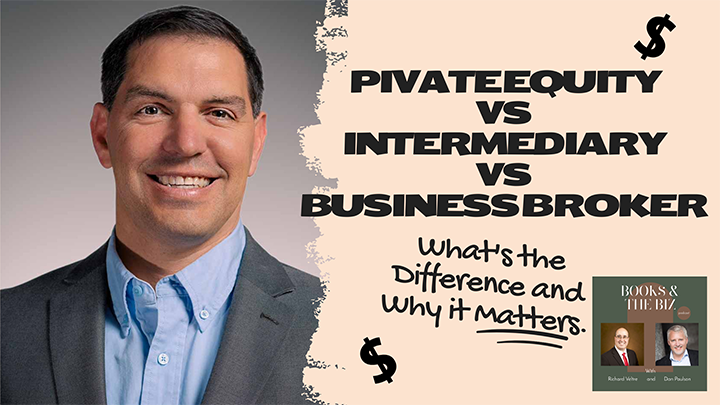
Which is best when looking to sell? Private Equity vs Intermediary vs Broker
Books & The Biz
| Dan Paulson and Richard Veltre | Rating 0 (0) (0) |
| Launched: Oct 16, 2025 | |
| dan@invisionbusinessdevelopment.com | Season: 3 Episode: 35 |
Which is best when looking to sell? Private Equity vs Intermediary vs Broker
Understanding the Different Agents in Business Sales: When considering selling your business, it's important to understand the different types of agents you may encounter. In this episode, Paul Curtiss from EBIT Associates will break down these differences and help you determine the best fit for your situation.

SHARE EPISODE
SUBSCRIBE
Episode Chapters
Understanding the Different Agents in Business Sales: When considering selling your business, it's important to understand the different types of agents you may encounter. In this episode, Paul Curtiss from EBIT Associates will break down these differences and help you determine the best fit for your situation.
Understanding the Different Agents in Business Sales: When considering selling your business, it's important to understand the different types of agents you may encounter. In this episode, Paul Curtiss from EBIT Associates will break down these differences and help you determine the best fit for your situation.
So you are considering selling your business. Or maybe you had a call from someone offering to buy your company. How do you know what the best alternative is for your situation?
To start, you should know the differences between the different agents you could be speaking to and what they offer. In today's episode, Paul Curtiss from EBIT Associates will join us to help explain the differences and give you some idea what may be the best fit.
Please like, share, and subscribe.
[00:00:00.00] - Alice
Hello. Welcome to Books in the Biz, a podcast that looks at both the financial and operational sides of success. Please welcome our hosts, Dan Paulson and Richard Veltre. Dan is the CEO of Envision Development International, and he works with leaders to increase sales and profits through great cultures with solid operations. Rich is CEO of the Veltre Group and a financial strategist working with companies to manage their money more effectively. Now on to the podcast.
[00:00:43.04] - Dan Paulson
Hello, and welcome to Books and the Biz here for another exciting episode. Rich, how are you doing today?
[00:00:48.10] - Rich Veltre
I'm doing well. Dan, how are you?
[00:00:50.06] - Dan Paulson
I am doing wonderfully. Paul Curtis, you are back again. Gluten for punishment.
[00:00:55.17] - Paul Curtiss
Excellent. Always. Thank you much. Thank you much.
[00:00:58.24] - Dan Paulson
Well, happy to have you and happy to have you talk more about succession and whatnot. And that's why we wanted to include you on this conversation. Rich and I have been talking with a number of companies over the years, and sometimes we get calls and we get people asking us, well, what's really the best deal or best alternative, or maybe what's some of the differences out there between one thing versus another? And I was just thinking of this recently because I had a client contact me and they were getting offered by one organization to potentially buy their business. As we're sitting here talking about it, it's trying to figure out what's the best deal for you? Because I think in some ways, Paul, even you and I have talked about this. Well, maybe it's the private equity, or maybe it's private sale, or whatever it's going to be. I think it depends on the situation. Sometimes one feels better than another. And you're busy trying to figure that out. And it could be rather confusing if all of a sudden you're getting calls from all these people wanting to do something with your business. And maybe you'll be able to help explain that.
[00:02:13.19] - Dan Paulson
Rich, What are you seeing out there? From a financial standpoint? I'm sure you're getting contacted by people trying to figure out everything from valuations to how to sell this business. What's been your experience?
[00:02:26.15] - Rich Veltre
It runs the gamut, to be honest with you. I get calls on, like you said, valuation is one. How do I set... I don't get enough calls with people saying, how do I set my books up for a sale? So that's my little plug here, I guess, for today. Feel free to call. Let's get those books ready to go. But I think the other thing is deal structure. Deal structure tends to be something that's very important and that unknown, because somewhere in there, someone has to take the first step forward, and you're afraid that by taking the first step forward, someone's going to take your foot off, and the deal goes away. So I think deal structure tends to be the one that I'm seeing right now. I'm seeing a lot of calls over, how do we structure this deal or how do we structure it so we can do this deal? And I think a piece of that comes from the recent tax legislation that allows for the qualified small business stock. So it actually, well, I'll say it doesn't allow for it. It allows an expansion of it. So I think that's added to everybody trying to talk about QSBS all the time.
[00:03:38.08] - Rich Veltre
And I think that no one really knew it before, and now they really want to know what it is. So I think that's the push of what I've seen.
[00:03:47.01] - Paul Curtiss
Well, Rich, I see a lot of people, and I'm learning about it as it comes along, too, is F reorgs. There's a lot of that getting pushed out there, too, depending on the size of the transaction. So that deal structure is always interesting. And that leads to some of the thought of type of purchaser or ways to sell, right? That can determine how the deal gets structured, whether it's from a PE firm or you have representation or it's a direct sale to a competitor, we'll say, or a like type business that is in your same area wanting to buy your market. That can affect deal structure as well, right?
[00:04:41.01] - Rich Veltre
Yeah. And I think the F for York has become way more popular. It all goes back to the... What's the other one? The 338H10. If you are an S Corp and you wanted to do an asset sale or it's a stock sale that I just treated like an asset sale. And then the bigger the deal gets, the more entities Please get involved in making it bigger and more complicated. I think for the small businesses, though, I just try to tell you, Keep it simple. Don't go too crazy if you don't have to. But all of these things are things that have been coming out as It's, how do I do? How do I do? How do I do? And I think it comes from the fact that there is such a pent up readiness for people who want to retire and people who want to buy a business. And then they're just trying to figure out how to put the two sides of it together.
[00:05:30.00] - Paul Curtiss
Yeah. And do you have a good way to describe an F reorg to people when they ask you? Because that one's... I know. That one is even when I'm asked, you have to pause and ponder it because it's one of those things that it's like a complete restructure of an entity buying an entity that now tries to eliminate this entity once it comes under the umbrella. And People go, Wait, what? Okay, well, let me think of another way to describe it, because that's one of the easiest ways I can describe it, is that this entity buys this entity, brings it underneath their umbrella, and then tries to dissolve this entity over time, and it just gets engulfed by this entity. And that's been one of the only ways I've been able to describe it. Do you have another way you can add it?
[00:06:24.14] - Rich Veltre
I don't think I have a much better way. What I will tell you is, the way I've seen it is, generally, there has to be an entity change. So in other words, if you were an S-corp, I believe the 338 H10 is what I'm trying to say, I believe the stock sale that's treated like an asset sale. And that's because the buyer wants to get to step up in the basis on the assets. So the problem is 338 H10 I believe, is only applicable to an S Corp. And so when you're an LLC, and you're trying to go into a deal, you can't follow the S Corp's regulation. So the F allows you somehow to change so that you can become and get the end result that matches the end result of the 338H10. But it's more complicated than that, right? So So your lawyer is going to talk about an F reorg, but underneath that, I'm not so sure. I'm not sure it's much more difficult than what I just said, than everybody trying to make it sound like it's more difficult than I just said.
[00:07:46.10] - Paul Curtiss
And that happens all the time. When you're a small business owner, and you have someone call you and say, we'd like to buy your business, and you ask Who's the we? And then you find out that it's, we'll say a PE firm or even family office. There's two different sizes, right? The PE firm is usually a much larger entity that probably has a hundred million or greater under asset. Sometimes those ones are 250 million in asset under their belt of like businesses, or they just have that many assets that they are trying to allocate into a business purchase, right? A family office is usually under 100 million. And the reason they're called family offices is because it's a small family or group of families that have a lot of money. They may have owned a really good size business. Say that business is $40 million, and then they sold it for $50 million, and they go, Okay, what can we do with these funds to make it so that we can make them grow without sticking them in the stock market or in some other high risk? If we're going to high risk them, let's high risk them in something we understand.
[00:09:12.05] - Paul Curtiss
We understand running a business. So let's go find like businesses that we just sold and buy those smaller entities that were smaller than us and rebuild a large one and sell it off to the bigger guy. And so those family offices are sometimes one individual or their family, or multiple individuals and their families coming up with 50 to $100 million, right? Those are the two different types of, I guess, equity entities that I have seen try to purchase individual businesses from me. And there's just a lot of questions I always have for those type of entities, right? Like, what are you planning to do with it? How many experiences do you have? Oh, well, this is one of our larger purchases. Oh, so you've bought in this type of business before, but it's just been smaller. And what is that revenue? I usually try to talk top line with them because they like to talk EBITDA, but a lot of the smaller businesses don't understand what EBITDA is, earnings before interest, taxes, debt. And I just forgot the A. There we go. Amortization. Thank you. Yes, I knew it had something What do we do with a loan?
[00:10:30.22] - Paul Curtiss
My brain just had a brain fart right there. Sorry about that. And so it's always interesting how that conversation comes up. So I try to make it keeping it simple, right? Do we talk net or take home? And every business owner understands that number. When you drop the term EBITDA, they're like, the what? Your net or take home after all things considered. Oh, okay. I know what that number is, right? And then they can drop that number. And so It's just really interesting to figure out how to help that business owner. Have you ran into a lot of businesses that are having to deal with that PE or family office, Rich?
[00:11:13.20] - Rich Veltre
Yeah, I've seen a bunch. To me, the family office reminds me of some of the leverage buyout crews that I saw back in the late '80s, early '90s. When I was first starting my career there were guys that were all working out of the same building. And you just realized that they all came together because they got to do all these leverage buy-out deals in the 1980s. And so they put all of themselves and all of their projects, et cetera, in this one building. So when family offices became really popular, I just remembered that this became a shared resource pool, right? And it just so happened that they were called family offices is because, like you said, these were families, whether it was groups of families or whatever. They had a common interest of some kind, whether they were familial or whether it was also some degree of business. They had somewhat of a same focus so that when they were sharing resources, the resources were really good for that particular interest, right? So they would hire four or five accountants who would do all the tax work for everybody in the family. And they knew how everything interacted.
[00:12:33.19] - Rich Veltre
So you had guys that really knew how everything was set up. I would come in as an outside guy because they'd give me a project, and I'd be like, I can't figure everything out because I'm not here as often. So I'm not a very good resource from the outside. They needed somebody inside who knew how 10 different partnerships all flowed into a certain person in the group or flowed into the family. So it's very interesting to talk about family offices because you realize, in many ways, they're saving money for themselves because they're sharing those resources. And then they have the resources or the money available to go and do a deal. And your question was fabulous, right? It's like, well, if you're a family office, and you have all this money, and you just want to go buy a business, how are you going to perfect that business if it's outside outside of that family focus? So it's a great question. It almost has nothing to do with the dollars, because clearly, they have the dollars, but they wouldn't have made the offer. But maybe they don't have the focus. So there's other things to consider other than just the dollars.
[00:13:50.11] - Dan Paulson
So Paul, one of the things that I know we had been talking about a couple of different conversations was a mediary. I know that's something that Rich and I haven't really talked about here. In a way, it's different than a PE firm, it's different than a private seller or broker. Why would somebody hire... Well, first of all, what is a intermediary and why would somebody hire them?
[00:14:18.15] - Paul Curtiss
Yeah, so we consider ourselves an intermediary versus just a broker, right? A broker is someone who can have a real estate a commercial real estate license, and will oftentimes use the same listing as a real estate listing. I have a client that... Well, I have an individual that I am helping. He is not actually my client. He is under contract with a broker. He's now been under contract with that broker for almost eight months. His contract does not end until January. And he's I'm not getting much else. And this guy just came to me and asked me if I should lower my price. And I go, well, that's because he's coming from a real estate mindset. There's a lot of business. And he gave him two different prices for the sale. They were going And they were going to list the business at one price, and they were going to list the real estate at another price. And there's two different percentages that they were going to get paid on or they were going to pay the broker on because of those two different listings. So it was typically 10 % on the business and 6 % on the real estate.
[00:15:38.14] - Paul Curtiss
That's just typical how it goes if the transaction is under a million dollars, which this one was. It was just north of $700,000 when both of those two things were combined. And he was trying to figure out, well, what else can I do? I gave this guy some resources that he could go and use, and I don't know if he used any of those. And I asked him, what was the resources you gave? And he goes, well, I have a couple of associations that I'm a member of, and I can get the list of all those members. And I go, and did he solicit in any way or at least even give information out? He goes, I don't think so. He didn't tell me he did. And I go, well, that's the real difference that an intermediary can do. An intermediary, what we do different is we don't give a list price. We typically give it more like a An open auction, right? We will make it an auction price, and we will have the buyer tell us what they think it's worth based on the numerics of the value of the business. We'll put together a quality of earnings.
[00:17:01.14] - Paul Curtiss
We'll provide a balance sheet statements for the prior three years. We'll give income statements for the prior three years. We'll give the tax returns for the prior three years. And then we will come up with a quality of earnings based off of those numerics and give our report of what that would look like. And that goes into our confidential information memorandum or SIM, as I call it. And And that SIM will give you the history of the company based on who their owner is, how the business was formed, how long it's been in business, what their key roles are in their specific industry. And then they will also get their key employees, how many they are, how long they've been with them, and their key, a blind, key Customers. So for instance, in HVAC, they will say, oh, well, we help these commercial buyers, and we also help these residential buyers, and here's how we get our business. And I will compile that all into one document. Sometimes that document is as short as 25 pages. Typically, it's closer to 40 to 50 pages because of all of the numerics that are associated, right? And so I will have that representation.
[00:18:31.04] - Paul Curtiss
And then I will take it out and I will usually do a blind profile out there to the market that will say, HVAC company selling in the Upper Midwest has revenue north of $3 million and earnings north of $800,000. And then they will go, hey, I'm interested in this, whether that's a PE firm or another business that is trying to grow its own market in that area. And it is oftentimes better for a smaller business, a lower middle market, as we will call it. Let's say they're at $3 million top line, and they're looking to expand, wanting to get to the $5 million range. And by natural growth, it would take them five years to do that on their current trajectory. But if they bought a competitor or another business in their desired focus area of growth, whether that is a region or a type of business provided, it's way easier for them to go from 3 million to 5 million in one single purchase, then it would be for them to try to grow it attritionally. And so they will come to me as an intermediary representing that person, and I don't list them out on the normal channels such as BizBuyCell or the like, or even some of the commercial listings that are out there.
[00:20:14.17] - Paul Curtiss
Do I list on those? Yeah, but a lot of times I will get a seller's SIC code. That's the government designation that they had to list their business as when they When they started their entity. And I will market everybody in a collar state, not just a certain region. I will go for if they're in Wisconsin, for instance, I will market Minnesota, Iowa, Illinois, Indiana, Michigan, and Wisconsin. Those are all the collar states, everything that touches Wisconsin. And market those types of businesses, direct market. And do I call them? If the seller wants me to, I oftentimes work on a tier pricing based on what type of services you want. So that's really, I mean, I could keep going off on how we do that because that's the world I live in, an intermediary. I don't- So how is that different from a broker? Yeah, I was going to say, I don't- We often hear about brokers out there.
[00:21:26.08] - Dan Paulson
So I hear a lot of similarities, at least what brokers will say. But how does it really different?
[00:21:33.08] - Paul Curtiss
What are some of the similarities you've seen?
[00:21:37.25] - Dan Paulson
Well, from listing the business to supposedly marketing the business, I think one of the main difference is I often see with a broker, then what you're describing is they will often list a price. I'm just curious what other differences are there really between a media area and a broker, because typically I would have probably defined you as a broker. So Wow.
[00:22:00.13] - Paul Curtiss
Yeah. As an intermediary, I'm going to always start from mine because I'm most comfortable there, and I don't broker much anymore. The last broker deal I did was a smaller ax throwing company. And how we represented them is I didn't create a sim. I didn't do a QOV. I didn't do a valuation. I took their tax returns, their income statements, and their balance sheets, of which we're not very detailed. They just gave me some numbers that they pulled from their accountant or out of their Quickbooks. And said, here's what my Quickbooks says I've done. Okay, so I've looked at their overhead, looked at their income, and went, okay, here's roughly what you should be at. And so a broker representation is oftentimes just a listing. There are some other brokers who do more work. I know they do. And they will try to market businesses that are of that same type. I have a bunch of memberships and will typically directly market anywhere from 900 to 1800 direct names. I've gone as high as 2,500 But I try to home that because of those representations, I am sending direct email to the business owner because I will acquire that business owner's name and information, and I will reach out to that business owner via email, via paper.
[00:23:51.08] - Paul Curtiss
Oftentimes, I will send out an initial mailer. I will also call out to those owners. And a lot of times I have a call out service that will call out to them and say, hey, we have a business selling in your same arena and in your same area. Have you been thinking about expanding? And My ladies will call out at least three times and acquire the email and send out an email. And from that, I will funnel down to usually 100 people that I know are interested in buying and interested in looking. And from that 100, a lot of times I will get 20 to 30 who are very serious and ask for all of the information. And then from that, I will usually get 10. And from that 10, I will usually have 3 to 5 who are ready to make an offer. And again, am I different? I do more targeted marketing, and typically you have to pay for that. I don't have a flat fee structure. So what do the brokers actually do then?
[00:25:12.22] - Dan Paulson
What would you say is their different?
[00:25:15.23] - Paul Curtiss
Their difference is they usually play in a smaller top line revenue number. At least that's what I found.
[00:25:25.29] - Dan Paulson
They're willing to- So 5 million, less than 2 million, where are they typically?
[00:25:30.13] - Paul Curtiss
Less than 2 million, typically, because they start to feel uncomfortable getting into that higher number, only because it takes a lot more work on that. I'm having to deal with attorneys on both sides. I'm having to put them in place with not only do I talk to their accountant, but I will often have to pull in a tax specialist, whether that's an accountant or a tax attorney who talks to their accountant. I never remove their accountant. Their accountant knows everything about their business. Those people who try to get worried that, oh, but my accountant does that. Well, yes, they know taxes. And Rich, I'd love to hear your thoughts on that in regards to, I get a lot of people who ask me, well, how is the guy you're bringing in different than my accountant? And I So he may not be different. But I want your two accountants. I want this guy who I know deals with the tax ramification and the tax structuring of this deal, that whole F reorg, that whole, Different type, the S Corp versus the LLC version of the same thing, right? It's just one is bigger than the other or is a different designation.
[00:26:55.22] - Paul Curtiss
Have you found that you have to bring in a different accounting representation into your transactions?
[00:27:07.15] - Rich Veltre
A lot of times, yes. And the answer isn't necessarily that one knows more than the other. I think that it's a question of focus.
[00:27:20.03] - Paul Curtiss
Yeah, I agree. Their focus is on...
[00:27:23.27] - Rich Veltre
The seller's accountant's focus is on the seller, and you're the buyer, so the focus is different. And the reasons for looking at it can be different. So if I just had a conversation the other day, and they're trying to structure a deal where whether they were going to buy the assets or whether they were going to buy the stock. And we're thinking that the seller is more interested in selling us the stock because that puts them into the qualified small business stock possibility of not having to pay tax on the gain. So if they go down that route, there's one set of ramifications. But if you're the buyer, you're more interested in the asset sale, because if there's the opportunity to step up the basis of the fixed assets that you purchase, then you get a lot faster write off of what you've actually purchased. So you have other tax advantages that the seller doesn't care about. So it's really perspective, it's focus, it's Again, something other than just the numbers. It's not, it's just, how do I put this together? How do I present it? Or are there pitfalls to my buyer? Because I know the buyer and I don't really care what's in the seller's financials.
[00:28:44.21] - Rich Veltre
I just need to know that so I can tell the buyer, here's your pitfall. Here's what you need to beware of. If you step over there, it's a landmine. I mean, these are the types of things that you want the buyer's accountant to tell the buyer. The buyer's account is not really there to deal with or present anything to the seller. It has nothing to do with it. He's there because he's putting together some package for his buyer. That's his client. He's advocating for that client.
[00:29:15.01] - Paul Curtiss
Cool. Yeah, that's good to hear from your perspective, because I guess, Dan, to answer, I don't have a good direct answer short to say what's the difference between a broker and an intermediary intermediary, and the only reason I don't have a short answer is because I've sat in a room where I was the only intermediary. And when I brought up conversation like we're talking about right now, like the type of representation, or I should say the depth of representation that is brought to the table, I was the only one in that room of 10 that coordinated all of the efforts of the attorney and the accountants and the tax specialist and the wealth manager and the internal financial going on, like the CFOs, right? And not only I also represent the documentation, what does that look like? I sit in on those meetings with them. Brokers do the same thing. But it comes down to when a question is asked, do they have the resources to be able to pull those in? And when it's a smaller business, a lot of times it's left on the seller to go find those representations versus being given those options.
[00:30:57.25] - Dan Paulson
So while we got just a few minutes Here's what we've left here. So if you're looking at broker versus intermediary versus PE, what's... From a company standpoint, if you could give it just a quick synopsis of what would be best for each situation. It sounds like the broker, if you're a smaller business, probably less than $2 million, seems like the broker might be a better fit. Now, what's a good fit for a intermediary, say, versus a PE company coming in? Because usually, again, the PE is going to do direct outreach. They're going to throw you some decent numbers. They'll put some good numbers in front of you, but there might be different requirements for that. So when is that a good situation versus maybe doing a mediarity situation?
[00:31:47.08] - Paul Curtiss
I will try to give an example in less than two minutes.
[00:31:52.06] - Dan Paulson
Good. That's all we got left.
[00:31:54.23] - Paul Curtiss
So a PE firm is going to call the business owner directly. They're going to get one call, and they're going to be solicited by one organization, where if you have an intermediary, I'm going to do my best to bring a hundred people in to talk to you and give you at least 10 different offers, and you get to choose which offer is the best one on the table based on what you're wanting to get out of the transaction. And a lot of times, I can make it so that that transaction happens in months versus years. The last three experiences I have had with a PE firm buying a business, I was trying to help two business owners exit. They got a call. The deal sounded great. The numbers sounded good. And then it took them almost two years to sell. One was north of two years, the other one was just south of two years from initial call, and there was money left on the table in both of those transactions. And the other one, I helped basically consult that transaction from the seller standpoint, and they tried to make the sale last longer than they originally They told me.
[00:33:31.22] - Paul Curtiss
They said six months. It still took eight months, and that was me pushing the envelope as we got closer to that six month time period. And the month of closing, they looked at AR and AP, accounts receivable, accounts payable, and said, we don't need any of those, which adversely affected the value upon sale. And we said, no, that's not how that transaction works. You originally wanted those. Why are you now pulling them out? And they didn't have a good answer. And so we were able to leave them in because it was going to make the sale price an $800,000 loss. And we were able to argue them to only a $200,000 loss off of what their original offer was. And so it's like, oh, my goodness, how does that normally go? So a PE firm has a lot of money. They usually can make it happen faster. But the faster that they want to make it happen means they are trying... They see your growth as a business owner and want to capitalize on your growth underneath their envelope instead of you capitalizing on that growth, so they have to pay you more for the value of your business.
[00:34:52.04] - Paul Curtiss
And so that's a lot of times what I'll see them trying to make the business close sooner versus they see that you're on top of your game, they want to try to make that transaction last a little longer so that whatever is in the hopper right here dissipates and is a one-off sale or one-off purchase so that when they buy you, they're lower than what you're at right now. Just typically what I see, it's not that the PE firm is the bad guy out there. Wouldn't you do that if you were the business owner trying to buy a business? I want to try to capitalize on your growth strategy. If you started the year out at 2 million, and at the end of the year, it looks like you're going to be at two and a half, I want to buy now before that two and a half hits. And let's say you're at two, two, if But it looks like you're going to hit two five. I want to buy you now. I want to make this close last two months so that I can capitalize on that growth into next year and this year, versus if you're at two five and they see that this is going to close I'm going to wait till next year and see where you're at at the end of Q1.
[00:36:05.07] - Paul Curtiss
Are you still at that growth trajectory or are you at lower? These are just things I see. I do not bash PE firms because I have probably 300 PE firms in my database alone that I call on all the time. I talk to you guys all the time. And have I sold to them? Yes. Yes, I have. Do they have the money? Yes. Yes, they do. But I I need to try to help the business owner. I guess that's a representation I bring to the table as an intermediary versus just a broker. My database is just different.
[00:36:42.17] - Dan Paulson
And that's really, I think, where the PE firm might be, I guess the long answer is it depends, and it really depends on your situation. Maybe if you're towards the sunset of your business, especially as we talk about age, I think that's something we're going to talk about in the future is, as you get upwards of 65, 70, do you want to put in the same effort anymore? And that PE deal might be the best thing to come out there because they can infuse cash in the business, keep it growing, and you're still going to benefit from that. Hopefully, once that PE firm sells the group of companies are buying, they're going to do quite well with it. It's a different situation than what you bring up about the media area or the broker. The broker is more of a fine sale. You're going to get whatever price you're asked for or if you're in In your situation, Paul, you're doing what you can to get the best offer for that client. But as you point out, it's going to be one or a couple offers. They're going to have more to choose from there than, say, a PE firm would.
[00:37:43.22] - Dan Paulson
Paul, if somebody want to talk to you more about this, if they're thinking about selling their business and they got some questions, what's the best way to get a hold of you?
[00:37:50.27] - Paul Curtiss
They can either give me a call that is, I'll give you my cell number this time, 608-209-0804. They can go to our website, EBIT Associates, E-B-I-T Associates, all spelled out. Com, or they can email me, P. Curtis, with two s's, @Ebitassociates.
[00:38:14.27] - Dan Paulson
Awesome. Great. Rich, how do they get a hold of us if they want to get a hold of us?
[00:38:19.20] - Rich Veltre
E-mail is the best, rich@xcxo.net.
[00:38:24.16] - Dan Paulson
And for me, you can get a hold of me at dan@xcxo.net. Rich, Paul, Always great to have you on. We will be back again in another week to talk more about probably succession and what else we can do here. So thank you all, and we will talk to you again.
[00:38:42.09] - Paul Curtiss
Thanks much.
[00:38:43.20] - Dan Paulson
Bob, take it away.
[00:38:46.11] - Bob
Want to boost your sales and profits but need the talent to help you grow? Xcxo is a one-of-a-kind platform to find skilled fractional executives to help develop your team into a high-performance powerhouse. Fractional leadership is a great choice when you consider the average executive-level candidate can cost you hundreds of thousands of dollars in salaries, benefits, and incentives. Xcxo finds you the executive and utilizes their talents to build your team's experience, all for a fraction of the cost of a full-time C-suite leader. Contact XCXO today to fill the gaps in your leadership team. Visit xcxo.net.