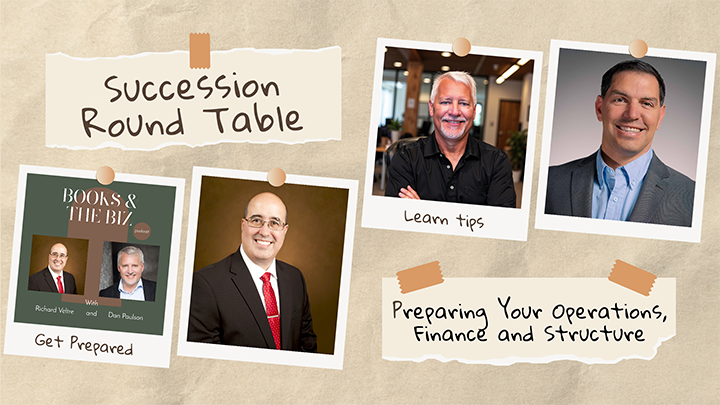
Three Areas To Maximize Your Business Sale
Books & The Biz
| Dan Paulson and Richard Veltre | Rating 0 (0) (0) |
| Launched: Oct 24, 2025 | |
| dan@invisionbusinessdevelopment.com | Season: 3 Episode: 36 |
As business owners, it's easy to get caught up in the day-to-day operations and forget about the bigger picture of succession planning. However, by participating in discussions like these, you can gain invaluable advice from experts like Paul Curtiss on how to prepare for the future sale of your business. From optimizing your operations to maximizing your financial returns and structuring a deal that benefits you as the owner, this series promises to be a game-changer for anyone looking to secure their financial future.
SUBSCRIBE

Episode Chapters
As business owners, it's easy to get caught up in the day-to-day operations and forget about the bigger picture of succession planning. However, by participating in discussions like these, you can gain invaluable advice from experts like Paul Curtiss on how to prepare for the future sale of your business. From optimizing your operations to maximizing your financial returns and structuring a deal that benefits you as the owner, this series promises to be a game-changer for anyone looking to secure their financial future.
Join us for this succession round table discussion.
We invite Paul Curtiss to continue our succession discussion in this multi-part series that dives into the three areas we believe are important for putting the most money in your pocket when it's time to sell.
Here we will each share our thoughts on Operations, Finance, and finally Structuring the deal so you as an owner can step away and gain the most from the hard work you put in over the years.
Please like, share and subscribe.
[00:00:14.17] - Alice
Hello. Welcome to Books in the Biz, a podcast that looks at both the financial and operational sides of success. Please welcome our hosts, Dan Paulson and Richard Veltre. Dan is the CEO of Envision Development International, and he works with leaders to increase sales and profits through great cultures with solid operations. Rich is CEO of the Veltre Group and a financial strategist working with companies to manage their money more effectively. Now, we're back.
[00:00:45.11] - Dan Paulson
Good afternoon. Welcome to Books and the Biz. We are back for another exciting episode, continuing our discussion about succession and what we can do. We have the three musketeers back together. Rich, how are you doing?
[00:01:00.00] - Rich Veltre
I'm doing very well, Dan. How are you?
[00:01:02.00] - Dan Paulson
Excellent. Doing wonderfully. We also have Paul Curtis with us. Paul, how are you doing?
[00:01:07.12] - Paul Curtiss
Excellent. Excellent.
[00:01:08.24] - Dan Paulson
Good, good. So, hey, we had you on last week. We were talking about certain things. So it would be a good idea maybe to continue that conversation for the next couple of episodes, because really what I've seen is we're framing us up to where we're talking about each phase to the process to getting to that final sale. And as Rich and I have talked about throughout succession is that our goal is to help companies or business owners maximize that value when they do go to to finally sell the business. I think each of us bring a little something different to that. So we're going to do this a little bit differently than we have In previous ones, this is going to be more of a round-robin type thing where each of us are going to share our input, ask each other questions. So it's not going to be one speaker. We're all going to do that. So if you're on board for that, Paul, I'll get us started here because I want to follow us through the process, and each of us are going to take our own piece of it. I tend to be more operations-based, so we'll get into that.
[00:02:10.11] - Dan Paulson
But I wanted to ask Rich, really, to get us started here, because To me, there's three factors. There's operations, there's finance, and then there's finally the structure of the deal where Paul comes in. Rich, when you're starting to look at a company and they're talking to you and saying, Hey, I'm thinking about selling or within the next couple of years, I want to get to a point where we can sell this business for the most we can get for it. What are you looking at from a CFO lens? We're not going to worry about taxes today, but as you're looking at the overall structure, how do you get them to where the sale of their business can be maximized based off of how you structure their accounting?
[00:02:52.25] - Rich Veltre
Well, you and I have always had conversations, and I talk about changing my hat, right? So depending on what hat I'm wearing at the time, if I'm wearing the CFO hat, I'm looking at if I'm a buyer, and I'm coming in to look at this company, what am I coming in and looking at? So the first thing I start looking at is not necessarily the sales. Usually, that's the part that gets people excited and gets them to come in the door. But I go down into the net parts of the business and start looking at, well, how are we doing on the bottom line? How am I translating this to, if I'm a buyer and I come in, that's going to be my bottom line when I start out. And what can I do with that? Can I make that grow? Et cetera. But the biggest thing is as a seller, if I'm talking to a seller or I'm the CFO of the company, I'm looking to prepare it so that when the buyer does come in, I know what I'm handing him. I know what they're going to look at. I know what I want to have in front of me because you've been working with them, usually.
[00:03:49.11] - Rich Veltre
You've been working with them with the operations. And I want to know from you, what am I getting out of this? Am I trying to sell a company that everything's being shut down? Or am I selling a company that has high And I want you, because you're deep in the weeds there, I want you to tell me what's going on inside the company so I know how to frame it. And when I talk about that, I'm not writing up some massive report. I'm doing it with the numbers, right? I know that these people are going to come in. They're going to look at the numbers, and I want them to get the story that you and I have coordinated. So when I come in and I'm setting this all up and saying, you guys want to sell? Here's what it looks like. Here's what I think is going to happen if a buyer comes in. Here's our skeleton in the closet, or here's the pitfall that they could step on. These are the types of things I want to prepare someone for so they know what's coming. And that's, again, from the sell side. So done it a dozen times, where we've set it up, and everybody knew it was going on.
[00:04:49.17] - Rich Veltre
And there's no surprise looks on anybody's faces. It's straight. We're doing a negotiation here, which will lead me to But that's the part that I want to be set up, and I want to know what I'm putting on the table, and I know that this is what they're looking at. I think that answers the question. I mean, basically, that's the finance's role in setting up if you're thinking about selling.
[00:05:21.00] - Dan Paulson
Yeah. No, that sounds about right. And that then leads back to, well, how do I get you to the story? So if my part is the operations, I guess if we look at this from a movie standpoint, I'm building the plot. And the whole plot is by the time we get to that end scene or that climax, what I have done is I have helped that owner remove themselves from the daily operations of the business. One of the first questions I ask any owner, whether they're looking at selling or not, is how involved are they in the business? And if they were to not be able to talk with anyone or reach out to anyone in their company for at least a month, what feelings would be going through their gut as that's happening? And the more you see that white look or that deer in the headlights look on their face, that tells me that they have a high degree of control over every component of that business. And the way I look at it from the standpoint similar to the lens that you're looking at through, how do you maximize the sale of that company?
[00:06:25.03] - Dan Paulson
Well, to me, to get the higher value, that company has to operate without the owner's heavy involvement. And what I often see in companies, anywhere from a couple of million dollars up to often 20 to $30 million, is that owner has so much control over every decision, over every action that takes place, that they run into the situation where now for them to not make those decisions or make those choices, there's really nobody on their team that's comfortable doing that on their own. So you see these stalls, or you see these wait until I an answer type looks on people's faces because they don't know if, A, they have permission to do it, or B, they don't know what outcome they should get from that decision. So that's where really when I'm working with the company, my goal is to get that owner completely removed from every aspect that should work without them being there. So that's getting them to delegate properly, getting them to hold their people accountable, building systems and processes in place. So we've got documented training, and we can really work with people to get to where they can make those choices on their own.
[00:07:34.28] - Dan Paulson
And the only decisions that should roll up to the owner level are key decisions that really just don't fall in their wheelhouse, or they've reached a price point where we're talking about tens of thousands of dollars, maybe if this is a mistake that really should get clearance from high up before they make that choice. So Paul, that's where we come from an aspect. And I I just want each of us to give a little three-minute dissertation. Now you're looking at it from the deal side of things. So you're looking at it from structuring the deal. What's your piece of this?
[00:08:10.16] - Paul Curtiss
Well, it's interesting because you said getting them out of the day to day multi hat roles. I will oftentimes ask a seller, have you been able to be gone from your business for an extended weekend? And they are either going to say yes or no. Oh, and let me caveat that without a phone call, back to see how things are going or having your phone blow up while you're gone. And then if they say yes to that, I go, great. Have you done that in the middle of the week? And if they say no, I go, well, you should try it. And then if they say yes to that, I will go, great. Have you done it for seven to 10 days? Oh, well, you should try that. And then I try to make it so that they can back out and go on vacations and go from one week to two weeks and try and get them to a full month, where they're dropping into the office only for an hour or two each day or something along that line. And that's my way to get them to you, to have them think about that way.
[00:09:17.22] - Paul Curtiss
And when it comes to looking at structure, a lot of times there's really two different ways that a deal can be structured. I mean, if you jump into the weeds, there's so many different ways that I could go with this conversation. But the one that came to me was there's two different ways to sell the business. There's either this thing called an asset sale or this thing called the stock sale. We'd have to jump into that a lot deeper. But the asset sale is the buyer's preferred way of doing it, and the stock sales is the seller's way to prefer doing it. And it's all a matter of risk and mitigation and tax results are really the main two things of those two that you go. I wanted to give an example of what I see when people are trying to figure out, well, what does this mean in the numbers? That whole beautiful thing of, oh, the sale. Like, oh, what am I going to walk away with? Because that's always what they're curious about. And they have this number in their head, whatever that number is. A lot of times it's their revenue plus something.
[00:10:17.01] - Paul Curtiss
And the reality is, is that's not how the numbers calculated off. So let's just say a business is worth 10 million bucks. Well, how that structure will sometimes happen is there'll be an $8 million dollar money received at closing, whether that's through a normal lender or an SBA lender, conventional or SBA. And the only two differences right there is SBA gives you a little better rate and you have to come down, you have to come to the table with less money down, where a conventional has way less hoops to jump through. Then you have this thing called the seller note that they are never aware of and never know that it comes, but I haven't seen a deal where it doesn't happen. There's some form of seller concession, holdback, note, earn out. I always aim for a note. That could be a $2 million note. You're at the $10 million. And then a lot of times, because there's a note, the buyer will often try to throw in, and I'll give you an extra million bucks as an earn out if you stay on for this amount of time longer than you really wanted to stay on, and we hit these certain numbers that you say we can hit.
[00:11:26.14] - Paul Curtiss
So that's a quick down and dirty of how a full structure and negotiation happens. And then you come down to, well, how do I get to that value? And I start to look at these things called Adbacks. I start to look at these things called, how much assets do you actually have? And is that included? Is the building included in the sale? Is all of the trucks and all the things that are inside that building included in the sale? How about all of your inventory? How does that play into everything? Because inventory is fluctuating. How about work in progress or whip? Same thing that's coming in. Okay, is that what we're going to be getting at the close, or is that staying with the seller, or is that going to go with the buyer? So there's all those things that people don't think about when it gets to the closing and close into that proximity of the date of close. They're just looking at this big number, and that big number can fluctuate greatly based on a lot of those items that I just talked about. And I try to tell people, the less you're doing in the business, the greater the value you will have and the bigger the number will be because the buyer can come in with everything running smoothly and you just fade off into the distance and everybody goes, I'm so glad you're sitting on your boat all day, right?
[00:13:00.26] - Paul Curtiss
And that's what your employees want to see, and that's what you want to have happen as a buyer. You want to be able to make sure that your legacy is handed off in a way that it will continue to run without you. That's the true legacy. It's not you. It's the legacy in the business that you've created over the last two generations or 20 plus years. It's one or the other. So that's what I've found in a big, broad nutshell of how people think about a deal, how it structures, and how they get their value. So I don't know if that answered the question, because I jumped through a lot of high level things there, but hopefully that gives an idea.
[00:13:44.17] - Dan Paulson
And I think it ties well into what both of us are talking about, too, from each aspect of what we bring into the table. So our goal is to make your job easier. Your goal is to make the seller's job easier or to maximize their value on it. And it It does, to me, really come down to how much of this business is turnkey. We've all heard of turnkey businesses or turnkey this, turnkey that. The whole idea here is a vast... There's a good chunk of owners There are a good chunk of buyers, I'll say, that just want the company to work. They don't want to come in and make changes right away because they know there's a high risk to making those changes happen. If the owner has been making those changes and putting in those systems and getting everything standardized so that the new owner can just come in and let it run for a while before they make any changes happen, it's going to keep their employees happier because the employee is not going to see this sudden upheaval with the new owner because that gets them very skittish and they might want to leave then.
[00:14:45.02] - Dan Paulson
Also puts them in a situation where that business can be generating revenue easier than when there's huge investments that have to be made by the new owner to basically recoup his investment in that business. I mean, also, and Rich, I don't know what you see here, but I see when businesses aren't structured well, and that owner has a lot of involvement, or the owner just hasn't made those critical investments in building out the operations and whatnot, that When those companies sell, they sell for a much lower price point than the company that's well run. So it might be well run with the owner in there, but you remove the owner, everything falls apart, and that The new owner is going to look at that, right?
[00:15:32.16] - Paul Curtiss
Absolutely. Right. Well, and before you jump in on that, Rich, I want to make one comment that you made, Dan, that's really important that the sellers don't think about. If the current owner who's been there at the helm for decades is starting to make changes, the employees will be usually aware that those changes are done by somebody they trust and for the betterment of the company to last when the buyer sells, because people will start to ask. I've seen it happen, where they'll start to ask the owner, Are you prepping this for your retirement or sale or something? Why all these changes all of a sudden? And that's when they can come back with, yes, I'm prepping it so that everything is in place, whether I'm here tomorrow or not, and I get hit by a bus, or I decide to retire in the next coming years to decade. And it takes away a lot of that anxiety from the employee's standpoint. And that way, if the owner is making change within a few years of sale, then when the buyer comes on and doesn't make any changes at first, but then starts to make changes within the first few years of purchase, the employees are used to that change for improvement.
[00:16:55.18] - Paul Curtiss
They don't consider change by the buyer a bad thing. They are assuming that change is for a betterment because the business owner put that in place.
[00:17:05.23] - Dan Paulson
Well, and it gives that new buyer or the new owner a chance when they step in to start asking questions and getting input. So employees If the new owner is smart, the new owner is getting buy in from the current employees on any changes they might want to make in the future, maybe even helping facilitate some of those changes. So now as an employee, I feel like I'm more engaged in the betterment of the company than I do when somebody just comes in and says, well, in order for us to be profitable, I got to change X, Y, and Z, and all this has to change within the next six months. And that was very painful for somebody who might have been doing their job one way for 20 to 30 years. That's when you lose that talent.
[00:17:48.07] - Paul Curtiss
Well, and it helps the business owner who are already in the company in the roles that they probably should have had already by the owner off unloading their responsibility onto the key employee and having the key employee hold more role responsibility or even giving them a new title so that you have a key employee with an actual title who has the responsibility of that title. And that's what I've seen in buyers wanting from the actual roles in place. Rich, now going back to the question that was posed by Dan before I jumped in again, adding more to that point because I just feel it's a really good one. How do you see it on the numbers when the employees, or I should say the company is, we'll call it structured on the inside from an ops standpoint, not on a sales side, but if it's structured properly with employees in the right places, we'll just go with salaries in the right position. Do you see that that benefits your side in prep for sale, or is there something else that you could add to that?
[00:19:04.01] - Rich Veltre
I think there's an extremely good operational... What you guys are talking about as far as from the operation standpoint is fabulous. It's easily masked in the financials, if you ask me. Because if I come in and was working with the financials, the part that usually strikes me, at least a little bit, is that if I start looking at the margins, the margins might look great. Gross margin and net margin. Where's the owner? The owner is not usually in that upper margin. It's not usually included in the gross margin. They get an officer salary line. Even on a tax return, you can see it that it's below gross margin, that officers are listed below gross margin. If they're doing a lot of operational stuff, then your margin isn't real. If they're doing stuff and actually producing the product, producing the service, and you're not including it, then the margin looks a lot better than it probably is. So I think that's a key question to prepare before you have a buyer coming in, because the buyer is thinking that already. They're thinking, where is the owner? How much is the owner really doing? Accounting firms, right?
[00:20:22.29] - Rich Veltre
Everybody loves to go in and see how much is the accountant for... The accounting firms, the partner will always say, I only work 40 hours a week. Yeah, right. If you're an old-school accountant and you're in the sailing, you lived through the '80s and the '90s and the early 2000s, and these guys were working like crazy. Crazy hours. So how can you come to a sail and say, well, I'm only working 40 hours a week. No one believes it. So now they're going to go and they're going to dig in. So again, are the margins okay? Are the margins reasonable? Or are we paying everything to the partner because the partner doesn't have somebody else doing part of this work for them. And now the buyer is going to turn around and say, I have to build a team. So I'm not paying for that. You're paying for that. And that goes back and shifts back to the buyer, to the seller. I'm sorry, I said that wrong. So, yes, you can find it in the numbers, but you're going to dig. And I think that's why a lot of times the buyer and the due diligence team on the buyer side will absolutely dig.
[00:21:27.28] - Rich Veltre
The questions will just come flying because they want to dig to the bottom and make sure that they're getting the real answer.
[00:21:36.24] - Paul Curtiss
So what are you some ways that you see that you can help to take out those numbers and make the owner's numbers show up a little better, or diffuse them, if you will, to put those numbers where they actually should be and what other areas they should sit in?
[00:22:02.01] - Rich Veltre
I think that in the first however many years that they're running the business, they're used to their accountants or their tax returns showing them that this is what I make at the bottom line. And what they don't realize is in a sales situation, that's not necessarily the bottom line. There's more to it, right? You're going to say, I made this much. This is how much I took home. Okay, I get that. But when you're selling it, there there are adjustments. And the adjustments could come from the fact that if the buyer comes in and buys your business, he doesn't necessarily have the same cost as you. So he's going to make adjustments to say, my ongoing costs are going to be X, so my value should be based on that number, not on the seller's number. So they start to make adjustments. And we call those adjusted addbacks or adjusted earnings before interest taxes, depreciation and amortization. And And that's the number when you're selling. That's the number you have to be focused on. So if you're preparing for sale, start figuring out what you think that number is. Because then they can come to you, Paul, and say, well, this is the number I figured out.
[00:23:13.25] - Rich Veltre
Do you agree with that? Do you think this is a fair representation? Because no matter what you put down on paper, the buyer is going to have their own, and your negotiation becomes the difference between your number and their number. But at least if you have a number, you have a starting point. If you're starting off from somebody, my accountant said, I made this much money, and that's where you're starting, you're at a disadvantage already.
[00:23:39.16] - Paul Curtiss
Yeah. Well, and I've also seen the number from, we'll call it bottom line earnings where the business owner will use a dispersion or a distribution to be able to, we'll say for tax benefits, right? But because it's for tax benefits, it doesn't show up. I can't add that back, speaking of addbacks, right? So you'll have a business owner. I've seen it on almost every transaction where the business And so the business owner will take some form of dispersion. And if I haven't talked to them with enough time in advance, typically at least a year, usually two, before we go to market so that they can start to give themselves a a better salary or a more accurate salary versus this menial thing that doesn't fit what their role actually is. And then they just take earnings and not put them back into the business or not pay taxes on them however you want to look at it. I can't add that back. I had a client that was taking earnouts around $300,000 a year. They got an offer at 4X. When you take a multiple of four on $300,000, that's a mill and a quarter that I can't touch, right?
[00:25:04.15] - Paul Curtiss
Not quite a full mil and a quarter, but it's something that I can't put into the value of the business. So by you taking a couple of $100,000 out, you just missed out on this big piece of pie at closing. Okay, I'd rather figure out how to play with taxes on 1. 2 than on 300,000. Give me that problem all day. I'm in. And that's what I try to do is to make it so that this thing is structured such that you have the ability to play with a bigger number and deal with what tax ramifications are there. Can I slide some of that into a retirement fund because I don't need all that millions of dollars right now? I can handle getting that five years from now when I actually turn 67 or turn, you know what I mean? So that's another structured game that I try to help clients with when they start getting close to that table of closing and signing on a dotted line for a number. But I don't know how that fit in to what we were talking about, but it came up. I thought it shared.
[00:26:14.19] - Dan Paulson
Here's something else that I think needs to be considered as well, because I know you numbers guy always talk about the numbers, but here's the other part of it. There's also standard operating procedures. There's documentation. There's proof that the work is being done and that the systems are documented so they not all falling onto the owner's plate. I don't think a lot of people realize that business happens somehow. They know that. That's why their interest in your business. That's why when they look at PnLs and the balance sheets and they see that there's profit, and they see there's something here worth buying, that's important. But then as you start doing that due diligence and you go beyond the numbers, okay, now, how do we know who's doing what? And what's the backup that's in place to explain why they did what they did. Well, if you have, again, documented systems and you have other people besides the owners delivering on those systems to prove that you're actually using them, that to me is just as valuable as the numbers you're talking about, because I, as a buyer, I'm coming in and looking and trying to see, as Rich was pointing out in the numbers with the whole salary situation, but I'm also trying to see, is that owner really letting the employees do the work, or is it falling back on the owner to make all those decisions?
[00:27:29.03] - Dan Paulson
If you have well-documented processes that are followed that can easily be pulled out and shown, it's a pretty good argument that the owner is not that involved in day-to-day operations, which makes it even more powerful than Paul for your case to say, look, this business is worth way more because how many businesses do you walk into that have any standard operating procedures documented or any system documented? And any- Or even a handbook for employees.
[00:27:58.04] - Paul Curtiss
All of those documentation is Dan, I have found become very valuable. And a buyer wants them, especially if you're in that realm north of five million bucks on, we'll just say, revenue, right? If you're north of five million bucks on revenue up to even 75 million, they're going to want some form of standardized book that they can go to and go, okay, so this is how you decide bonuses, or this is how you decide who functions in the shop, or who functions in the front office, or who functions out in the field, or who functions on the sales side. You get those standards of SOPs, standard of operations. You get the ability for a buyer to just come in and go, it makes it easier for them to not make changes for the first year because they know what's happening.
[00:28:54.21] - Dan Paulson
And they know what to expect.
[00:28:57.08] - Paul Curtiss
Yeah. And if that's all you do before you exit, is start asking your key employees, how would you describe to somebody what you do? I, as the owner, know what you do, but I'm curious, how would you describe that to somebody? Not me. Just when somebody came up to you at a bar and goes, hey, what is it you do for such and such, A, And you see company, oh, I do this. Okay, in that, what is your daily operations look like? What is your daily work look like? Those are the questions as a business owner. If you just ask those of your employees, Dan, I'm sure you have a better way to dig deeper.
[00:29:30.21] - Dan Paulson
Well, it's a little bit more detailed than that because there's a lot of nuance in somebody's job that they just don't realize that they do. So you can get 60 to 70 % the way you're talking about. Tell me what you do. Walk me through the steps. But then you got to get to, well, this happened. Why did you make this decision versus that decision? And that is where the details really come in. So really developing standard operating procedures isn't a 10 minute process. It's more like a several week or even a several month to get all that stuff documented. And that's why when I walk into companies and you see that guy who's been doing that same job for 40 years, you know that job like the back of his hand, and you point to the owner and say, okay, he gets hit by a bus tomorrow. What happens to you? And then again, deer in headlights look, blank look on the face, and they freak out. It's like, that's because you haven't documented anything. Guess what the new owner is going to do when he sees that, too? Because now the new owner has another risk involved.
[00:30:29.17] - Dan Paulson
Somebody who's been there for 40 years, sees the old guy walk out that he's worked with for that long, he starts thinking about retirement pretty darn quick. So there's other things there that really help with those having those procedural things in place. Guys, as we're wrapping up here, because we're getting at about 30 minutes, Paul, what's the one takeaway from this conversation that maybe we can carry into our next conversation? Because I think we're going to do this one more time before the end of the month here. What's That's the one thing you tell people?
[00:31:03.02] - Paul Curtiss
I actually enjoyed this conversation. I didn't think about that question. They need to start sooner than they expect, right? They need to give themselves a little bit of a good runway. I mean, don't get exhausted at the point of going, okay, I'm ready to sell. Where do I start? Okay, will you start with someone like Dan or talk to your accountant and figure out what What numbers are actually making it so my business value is less? Or do you go get a valuation at any point? I've done valuations five years before the people have decided to sell, two years before they decided to sell, and that's what they used. I'm already working with the accountant, and I get to show things that make it so that they would want to talk to somebody like you, Dan. And just talk to your family, too. If you don't talk to the family, if this is a family business and say, Hey, I'm What are you thinking about wanting to retire, what does that look like? Does anybody want to take over? What does that look like? Yeah, that's what jumps to mind. I didn't have a good question to jump in in the next one right now, other than maybe trying to dig deeper into what do adbacks look like and what are those?
[00:32:21.10] - Dan Paulson
Yeah, I think what we talk next time, maybe it's more about things like the after the effects, the addbacks, maybe even get some into, okay, now you sold the business. Now, let's worry about what tax ramifications are involved in. How can you maybe mitigate some of that? Rich, how about you? What's one takeaway that you had from all that we've discussed here so far that maybe the listeners would want to be aware of?
[00:32:47.22] - Rich Veltre
Yeah, I think if you're getting monthly reports and your idea of getting the monthly report says, well, he gave me what I paid for. So I'm going to put it in the file over here and not look at Then rethink your strategy, because those numbers are really key. They're key to operating on a day to day basis. They're key on whether or not you can build a team. If you can build a team and do all those things, then you're a significant percentage down the line beyond what other people are. Because that inherent knowledge and that data becomes what you can use to sell when you decide to sell. So if you're getting those numbers and you're actually tracking them, and you start to think about what a buyer would look at if they were looking at this. You don't have to have that surprise. You don't have to have the knowledge that your employees have figured out that you're thinking about selling because you're doing it all in this compressed timeline. So the numbers really become key, especially if you're going to sell to a... Maybe we can have this conversation next time, too, the financial versus the strategic, right?
[00:34:01.22] - Rich Veltre
If you're looking at a financial buyer, they don't want to come in for a job. They didn't come in to buy the business as a job. They bought the business as an investment, so they want to know it's going to grow. If they bought it as strategic, we might have a different conversation. But a financial buyer, which there's probably more of than there are strategics, the financial buyer wants to know they're going to make money, and they can feel a lot better about making money if they're thinking, You already built a team, and it's going to make me money on day one.
[00:34:31.10] - Paul Curtiss
And both of those buyers are looking at a company. If you put these things in place and you look at the numbers, like you're saying, and how your business is operating, it's going to make them want to buy something that is trending up. They don't want to just buy a stagnant business. They're usually looking for something that is constantly... It doesn't have to be a massive growth. It could be even just 5 % a year, right? If you're growing 5 % a year, they're going to be like, holy cow. And how long has that been going on now? And if If it's been greater than two years, they're going to be happy, especially if there was this growth period, a plateau in another growth period. They're going to be like, let's buy it now while it's in this growth period, and both parties are going to be interested. We should talk about that for sure.
[00:35:11.16] - Dan Paulson
Well, it sounds like we got a lot more to talk about. I'd say the big takeaway from all this is really prepare ahead of time. Don't wait till you're so frustrated that you get to the last second, because I don't know how many times I hear that I want to sell this company in six months or less. And Paul, you can elaborate on in a future episode. But I mean, that really boils down to it's going to take longer than that anyway. And it also tells me that the company is probably not prepared to sail because if you're burnt out from it, all you're doing is you're handing off your problems to somebody else. So keep that in mind. Guys, it's been a great conversation. We will definitely continue this on. And thank you both for being here. Now I'm going to let Bob take it away.
[00:35:57.02] - Bob
Want to boost your sales and profit? Benefits but need the talent to help you grow? Xcxo is a one-of-a-kind platform to find skilled fractional executives to help develop your team into a high-performance powerhouse. Fractional leadership is a great choice when you consider the average executive-level candidate can cost you hundreds of thousands of dollars in salaries, benefits, and incentives. Xcxo finds you the executive and utilizes their talents to build your team's experience, all for a fraction of the cost of a full-time C-suite leader. Contact XCXO today to fill the gaps in your leadership team. Visit XCXO.net.