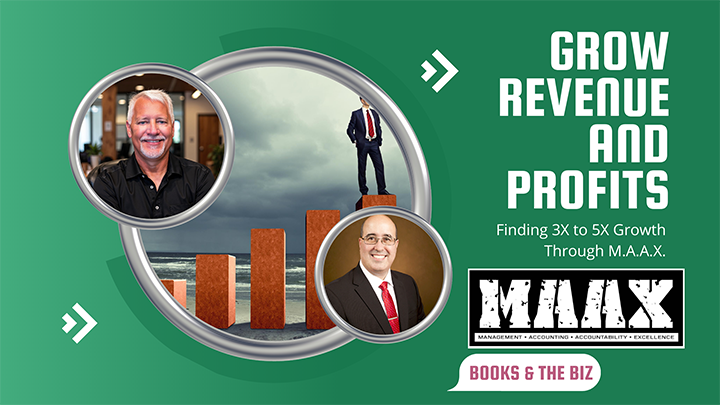
Getting to 3X to 5X Growth
Books & The Biz
| Dan Paulson and Richard Veltre | Rating 0 (0) (0) |
| Launched: Nov 06, 2025 | |
| dan@invisionbusinessdevelopment.com | Season: 3 Episode: 38 |
The M.A.A.X. System is a revolutionary approach to business success that focuses on four key areas of financial and operational performance. By implementing this system, small to medium-sized companies can achieve unprecedented growth and drive their business forward. In this article, we will delve into the principles of the M.A.A.X. System and explore how they can be utilized to propel your company to new heights.
SUBSCRIBE

Episode Chapters
The M.A.A.X. System is a revolutionary approach to business success that focuses on four key areas of financial and operational performance. By implementing this system, small to medium-sized companies can achieve unprecedented growth and drive their business forward. In this article, we will delve into the principles of the M.A.A.X. System and explore how they can be utilized to propel your company to new heights.
Success in business doesn't need to be complicated. That is why we have developed the M.A.A.X. System. The goal was to focus on four key areas of financial and operational performance that truly drive business growth.
Today we dig into the M.A.A.X. principles and show where, when utilized successfully, they lead to unprecedented growth for small to medium-sized companies.
Please like, share, and subscribe.
[00:00:00.00] - Alice
Hello. Welcome to Books in the Biz, a podcast that looks at both the financial and operational sides of success. Please welcome our hosts, Dan Paulson and Richard Veltre. Dan is the CEO of Envision Development International, and he works with leaders to increase sales and profits through great cultures with solid operations. Rich is CEO of the Veltre Group and a financial strategist working with companies to manage their money more effectively. Now on to the podcast.
[00:00:43.22] - Dan Paulson
Welcome to Books and the Biz. We are back for another exciting episode. Rich, how are you doing this week?
[00:00:49.23] - Rich Veltre
I'm doing very well this week. How are you doing this week?
[00:00:52.27] - Dan Paulson
I am doing good. I'm doing good. Staying warm here for at least a couple more days until we drop into the frigid temperatures. I don't know what it's going to be like out in Jersey, but it's staying a little bit warm here, so enjoying that. Anyway, here we are. We're going to be touching on something a little bit different this time. We were talking about succession in Paul Curtis all last time, but then you and I have been working on something. So we talk about systems, we talk about processes, and of course, everyone's looking for their system to implement. And something I've been speaking about a lot as some of the engagements that I talk at is something called MAX, which I think is our proprietary approach to things, which is the idea basically is to help companies simplify the method by which they track information, build leadership, build culture, hold people accountable, and manage excellence. So that's what we're doing here. And we just thought we would touch base on why we believe this system is so important and come up with a few examples of each in the category. So MAX is actually an acronym, and it's got two A's in it.
[00:02:09.02] - Dan Paulson
So it's not just M-A-X, it's actually M-A-A-X. M A is for management, which is basically the leadership component side of it, the culture side of it. A is for accounting, which is all about rich, all about you. It's managing the numbers, making sure those numbers work. Then Then there's accountability. Sounds a lot like accounting, but a little bit different in that it's actually holding people accountable to the tasks, jobs, processes, whatever you're doing there, and excellence. And what both Rich and I have found is if you manage those four areas, you don't really need much more complicated than that. And you can actually grow business. I've experienced three to five X growth. That's what I've been touting on, is that if you do these steps effectively, it will lead to further business growth. So Rich, I've talked a lot. Now, what's your thoughts on all that?
[00:03:08.12] - Rich Veltre
No, I think it's exactly right. I think we, over however long we've been doing the podcast now, Most of what we've talked about has led up to max. It has led up to all the things that add up to max being a success. And it's important because I think people lose sight of the fact that I'm running a business. I'm doing this much. Revenue is good. As you try to scale, if max is in place, you can do that. It's one of those things where if you don't have those things in place, the likelihood is you're going to fester. And I hate that word, but you're going to get stuck. It's just like the example of the company that has 10 employees, but nobody's doing anything because they're all waiting for the CEO to tell them that it's okay to do that. And that's how I feel about Max. Max is the part where how do you get away from that? How do you move to the next level? How do you jump the next hurdle?
[00:04:15.20] - Dan Paulson
Yeah. And so what we're going to spend our time today talking about is we're going to touch base on some companies you might recognize because we want to filter those in with some companies that you definitely won't recognize because they're clients of ours. But we can talk at a broad level about some of the companies we've worked with on implementing this plus share where we've seen different elements of this be applicable. So first one I found, and if we just look at management. So let's just start with the M. If we just look at management, well, what company is out there that have very strong management principles, very strong workplace cultures? I found several of them, but one I'm going to hone in on here is Patagonia. So So as I was reading up on it, very loyal customer base. They're targeted towards that outdoor industry, outdoor feel, but they're very focused on their employees. And that's what you're going to hear a lot with this is strong employee focus, strong workplace culture focus is very important. And to me, why is that so? We're all having troubles hiring. If there isn't a single company that I think I've ever talked that hasn't had hiring as a challenge.
[00:05:32.17] - Dan Paulson
Now, some companies have greater hiring challenges than others. And the ones that have a lot of turnover, I look at their culture, I look at what they're doing. I find that in most cases, they're not not leading their people well or they don't have systems in place that help those people grow in their positions. And I'll just give some examples of what I've experienced or what I've seen, because I came from corporate America. I came from three different corporate jobs before I launched Envision. And what I found was usually within about 2-3 years, I could set a structure around me that, A, retained good people, or if those people left, they left for advancement reasons. So I was already looking at how I brought people in, making sure that they were promotable and that they had a pathway to growth in the organization, which while they might have been led to higher turnover in my department or division, it made it so that they stayed within the company. So there was lower turnover overall. And that really came down to empowering people, setting up ability for people to learn new skills, grow with those skills, listening to what they had to say, giving them power to make decisions because they all want some autonomy in what they do, and they want the ability to make choices on their own with some guidance.
[00:06:53.25] - Dan Paulson
It's putting in place strong ethics, values, guidance that allow people to make the right decisions, which I think is powerful. And it gives leadership the ability to step back and manage the bigger picture versus focusing on the little stuff. And that's often what I see most leaders doing. You brought up earlier when we were talking here about how business owners tend to get stuck in day to day, just making sure everything's getting done. And they have a line of people waiting out their door for answers to the questions that they have because the people haven't been empowered to make decisions on that. So then they're afraid to do so. And that's where I see management being a really strong case. If you build strong managers, they don't have to do the task as much. They can, again, provide some guidance, but allow people to do their jobs. And to me, that's most effective. What I've seen with that is, again, we've lowered turnover by 20, 30, 40 % in sometimes. And these are high turnover businesses, things like construction, things like manufacturing, food service, retail, both of those positions, which tend to be extremely high turnover.
[00:08:05.26] - Dan Paulson
We were able to reduce, that I can't talk today, reduce turnover pretty significantly in that method. Now, does that mean there was no turnover? By all means, there's always going to be some level of turnover. But if you can compare that to your peers and you're doing 20 or 30 % less employee turnover than your peers are, they're spending more money on hiring, they're spending more money on wages, they're spending more money on training than when you invest in those people on your own. I think that's what most people really don't get with this is invest a little bit at the top and all of a sudden it pays dividends throughout. I don't know what your experience is. I mean, you've come from corporate America, too. You've come from major accounting. You've also had several clients that you're doing accounting and CFO work for. So what do you see out there?
[00:09:00.09] - Rich Veltre
I would say everything you said was 100 % accurate. I would add two more things or maybe at least one more thing. Building the great culture is one, and then having the ability that you're working on the business and watching your management as well. There are times where it seems like everything's going fine, but management might be misaligned. And I have one example. I have the example I said before. There was the guy who was knee deep in the details of the day to day. And there were at one point, he went to Australia on a business trip, and there were 10 people in the office going, we don't know what to do. He's not here, so we don't know what to do. So that's a real example. And then the other one, I was brought in on a company that was failing, and you start to realize that management didn't have a clue. The people they hired seemed to interview well, but the implementation of was really bad. What wound up happening was they hired a whole new C-suite top-level management came in, and it was a shoe company that was making a orthotic type shoes, shoes for people with foot problems.
[00:10:20.02] - Rich Veltre
When I first walked into the building and I walked through the conference room, I'm looking at all these pictures of athletes. They got a football in their hand, they're doing a run down the street now, throwing down the field. And I'm looking and going, this is a diabetic shoe company. You're getting sponsors, you're getting athletic sponsors, missed the mark 100 %, totally out, immediately got to the point of, well, we're management. We're going to cut costs. They cut costs to the point where they were not able to get the shoes anymore from production. And it just the whole thing failed. Sales were dropping through the floor. So I think from a management perspective, you really have to make sure that you've aligned everyone, make sure everybody's on the same common mission, not off on their own. And you're not watching them. And you think they're great because you hired them great. You got to have your eye on the ball.
[00:11:18.02] - Dan Paulson
Yeah, I think we've all seen those situations where you bring in talent and you expect that talent to perform. But if the talent, as you pointed out, is misaligned to what the goals of the organization doesn't work out really well. I think of Apple back in the day. Steve Jobs hired the executive away from Pepsi, I believe, asked if he wanted to just sell sugar water his entire life or if he wanted to change the world. Well, that's a pretty attractive offer. But in the end, when he brought this gentleman over, it didn't really lead to growth for the company because it was misaligned in the company's management. So, yeah, I can I can definitely see where that could be an issue as well. How about the next one? So I talked about some of the things related to management. How about accounting? That's in your wheelhouse. And with CFOs, they You've got to understand the numbers, and they know the impact of how the numbers drive business and drive profits. What do you see that leads to three to five X growth, when acting as a CFO and managing those numbers properly?
[00:12:31.05] - Rich Veltre
You don't have enough time, Dan.
[00:12:35.14] - Dan Paulson
Keep it for about five minutes.
[00:12:37.05] - Rich Veltre
We'll take a long. I'll keep it short. Let's keep it short. The county is a lifeblood. That's the language of everything that's happening in the form of numbers. So the fact of the matter is, you really have to, as a business owner, make sure you understand the numbers, make sure you're getting them regularly. That's my biggest beef right is that you're not getting numbers, then you're not making decisions on real actionable current data. That's your first problem. Make sure that you're getting those numbers on time every month. And I don't care how small you are, how big you are. You're not getting them, and you're bigger, hire another person. That's 100 % accurate must do. I'm very tired of hearing people saying that the CFO has to come in, and for four days, they're trying to fix all the accounting stuff, and they're only doing actionable items on the fifth day. So accounting is so important because you can't make accurate decisions without accurate data. And if it's old, it's not accurate, period. So without constantly just beating that home, because I know that's probably how I sound right now. If you're watching any social media, this is what you're hearing about.
[00:13:58.20] - Rich Veltre
You're hearing about it all the that they can't get these things done. That's because you have to set it up. It comes past the actual numbers, past the report, and down the process. Make sure that that process is getting you those numbers. That's how important this is. Because somebody tells you, Oh, I need a... You're a small company, and somebody says, You need a fractional CFO. If you don't know why, don't do it. You need to know what that person is going to do. If you're hiring a very expensive fractional CFO to do bookkeeping work, you made the wrong decision. You're paying a lot of money for nobody. You're paying a lot of money for nothing. Make sure you understand what that person is supposed to do for you. That's how you get to the three times to five times growth. That's how you have somebody that's saying to you, that'll work, because these numbers are showing that that'll work. That's where the accounting really comes into, let's prove your use case or prove your Okay? That you're saying this will cause us to grow. The numbers are showing that will cause us to grow.
[00:15:06.13] - Rich Veltre
Done deal. All right? Your CFO, your accountant, everybody that's working with you on the numbers has to be your partner. They have to be giving you details that actually give you the information so you can make the final decision. And they also have to be the people that can tell you, no, that's not going to work. And you have to work with them as your partner. This is why it work, or this is why it won't work. There is such a thing as healthy debate.
[00:15:34.04] - Dan Paulson
Yes. Well, and what I'm often surprised by is how often business owners don't understand how they make money. It seems like that would be a stupid thought, especially business owners that tend to have money, success in spite of themselves is what I say, is they really don't understand the link between operations and the numbers and the fact that they look at the PnLs and the balance sheets. And I think you've even said this multiple times. You can't drive the bus if all you're doing is looking in the rear view mirror. You have to understand how one thing interacts with the next so that way you can make good forward-looking decisions. And I often use the case of there's leading indicators, there's lagging indicators. Most business owners are used to looking at lagging indicators. And I think you've even brought up the example of where if there's money in my bank account, I be making money. And you and I both know that that's not true. That could be one step away from bankruptcy if you're not careful. So it's really understanding how the business works to produce cash and produce profits and how everything interacts.
[00:16:45.07] - Dan Paulson
To me, it's also important that not only does the business owner understand how the finances work, that the employees have some basic understanding of how the company makes money and gets to profit. And maybe this is a bit controversial with some people because they don't want to open the books and show people how the business produces cash because they're always afraid, well, they see how much money we're making, they're going to want to raise. Well, they're going to want to raise anyway. Now, can you justify that raise? Or can you show them numbers that if you achieve these goals, we can get you more money or we can get you that raise? And that's where, to me, the more that people understand the numbers, understand how they work, and understand it from an input side versus an output side, it's going to be a lot stronger case to getting that three to five X growth than it is if you just wing it and get your reports once a year around tax time and make your decisions that way.
[00:17:43.23] - Rich Veltre
Right. No, I definitely agree with you on that one. And people will hold back ideas. If you're bottled up, they'll be bottled up. And I think that what I mean by that is, if somebody comes up with a really good idea and says to you, This is going to make us more money, you should be willing to take a look at it, really analyze it, and say, you know what? If you're right, and the numbers go higher, we'll give you a cut of that. It's your idea. That's where you go back to this, where you get a little bit of a crossover back to management. Like, this is your leadership style. How are you getting people to help you? I agree with you 100 %.
[00:18:30.10] - Dan Paulson
Yeah. And that then leads to the second A in this whole process, which is accountability. So again, similar sounding to accounting, but this is about now actually getting people to do what you asked them to do and making sure that they did it the way you needed it to. And to me, this goes from top down. So it goes from the C-suite level, the business owner, all the way down to the front line employees. And as I look at businesses when they're either struggling or when the business owner is overworked and just can't seem to get stuff off their plate, what I often see is this because there's no accountability in place. So the business owner might ask an employee or a manager to do something. That employee or manager then supposedly goes to do what they're asked. They either don't do it right or they don't do it at all because nobody ever follows up with them anyway. And then the owner gets frustrated because they don't see the results that they're expecting. And to me, even though this is the third on the list, this is probably the most important one because nine times out of 10, if you fix the accountability issue, all the other stuff takes care of itself.
[00:19:38.23] - Dan Paulson
The management improves, the financials improve, the accounting improves, and even the last one, we're talking about the excellence, which is really quality and service tend to improve as well. For some reason, and I think this is just human nature, we're used to telling people something, what to do, but we have a different mindset as business owners because we're just expected to do it because we're on the hook with the business. We have a stronger vested interest than our employees do. It might not seem like that should be the case, but most employees are there for a paycheck unless They've been coached or mentored into something different. So if that's all they are there for, they're just going to work their hours, their job that they're told, and do no more. So as leaders, we have to tie the management and the accounting right into the accountability and make sure that the employees are delivering what we've asked them to do, and they also understand that they're supported in the process. So if you can fix that problem, you're going to see tremendous growth in the success of your company. And that's where I spend a great deal of my time focusing on when I'm working with businesses.
[00:20:50.29] - Dan Paulson
How do you see it from the accounting side?
[00:20:54.17] - Rich Veltre
Well, from the accounting side, I can think of one really good example, right? People who sit there and say, look, I'm going to do a budget for next year. And here's the budget. And this is what it's going to look like for next year. But then they never do a budget versus actual. They never compare it. This was the plan. And then next year, we'll do another budget. Okay, did we hit budget? Did we go over budget? Are we under budget? How do we do? Nobody knows, because they don't take the time to actually do it. I've seen that a dozen times. It's like, why do the exercise if you're not going to find the- Because it's a checklist item that somebody told them to do.
[00:21:29.05] - Dan Paulson
That's really what boils down to. Somebody told them, you need to do a budget. They do a budget, and they figure that that's all there is to it. There's a book out there called Extreme Ownership, and it's basically about military and how it If I remember right, it was a battle cruiser that was underperforming, brought in a new captain, commander. Forgive me if the title, if there's any military people out there, but they were able to turn things around. And it was through, again, that whole accountability piece and getting people to own what they're doing and being responsible for the results. And we talk about what are some other companies out there that do stuff like this? Lego, for example, is one that I found. They've got a very accountable environment where they actually structure things, so you are accountable for the work that you do. Unilever, this is one I just looked up, so I apologize if I don't have all the knowledge on it, but there's strong governance from top to bottom in making sure that they're hitting their numbers and hitting their goals. And to me, the greater the responsibility, the greater the output.
[00:22:45.17] - Rich Veltre
Understood. Yeah.
[00:22:51.20] - Dan Paulson
Trying to be- You're pondering?
[00:22:53.15] - Rich Veltre
Yeah, a little bit. There's plenty of... There's plenty of ways for From who didn't hit their mark, who said they were going to do something and didn't. You've got... The one I'm thinking of is, I think, Starbucks that let go of their CEO and hire the guy from Chipotle. And that changed just about their entire focus. And I'm trying to think of some other places where accountability became a more blown up story on the Internet that basically became, I know that name and here's what's going on. You always hear that accountability. You definitely hear about what the big accounting firms Because they're doing audits and they're supposed to sign off on whether something is going to happen, basically say, No, their financials are fine. Two seconds later, somebody goes bankrupt. It's like, wait a minute. You said we were going to be fine. So they're definitely accountable.
[00:24:01.21] - Dan Paulson
Well, and there's a huge fiduciary liability to that, too.
[00:24:06.00] - Rich Veltre
Yeah. Cross the board. So you can always find those examples. Accountability, I agree with you, is definitely 100 %. Probably one of the most important parts of it. So whether it's at the individual level, the full-blown company level, hell, sometimes it's at the industry level. But there there is an accountability that has to be played here. You have to take that into account. And a lot of people don't. They just fly by the seat of their pants.
[00:24:38.11] - Dan Paulson
Yeah. I see that a whole lot, which then takes us to our last part of the max process where we use the X in excellence. So excellence being customer service and quality, in my opinion. What are you doing to strive for excellence? And I often use the example because Vince Lombardi, I'm from Wisconsin, Green Bay. And one of his famous quotes was, We will relentlessly pursue perfection knowing full well we will never achieve it. And the simple meaning was that, was it's going to be impossible for us to be perfect or perfect all the time, but that's not going to stop us from trying. And I think the more businesses look to strive for that purpose, the better off they're going to be. And that ties into the other three components as well. It ties into accountability, because If you have good quality, good experience, then that's going to lead to higher accountability amongst your team from the top all the way down to the front line. It's going to definitely lead to accounting because you should be more profitable, you should be more efficient, you should be able to grow at a quicker pace than your competitors.
[00:25:50.02] - Dan Paulson
And that all stems from having proper management in place. Each of these things ties one into the other. I'm sure we can find several examples that we could use that would be across the board in all three of these cases. I've looked at what I've had with some of my clients, and where you were able to apply that excellent standard, that easily led to 2-3 times growth just by itself if it was done well, because you look at what people spend nowadays. We've seen inflation go up quite a bit. The more money you have to spend on something, the The more critical you become on where you're going to spend that money, whether it's a car, whether it's a home, whether it's food, going out to a restaurant, whether it's going shopping, the person that takes care of you better is going to More likely win your business than if somebody is just treating it as a transaction. That's what we stress here. A personal example with the company that I think a lot of people will recognize, at least if they have pets, is Chewy. We use Chewy quite a bit. There aren't a lot of local pet stores.
[00:27:04.28] - Dan Paulson
Most of those have gone away. It's just easy to place our order for stuff with Chewy, and they have a bigger selection. But here's what I found. We've had times where we've got something and the product has been defective. We call up Chuy, and immediately they send a replacement. There's no request to return the product. There's no request. We can't send it out until we get this or whatever it might be. One example was it wasn't even a bad product. It was we ordered the wrong size. So we got a jacket for our dog for the wintertime, and it was a nice sweater. But when we got it for them, it was like two sizes too big. We didn't realize it. We're looking at it going, well, we thought this was the correct size based on his weight and everything, but it was too big. Called up Chuy, and they said, Well, don't bother sending it back. Just take it to the local animal shelter, and we'll send you a new one right away. Within two days, we had a new one, and we had this other one that we could take over to the animal shelter and didn't have to worry about it.
[00:28:10.07] - Dan Paulson
We weren't charged for the second one. To me, it's things like that that seem little, but can make a huge difference because you're making that customer's life easier. You're giving them a better experience, which then is leading them to decide to work with you more than working with somebody else.
[00:28:28.07] - Rich Veltre
Totally agreed. That's brand recognition. That's putting excellence around everything about the name of your company, its reputation. I'll go the opposite for you. And I just recently read the articles about the BDO accounting firm. And they took out a massive loan from a private equity partner and use that in order to convert their company to to being ESOP owned. So they funded the ESOP with money they borrowed from their partner, who is a private equity firm. And at the same time, they were doing the audit of a relatively large client. And I don't remember the name, unfortunately. I apologize for that. But they did the audit and said, everything's fine, and you're going to be around. And at the same time, they must have had data that the somehow private equity firm got a look at, at least this is the perception that the private equity firm had got to look at, because they put a short out on that company's debt. Six months later, they come in bankrupt. So the private equity firm made a bunch of money on the short. But how did they know that there was data to support the fact that they took out a short?
[00:29:54.10] - Rich Veltre
Now, accountants are held to an ethical standard that's pretty high. And so now you're going to get a look at, Hey, there's some impropriety potentially here. Maybe there's none, but the perception is that there's some. So these are the two I want to have. And this is where you get to that X in excellence. If you wanted one of those firms that's like top seven, top eight in the country, then the only way you can stay there is by maintaining that X. So take that example from the big boy and take it down to your smaller companies and mid-size companies as well and say, this is the type of stuff that can ruin you because that reputation is not one that I would want to have.
[00:30:45.02] - Dan Paulson
Yeah. Well, we can look at other companies. One of them that just stands out recently that I saw that, again, on the negative side here was Bud Light. They changed their marketing to market to a certain clientele that wasn't their audience, and not to get political about it. It's just they thought it would open up a broader audience. And what it did was it took away their loyal beer drinkers. So was that excellent? Did it change the product? Well, no. But it changed how you market to that group of people. And I believe the marketing person at the time, the chief marketing officer or the VP of marketing, basically said they didn't want the frat boys anymore. They wanted a new bunch of clientele. And unfortunately, I think they're still recovering from that. So big mistake on Bob Weiser's part with that. That's been well written over the time. So, yeah, I think this shows where all four areas impact, and there's a process to addressing each of those areas, which you and I are working on fine-tuning, plus what we've experienced with our own individual work in the past. So I think companies, if they just look at those four core areas and learn how to manage each of those effectively, they're going to see significant growth without implementing some convoluted or complex system, because there's a number of systems out there And you and I, I think, have been experienced with some of them.
[00:32:19.01] - Dan Paulson
So it's very interesting on how complicated business owners can make their job, which is why most of those systems tend to fail. So keep it simple is my opinion.
[00:32:31.01] - Rich Veltre
I love that.
[00:32:32.20] - Dan Paulson
Anything else we need to cover? I think we did a pretty good job with this one. How about you?
[00:32:39.08] - Rich Veltre
I'm liking this one. That's definitely all for it. All right.
[00:32:42.14] - Dan Paulson
Good deal. So if you want to learn more about the Mac system, contact us. We will be be sharing our ideas with that and be able to help you out with that. We've also got some new stuff coming up here towards the end of the year. Rich, what's the best way to get a hold of you?
[00:32:58.25] - Rich Veltre
Always by email Rich at xcxo.net.
[00:33:02.26] - Dan Paulson
And you can get a hold of me at dan@xcxo.net. Rich, as always, good times, and we will talk to you next week.
[00:33:10.16] - Rich Veltre
Sounds good.
[00:33:12.14] - Dan Paulson
Bob, take it away.
[00:33:15.08] - Bob
Want to boost your sales and profits but need the talent to help you grow? Xcxo is a one-of-a-kind platform to find skilled fractional executives to help develop your team into a high-performance powerhouse. Fractional leadership is a great choice when you consider the average executive-level candidate can cost you hundreds of thousands of dollars in salaries, benefits, and incentives. Xcxo finds you the executive and utilizes their talents to build your team's experience, all for a fraction of the cost of a full-time C-suite leader. Contact XCXO today to fill the gaps in your leadership team. Visit xcxo. Net to learn more.