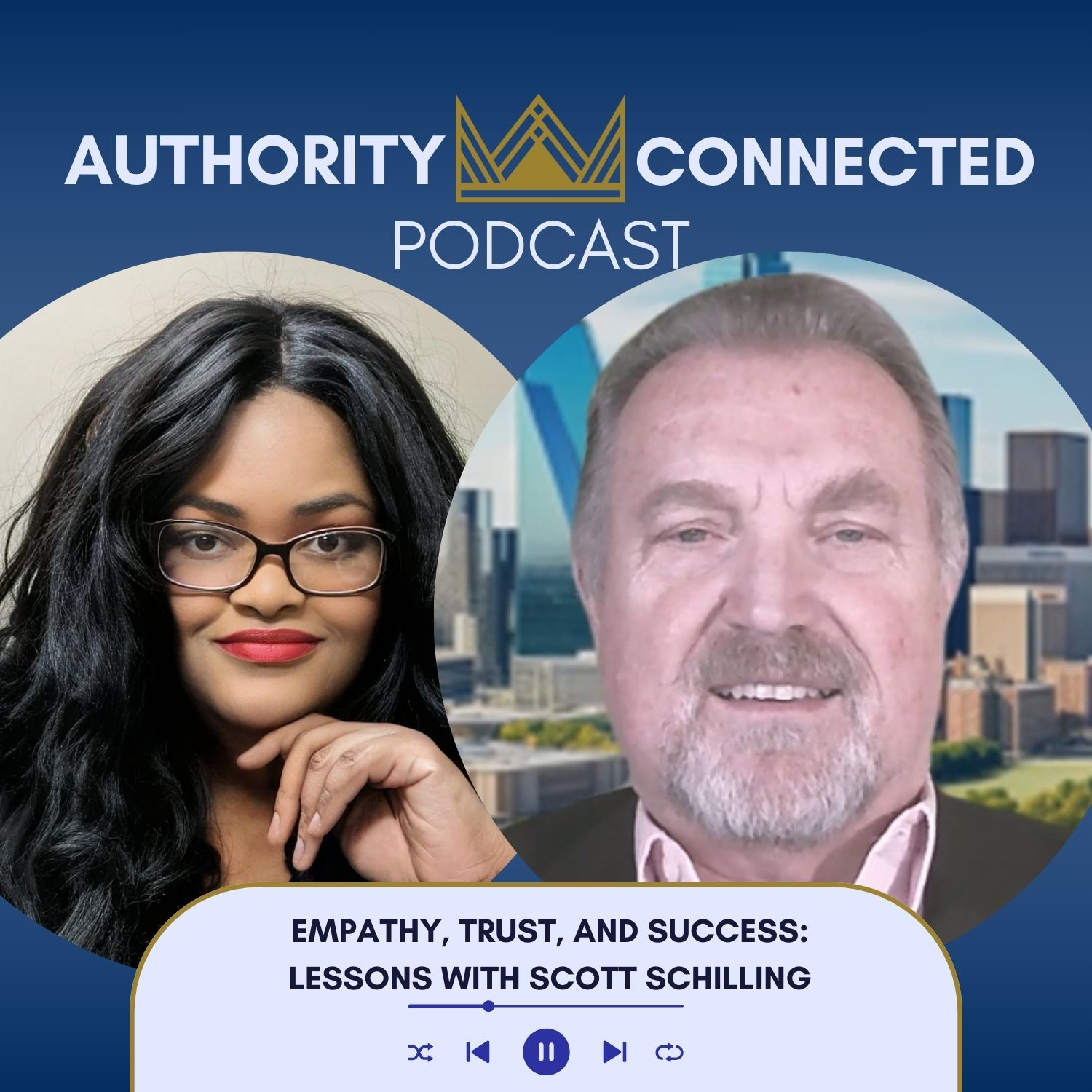

Empathy, Trust, and Success: Lessons with Scott Schilling
Authority Connected with Burlingtina
| Burlingtina Vines, Scott Schilling | Rating 0 (0) (0) |
| http://authorityconnected.com/ | Launched: Nov 27, 2024 |
| burlingtina@authorityconnected.com | Season: 2 Episode: 2 |
Empathy, Trust, and Success: Lessons with Scott Schilling
Empathy, Trust, and Success: Lessons with Scott Schilling
In this episode, we bring you Scott Schilling, known as the Authentic Connector, an international speaker, trainer, media host, executive coach, and consultant with over 35 years of experience. Scott shares his insights on building authentic relationships, emphasizing the importance of respect, honor, and dignity. He provides valuable advice on the significance of empathy, effective communication, and the cycles of learning and growth in entrepreneurship. The conversation covers topics such as building trust, the role of vulnerability in relationships, and setting boundaries while maintaining authenticity. Scott also offers a special free gift: his book 'Talking with Giants,' highlighting stories of perseverance and generosity.
Free Gift: https://TWGfreegift.com
Authority Connected: https://www.authorityconnected.com/
00:00 Introduction
01:14 Guest Welcome
01:22 Life Lessons and Seasons of Growth
03:56 Building Authentic Relationships
06:39 The Importance of Trust in Business
10:12 Empathy vs. Sympathy
12:51 Effective Communication Strategies
16:56 Setting Boundaries in Communication
18:22 Building Trust in Business Relationships
18:55 The Importance of Fun in Relationships
19:33 Setting Boundaries in Conversations
20:16 The Impact of Past Actions on Present Outcomes
20:38 Authentic Communication and Sales Tactics
24:35 Sharing Personal Stories and Experiences
26:53 Faith and Courage in Public Speaking
29:31 Empathy and Understanding Others
31:23 Free Gift: Talking with Giants
34:31 Final Thoughts and Encouragement

SHARE EPISODE
SUBSCRIBE
Episode Chapters
Empathy, Trust, and Success: Lessons with Scott Schilling
In this episode, we bring you Scott Schilling, known as the Authentic Connector, an international speaker, trainer, media host, executive coach, and consultant with over 35 years of experience. Scott shares his insights on building authentic relationships, emphasizing the importance of respect, honor, and dignity. He provides valuable advice on the significance of empathy, effective communication, and the cycles of learning and growth in entrepreneurship. The conversation covers topics such as building trust, the role of vulnerability in relationships, and setting boundaries while maintaining authenticity. Scott also offers a special free gift: his book 'Talking with Giants,' highlighting stories of perseverance and generosity.
Free Gift: https://TWGfreegift.com
Authority Connected: https://www.authorityconnected.com/
00:00 Introduction
01:14 Guest Welcome
01:22 Life Lessons and Seasons of Growth
03:56 Building Authentic Relationships
06:39 The Importance of Trust in Business
10:12 Empathy vs. Sympathy
12:51 Effective Communication Strategies
16:56 Setting Boundaries in Communication
18:22 Building Trust in Business Relationships
18:55 The Importance of Fun in Relationships
19:33 Setting Boundaries in Conversations
20:16 The Impact of Past Actions on Present Outcomes
20:38 Authentic Communication and Sales Tactics
24:35 Sharing Personal Stories and Experiences
26:53 Faith and Courage in Public Speaking
29:31 Empathy and Understanding Others
31:23 Free Gift: Talking with Giants
34:31 Final Thoughts and Encouragement
Empathy, Trust, and Success: Lessons with Scott Schilling
In this episode, we bring you Scott Schilling, known as the Authentic Connector, an international speaker, trainer, media host, executive coach, and consultant with over 35 years of experience. Scott shares his insights on building authentic relationships, emphasizing the importance of respect, honor, and dignity. He provides valuable advice on the significance of empathy, effective communication, and the cycles of learning and growth in entrepreneurship. The conversation covers topics such as building trust, the role of vulnerability in relationships, and setting boundaries while maintaining authenticity. Scott also offers a special free gift: his book 'Talking with Giants,' highlighting stories of perseverance and generosity.
Free Gift: https://TWGfreegift.com
Authority Connected: https://www.authorityconnected.com/
00:00 Introduction
01:14 Guest Welcome
01:22 Life Lessons and Seasons of Growth
03:56 Building Authentic Relationships
06:39 The Importance of Trust in Business
10:12 Empathy vs. Sympathy
12:51 Effective Communication Strategies
16:56 Setting Boundaries in Communication
18:22 Building Trust in Business Relationships
18:55 The Importance of Fun in Relationships
19:33 Setting Boundaries in Conversations
20:16 The Impact of Past Actions on Present Outcomes
20:38 Authentic Communication and Sales Tactics
24:35 Sharing Personal Stories and Experiences
26:53 Faith and Courage in Public Speaking
29:31 Empathy and Understanding Others
31:23 Free Gift: Talking with Giants
34:31 Final Thoughts and Encouragement
Empathy, Trust, and Success: Lessons with Scott Schilling
Join us in today's enlightening episode of Authority Connected with Burlingtina as we dive deep into the essence of authentic relationships with Scott Schilling, the Authentic Connector. With over 35 years of experience, Scott has shared stages with legends and has valuable insights to share from his extensive journey as an international speaker, trainer, executive coach, and consultant. From the importance of respect, honor, and dignity to the intricacies of effective communication and empathy, Scott provides actionable advice for creating connections that truly matter. He also shares personal stories, including his near-death experience and the life lessons he's learned along the way. Don't miss the chance to download Scott's free book, 'Talking with Giants,' to get more inspiring insights and tips.
Free Gift: https://TWGfreegift.com
Authority Connected: https://www.authorityconnected.com/
Empathy, Trust, and Success: Lessons with Scott Schilling
Scott Schilling: You can have everything in life you want when you help enough other people get what they want.
We don't have to agree on everything, but we do need to respect each other.
Honor each other, lift each other up, and therefore dignity now comes into place.
Communication is a, Literally a two way street and the good Lord is on our side. He gave us two ears and one mouth. We should be listening twice as much as we're talking. If you buy something, you're making the decision.
That's the way it should be. It's for you to solve your challenges.
Entrepreneurs, get ready for a treat because today we're bringing in none other than Scott Schilling. Known as the Authentic Connector, Scott's an international speaker, trainer, media host, executive coach, and consultant with over 35 years of experience in coaching, sales, marketing, and training. Having shared the stage with legends like General Colin Powell, Suze Orman, and Les Brown in over 3, 000 events, Scott knows how to captivate and deliver the goods.
Tune in for a conversation packed with insights from Scott's incredible journey and his tried and true advice for creating meaningful connections that drive real results.
Burlingtina Vines: It's a pleasure to have you today with us, Scott.
Scott Schilling: I'm honored to be here. I'm looking forward to this.
We're going to have some fun.
Burlingtina Vines: I'm going to ask you the question I ask everybody.
What is the one thing that you know now that you wish you could go back in time and tell yourself when you first started?
Scott Schilling: When things are really good, they don't stay really good forever.
Get out ahead of it. Utilize the really good to make sure that your life is always really good.
Burlingtina Vines: That's fantastic advice, because like I was saying, it's a content that I'm going to be releasing this week. Is that there are multiple seasons. There's your season of learning when you're learning everything and getting into it, then there's a season of growth when you see it starting to do it, then it's a season to harvest, but you won't be harvesting forever.
Scott Schilling: Well, you got to plant again. I mean, there's a cycle, you know, what's interesting that you just said that because the reality is the process of growing a plant. Is the process of growing virtually everything. And there is a time where you have to plant and you have to seed and you have to weed and you have to water and you have to be patient, which that's hard for some people.
And then you can finally get that harvest and do it again. But, as an example, you know, who would have predicted two hurricanes in the last month?
Burlingtina Vines: True.
Scott Schilling: You know, you just got to be out ahead of it. Fortunately, I'm in Texas. I'm not in that area, but I got a lot of friends that were severely impacted.
Burlingtina Vines: Yeah, that's true. Because the thing is, we never know what's going to happen in our future because we don't have the magical foresight to see, but what we can do is use the resources and time we have to, plan as much as possible. You can't be perfect, but you can at least try.
And it's better to have tried to save up something for a rainy day. And then even if you do have to deal with two hurricanes, floods and damage and everything, at least you got something, at least one of those days,
Scott Schilling: God's plan and timing is perfect. And I used to teach that, rarely could you understand it.
Now I teach, you can never understand it. So just understand that he's got this. And, things are going to be okay.
Burlingtina Vines: Amen to that, because there's no way for us as human beings. We don't have the ability to see everything. We can't see all the, it's not like Dr. Strange on Marvel. He's like, I've seen all these versions and this is the one that's going to make, we can't do that because we can't look and see all the different ways, there's no way for us to know.
So, like you said, you know, we have to go by what the best way we know how to prepare and let God handle the rest of it, because we had to do our part and let him do his part. Yeah. Okay.
So I see right here, you're talking about the importance of creating authentic relationships that matter. And what does that, what does an authentic relationship mean to you?
Scott Schilling: Well, an authentic relationship is exactly that comes out of authenticity. I can't be you. You can't be me. We can only be the best. Us, we can be in authentic relationships are those of, I think sometimes people think these are intellectual tactical things and they're not, they're strategic, relational, heartfelt things.
Authentic relationships are really caring about other people. My platform is really to return respect, honor, and dignity to the planet. We don't have to agree on everything. But we do need to respect each other, honor each other, lift each other up, and therefore dignity now comes into place.
Burlingtina Vines: That's true because you don't have to agree with everybody to treat them well.
No. You don't have to agree on anything. Just be decent to other people. It's not that hard.
Scott Schilling: No, it really isn't. I think people are making it way harder than it needs to be.
Burlingtina Vines: Yeah, you're right. So now I know that, you're the authenticity guy.
And when you say it's important to have real, true and honest authentic in your relationships, what do you mean by that? Like you were saying, it's not intellectuals in your heart. So how can a person start doing that?
Scott Schilling: Well, I think there's a lot of ways.
How many of you know how to smile? It's not that hard, right? So it costs you absolutely nothing. You totally positively impact two lives immediately yours and theirs. And why is it important? Because we're meant to be of service to others. We're meant to be of service to the greater good.
We're meant to lift up other people and support them.
We're supposed to be doing this we're open hands and how can I be of service to support? Because I come out of the Ziegler camp, I was very fortunate to know Zieg, be on the road with him, still friends with the kids, , their kids are, they're my age, but they're kids, they're his kids, Tom and Julie and Cindy, but there was a line in his book, see you at the top that set my path in life.
You can have everything in life you want. When you help enough other people get what they want. You come from a servant heart and a servant leadership position. It's amazing what can happen in your life.
Burlingtina Vines: That's true. You're 100 percent right on that because that's why a lot of people talk about being a servant leader because it's important to, like you said, build up other people because those people will help you create that network.
I looked at some of your work.
You said it's important to build trust quickly. And you said that's foundational for your success. What, what does that mean? What does that look like?
Scott Schilling: Well, as a sales trainer and a sales guy, right? People do business with those they know, like, and trust.
And trust is what is imperative. Well, if they don't know you. They probably don't like you because they don't know you. And if they don't like you, they probably don't trust you, but it's imperative that people trust you to do business with you. Therefore, by definition, you have to build trust ahead of the need for that trust, which means you have to create an authentic relationship.
Where, you know, that's why I say it's not like these techniques are necessarily hard. Can you smile? Well, that gets somebody to maybe know you and then like you a little bit. Boy, I like a happy face. You know, if you're happy, tell your face. Right. Yeah. Have some fun doing what you're doing. Right.
And, and then you can build trust and you have to develop trustworthiness across the time. Now I've been blessed. I've sold 25 million of other people's product from stage, typically in an hour or less. Well, what do you have to do to accomplish that? The first thing you have to do is build trust with a 25, 000 person audience that didn't know you a few minutes earlier.
You have to build trust quickly and efficiently, and people can feel if you're trustworthy and they can also feel if you're not.
Burlingtina Vines: That's true. When people, you know, somebody comes up, like, the used car salesman stereotype, being all sleazy, like, "Hey, you know, let's go ahead." And they're like, yeah, I don't know if I trust you.
You're not giving me the vibe of a trustworthy person. You sound like you're trying to get as much money as possible out of me before I even say hello.
Scott Schilling: Exactly.
Burlingtina Vines: So, yes, it's true. You do need to have that good rapport with a person and build that trust with them, because. If there's nothing trustworthy about you from the beginning, they're not even going to want to give you the time.
Cause like you said, you quickly sold them from the stage. And if in those first 25 minutes, you seem like the sleaziest dude on the planet. They're not going to give you a dollar.
Scott Schilling: I can assure you they shut down immediately. It's about, you know, you've got to build trust. You've got to share a story.
They can embrace. You've got to provide a solution to one of their challenges in life. And then you've got to. Ask them to participate in it. And that's how you accomplish those things. Yes, it's a process, but the more real you are, the more that is you 100 percent of the time. I mean, I get that all the time.
You know, people, I come off stage and they'll go, "man, you're the same guy. You don't change." And I go, yeah, it's too hard to remember how to do something else. This is who I am. This is what I did.
Burlingtina Vines: Yeah. And that comes across here as well, because, you know, when I saw you over at Speaker's Playhouse, I was like, yeah,
I need this guy. So, yeah. And I see that you're presenting that same thing to my audience. So it's a pleasure to have you here.
Scott Schilling: Well, I'm honored.
Burlingtina Vines: Yes. Happy to have you. And so the next thing is, you know, when you talk about empathy and cultivating it at deeper levels, a lot of people know, "well, you know, I'll just be nice to people," but that's not where true empathy is.
Like, you know, you can be nice, but just not just being empathetic. So could you speak some on that?
Scott Schilling: Well, yeah, I think the biggest thing is people confuse empathy and sympathy a lot. Sympathy is "aww, isn't that too bad for them?" And I mean, yes, it's an admirable qualities in the appropriate times.
But it's really the empathy it's stepping into their shoes. It's not you, them separated from you like sympathy. It's you actually step into their shoes. And it's like, how can I help learn and appreciate their situation in a different way that I might come out with a new idea on how to serve that need.
And that's really the stepping into the shoes action, right? You know? One of the things I say in sales training all the time is, is when, when somebody's objecting to something, please don't say, "I understand." For a couple reasons, number one. It could be taken as confrontational even though you don't mean it that way.
But number two is, can you really understand? Now that being said, 100% of the time you can say, you know, "I can appreciate your situation."
Burlingtina Vines: Mm-Hmm.
Scott Schilling: "I can appreciate it from my sphere of reference. From what I know about the situation," whatever. And so now we have an opportunity to truly, work with each other, to get to a better place.
Where I can potentially help give an idea for consideration or a solution.
Burlingtina Vines: Yeah, that is a very valuable tip because like you said, a lot of people see, "Oh, I understand where you're coming from" as condescending. They're like, "how can you understand me?" Especially when you're dealing with deescalating customers.
Because, hey, I have a background in critical customer support, a. k. a. the complaints department. And I had a 300 percent retention rate in the complaints department. So, I told my fellow co workers that saying that makes them feel, they're already mad. So, the better thing to do is " you know what, you're right.
It's not fair. We need to solve this." And I like your approach as well, because both approaches come from a solutions area because
Scott Schilling: Yeah. Exactly.
Burlingtina Vines: You can't come to people and be like, "Oh, I totally get where you're coming from. I understand you." And they're like, "Oh, do you really? Do you understand?"
Scott Schilling: "How do you know?"
Burlingtina Vines: Yeah. "Who do you think you are telling me that?" So, yeah, we want to prevent that from happening in our customer interactions and with our clients and people we want to sell to and even network and day to day. So, and once again, that leads to communication.
Like we were just talking about, what way do you feel that effective communication can, like you said, give deeper understanding as well as deepening your relationships?
Scott Schilling: Well, communication is a literally a two way street and the good Lord is on our side. He gave us two ears and one mouth. We should be listening twice as much as we're talking. We many times. Have this tendency of wanting to be right, or the authority or cool or who knows. And so we work to impart things as opposed to really addressing and listening.
It's funny you said that about customer service. I actually had a customer service issue with a company today. I couldn't get to the support department. I finally found another link and I sent it to them and they said, "well, this isn't our area of the company. Go, go reach out to them." I said, "if I could get to them, I wouldn't have gotten to you."
Burlingtina Vines: Oh, my goodness.
Scott Schilling: And so you sit there and you go. Did you, did you read any of the stuff that I sent to you? The point is we live this stuff every day. The question is, do you ever step out of your self and turn into an observer?
I mean, how would you react if you were outside of you listening to you? And how you're presenting things or whatever. So, I mean, I think there's some, you know, I don't ever want to present, I don't want to ever want to sell you anything. I do always want you to buy a lot from me. Therefore it's my responsibility to create that environment for you to want what I have.
Right?
Now you're making the decision. If I sell you something, I'm making the decision. If you buy something, you're making the decision. That's the way it should be. It's for you to solve your challenges. Right? So again, I mean, I think a big part of this, it is communication is truly like one of the questions that I ask right out of the blocks to new people.
"If you could improve one thing in your...," formulaic question, you could improve one thing in your life. What would it be today? If you could improve one thing in your relationship with your kids, what would it be today?
The point is, if I can ask that and now listen, you're going to now open up and share what would serve you the most.
And the communication comes. That I have now heard this and I can now think through critically, evaluate what you said and do something that becomes a value to you because it ain't about me, it's about you.
Burlingtina Vines: Yeah. You're a hundred percent right. Because in marketing and sales, you know, both sides of the coin.
You're not the superstar, the person you're working with, or making a relationship with, they're the superstar. You know, you're there to help them out. You just shine the spotlight on them.
Scott Schilling: That's right.
Burlingtina Vines: A lot of people are like, "I feel so nervous when I'm doing that." As Marie Forleo said, "the spotlight isn't on you. Shine it on them."
So, you know, it's about their wants, their needs, their fears, their desires. And like you said, you know, when you're listening, you can hear that. You can hear their answer. They say, when you ask them what they could improve. And they give you the answer. The answer is in it. That's what you need to use, you know, when you're working with them because you are building them up because that's why they need to see you as indispensable because they won't see that if you just give them one of those instant rate formulaic answers back.
Like, "Oh yeah, well, I understand you're going for that, but over here, my product!"
Scott Schilling: "Let me, let me tell you why I'm the best at this."
Burlingtina Vines: "Yeah. I'm the best one you need. Give me your money!" It's like a conversational stick up. "I said, give me your money! Buy this product!"
Scott Schilling: I love that.
Burlingtina Vines: And then, you know, when there are a lot of people, when you get to be good at communication, a lot of people really want your time. They want your energy.
So it's important to set boundaries. So how do you set boundaries with people who you communicate with and who you serve and, you know, work with?
Scott Schilling: Well, I give everybody the benefit of the doubt. And so I'm actually very easy to get ahold of and work with, you know, whether it be a meeting or whatever.
And we'll have some, we'll start in a conversation. It's the only way we're going to get to know each other. But I mean, it's so funny. I find it hilarious that this woman said, you know, just communicating back and forth, right on, on Facebook says, "I don't understand! That offer was so good. It makes penguins cold feet cold. And, and you're not..." It was this corny, As opposed to try to sell me something, the minute we meet, why don't you ask me a question about my business or my family, or do I have kids or do I like breathing air? You know, you can ask almost anything.
One of the things that I say to people. I don't teach anything I don't use or say myself, right.
But, I'll walk up to somebody and say, "Hey, you know, what's new and exciting in your world?" Well, why would you ask something like that?
Well, let's go back. People do business with those they know, like, and trust. And if I ask about you, you're going to get to know me a little bit better. And you're going to probably like me because you're talking about your favorite subject. You. And so if I say, "what's new and exciting in your world?" And you say, "Oh, nothing," you know? I won't let them get away with that.
Burlingtina Vines: Oh, no.
Scott Schilling: It's like, "oh, come on there. You know, you're doing something new and exciting." "Oh, no, I'm really not." "Well, you must be doing something that's really good because you're not willing."
And so now we're playing, right? We're having fun because that middle part is getting people to like you. People like people who they have fun with.
It's a novel concept, right? I think this is so hard to create relationships and be connected and do all this different stuff. It's really not, it's actually common sense, but the common has left a long time ago, right? That's you know, we, if we have fun with each other, If we honor each other, if we respect each other, all sorts of good things can happen.
And so setting boundaries is now, if you and I got on a call and you went after the jugular immediately, I would shut it down in a second.
But if you're doing, you know, legitimate interrogatories, That's a big word for asking questions, you know, if you were doing that and it was in an appropriate tone and that it felt as if you were really trying to learn about me, we can go on that's the thing that people don't, a concept that I teach pretty much every day.
Today's activity does not determine today's volume.
Today's volume was determined by what you did 30, 60, 90 days ago. Today's activity determines what happens 30, 60, 90 days from now.
Burlingtina Vines: Exactly.
Scott Schilling: If you're not doing enough right now, it's not because of today. It's what you didn't do in the past.
If you don't like where you are today, change what you're doing today for the next little bit.
So that's the same thing with boundaries, right? If you call and are a pest.
You change the boundary if you call and are very nice, as you are, then you open yourself up and you say, how can I be of service to you?
What would serve you in what you're working to do? Because again, I trust that you're going to, there are people in your audience that aren't in my audience.
And we are going to open up to people who need to know us.
Burlingtina Vines: Exactly. Because that's the thing at the end of the day, when you are trying to work with somebody and try to build a boundary, like you said, I get these messages saying the same on Facebook and LinkedIn, the first message, "Hey, don't you want to buy our product? Don't you want to buy this service? Don't you want to do this? It only costs this amount." I'm like, "who are you? Why are you? What is it?"
Scott Schilling: I get, I get this guy who's been trying to sell me this wonderful program. Well, it first started with, "send me a check for 5, 000. And I'll only keep 50 percent of the profits you make from the system I teach you." And I said, "no, thank you." And he's like, "well, how about 3, 000?" "No." "Is it the money you're going to send to me first?" "Well, no, because I'm not going to send you any money first." "Well, is it, you know, can you help me perfect my offer? Is it the 50 percent commission on the backside?" "Why would I help you perfect anything? You're, you're scamming people." And so now the message is, "I've got one guy that made 250, 000, one guy that made 400, 000 with this system so far." " I'd encourage you to go work with them. They seem to be doing great."
Burlingtina Vines: Exactly. Because you can't hold them at conversational gun point and make them give you money.
Scott Schilling: And then it's the question mark, "how come you're not responding to me quicker?"
Burlingtina Vines: Oh God.
Scott Schilling: Oh, I didn't realize you're the only thing in my world.
Burlingtina Vines: Thank you. I have so many in my inbox. "Did I say the wrong thing?" "Yeah, you did actually". And I'm like the fact and sometimes that they really do it. I'm like, you know what, this is a teaching opportunity.
I'm like, "I'm just going to tell you, I'm not going to tell you what you need to do better, but I'm going to tell you what you did wrong."
Scott Schilling: Yeah, exactly. "That's something you might want to reconsider in the future."
Burlingtina Vines: Yeah. "Like, you're a little too pushy and, I didn't even, all I said was, hello, how you doing?"
And you just said like this much of text. A whole wall about "our product is great and sign up for this." But, I'm like, " okay. See you! Bye!"
Scott Schilling: Exactly. That's why I think people, authentic relationships are, you know, the thing is that you can call people, you can talk to people. You can talk to them a lot, or you can talk to them almost never, but if you leave the last conversation in a good way, the time between conversations can be extended.
You know, if people know your heart, that's what it comes down to.
Burlingtina Vines: Yes. Because knowing your heart is really important for people to understand and build relationships with you.
Scott Schilling: Exactly.
Burlingtina Vines: Like you were saying about building relationships and, to build a good relationship, you have to be vulnerable.
You have to open yourself up. And what would you like to say about that to the audience?
Scott Schilling: You're seeing me. I'm me. I've been blessed to do a lot of things and that and a quarter gets me a quarter. So, you know, the reality is now, did I pick up a ton of skills and a ton of knowledge and expertise and stuff?
Absolutely. But it doesn't make me any better than anybody else. What it does is it makes me more knowledgeable about certain things that I can serve more people with. Right?
And so you've got to be vulnerable and, and that's where, I mean, I was on the speaking circuit. I did 288 talks a year for six years.
I mean, crazy. When you're doing it, you're just doing it. You don't think about it. Then it stops and you go, "what the hell was I thinking?" And, you get to see, you get to meet so many people and truly understand their situations. Right? And I mean, It's funny, it depends on what kind of talk I'm doing, but I actually did one to a Christian, kingdom entrepreneur group in Austin, Texas, a couple of weeks ago, and probably about 12 minutes into the talk, I started to well up and I went, first of all, I just allowed it, it just happened, I didn't plan it, and then I went, "Gosh, somebody could have won the over and under if they would have said, I would have welled up before 15 minutes. I wouldn't know."
Burlingtina Vines: Yeah. Yeah.
Scott Schilling: Know what I'm saying? That's that vulnerability, right? Is be you, it's okay to be emotional. It's okay to let people understand they've got to feel you, you know, and if people can feel your heart in one of the ways, again, I more than likely, if it's by certain talks I do, I mean, I lived through a near death experience.
And that talk, I happened to be talking about that. I said, you know, start, you know, I'm an overachiever. I lived, what can I say? And so I can make fun of it. There are parts of it. You know, when people are sitting there, "we don't understand why you're alive." And they kept on saying that to me. And so I was sharing that portion of the story.
And there are times where that hits me in a way. You know, because it's like, you guys are supposed to, why am I the only one that believes? I said, I got it all figured out.
I said, okay, what is it? I said, it's obvious. It's God's grace, mercy and favor on my life. I said, this isn't me. This is whatever.
And so to be able to share that from stage, I had one woman walk up to me one time and she said, "can I ask you a question?" She said, "I'm a speaker and I've done a lot of talks. But she said, I'm just absolutely amazed."
She goes, "what gives you the courage to lead with your faith?"
And I said, "well, I'm allergic to lightning."
She goes, "what's that mean?" And I said, "I've already lived through one near death experience. I don't need a second one. I worked for one guy and I'm doing the very best I can to be the best representative of human as I can be." And so, you know, I said, I've won 100 percent of my audience is exactly never, or do I ever anticipate I will. All I can do is do the best I can do to share good quality content for other people's consideration. Like it, absorb it. Don't like it. Deflect.
Burlingtina Vines: Exactly. Exactly.
Scott Schilling: I know why I'm doing what I'm doing. I'm here to do what I can to serve other people, including you.
Burlingtina Vines: That's right. Like you said, when it comes to being open and vulnerable and, showing yourself, whether it's your faith or your background or like a lot of people, they're embarrassed about their background or they're embarrassed to talk about their faith.
Like I tell people, whatever led up to this moment made you, you. And if you try to hide that or you try to you know You're being inauthentic. You don't have to be like, "hey everybody today, I had a headache today, but I came over anyway," unless you're gonna make it really funny. But if you don't make it funny, you won't be able to do it because then they'll be saying oh they're complaining like you said Being open about your faith and being open about your near death experience.
My mother had three near death experiences. So I come from a family. I know what that's like, and she praised God every day for it.
Scott Schilling: Well, that's what I, I was part of a compilation book where we had 23 authors. The book is called Second Chances: From Surviving to Thriving. And it's there were a lot of near deaths.
You know, I only had one near death experience. One guy had five. I'm an underachiever. You know, a mom of four kids that got addicted to heroin and then got off of it. Some amazing stories of hope and inspiration and perseverance and all that.
It's what happened to you.
Burlingtina Vines: Yeah.
Scott Schilling: I mean, I've had some really great ups. I've had some really less than great ups. Yeah, you know, it's, but the ups are more fun by the way, just in case you're wondering.
Burlingtina Vines: A hundred percent always!
Scott Schilling: But I truly believe God put me through the less than ups, so that I could be more empathetic with people.
When people say, "well, you couldn't possibly get what I'm going through." You know, do I know exactly what you're going through? Not really, but I think I got a pretty good appreciation for it.
Burlingtina Vines: Because like you said, you don't have to be a cold carbon copy of that person to have empathy for them.
You can step in their shoes without having to literally open their body up and let me get inside your skin. Let me just stand inside. "Oh, wow. Ooh, it really is. Ooh, you're right. It really is bad in here. Ooh, goodness. Ooh. You know, I don't know how we got in here, but yeah, you got some problems. You know, we need to work on this."
So you don't have to have that level of working through it to be able to help somebody to be empathetic with somebody to build a relationship with somebody.
Scott Schilling: Exactly. You just gotta have some want to.
Burlingtina Vines: Yeah.
Scott Schilling: You can learn the rest of the stuff if you want to.
Burlingtina Vines: Exactly. And like you said, you have your, why your reason is your faith and your reason is helping people.
So you got your reason. See, that's the thing. People need their reason to do what they do, because if you go and a lot of people, they'll go, "Oh, I heard so and so, so and so they became successful from doing that. Let me go do it too." And then they go do it. They're like, "nah, that's not me." I'm like, yeah, it didn't work for you because you weren't being true to you.
Scott Schilling: Authenticity, Pete, right?
Burlingtina Vines: Yes. Yes. If you're being authentic to somebody else, You can't. There's only one of them. You can't be them.
Scott Schilling: That's right.
Burlingtina Vines: You have to be you.
Scott Schilling: They already made. Well, and and I share this a fair amount, multiple people can go through the exact same experience and they will live it completely differently, right.
I mean, we just had the hurricanes you can look at storms, you can look at a lot of different things and everybody's experience and takeaway will be different even though they experience the same event.
Burlingtina Vines: That's true.
Well, I see you have a free gift for our audience. Could you tell us more about that free gift?
Scott Schilling: Yeah, it's actually, the full, my first book, Talking with Giants: Powerful Leaders Share Life Lessons. Cynthia Kersey made this impassioned plea to support Habitat for Humanity. And we were in an event, probably 800 people in the audience. And my buddy on one side said, "man, did that hit you?"
I said, absolutely. He goes, "I'm going to write her a big ass check." And he said how much it was. And it was a big ass check. And my other friend on the other side said, "wow, that's pretty amazing. I'm going to write her a check too, but not that big." And they both looked at me and said, "what are you going to do?"
And I said, I can't. And they said, "what do you mean?" And I said, well, I'm in a stock play, you know, this is when I was back in a corporate situation. And I said, I don't have free cash. I mean, my future is bright, but right this second, I can't do that. And they said, "what are you going to do?" I said, I'm going to figure something out.
And what I figured out is that I could write a book, sharing the experience, interviewing, not only Cynthia Kersey to support Habitat for Humanity, but also Jack Canfield, Mark Victor Hanson, Harv Eker, the CEO of Kimberly Clark. I realized that I knew a bunch of really cool people and they all were cool then, but they weren't always cool.
So the story, the stories were kind of like, how'd you go from uncool to cool?
And what I noticed is each one of you has a philanthropic bent to you. You have a desire to give back. So there's 21 charities tied to the book and the book is really generosity builds prosperity, not the other way around. You don't give to prosper, but when you give, you do prosper.
And so it's an encouragement for people to read the stories, see the support, you know, whether it be the American red cross or habitat for humanity or juvenile diabetes or autism society, and, and find something that makes your heart sing and support them, whatever that means for you. Now, if something in the book doesn't, you don't like the 21 that are in there, then find something else.
Oh, then the book did its thing. It's called Talking with Giants. You can go to TWGfreegift.com and download the whole book and, feel free to give it to other people because the only thing I really wanted to do with it is create the environment of giving.
Burlingtina Vines: Well, I think that's fantastic. And I know with all those amazing people showing the insights of their trajectory and how they went from uncool to cool, I know people will be able to find wonderful nuggets of inspiration and ideas.
And once again, we're not encouraging you to copy and paste anybody's life, but we are encouraging you to take insights from it. Because like I always tell people, why reinvent the wheel? If somebody else already made the wheel, look at their wheel and see how you can grow yourself.
Scott Schilling: The model is there.
Burlingtina Vines: And that way you don't have to work yourself to try to figure out everything when you can just use what somebody else did.
So it has been a pleasure to have you. And as always, if anything else you want to leave our wonderful listeners with before we wrap things up.
Scott Schilling: Well, first of all, I want to thank you for the opportunity to be here. This has been fun. I'd love to do it again and, and, we'll figure that out, but.
You know, I just would encourage people we were coming into a time where hopefully people are nicer and, you know, the holidays and thanksgiving and that there's a lot more gratitude and whatever. And just love on people, you know, be nice, be kind, let's return, respect, honor, and dignity to the planet.
Again, we don't have to agree with each other. We don't even have to like each other, but we should respect each other, honor each other, and then dignity is created by all.
Burlingtina Vines: Thank you so very much, Scott. That was Scott Schilling, everybody. It was wonderful to have him. And as always, if you enjoyed what you heard today, go check out his website.
Go get that book. It will be in the description. It's there. Don't act like you don't see it. So go to the website. There will be a transcript. And don't act like you don't see that either. There's also going to be a document you can download with the highlights from this. You can take it home with you.
Once again, it's now, don't act like you don't see it. So if you enjoyed it, please leave your comment if you're watching it on YouTube. And if you're watching it online, what are you waiting for? Sign up to our email, join us so you can get all these great resources and all this information from all our wonderful speakers.
Thank you so much. Scott Schilling, everybody. And once again, thank you for being the listener of Authority Connected with Burlingtina. Have a great day.