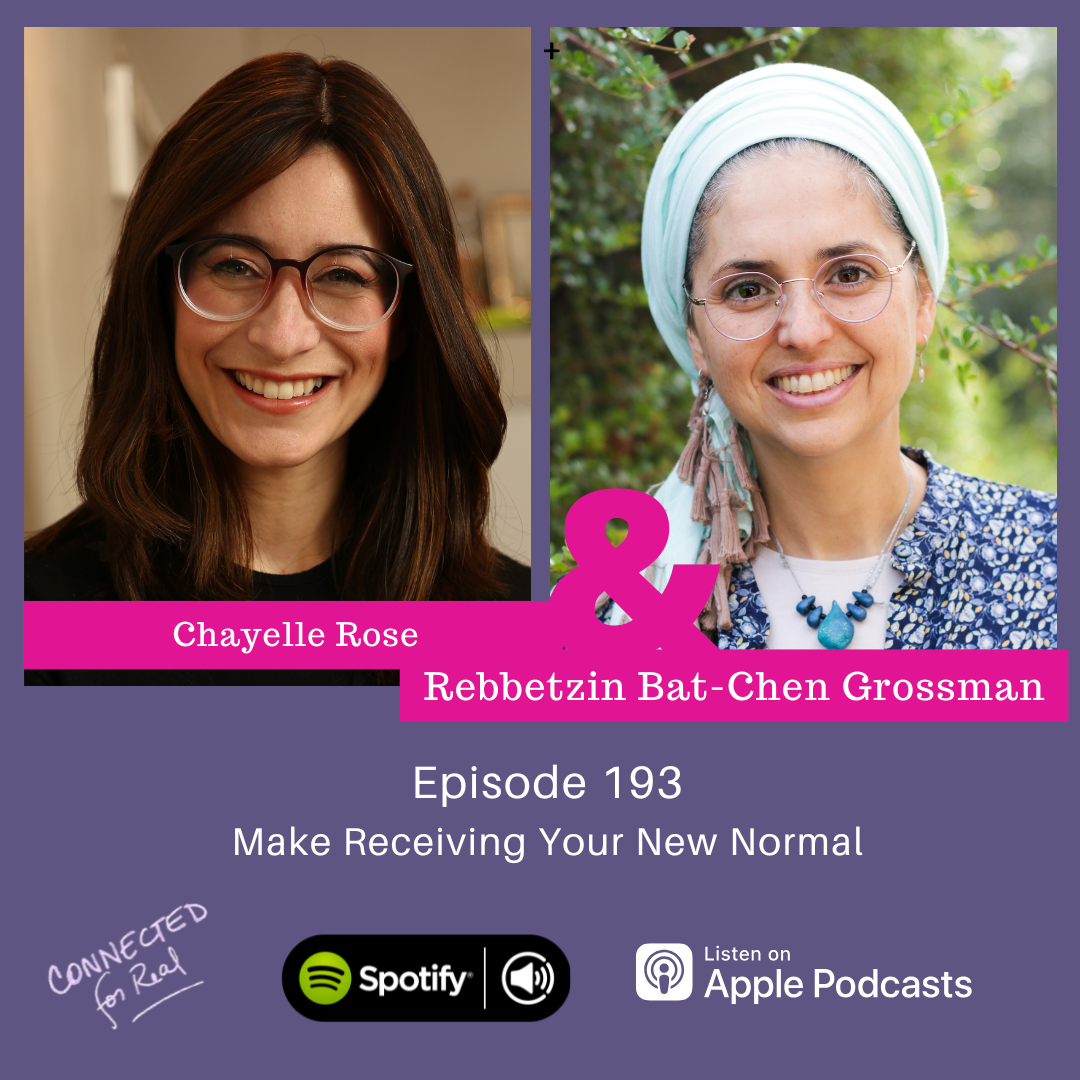
193. Make Receiving Your New Normal
Connected For Real Podcast
| Bat-Chen Grossman | Rating 0 (0) (0) |
| connectedforreal.com | Launched: Jun 30, 2025 |
| advice@connectedforreal.com | Season: 6 Episode: 193 |
Chayelle Rose is a Three Principles Coach who works primarily with moms to find more peace and joy. Rebbetzin Bat-Chen Grossman is a marriage coach for women in business. Together they will talk about Receiving and You.
Links:
Get my free guide to Unravel Ovewhelm HERE
Schedule a discovery call with me HERE
Find Chayelle Rose HERE
SUBSCRIBE

Episode Chapters
Chayelle Rose is a Three Principles Coach who works primarily with moms to find more peace and joy. Rebbetzin Bat-Chen Grossman is a marriage coach for women in business. Together they will talk about Receiving and You.
Links:
Get my free guide to Unravel Ovewhelm HERE
Schedule a discovery call with me HERE
Find Chayelle Rose HERE
Chayelle Rose is a Three Principles Coach who works primarily with moms to find more peace and joy. Rebbetzin Bat-Chen Grossman is a marriage coach for women in business. Together they will talk about Receiving and You.
Welcome to the Connected For Real podcast. I'm Rebbetzin Bat-Chen Grossman, a marriage coach for women in business. And my mission is to bring God's presence into your life, into your marriage and into your business. Let's get started.
And we are live. Welcome everyone to the Connected for Real podcast. I'm Rebbetzin Bat-Chen Grossman. And today with me is Chayelle Rose. And before I, yes. And before I let her introduce herself, I'm just gonna give you a little heads up. We are in the tail end of receiving. So we had receiving and God receiving and marriage, receiving and business.
And this week we are talking about receiving. And you, so Chayelle Rose, introduce yourself and then we'll get right into it.
So my name is Kyla Rose. I am a three principals coach who walks with moms to find more peace and joy. I live in, in, Jerusalem and I give five stars to anyone who actually knows where that is. It's a little bit off the beaten track, and it's basically in between the Shook and Rechavia, those two places, people now. We moved here from Rechavia about six years ago, and it took me a while to become integrated in this place and to really enjoy living here and now I couldn't imagine living anywhere else.
It's just. Gorgeous. Like you, you don't feel like you're in the city. You're surrounded by all types of Jews, all types of people, young, old, like my kids have all these characters in their life. And it's just, I really enjoy it and it's really nice to live there and I really appreciate where Hashem sat me 'cause I definitely didn't choose to come here.
That's amazing. Where'd you come from before that? Where are you originally from? So, I grew up in London. I knew as a child I wasn't gonna live in London. I had no idea where else I was going to live because the only other place I'd been to was Switzerland and I wasn't gonna live in a shallow on a mountain.
So, you know, I, I'd been to like different places in Europe too at a certain point. I hadn't been to Israel until I was 17 years old when I went to seminary, which is rare for a British person. Or Rish. And we had this amazing teacher in seminary that besides for, you know, doing the usual brainwashing, she allowed us to, not even allowed us, created a space that was nothing else to do in that lesson.
It was probably on a Sunday or a Monday to just talk about our experiences over the weekends, even if you didn't have a, a fun shabbas experience, you heard someone else's, it was really clever. And so we got to know all parts of Israel, all parts of Jews in Israel, and the mentality and the culture. And they would teach us a lot about the mentality and the culture so that we weren't just being like, oh, these rude, horrible, strange people who talk in loud voices.
It was just like understanding what makes them tick, understanding what makes them behave a certain way, understanding, and seeing it through completely different eyes. And I literally fell in love with the culture, which I think is super important because people have a lot of different pieces of why they want to come and live in Israel, and then they can't make amends with the culture.
Mm-hmm. And so they're bringing up their kids in, in, in something that they're like, like living in friction with. Right. And it's very jarring. Yeah. Yeah. Have you seen that? It's so beautiful that you're saying that, and I think that your seminary did such a good job by having everyone discuss it in a group setting.
Such an interesting thing. Really? Yeah. I have so many friends who say they would come to Israel if not for the people who live in Israel. Yeah. And personally, you know, most of my family is Israelis, so I find that a little offensive. 'cause I think they're all nice people, but I get what they're saying.
'cause you have the eyes for it. Right? Exactly. Yeah. But I get what they're saying from their perspective. It's just jarring when you don't know anything else. Mm-hmm. And then when you judge it a certain way. So I love that they were able to help you navigate that shift. And that's really, yeah, I think I'm lucky in the sense that once I understand where something comes from, it's anyway much more closer to, to how I like to be in the world.
Like, I liked things straight in my face. I prefer someone tell me like the straight honest truth up to my face. Then I can, you know, talk back about it than like, I. All these, I can't even remember how I used to live, but in England, so you might not know this. Like give an example, right? So when my kids started first having play dates they would say, okay, I wanna go to so and so south.
And I would say, well, you can't, can't call them. They didn't invite you. And they were like, why can't we ask them if we can go to their house? Why? Because I didn't know this until I went to actually parenting classes in Israel with Robertson Bena. And she's like, people in Israel say no, huh? Oh, if they need to say no, they say no.
So you can totally invite yourself to someone's house. 'cause if it isn't good, they'll say no. But when I would talk to my sisters who are raising their kids in London, there's no such thing as inviting yourself to somebody's house. And they reminded me of how I. Had thought to raise my kids. Yeah. You know, that's so beautiful.
And I think it's also, it makes me crazy when my husband says something in a way that's not direct and then I just like ignore it and move on. And he's like, I was being British about it. Go do it or something. And I really do British people really not say what they mean to say, like, is that the thing? So I'm happy you said no because I'm like, I dunno.
How do you live like that? How do you just like hint and wait for someone to like pick up on a hint? There's a lot of like undercurrent and, and, and I'm so out of it now that if my kids ever marry someone from England, I will have to inform my future. I am no longer British. If I say something that sounds rude to you, it's just 'cause I can't remember how, like Right.
I am. I'm not trying to be rude. Yeah. No, and I think it, you know, when I teach boundaries and when I teach women how to ask, part of the lesson is that you have to trust that just like you are an adult, the other person is an adult too. And if you're going to say, Hey, can you this, that, the other, they're allowed to say no.
And that just means they're communicating. It doesn't mean they're being mean. It doesn't mean they don't love you. It doesn't mean they don't care. But when somebody comes from a home where it's not like that, you can't be direct or you can't say no, then wait, what do I do now? Like, where's the permission to ask if you think you're forcing?
Yeah. And so just like before we went live, right? And you're like, how could you do that to them? I'm like, I'm not doing anything. I'm just allowing it. I'm helping that. It, it was, we had this really fun conversation before where it was, it was as if you are assuming. I am making someone do something where in reality I am here to serve and I'm helping them come to a decision.
It's like, poof. A completely different approach to the same exact thing. Yeah. I've always had this dream of wondering if you can somehow, I, I don't think it works, but like, just change a culture a little bit in that way. Like invite a culture to start being more honest. Because it's just so much easier and everything looks simpler that way, you know?
And like you're saying, like, you know, in in family relationships and business relationships in, in all relationships, if you can ask, you can answer. If you can't, then. Just like, you know, I think early on, like in marriage, I learned this, that you have to train each other to be able to say no.
'cause then you can ask and you have to be able to trust each other when there's a no. And you can then communicate without all this angst and all this like worry and wondering. Yeah. Yeah. You know, in my intimacy masterclass I talk about this, that your your no's should be no's, but you're also allowed to say, I don't know.
I'm not ready. I'm not sure. Like there are so many in between Yes and no. Where you can communicate where you're at without giving a definitive answer so that the other person knows if there's what to do about it or if there's nothing to do about it. Right? I was once in a, in a business course where the lady said she was on a Facebook group and one of the men wrote No means, and all the women responded, no means no.
And all the men responded, no means try again. And she thought it was like a sales, you know, group for whatever, like a bunch of salespeople. And she was like, why do the men here know and think, oh, okay, so I'll just try again. Oh, so I'll just push a little more. Oh, okay. So I just need to, you know, give her more options or whatever it is.
And for the women, it was just like, oh no, just has one, one option. Like no means no. And once she was able to see the thread of, oh, all the men said this, and all the women said this, and she was able to bring it back to everyone and say, do you guys realize that when we say the same thing, we're meaning different things.
So we have to really communicate, and we also have to take responsibility for what we meant. So if I say no to someone who's, who's trying to sell me something, they're like, oh, no means that not now, no means that whatever, you know, no means that you don't understand it well enough. I'm gonna try to sell it harder.
If I'm not clear on no means no, then I'm giving them the permission to go ahead and try to sell it. Right? And so it's really up to me also to take responsibility from my no's.
Could you say that last bit again? It's up to you to take responsibility. To take responsibility, to hold your no's, to hold your no's if you're, if, if you're putting down a boundary and someone says, oh, I know from all my other experiences that boundaries are just like warning signs, they're not really red lines.
So I'm just gonna walk over this and see what happens. 'cause I know I'm safe. I know from experience, right? This person lived with all the people who didn't hold boundaries. Your job is to hold your boundary and say, no, no, but this person with this boundary means no. And they're like, no, but that's not what my life has shown me.
Like, you can have two people who have a very different relationship with the word no. And so you can't blame them for being, you know, oh, you have a bad, you know, I don't know. You were around the worst, the wrong people. You don't understand how to live or you don't understand what no means. You're being rude.
You're right. Mm-hmm. Like you were saying, if you come into a culture and say, right. If you come to a culture and say you're wrong, what you are doing is you're not owning your part of your culture. And it's fine that in your culture no means everything else, but No, but I, I want to say no, so I'm gonna hold my, no, it's not their responsibility to respect my No.
The way I want it respected. It's my responsibility to hold my no to the way that I wanna hold it. Mm-hmm. Was that clear? Yeah, that's very cool. And how that intersects in a culture is very interesting because, you know, I talked about like being an Israeli, so to speak, to within a British culture, though I'm not there currently, but like how I would be.
But you know, to the Israelis, I'm the British one, right? So however Israeli I think I am they're going to treat me differently. And so you then it comes to, you know, you can look at it like that and then you can look at it as just people. 'cause we so often like put things in boxes and sometimes there's so many boxes that you just see, forget British, forget Israeli.
We're all just people and we're all gonna have a different understanding of no, all gonna have a different understanding of how to navigate, how to negotiate, how to get something done that we want. If I would bring this back to like what the topic we wanna talk about about receiving. 'cause on your questionnaire you wrote something about how does this factor into marriage?
And the only thing that I could think of was resentment. And I think it comes in here a lot because if we go away from the nos for a second, if we go to receiving in terms of getting stuff, you know, not getting nos, getting yeses, hopefully. But like, let's say in the context of getting help, getting time off you know, I wanna go for a rest.
I wanna just have a break. I'm tired, I'm this, whatever it is, right? You know, we just came from the Pesach break. And I always found breaks to be like, I always used to find them extremely difficult to negotiate time and time off and how, how to, and so I feel like we, we have this myth sometimes that you carry on until you can't anymore.
And when I can't anymore, then I'm finally in a position to receive. I. But then my re Yeah, can you, oh my gosh. Okay. Could we, could you say that again? I'm gonna go and go and go and go, go until I'm like dead and I'm like, okay, fine. Now I can receive help. I think of examples like being sick, right? Like people will only receive help when they're finally like, almost dead, so sick that they can't run the kitchen.
And then it's like, fine, you can make me a meal. But they won't receive the help when they're just needing it or wanting it, even if they would love it. Like, wouldn't it be fun if somebody just made you a meal for no reason? There's where I confess, I don't care about food. I wish I did. I like food. I I'm better than when I was a, you know, growing up, growing up I didn't like food, but I like food now.
I just don't care about it. I. So the certain foods in our house that only my husband will prepare because he cares about food. Mm-hmm. And so what's the point in someone not caring about food? Throwing it in the oven and ruining it? Although I can make nice meals, I do make nice meals. Like I, I come from a completely different angle when I make food.
It comes from like wanting to nourish my family, but not, Ooh, that tastes delicious. Sometimes, sometimes not, never. But it's not like food driven, driven. So it's so interesting when you say that. 'cause me personally, when you use that example, wouldn't it be so nice for me that's natural in this area. And I wonder if everybody has an area, if they really thought about it.
And I'm not saying it, it, it needs to be this way, but I wonder if everyone has an area, an area in their life where it's more natural for them to receive to. So for example, silly things like if my husband's preparing. Like some avocado I'd be like, Ooh, sure. Make me some, like, as a standard. Right? And, and so easy for me to say that 'cause like why wouldn't he, you know?
Right. And like, like you are the good food maker of the house. He doesn't have so much time to do it, but when he's doing it, you know, Right. It doesn't cost him any more time or energy to make an extra, I think finish it does. I'm totally fine with it. Totally. Good. Good usage of his time, energy, this, I'm saying so natural for me.
And sometimes when you see that you have a skill in a certain area, like it makes sense to you now, how about we transfer that to someone where it feels more unnatural? Like maybe he enjoys it less. Right. Maybe he enjoys this thing, that doesn't mean you need it less of him. And can you think of an example, sorry, since you gave the example of him giving you food and making food for you, and it's easy for you to receive because he just does it better and you don't care as much.
Can you think of an example where it's harder for you to receive? Oh, totally. Yeah. So, so an example of that would be more the classic like can you look after the kids now? Right? And because that's typically like, because I, I started out with thinking like what kind of things would've come up when we had vacations?
So that's kind of. I think now, now it could be other people would have the complete opposite examples. Right. Or something completely else. But it was less natural for me to do it. And so for years, I would wait until I absolutely needed it. I couldn't understand the warning signs in my body and, and forget the warning signs it even before you get warning signs it's just normal for a person to want to have 20 minutes, half an hour, an hour, two hours, four hours, who knows, you know, of time allotted to when they can breathe by themselves on a vacation, let's say two to four week period.
Like, why wouldn't that be normal to us to plan that out? Mm-hmm. Why wouldn't that be? And so, when you are not willing or because I think sometimes it takes it takes guts to say you may even have to take time off learning during this vocation period. You may even have to take time off your leisure period. You may even have to, whatever it is. Yes. There's a, you know, getting an example of my life.
Yeah. I had a very hard time praying consistently every single day. That was like the thing for me that I tried since high school, tried to do daily and then I'd fall off good for a while and I'd fall off and on and off and on and off and for years, years, years. And, you know, because I, I, I was a daughter of a rabbi and my father always told me like, you know, it's it women who have children and have a different schedule are not.
Obligated. So don't be so hard on yourself. So I'd be like, yeah, yeah, but I want it, but it's not working out. Okay, so I'll just say this. So I'll just do that. And I was like sort of grabbing at little bits here and there until I was finally pregnant with my number six. So we're talking a lot of years.
Okay. I finally decided that that's it, I'm done. I'm sick of it. I need to own my space I just committed to allowing myself to receive that alone every day. And that's when I was able to break through.
Like that is the beginning of my entire journey, is how interesting. How interesting that that's, that's the package that came in the alone time. And you know what? I think my fine, it makes sense for me to let my husband go hour to pray and study and then come back home and continue our day. He goes again, you know, away for prayer and study and then he comes back.
And even on vacations he has these times and they make sense. No problem with them, you know? Mm-hmm. Except I don't let myself have that, you know? Okay. Now I need a 20 minute break so I could stand and prayer and not be pulled by my skirt. Like, you wanna has something really cute. Yeah. You know who Robertson Alki is?
No. She's probably in her nineties and she is the daughter of Rav Chaim Pinchas Shainbaum and she's got the most wicked sense of humor. She's just hilarious. She says the funniest things. And I once actually picked her up in a car. This is just not intended to say this, this is too good. I picked her up in a car with, with my friend who was driving and we were picking her up to go to her speech, and we'd had the time wrong so she wasn't ready.
And she put her wig on and like, you know, in the back room, whatever. And she came out and she's fussing with it. And she said, why won't it ever do what I want it to do? I said, what do you want it to do? She goes, I don't know, flatter me
like an 80-year-old woman. And so she told us that on Friday night, Friday night she would her mother taught all week. Her mother was a teacher, and her mother would go to bed after she lit the candles. Can you imagine? She didn't sit there praying and saying to him, she went to bed and her father Berg, who was, you know, a worldwide consulted big, big rabbi would come home from prayer.
And the kids were not allowed to wake their mother up. And she said we were starving. 'cause all Friday my mother cooked and if we wanted something to eat, she would say, take a banana. And so all we had to eat was bananas. And so, so we were starving. And she said, we would be so naughty. We would go into the bathroom, we would make as much noise as we could to try and get her to it, but he would not let us go in and wake her up.
Not, not just us. He would serve the meal. Wow. When she, we take some permission from that, that when she did wake up and even while she's at the meal, he would serve the meal. Mm-hmm. Now, I, I, I don't have like, you know, hundreds of notes if he did it every week or if, or if, like, maybe it was sometime. I have no idea.
I just know this is something he did and people know this. Yeah. And for good reason, we ha we, and I know I've, I went through a long, long, many, many years of, just because of who I was and, and silly ideas I picked up, I did need to bring out that mothering, nurturing, wanting to do those things for my family.
If it just becomes a, well, I don't wanna do this and let's just split, that's not what I'm talking about. But this is how I really boil it down. So at some point when you become a mom, at some point you discover this term self care. Thank goodness teenagers don't have it yet. I think no teenagers have it. It's really beautiful, really beautiful. My daughter, I'm so proud of them. I'm so proud of that.
I have a daughter who comes home, she's excited and she'll, you know, she jumps right in to help because this is like, the hardest words are from to six or whatever. And then at a certain point she's just like, I need to go into my room. And she puts her in bed and just reads a book. I don't know how long.
And then she comes like, okay, I am ready. Sorry. It's cute. Oh my goodness. That's not what I would describe as teenage selfcare, but yes. Wow.
Wow. Okay. Okay. So I discovered this word self care. Okay? And I took it to places. And one day a friend came to visit me. Now I was living in a very old Israeli apartment. Very old, like imagine an old one. Now imagine an even older one. And the floor was like not nice again. Again, imagine a not nice floor, and then imagine an even more not nice floor.
And it was broken and it was uneven, and it was old and it was dirty, and you couldn't do much to make it look decent. But there was a difference when it was cleaner, when it was dirty. And I think it started my obsession that I'm not a neat freak and I'm not a tidiness freak at all. But I really like clean floors.
If nothing else is tidy, I like the floor to be clean. And so one day a friend comes to visit me and, I said, I just did self care. I came home and, and instead of doing this, and I, instead of doing that, and instead of doing the other, cleaned my floor, and now I feel amazing. I, I just really wanted that floor clean.
And she looked at me and she said, no, no, no, that's not called self-care. And she quote you from the Bible of self-care, what self-care really is. And I said, thank you very much. Goodbye. And I showed it to the door. No, maybe not, maybe not. But I did not care that she said that. I understood the point she was making, that cleaning the floor is not a manicure, but you cannot quantify what a manicure does for someone and what a clean floor does for someone.
And that's the moment where I took that phrase and threw it in the bin, and I replaced it with a new phrase over the years, and it's called very, very impactful phrase, be a normal person. Yeah, because if you feel you have to follow this criteria of someone's, or that criteria of someone's, or this definition you are not receiving, you are not receiving the wisdom within you to know what you need right now.
I love that. I love that. You know, by the way, that this week I started, my week after it took out this, the floor cookie. We had a great shot. It was wonderful. The kids were very active and we, I could not stand it floor, and it's so that you talked about your floor, but I went crazy Lady Ready? I cleaned the floor, like I don't clean off it.
And we cleaned it just like it wasn't dirty before, but it was so dirty and I couldn't kill. I was like, but we cleaned out today. What's your problem? I was like and I made a huge thing of, of cleaning solution and I spilled it all over and I'm scratching and I took a knife and I scratched all the sticky stuff and I'm like going at it.
And when I was sweeping it out the door, my husband came and saw black water. It was like gross water. And he is like, how'd you get so much dirt? Like it was washed on Friday. I'm like, no, it wasn't wash like this. And I like, I totally resonate with what you said. It feels so good. This is it. It's when you take responsibility over your sanity.
This is bothering me and it's important enough for me to stop everything and take care of it now and. End of the day, you know, when you narrow life down into again boxes, you know, you and, and you think that all right, these kind of activities are called work. These kind of activities are called leisure.
These kind of activities are called, again, you are so limiting yourself from experiencing the broadness, the broadness, and the depth of life. So could be, you could have a vacation period where you haven't even had thought of having time by yourself because the dynamics of your house are such that you just naturally get to be in your room sometimes by yourself, and you didn't even feel or experience a deficiency in any area.
Or it just doesn't even come on a register on your mind. Such a thing. And then you hear somebody else say something, and this is for sure happened to me, where you hear somebody say something and they are resentful about something and all of a sudden it creeps into your mind like, huh, I don't get that.
And it trips you up into thinking again that this experience means this. I love saying that. I just had a client tell me that she does so much self-care. She feels lazy and guilty for doing all the self-care. Worst thing is care she's doing. She's still feels empty. Yeah. Said to her, has not actually doing the self-care you need, that fills you up doing self care by like all the things you think you should do.
And so you're doing them. I, if it's not filling you up, it's not the self-care you need. I really, I really hate that you say there's this real
openness that happens. Willing to receive the messages from God, from within, from knowing what you really need right now. And the more you lean into that, the more fulfilled you'll be because you'll be filling the thing that you need to be filling as opposed to just doing things you're supposed to be doing.
Mm-hmm. And it's amazing how guided we are when we slow down enough to experience what it feels like. Like I give an example. So
there are times when a person can really feel like a certain thing would be good for them. Okay, so anything so was, I'll give you, I'll just throw in examples, right? So they felt like, oh, there's this retreat coming up and I really wanna go on this retreat and, and blah, blah, blah. Okay. Or just, I wanna take off a day off work for myself.
Or there's this store I've been meaning to go for a long time and I just don't seem to get to go, and I just, I just wanna make this time for myself and go there, whatever. It's mm-hmm. Right? These are very self focused me focused activities. And then what happens next is it doesn't seem to be happening.
Like they, they are, it's not that for lack of trying, but things seem to be coming up in their lives and it doesn't seem to be a good day. Now here's the interesting thing, how do I then approach it? Because if I start believing that I must get this thing to be happy. I must need this thing. I then go on this chasing journey, and there's so many types of chasing journeys.
This is just one example, but as soon as I can get in touch with the fact that I am chasing, there's my sign that I'm going down the path and I've, I veered off the path slightly. Mm. 'cause you're not gonna get anything from chasing, you're either following your wisdom, you're either following that internal guidance that's, that's giving you a little nudge to do something.
But not, because therefore I will be happy, because therefore I will be satiated. Doesn't work like that. It's because it's a good idea to do it. But if it didn't yet become a good idea to do it, and it's just something on the horizon and you're playing with it and you're trying, stay there. Stay playing, stay with it on the horizon, because once you start chasing.
You've left your wisdom, you've left that good feeling that you may never even need it. You may not even be able to get it some of the time. And it's a constant journey of exploring and wondering and working out and being open to change. And it's a very, very, all like, non concrete, non-specific things, but that's exactly what I'm talking about.
The moment you make it too concrete, like, like, yeah, it's not gonna fill you up anymore, but do you feel like there is a procrastination that's happening when something you want isn't happening because you just don't believe you deserve it or you're not worthy of it? Yeah, but that's I'm not describing that type of experience.
Okay. So tell me again what, what you're talking about that's different. I'm talking about. Okay, so if, if, if I would talk about in terms of my own life, just 'cause it's the only life I know intimately. And so I'm going to assume that many people are like this, but not everybody. There was a learning curve, like I already explained about, you know, I discovered the word self-care.
And so there's a learning curve to get in touch with. Ah, those things are coming on my horizon. I'm gonna, I'm gonna hold onto them and, and see if I can make that happen and deal with those feelings, as you said, that, that come up and say, well, why should I? And, and, and we have a million reasons why not.
We're really good. It's always gonna be in line with what you believe. Very tricky. And then you see your mood keeps going down. Then you see. You start getting resentful and you start taking it out on other people. Usually there's one being an adult in your house, you seem to be taking it out on just conveniently there, you know, and there's your sign.
Aha. I need to be taking responsibility for those things that come up in me. Why? 'cause I'm the only one that intimately knows myself as much as we would love our husbands to just sort it all out for us, because, you know, he could make me an avocado. Why can't he also tell me what my dreams are?
Yeah. And so there is that stage for most people where you, you take, you see that you need to take control of your life. So I'm talking before I was talking, really, once you're past that stage, right, you're in that, you're in that stage where you're ready to. Put things on the map and decide that, again, be a normal person.
If I would tell my husband happily to like, my husband's a biker, go on a bike ride, you, you, you need a tap, right? Like go on a bike ride. It's good for you. Like, I happily, you know, go do it. Why would I not treat myself like that? Why am I not a normal person? Be a normal person, right? It becomes so simple.
But again, not in a chasing way. 'cause you can go in the complete extreme opposite direction where now I need to get an iced coffee every day and, and I need jewelry and I need a new wig. Should I stop? No, I'm loving it. I'm loving it and I'm. Why aren't we normal people? Like what is, because you, you know, I love, by the way, you guys should know, Kyla has this great course called bedtime Made Easy, which is where I found her.
And I think she's so awesome and I fell in love with her the way that she explained it and the way that she made it that easy. And because you come from the parenting world, and I come from the marriage world, we're working with the woman, right? We're working with the mom, with the person who is the female head of the household and this character who is so nurturing and so loving.
And the reason why it's so hard for her to get out of the roles where she is mother and wife is because she appreciates those roles very much and she loves them and she prioritizes them, and she doesn't want to take away from them. So there's this thought that if you do something for yourself, it takes away from someone else as opposed to the opposite, which is true, right?
When like when my daughter told me when she was 15, she turned 15 and I asked her for a blessing from, for her birthday. 'cause you know on your birthday you have bless. So I said, give me a blessing. And she said, I bless you that you take a nap every day. And I turned pink and purple and whatever, like I blushed.
I was like, no, that's impossible. That would be so embarrassing. What are people gonna think? And she said, EMA, you don't understand when you take naps. You are an amazing mother and you have patience for us. And everything feels so good. And when you didn't take a nap and you're just sort of like, I need to do this and I need to do that.
And then like you end up. Filling the roles that you need to fill 24 7. We feel it, and it really, really does not serve us as a family. When you're overtired, when you're not at your best, like it is not an embarrassment to nap every day. If anything, you could be really, really proud of taking care of yourself and your family when you go.
So she gave me the speech, which was I, I, to this day for, because the last three and a half years I've been napping every single day almost consistently. And she gave me the permission to do that. She reflected to me that it's not taking away from, it's actually the opposite. It's giving. So why is it so hard for us to be normal people when we are running these lives and growing these beautiful families and businesses and you know, just here.
Doing God's will. Why is it so hard for us to be normal people? You're asking me? Yeah. Hmm. I I even, you know, if you're listening and you're watching, please let us know what you think.
Hey, before we continue the episode, I want to ask you something. Are you ready to get answers from God directly, feel more in love with your husband and more supported than ever? Run the business of your dreams without having to sacrifice any other part of your life? That is exactly what my one-on-one private coaching is for, and I want to invite you, just you and me.
For a free deep dive discovery call, this is a 60 minute free call where I ask you lots of questions and we extract the three main things that are holding you back. I then put together a personalized plan for you where I create a roadmap of recommendations. With practical steps, the call is free and so valuable in itself.
So go book yours today. Now back to the show.
Okay. So my personal theory, which I forgot about until the second my personal theory, which I'm judging up from the past 'cause it is something I spent many hours thinking about, is that okay.
So I remember as teenagers, a few different conversations we had, which is phenomenal for me to remember stuff from teenage well done. I remember us having these kind of teenage discussions. I. Where we knew everything about the world, right? And so we get to also complain with everything about what's wrong with the world and the systems that we're living in.
And so one of the things I remember us talking about was the, the schools don't really teach us how to become mothers. And as a mother I realized, oh, you can't learn in school how to become a mother 'cause it's the wrong setting. Like it just can't forget it. And then I thought, okay, is there any way to learn?
And then I realized, ah, you kind of have to learn in the home of it. Those are the, that's the setting to have, to learn some of the skills, right? For example, your 15-year-old. Wow. Like how amazingly mature and in tune of how to say that. And by the way, I think that's another Israeli thing. I don't think British people will talk to their mothers like that.
It's really interesting and like we, we have these, yeah, it's different. And
so in that kind of setting, she can see what it takes to become a mother. She can also help you and get the skills in helping. But what so often happens in the way, just like modern life is created and also just for some reason the way we approach teenagers is we handle them with so much care that they're so fragile, that like, heaven forbid, like, you know, to ask them to do something.
So many, many, many people grow up, get married with zero, zero skills in, in any kind of motherhood related area. So they get thrown in a deep end and then. They have to learn. And it's really hard now, my mother was amazing. I was the youngest in my family, so I didn't, I just naturally didn't have to do that much.
You know, I laid the table, I emptied the dishwasher, I cleaned the sinks, probably not much else 'cause I was useless and a bookworm. So, so I read, so what you just said is, is like my most helpful one is, and she fills it and she up okay. Up it's like, and she's a bookworm. So, yeah. So the final piece is you, you, you get thrown in at the deep end.
And you have to go from zero to 100. You have to look after a home, you have to look after a husband. You have to cook the meals. And, and hopefully you wanna on some level because, because. You, you think it's a good thing to do. It doesn't mean you're gonna like it, and it doesn't mean you're gonna be good at it.
And it doesn't mean you're gonna have not gonna have tremendous struggles because this is totally new. And anything new, you're gonna have tremendous struggles with, you know, on every level. And okay, so you get to grips with that and you, you go from zero to 100 of being totally devoted to foster husband and then hopefully a baby.
And I had no idea how to take care of myself and a baby. No idea. So I did, I did my best to take off to my baby to take care of him. I really didn't take care of myself, didn't eat properly, didn't sleep properly. I, I didn't make sure to get, you know, like social to socialize even though, you know, I love socializing, but I just didn't prioritize.
It just, I just didn't know how I have the skills. I didn't have the. Understanding of how important it was, you know? And also probably didn't need it half the time. You know, you, you, you, you're learning to live with a new person. You're still learning even when you have a baby and, and you're enjoying that fine.
So, you know, you'd seesawing the whole time. You know, you go from selfish to, for lack of a better word, selfish to, to completely devoted, and then you gotta swing back to somewhere in the middle. So to me, that's, that's why
No, I love that. We have a listener who gave a whole, a whole explanation. You know, she says, as you said, since we're so much in the role of nurturing others, even Robinson Batan only allowed herself once. Her daughter gave her permission and explained how it, it's better for her, and those she nurtures. So.
I love that you picked up on that, that I'm also human and that I am not, you know, I wasn't born able to give everybody advice about what to do just because I know it's because I had to experience it and learn to receive and learn to let myself be human and, you know, be a person which I love you say 'cause like it makes it.
So if you wanna do something, then do it. And if you are not sure how to do it right now, figure out when you can do it. And somebody, one of my guests said that when you have a baby, you are actually in masculine energy because you're giving and you turn into a giver. And so it's really interesting that you're most feminine when you're receiving.
And the roles that we see as feminine actually take you away from your superpower, which is receiving. And it's your responsibility to, like you said, swing back into that feminine, even within those masculine roles in your life. And so this is really interesting. You just reminded me of it when you were speaking like, I'm taking care of a newborn baby, therefore I am a hundred percent a giver.
And that's the male superpower, right? Like it's, oh, my daughter said something I just remembered. Okay. Same daughter now she's 18 and a half and she's studying full-time and she's also serving in, in the Israeli education system. And she said something beautiful that has to do with this. And I'm trying to remember what the actual concept.
That she was explaining was, but basically she says, why is the advice to men to give? Like you need to give to your wife, you need to give to, you know, whatever the world is. Because their automatic is to think of themselves. And so giving will take them out of their automatic, and women, their automatic is to give, and so they have to learn to receive.
Now, when you can tap into that, then you're in alignment because receiving is the actual feminine superpower and giving is the masculine superpower. So even though it comes easier for the other one, when you tap into it, you open up massive. Openings of, of abundance. It's just everything starts to flow.
Yeah. It's, and now I have the, now I feel like I have to call her and be like, what was that thing? Like what's the that's the missing piece. Yeah. But it's, so I love what you said. 'cause it's so symbiotic all here to join together cohesively and become a unit, and, and the closer we come to Mashiach's times, the more these things become more and more apparent, the more they become available in the world.
And it's part of common culture as well. And so it's so symbiotic. It's so flowing into the other one that I'm helping you with your what You are not good at, you're helping me with what I'm not good at, and then we are both getting what we need. Right. Not from place of resentment, from a place and desperation, but from a place of, I'm receiving the wisdom to know that this is what's necessary and now my job is to step up, confront, and face that, and perhaps push through a comfort zone.
Right? Not hard. Once you, once you are, once you see that, that's what it is, all I need to do is push through that comfort zone slightly. Wow. We're all much happier for it, right? Everyone? Yeah. And notice that a lot of what's stopping us from receiving is our thoughts, is our thoughts about it. It's what are people going to say, what am I going to look like to others?
It's like, I'm going to seem a certain way, I'm going to be judged for it. It's really not about the thing itself. Mm-hmm. Right? Like, you know, this is what you want. It's not a question. It's really just getting over the noise.
And it takes just a moment of slowing down and just ignoring all that and letting it out of your head. And then you're left with just simple, basic, what do I want, what do I need? Like, what's next?
So what is next? Let's wrap it up for the listeners who are, you know, we went a lot of different directions and we're, we're just, this is so fun. 'cause I, I'm just like, Ugh, I love talking to you. Same. How, how can we practically, you know, the listener is sitting here going, wow, this was so fun to listen to.
But like, how do I. Receive more in my life. How do I lean into receiving in a way that I can fill myself up and create space for others to be around me and really open up that wealth of space connection. So you've gotta be very trusting of what's coming through you, not what's coming through someone else.
And with very, very used to hearing this thing from that person and this thing from that person. I should do it like her and I should do it like that. There is no one path. I told you I was listening to your, your podcast last night with with Hannah Mason. Right. And it was so interesting how you resisted something she had said to you years ago and now she was coming around.
Right. She needed to be where she needed to be on her journey at that point. Right. There's no contradiction there. She was where she needed to be. You were where you needed to be, happened to be. She came back, back to you and she was your teacher at that point and you trusted yourself. And then it was funny because within the same conversation, she said something and I thought to myself, I hear her point.
I'm still where she used to be, and that's where I want to be. Mm-hmm. That's where I'm currently exploring. That's where I'm up to. And that's great. 'cause I'm not on her path. It's not like we're not trying to be like each other. We're trying to be like who we are right now and to get closer and closer to the truth of who we are because that gets covered over, as you said, with all these thoughts.
Hmm. And so the first step is to know it comes through you. I never used to know that it comes through you. You are given wisdom. You are given the power to know what's next. I can't tell you every coach will understand this because a big part of coaching is you help the client unearth what's their desire, what do they wanna do next, because it comes through them and you deeply know that. It's so freeing because you don't even need to have opinions about somebody else 'cause they're pointless.
And so when you know that that's coming through you, you can learn to increase your trust in that and learn to really know that even if I don't know right now, I'll know when I know 'cause it's going to come through me. And then for me, it always comes back to just be a normal person. When you find yourself like getting all twisted around and not knowing and getting worried, like, don't need to engage with all that noise at some point, just be a normal person.
How would you treat someone else if they were saying the same thing? Yeah. And challenge yourself to do that. Yeah, I was going to say, when you said, how would I treat my husband if he asked for that, or when I was in a parenting class, she, you know, one of the women said, my son keeps calling me to say he forgot his lunch and I don't know what to do anymore.
So the teacher said, what would you do if your best friend called you and said, I forgot my lunch, you know? And she's like, well if, you know, if I had the time, then I would go and bring her food. But if I was in the middle of a meeting, I wouldn't. It's like, okay, so treat your kid the same way if you're able to bring, if not not, but like, don't overthink it just because it's your kid, it's human and you know, he forgot his food and it's okay for him.
To learn that sometimes you are available and sometimes you're not. And it doesn't mean anything about you as a mother. I love that. And how you said, you know, the example with your husband, he, he needs a, a drive or a whatever it's called when you ride a bike ride, he needs a ride, ride, a bike ride he needs a bike ride adventure.
Go and do it and then allow yourself to be like, oh, I need a bike ride, or I need a walk in nature, or I need, you know, I just told my husband yesterday, I'm like, I need a date. I need to go somewhere in nature with you alone. You know, because that fills me up. It makes me happy to be with you. It makes me happy to be in nature.
It makes me happy to take a break and just pause everything. It connects me to God when I am in. You know, outdoors land, like it's so fun. So I need that. And I was able to communicate. Now my husband knows exactly what to do to make me happy when I start to like, you know not. Another thing you said about my conversation with Connie Mason that was really beautiful is that you are where you are and she is where she is.
And it's not a linear journey. And I wanna sit there for just a moment because that linear journey that people have in their minds, it's like in business, is very obvious. It's like, while she is ahead of me because she makes more money or she is ahead of me. Oh, because we know. Yeah, exactly. 'cause, 'cause she cracked whatever, you know, I haven't cracked yet.
She has, you know, the messaging figured out and she has the this and then that, whatever. Because it's very easy in the marketing world and the business world to say like, come, I will show you because I'm ahead of you, or come work with me. So what happens is that it ends up being sort of like, you know, my husband makes fun of like the whole business coaching world of like just one big pyramid scheme.
'cause like, I'll show you how to make your first thousand dollars because my coach for 10,000 showed me how to sell those, you know, whatever. And it's like everybody is above the other person and showing them how to get ahead. And so once you're ahead, you can help other people who are below you. That's very linear.
But what happened to me when I, I posted early on in my coaching that, and you know that I was helping women with their marriage. I posted on Facebook and this one lady said to me, who do you think you are? I could be your mother. And I said, what does that have to do with the fact that I can help you have a better marriage?
She says, I'm older than you. I said, I have news for you. Even in 10 years, you will be older than me, right? It's never going to change. I can get older and wiser and more capable of helping you, and you will never give me a chance because you see yourself linearly as more ahead of me. But what happens is when you get out of that linear mentality and you think, I can learn from anyone, I can receive from anyone, I have the capacity to open up and allow the wisdom, the help, the love to come in from anyone.
And now suddenly you've opened yourself up to an amazing world mm-hmm. Where your biggest teachers are, your students. Oh my goodness. Right, right. Which is what we learn when we're in this work where you, you're able to hire people who are below you, who have a specific, you know, expertise or you're able to ask for advice from people who are just on the sides of you.
And you know, the people who are ahead of you aren't actually ahead of you. And we could all learn from each other. This is, it opens up the ability to receive in such a different deep way. And something occurred to me at some point during this conversation or just before, where, when you say the word receiving, I, I always think of God always.
It's just to me that's just, you know, unanimous whatever synonymous. But then we use it with tons of people. And so that's what makes me think that when, when we are receiving from a person, we're still receiving from God. Yes. And that's really encouraging to me. You know, the old classic story of the, the man who stood on the roof of his building and everything's flooding and this, you know, this rescue thing comes by and that rescue thing.
He says, God will help. God will help. And then he drowns and he says, goes, why, why didn't you help? He is like, you didn't see all those people I sent you. Right. And so in a certain way, there's nothing more egoic than thinking, I don't need help. Mm-hmm.
Because you, you don't realize where it's coming from. It's so much bigger. Yeah. Yeah.
I need no help. Roberts and Grossman. Yeah. I can make you a list of all the things you've helped me with in the last few weeks. That's amazing. I love that. Yep. Well, I encourage you and everyone else to schedule a call and talk to me because I love, love helping people. It's like what I am here for. Yeah.
And you've really helped me, you've really helped me setting up my course that I'm just about to launch, which by the time this this goes on, your podcast will be somewhere sitting on my course ready to buy. Awesome. So tell everyone, because we're at time and Exactly now I was gonna ask you, so how can people find you?
So I have an annual program called Present Parenting. I. But what I do, and it's a four month program, but what I do in the interim during my time off is I create mini programs and I absolutely love them. They are so fun and so invigorating and really life changing. Like for, for a short amount of time.
You focus on something and things really shift. And many people who have never done anything and who think this is not for me, and ah, it's gonna be anyway. They join 'cause why not? It's a good time in their lives or this speaks to them or that speaks to them and they are completely blown away with how much a short course can do for them.
So this one's good. I can say that about the bedtime made easy. I was part of that one. Thank you. And and I love it also that you're not like a, you've got an 18-year-old, you're taking a bedtime course. I love that. Are you kidding? I also have a 1-year-old, hello. I have like the entire spectrum of all.
I love that. All the children who don't wanna go to sleep, not just one. So my current one that I'm working on is called Playful Productivity. And it's all about bringing more play into your productivity. So it's on the one hand becoming more productive, but on the other hand, becoming more playful and seeing how that really invigorates your life, invigorates your productivity.
And actually, I. Unchain you from your to-do list, rather than simply focusing, focusing on getting everything done. I love that. I'm in, I'm in people. Please put the link below when we finish with this live so that anybody who's watching this video can join. And we're also going to be putting all the links below on the podcast so that if you are interested in any of Chayelle stuff, make sure to check her out.
What's your website? It's Chayelle rose.com. YE double LE and then you will find all the, all the follow up links from there. Awesome. Yeah. Well, this was fun. Thank you. Same here. Thank you. Thank you for listening and for being with us. To all those who were live. I love this conversation.
I thank God for allowing me to receive so many more awesome people into my life just through this podcast. And I thank God for the listeners who are here to receive what I have to give. So thank you for being here, and make sure you come back next week for another amazing episode. Thank you, Chayelle, for being here, and don't forget to be connected for real.
And that's it! Thank you for listening to the very end. I would love if you can leave a review and subscribe to the podcast. Those are things that tell the algorithm this is a good podcast and make sure to suggest it to others. Wouldn't it be amazing if more people became more connected for real? And now take a moment and think of someone who might benefit from this episode.
Can you share it with them? I am Rebbetzin Bat chen Grossman from connectedforreal. com. Thank you so much for listening and don't forget you can be connected for real.