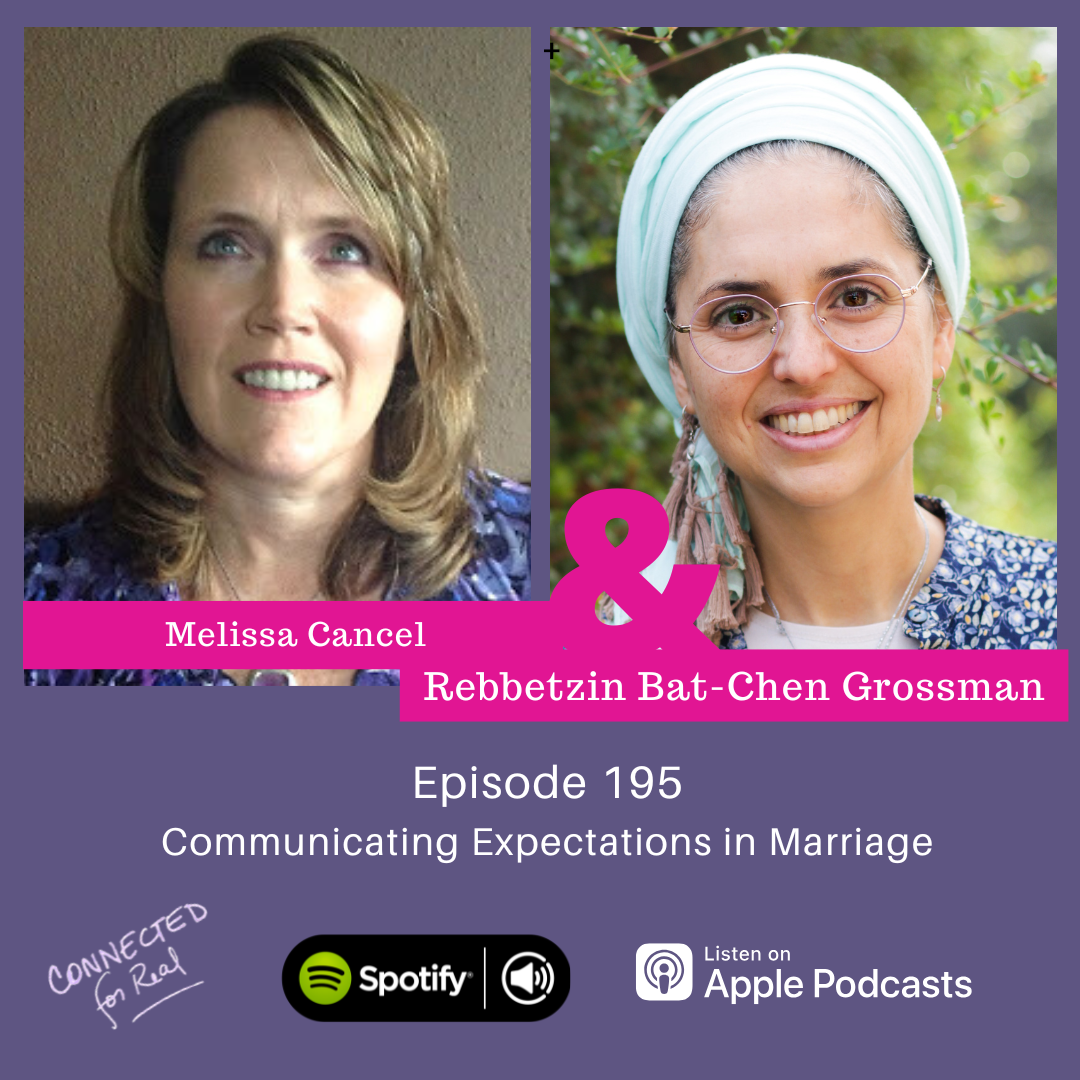
195. Communicating Expectations in Marriage
Connected For Real Podcast
| Bat-Chen Grossman | Rating 0 (0) (0) |
| connectedforreal.com | Launched: Jul 13, 2025 |
| advice@connectedforreal.com | Season: 6 Episode: 195 |
Melissa Cancel has a PhD in communication, 30 years teaching experience, and a healthy, satisfying 18-year marriage still going strong. She started The Communication Doc with a passion to help committed married couples improve communication, cut conflict and achieve the kind of fulfilling marriage they’ve always dreamed of. Rebbetzin Bat-Chen Grossman is a marriage coach for women in business. Join them as they discuss expectations in marriage.
Links:
Get my free guide to Unravel Ovewhelm HERE
Schedule a discovery call with me HERE
Find Melissa Cancel HERE
SUBSCRIBE

Episode Chapters
Melissa Cancel has a PhD in communication, 30 years teaching experience, and a healthy, satisfying 18-year marriage still going strong. She started The Communication Doc with a passion to help committed married couples improve communication, cut conflict and achieve the kind of fulfilling marriage they’ve always dreamed of. Rebbetzin Bat-Chen Grossman is a marriage coach for women in business. Join them as they discuss expectations in marriage.
Links:
Get my free guide to Unravel Ovewhelm HERE
Schedule a discovery call with me HERE
Find Melissa Cancel HERE
Melissa Cancel has a PhD in communication, 30 years teaching experience, and a healthy, satisfying 18-year marriage still going strong. She started The Communication Doc with a passion to help committed married couples improve communication, cut conflict and achieve the kind of fulfilling marriage they’ve always dreamed of. Rebbetzin Bat-Chen Grossman is a marriage coach for women in business. Join them as they discuss expectations in marriage.
Welcome to the Connected For Real podcast. I'm Rebbetzin Bat-Chen Grossman, a marriage coach for women in business. And my mission is to bring God's presence into your life, into your marriage and into your business. Let's get started.
And we are live. Welcome everyone to the Connected for Real podcast. I'm Rebbetzin Bat-Chen Grossman, and today I'm so excited because this is a really good topic. We are talking about expectations and marriage. And with me today is Melissa Cancel and she is going to talk about communication and how we can set expectations and how when we don't set expectations, it affects our marriage.
So let's start with Melissa. Introduce yourself. Thank you. I'm so happy to be here. As she said, my name is Melissa Cancel. I have a PhD in communication and I've been teaching communication courses for 30 years now, which is hard to believe. Recently I decided that I wanted to take what I teach out of the classroom and move it into my own business.
So I recently began the Communication doc, which is primarily focused on helping couples in marriage to not create happy marriages, because I don't believe the idea of Happily Ever After is realistic. But I do believe you can have a healthy marriage through effective communication. So that's really my goal.
Everything related to helping you be able to develop healthy communication in your marriage. So I'm going to add to that I believe in healthy and happy. Yes. Because when you're in a healthy relationship, then you are safe to be happy. Right? Very true. I was meaning more as far as the goal goes. If we only look for happy, then we're going to be disappointed when circumstances create a situation that we don't feel the happiness.
Whereas if we focus on being healthy, as you said, that's perfectly true. We also find out that we're happy. Yes. Yeah. So let's get into it. I think everybody listening here is married and wants to know how to communicate better, how to set expectations. A lot of the women listening are going for big things in their lives.
They want to expand, they want to grow, they want to impact, and they're having. A hard time getting their husbands on board, right? They're like, you know, why can't you just get it? And for some of us, they just don't. So one of the things I talk about is the idea of making sure your expectations are realistic.
So I do think that we need to set expectations and we need to make sure that we're working towards something, but if those expectations are not realistic, especially when it comes to our marriages, we're going to end up frustrated and we're gonna end up frustrating our husbands. So I think there are some aspects of our expectations.
There's some that we basically could say are what's the word I'm looking for? Not assumed, but I guess, I just lost the word, but basically things that we should know that we can be able to expect from our husbands because we're married, you know, they're basically part of like our wedding vows.
For example, I expect my husband to be faithful to me because that's part of our vows. Now I know there are people who have had that violated, and that can be a completely different situation. But there are certain kinds of expectations we have just because we're married, which are part of the marriage relationship, and those are ones that we can assume will be fulfilled.
But we also have to work towards maintaining, and part of having that healthy relationship is going to help maintain those as well. So, for example, if my husband and I are having healthy communication, I'm meeting his needs, he's meeting my needs, both of us are less likely to ever consider trying to get our needs met elsewhere.
Which means it makes it easier for us to be able to fulfill those vows, even though we should never consider breaking the vows in the first place. Right? So those are kind of those expectations that are built into the idea of marriage. Well then there's expectations that are necessary in a marriage relationship for us to be able to function.
Some of those can be more of the things related to our daily functioning. So, for example, I do more of the stuff inside the house to maintain our house, and my husband does more of the stuff outside of the house. That's just how we've negotiated things. So then I can have an expectation that my husband is either going to take care of the yard or he's going to find somebody and pay them to take care of the yard so that it doesn't become a jungle.
If that expectation isn't met, that's something that then we can come back and address and say, okay, we have this agreement. This is my responsibility. This is your responsibility. Your responsibility is not being fulfilled. What can we do to help make sure that that's happening? And then there's another category of expectations, which would be just those desires we have.
So one of the things I always do before when I'm talking to a couple who's considering getting married, is I ask them to make a list of all of the positives and all of the negatives. And you know this, when you're first getting married and you're all starry-eyed, it's, it's sometimes hard to fully acknowledge the negatives because the positives are all filling your eyes.
But I encourage couples to write down both, and especially focus on the negatives and then ask yourself, if this never changes, can I stay in this relationship? And if the answer is yes, then get married. And if it's not, then don't. Because I find that especially for us as women, many of us enter into marriage recognizing some negative aspects of our husbands, but then thinking, oh, well, once we're married, that'll change or I'll change that.
And that's very dangerous because we don't have the capability of changing anybody other than ourselves. Yeah. And when our focus becomes changing, our spouses, and then when we get into the marriage and they don't change, we often feel disillusioned with a marriage or like somehow we've been tricked.
Like I expected this would be different than what it was. And yet if we go back and we look at our relationship and what we knew of our spouses before we got married, if we're honest, we would say, well, he was this way before we got married, so why am I disillusioned now? Well, it's because I had the expectation that once we got married he would change.
And he hasn't. Oh, I think it's a story of everybody's life. It's like, you know, we go in thinking it's fine because he'll grow up or he'll change, or he'll figure out what's important and you know, he'll mature, whatever. And also the other way around, right? Mm-hmm. And then it's like, why, why'd you think that?
Yeah. So I'll give you an example. My husband is a procrastinator and he's been that way for majority of his life. His mother tended towards that. And so, and, and he, his father left when he was very young, so he struggled a lot growing up and that's a tendency that he developed. And I knew that. I knew that when we got married.
I am not a procrastinator, and I will tell you that his procrastination drives me nuts sometimes. But when I get to those places where I'm frustrated with him, I can go back and say, I knew he was this way before we got married. I still chose to marry him anyway. It is not my responsibility to change him.
Now. I can work on changing me, I can work on changing my perspective towards him, but I can't change him. And that's a really important thought process to keep in mind. Now, that's not to say there aren't things that I can't do to help him, and I'll talk about those in a minute, but just that whole idea that I have to accept that I am not able to change anybody else other than myself.
And so when the people around me when my circumstances are not what I want them to be, I can't change a lot of those things. Sometimes I can't change my circumstances. I definitely can't change the people around me. But what I can change is my reaction. My response to those situations and to those people, that's what I have control over.
So I work to keep my thinking correct in that way. And once I've accepted that, then that allows me to say, okay, but we still have an issue here. Let's go back to some of those necessary aspects. His procrastination impacts some necessary things for our functioning in our home. Like I said, the yard, we can't have our yard go crazy.
We live in a subdivision and there are certain regulations about how places are supposed to look. And if you don't keep it up, you're gonna get a nasty note that says, you know, you need to take care of this or else, we can end up taking action against you. That type of thing. So we don't want that to happen.
So, well then how do I approach that? Well then that's a conversation that we need to have to say, okay. What's going on in his life that is making it more challenging for him to fulfill his responsibilities. There can be things going on with work where maybe it's unusually stressful right now for whatever reason or things that maybe he's struggling with personally, and so I can approach him and say, okay, we've, we've got this issue.
The yard is not being done. This is something we know that needs to get done. Usually you're able to, make it work for you that you can get it done. So what's happening right now? And he may not even know. It may take time for him to think about it. For us to be able to have this discussion, and this has happened numerous times then where I will say, okay, I know you've been stressed at work.
I know you're working extra hours. I know you've been sick, whatever the situation is as we discuss, and that's when we get to the point where we say, okay, so what can we do about this? Do we need to hire somebody to do the yard just for now until the other circumstances change and you're able to fulfill that responsibility?
Do we need to transfer that responsibility to somebody else in the family temporarily or what can we do to resolve that issue? And what I've found is if I approach my husband in a discussion to try to resolve the problem, men naturally have a desire to fix things, which is why if you go to a man with a problem, for example, if I go to my husband with a problem I'm having and I I just approach him with a problem, he's likely to interrupt me and try to fix my problem.
So if. I want that, then I just approach him with a problem. But if that's not what I want, I have to actually tell him. I don't want him to fix my problem because that's his natural go-to tendency. So the same thing happens when we're dealing with an issue together. If I approach him with a problem, his tendency is gonna wanna be to fix it.
And I have him come up with solutions rather than me telling him, well, this is what I think we should do to fix it. And the benefit of that is he's much more likely to follow through on solutions he comes up with himself than ones that I try to give him, because now he doesn't feel manipulated. He doesn't feel nagged.
He doesn't feel pressured. All of those things that we often resort to as women, to get our husbands to do things. None of those things are in play. He's come up with his own solutions to a problem that then he can implement and then to help him, because I know he procrastinates, I will ask him, okay, these are the solutions you've come up with.
If you procrastinate on following through with these, how can I help you? And then he's able to tell me, all right, then this is what I want you to do. And then when I follow through with those actions, he can't be upset with me because he told me that's what he wants me to do to help make sure he follows through.
Right. So that's one example. But I hope that that process makes sense. Yeah. So I wanna dive into every single one of these and Okay, talk about it. It's so fascinating what things we expect because that's what we saw, because that's what we thought is, that's how it seems so obvious to us. And then, wait, it's not like that in all the houses.
It's not like this all over the world, like not everybody. And I have a funny story about my own first year of marriage. My family very warm and you know, loving family. We sit down to eat even breakfast, like my mother will cut up vegetables or whatever. We'll take out whatever we take out and eat. You know, yogurt and granola cereal, it doesn't matter.
Everybody's sitting around the table and talking to each other like before the day starts. And. It's pretty much like that for every meal. So if you just come and grab food and sit yourself down, there's something wrong. You know? It's not normal. And that's how I grew up and I saw my grandparents doing it in our family.
It just was, that was the norm. And then I get married and my husband just sits himself down with his bowl of cereal or whatever, and he opens up the newspaper and ignores me completely just reading the newspaper. And I'm like, what is wrong with you? This is so rude. It's so inappropriate. What do you think you're doing?
They're like, I don't know what you want from me. Like, he was so clueless and I was so upset. And I'm sitting there furious. Every time there's a meal, he just takes out whatever he wants, sits himself down, like reads whatever, like, you know. Now it's scrolls. And I'm sitting there going, I feel so invisible.
It's like the most painful, hurtful thing you can do to a newly married wife. Like, what is this? And then a year later our apartment was, you know, was done. We had to move out and we were just going to move to Israel. So it wasn't like we had to find a new apartment. We had like something like a couple of weeks between that place being done and the move.
So we ended up living with my in-laws for a couple of weeks. And for the first time in my life, life I saw an entire family sitting down to eat breakfast. Each one reading his own part in the newspaper and completely not interacting with each other. And I'm sitting there going. What is wrong with all you people, you know?
And the the truth is that they were thinking, what is wrong with you? Because this is normal and this is what we do every single day since we were born. Like why do you want us to do anything differently? But that was the first time in my entire married life that I finally realized that there is nothing wrong with my husband and he's not doing it to hurt my feelings.
And he is not doing it because he doesn't care and he is not doing it because he's not emotionally attached to his blah, blah, blah. Like the whole stories I had, you know, like mm-hmm. Socially awkward or whatever. No, he's just doing it because that's how they do it. And I saw a table full of grown men all sitting around 'cause he's one of four boys, right?
So it's like all these guys and his father are all sitting at the table and they're not interacting and they're not talking to each other and they're all reading. And they're eating their breakfast and they're putting away their stuff and going to work and bye guys. And that, that was the end. Mm-hmm.
Like not what is your plan for today? Not what do you hope for? What are your intentions like? Nothing. No interaction. Yeah. And it made me realize that was the first time. It, it took a long time. Right. You, you're sitting there thinking for an entire year there is something wrong with your husband and then you find out, no, there is nothing wrong with my husband.
Yeah. And yeah, exactly. And that's the thing with marriage, because we come from different, even if it's the same culture, just how you were raised in your family gender makes a difference. That's one thing that even came to mind when you were talking about that. And you mentioned that he had a whole family of boys, men perceive that they build relationships, doing things side by side.
So if you were to ask them, does sitting at the the table, reading your own paper next to each other. Make you feel like you're a family. They would say, oh yeah, we feel really connected because they're doing something next to each other. They don't have to talk. But for us as women, we feel connected when we are face to face and we communicate.
So I don't know. Did you have any siblings? Yeah, we're also four, but we're two and two. Two and two. Yeah. Yeah. So your parents, of course, that's the family interaction, that they set up that component. But for you, especially as a female and probably for your sister, that was really a point of you guys connecting during the day.
Your brothers probably are used to it, but maybe don't feel the same emphasis on that component of your family interaction as you guys do. You know, it's interesting, I never brought it up with my siblings to see now that we're all married, how they interacted with the other types of families. Mm-hmm. I, it would be a really fascinating question to ask them now that we're all grown.
But you know, what really stuck to me was that these are little things that we don't expect to talk about. You know, there are, like you said, there are certain things that when you're dating, you ask, you find out like, what do you wanna do about this? How do you guys deal with this? Whatever it is.
But I never thought to ask, how do you guys eat meals? You know, like, how do you eat breakfast? I don't know. Well, yeah, because there's, they're so integral to how you live your life that you grow up assuming, well, that's how everybody does it. And that's the problem with assumptions, expectations.
We think, well, that's how everybody should do it. And if somebody doesn't do it that way, there's something wrong with them. And we don't ever stop to think, well, wait a minute. Why do I have this assumption? Or why do I have this expectation? And is it actually. Wrong or bad for somebody to have a different assumption or expectation and then to top it off, we don't communicate those, right.
So, so we don't sit down and have that discussion about, okay, this is how I grew up, this is how you grew up, what's our expectation of how we're going to do this together form our own culture in our marriage. Yeah. And you know, you said culture. I think we were dealing with so many other culture shocks that we didn't even know this was anything to address, you know?
Mm-hmm. There is so much that goes into creating your own unit and that, you know, in the Jewish culture, there's something called the first year, because you are that entire first year literally creating from scratch something that is now going to be the foundation of your whole. And usually that first year is a very hard one because it's not something that you expect it to be hard.
You're like, oh, I'm supposed to be like, you know, sort of like flying on cloud nine and having fun. Mm-hmm. And feeling like a queen and yay. And it's like, no. Mm. You know, things are happening. Real life is hitting, and now what? And that's why I go back to that term happily ever after that kind of fairytale version of marriage.
I recently had a young lady say that to me. You know, she's been married for about seven years and she was like, I. I feel like I was duped because all my time growing up with all these fairy tales and all these romantic movies, it was, oh, you get through everything and you get married and it's gonna be happily ever after.
And it's not. It's hard. And I feel like I. Something's wrong. Why are my husband and I not able to get our happily ever after? And I told her, I said, listen, that's not realistic. Marriage is hard. Yes, you can be content, you can have joy, you can even have happiness in your marriage. But that cannot be your goal.
Your goal has to be to make sure that your marriage is healthy, because that is always achievable. I think of happiness as being based on my circumstances. And there are times where my circumstances are not what I want them to be, and I don't feel happy. But just like your physical body. So if my physical body is healthy and I get sick.
I'm still gonna have to deal with that sickness, but my body is better able to overcome the sickness than if my body is unhealthy. And I think of marriage in the same way. If my marriage is unhealthy, then when, for example, we recently, we live in Florida and we recently went through two hurricanes in October.
That was a very stressful time. We have no control over that situation and that kind of stress, those physical storms, not just, you know, right. Emotional storms, but actually physical storms, which create emotional storms can have a very negative impact on a marriage if it's unhealthy. But if it's healthy, you deal with it.
You work through the stress, you work through the fear, you work through the aftermath of, now what, how do we rebuild, how do we keep going after this situation? Yeah. And I mean, we've been seeing it now that COVID has passed long enough. That it really shook people to the core.
So if you didn't have a healthy marriage to begin with, like you weren't working on these skills, you weren't able to communicate openly, you weren't comfortable speaking what you really felt, then these were very hard times for a lot of people. Mm-hmm. Not only did you not have the skills, but then on top of that you were on top of each other.
So everything is exasperated. So we're seeing the effects of that now. You know, after people have tried everything and, you know, tried to fix it and try not to fix it and, you know, I don't care anymore and I do care, whatever. Mm-hmm. Now it's starting to really, you know, show and it's making it that much more obvious for us that the skills are the proactive skills.
Mm-hmm. The things that we need to learn to do, not because we have to, but because. We want to make sure that mm-hmm. Whatever happens, I'm still okay. You know, there's this beautiful Yeah. Question. Why did the orange juice spill? And so the answer is because there was orange juice in the cup.
Right. If there was coffee in the cup, the coffee would've spilled, and if there was tea in the cup, the tea would've spilled. So there's going to be times when your cup is shaken up, but what comes out is what you put in. Mm-hmm. So when you're able to focus and mm-hmm. Fill yourself with skills and tools and the ability to know that you have a support system and who to turn to and whatever, then when things shake up mm-hmm.
Nothing other than what you put in is gonna come out. Yeah. I've heard a very similar example to that. I don't drink coffee, I drink tea. And it's the example of the tea bag. You put a tea bag in cold water and not a lot's gonna happen, but as soon as you put that tea bag in, hot water, what's inside the teabag gets released.
Right? Mm. So very similar idea. And what you were saying about COVID, I remember maybe we were six months into COVID and I heard a news commentator say something about how there were gonna be a lot of divorces happening, and there were already seeing that there was that tendency because of everybody being locked down.
And I thought about it, I hadn't even considered it because. We have a healthy marriage, we get along well. We enjoy being at home together. In fact, even now because of COVID, my husband works from home. I work from home. My son homeschool, we're at home all day long together. But as I started thinking about it, I thought, you know, that does make sense because a lot of couples use work as a means of dealing with an unhealthy or unhappy marriage.
They go away to work and they don't have to be around their spouse. And so then they come back and they can tolerate the time they have to be together. And that allows them to ignore issues and continue to stay in a marriage that is unhealthy, unhappy. But when you don't have that opportunity, and like you said, you're on top of each other, you're stuck together, you don't have an outlet, and that was the result, right?
So, you know, some people do use going out as an escape, but other people go out because that's just how they function. So in COVID, during COVID, my husband actually set himself up a little table and a little chair in our shed. Like, you know, with all of the stuff, he moved everything aside and set himself up a place and continued with his rhythm because to him as a person who's very, very routined and mm-hmm.
And systematic and whatever, he needed to feel that normalness of like, I'm going out, I'm coming in. I'm not around, you know, deal. You guys will figure it out. You've done it before. But it actually was better because he was aware of his needs. Mm-hmm. And that made it possible for us to accommodate that.
Mm-hmm. We were okay with him leaving the house to go outside two, you know, two feet to the shed and. We were okay when he came back and everything was fine. And even more than that, the fact that he was able to communicate his needs made it that other people in the family were able to communicate their needs.
So like for example, I was coaching through COVID, so I would lock myself in the room and everybody else knew that I'm not available right now. And we all just sort of helped each other with our needs. And so it wasn't this like, oh, free for all everybody's together all the time, and now we have to live with each other and deal with each other's crazy, you know, whatever.
It's like, no, we are able to respect each other's space. Mm-hmm. And everybody who, you know, has different needs. The the kids all needed computers for doing Zoom school, which was crazy because how many computers do you have in one house and how many kids do you have in one house? Just for all those who don't know, I have eight kids at the time of COVID, I had six and I was pregnant with number seven.
So it just didn't make any sense. Right. So my kids definitely did not get the schooling according to what the school wanted, but they nevertheless learned a ton because they were around us and they learned skills for, you know, dealing with hard times, which is really important.
Hey, before we continue the episode, I want to ask you something. Are you ready to get answers from God directly, feel more in love with your husband and more supported than ever? Run the business of your dreams without having to sacrifice any other part of your life? That is exactly what my one-on-one private coaching is for, and I want to invite you, just you and me.
For a free deep dive discovery call, this is a 60 minute free call where I ask you lots of questions and we extract the three main things that are holding you back. I then put together a personalized plan for you where I create a roadmap of recommendations. With practical steps, the call is free and so valuable in itself.
So go book yours today. Now back to the show.
And that's a perfect example of using communication to adapt.
Right. We were, in hard circumstances, we didn't have a choice, so we adapt, but we use communication, like you said, to make sure that we express our needs. And that's really. Going back to the expectations, that's really where there's a big issue, is we have these expectations, but we never communicate them.
And so the process that I've set out is to divide out your expectations into different categories. Analyze them, determine, you know, are they, are they realistic? Are they achievable? And then the ones that need to be discussed, you, you've got to sit down and you have to discuss those. You have to communicate your expectations with your spouse.
Otherwise, just like your husband sitting there reading the newspaper, he has no idea what your expectation is. He has no idea that you're feeling like. He's ignoring you and you're alone and, and all of those things you were struggling with your first year. And so that communication of those expectations is so important in a marriage.
And it happens as things continue because our lives continuously change. I'm at the point right now where I'm going through menopause, and so I'm having things happen to me physically that are very different than anything I've ever experienced. And I'm having to communicate those things to my husband to be able to say, okay, you know we can't cuddle in bed at night because I'm having hot flashes all night long.
And so I, you know, I have the cover on and then I have to take the cover off and then I have to put the cover on and I have to take the cover off. And the idea of having anybody near me is like. I, I can't, I just, my body isn't allowing that at the moment. And so that's something where if I wasn't communicating to him what was happening, he would think, oh, she's drawing away from me.
She doesn't wanna be near me. She doesn't want to touch me. And, and that has nothing to do with it. It's something happening in my body and it's something different. And I have to communicate that. You know, I think one of the most important things to bring up in this conversation, especially since the topic is expectations in marriage, is that you can expect that there are going to be unmet expectations.
You know, you can expect that there are going to be a lot of expectations that are just not lining up. And. If you expect that, then when it happens, it's not gonna throw you off, right? Mm-hmm. It's, you know, when, when my husband's sitting down reading his newspaper, I wasn't sitting there crying, being all alone.
I was like, yo, something's weird. You are not acting normal. And he is like, I don't know what you're talking about, but I continue to try and figure out what is going on. Like, why is this not aligned so that I wasn't sitting there allowing it to happen, right? Mm-hmm. But like a lot of my clients are, you know, they're nice people and they don't wanna make a problem and they don't wanna start a fight.
And so it's like, okay, I guess this is just how it is and like I need to. You know, just live with it. Mm-hmm. And so like I get people who tell me, I've come to acceptance of my husband's blah, blah, blah. And I was like, no, you haven't. You're still annoyed. You know, it's like, I accept that this is what God wants for me.
I'm like, no, no, this is not what God wants for you. You have to come to acceptance that like you actually have a voice and you're allowed to speak, right? Mm-hmm. So if you know ahead of time that there's going to be things that are not going to go the way that you expected in your fairytale, you know, fluff, then, then it's not gonna bother you to be like, wait, something's weird.
We gotta talk about this, you know? Yeah. Now I will say, depending on the situation, I do a lot of praying and asking for wisdom. My husband, because of some of his life circumstances and how he was raised with his dad leaving and everything, he is very sensitive to feeling disrespected. Now, I think that's important to all men, but I would say he's amped up on it more than, than what would be average.
And so I have to be very careful when I approach him, how I approach him or else I know it will not be a positive result. So I don't walk around on eggshells around him. But on the other hand, I do spend time. Asking for wisdom, seeking the right timing to, and the right words to approach him in a way that will make sure that he does not feel that I am not respecting of him at the time.
Because if he feels that he's gonna shut down immediately to him, it's almost like all the air has been sucked out of the room and he can't breathe and, and then he cannot function. So there are, and, and all of our, all of us are that way. All of our spouses are gonna be that way. So I think it's a great idea not just to accept, like you said, but also to, to do take time, to ask for wisdom, to, to pray, to think about things in advance, and then use your voice and you'll find that you are going to have a better result than if you say what's on your mind.
Right, and there's, there's a, a Chinese proverb I love that says The open mouth gathers no feet. I don't know if you've heard the phrase, I stuck my foot in my mouth or I said something I shouldn't have said. Well, it's the same idea if I, if I don't speak, I can't stick my foot in my mouth. Now, that doesn't mean I should remain silent.
And I agree with you. There are a lot of people who deal with conflict by clamming up by staying silent. But the problem is they don't really accept it. What they do is what I call gunny sacking. It's, it's like I have this big bag on my back and every time this whatever upsets me, I throw it in that bag and eventually I've had enough and I'm gonna whack my husband with it all at one time, which is impossible to deal with.
You know, a week or a month or two months of problems in one situation where I've just been accepting it supposedly, but now I'm upset and now we're gonna deal with it all at one time. I love how you said a week or a month or two months, I'm sitting there going, some of my clients are in their sixties and they're still talking about the first year when you did this to me.
Right. So, oh my goodness. Yes. There's a lot of baggage. There's a lot of baggage. And it's okay because it's normal. It's the way that we survive. It's the way that we get through things, but also we get to become intentional and want to change things. We can really do it. And I, you know, I like how you said you pray for the knowledge and the wisdom to know what to say, when to say it.
In my method, the Calm method, four Steps to Creating Flow. Step one is connect to yourself. So before step two is ask for abundance, right? So turn to God. But step one is a prerequisite to step two because mm-hmm If you can connect to yourself and know what you want, then you can ask God for it and really ask for the guidance and the wisdom.
But if you don't know what you want, you're gonna turn to God and be like, why is my husband this way? What do you want from me? What am I supposed to do with this? Right? And so you're not really open to hearing answers. You're more like just complaining and, and so, you know, and then step three is listen for the answer where God will give you the guidance and show you what to do and how to do it.
And also be part of the conversation, right? Once you bring God in, he's in. And so it's no longer you against your husband or, you know, trying to get through to him, but more like there's three of us and God is unlimited. So it's really to our advantage that he's here, you know? Yes. Like instead of us trying to figure it out with our limited understanding, how about we tap into this unlimited abilities?
Mm-hmm. And just allow God to show us what other options we're not seeing. And a lot of times the coolest stuff happens when you do that because then Oh, I agree. And because I'm a communication person and because I'm a peacemaker by nature, when there's a problem, I like to think, and
could be my parents, could be my my husband, my son, my kids, whatever. I like to think if I just come up with the right words, that I'll be able to fix this situation. And I know that's my tendency. And what I've tried to start doing, you know, over the many years now, is, is I, like you said, I, I turn to God.
I, I say, okay, now wait a minute. I know again, I can't change anybody. It doesn't matter if I come up with the perfect words. I can't change anybody, but God can. And so I turn to God for the wisdom, the knowledge, and I sometimes I don't speak. There's been many times with my husband, I'm like, all right, God, I'm leaving it in your hands.
And it's amazing that he will change my husband's perspective. But then there's times where. I do feel led to speak, but I've already taken that time to get the wisdom and then when I approach my husband, we're able to work through things, as you said, because God has been involved as opposed to me rushing in, in, in my own strength and ability trying to fix it.
Yeah. You know what's beautiful? You were talking before about the different stages of expectations and, and when you said, you know, I'm in charge of the stuff in the house. My husband's in charge of the stuff out of the house. This is one point where I wanted to like come back to it and really bring it up because a lot of people, I.
Think that, you know, just like we said about the, the breakfast or whatever, like his mother was a perfectionist. She cleaned up. Everything was always neat. There was no shoes on the floor, there was nothing. Everything was perfect. And then we get married, we have a couple kids we're married with like, you know, a, a tornado went through the house and it doesn't matter how much you clean, it does not clean because somebody just walks in, throws their coat, throws their backpack, throws their shoes, runs in, throws a fit, and then you're like left there going, I don't know what to do now.
You know? And then your husband walks in right at that moment and says, why is there mess all over the house? Like, you know, so this is extremely common and. A very important thing to consider. Not even to like, I'm not telling you sit down and have a talk now, but just awareness that it's not because there's something wrong with you more, it's more about his expectations and that he never really thought about them being expectations.
It's just sort of as a given. Mm-hmm. Yes, I, and I agree, and recently I've been experiencing that I'm usually. I, I'm a, I'm a, not a perfectionist per se, but I, I'm actually legally blind. I'm visually impaired, and so it's, it's challenging for me if stuff is all over the floor because I could fall, I could trip.
So I've been, and I've taught our kids to be one of those, you know, just to kind of keep things generally picked up. It's definitely not perfect, but I've noticed lately between teaching full-time and trying to start my own business and then just the normal aspects of life that I'm not doing as good of a job as I used to do, keeping my house cleaned.
And that's been something that I've had to come to an acceptance of number one, that okay, it's, it's livable and that's okay. And thankfully my husband is very gracious. Probably because he procrastinates things. He can't exactly say to me, oh, this isn't done. But he's been very kind to say, you know, I know you have a lot going on and you know, how about if maybe we, we pay to have somebody come in and clean once every, you know, couple months or something just to help you out.
But that's something that we both have had to try to acknowledge. And there again, instead of him just getting upset with me and being like, you know, you're not cleaning, you know, whatever, we're trying to come up with a solution together that looks at the situation and the expectation and has determined now that the expectation, while I could fulfill it before, it's, it's not realistic right now in this phase of our life.
So what can we do to make sure that our house can function? But we're also not frustrating each other with unmet expectations. Yeah. You know, I, well, something I love is, is also when it comes to delegating. You know, like you were saying, what if we can hire someone, and I'm sitting there thinking for, especially for a person who's a procrastinator, having things on autopilot is so helpful because then they don't have to think about them.
So, you know, even just hiring the neighbor kid to always on the first of the month or whatever it is, the first Sunday of every, you know, whatever it is that you set an expectation and then just mm-hmm. Set it and forget it type of thing. Like, yes, whatever it is that needs to happen, let's just make sure it happens.
Not have to make a decision every single time, because the procrastination is going to lead to not making the decision. Yeah. Yes. The next time around. So even if you get help right now, it, it's gonna take you all that energy again to make the decision again. Mm-hmm. So something that has completely changed my life was hiring a girl to come in on Friday for an hour.
And, you know, for us Friday is like hectic because it's right before the Sabbath, everything has to be like, you know, taken care of and done and clean and, and like ready. And just having another person whose sole job is to make sure there's nothing on the floor and that the floors are clean is an amazing, magical gift.
And I taught this to my friends and they all said, no way. I would never get help. That's so like, whoa. And I said, why? You know, like, come on people, you can do it. And there is something about their expectations from themselves mm-hmm. That don't let them create. Flow that, you know, it's almost like I have to figure this out myself.
I have to do it myself. I have to. And what does it mean about me if I don't? And you know, that's something that we have to talk about also when we talk about expectations, is we have expectations of our marriage, of our husband, but we also have expectations of ourselves. Mm-hmm. And sometimes in certain seasons of life and in certain times, it's okay that you're not living up to your own expectations.
Mm-hmm. Yeah. And that was something I had to come to because I definitely had the expectation of myself that I'm going to get this done. I'm very independent. And so as much, in fact, my husband's been talking to me about that lately. We've had to have several discussions because there are some things that I cannot do for myself because of my visual impairment, but there are things that
I struggle with, but I still want to do for myself because I want to maintain my independence. And so a couple times lately he said, you know, why don't you just ask me to do that for you? And I've had to tell him, listen, that's something, yes, it's harder for me to do for myself, but I need to maintain my independence as a disabled person.
There are so many things that I have to have you do for me. The things that I can do for myself, even if they're a little bit harder, I have to be able to do for myself. But at the same time, like you said, I have to be able to accept, alright, if it's gonna take me an hour to do it and it's gonna take my husband five minutes, is it more important that I just meet my own expectation of independence?
Or is it more wise for me to have my husband do it right? And you know, a lot of times it's. I don't have to do it every single time for me to feel independent. Mm-hmm. I can, you know, I can practice every so often, but I can let it go because it's not necessarily serving us right now in this season of life.
Mm-hmm. And, you know, please God, you'll have many years where you can be independent and do the thing and it's fine. But, you know, just being okay with the fact that right now there's a season where I'm not doing this and it's okay. Mm-hmm. Is really amazing. It's freedom. Like when people are looking for all that, all that freedom, it's like, just let yourself be yourself.
Yeah. My mother-in-law gave me a book a number of years ago, which I haven't actually read because I can't read books. But I remember the title. It was I'm not Wonder Woman, but I'm a wonderful woman. Hmm. And I loved that title because we try to be Wonder Women. We try to do everything ourselves, and we put that demand and expectation on ourselves.
And when we don't fulfill that, when we fall short, then we feel like a failure when, you know, really we're not, we're wonderful as God created us with our abilities and our skills and exactly as he designed us. But he never created any of us to do everything, to be everything, to be Wonder Woman doesn't exist, right?
So we have to, to let go of that expectation. And really, God created us to work together to get help from other people, to be part of family units, to be part of communities. And when we don't allow, I. Or accept help from other people, we're robbing them of the blessing of being able to help us. Right, right.
This is so powerful. And you know, when we can let go of the expectations of ourselves, then a lot of times our conversations are a lot smoother. You know? I have a lot of women who aren't excited about home stuff. You know, I don't love cooking, I don't love cleaning, or I just don't have the energy. I like it when I do it, but I'm not consistent at it.
You know, my kids are messing all the time, whatever. So there is a lot of this like, but I have to do it because that's just how and because I have to do it, then I can't do anything else. And I once heard, I don't remember which podcast it was in, maybe it was Denise from chill and Prosper, she said.
One hour of cleaning help. We usually think it's like, okay, one hour will take me, you know, will take an hour off of my mind. But it's actually not true. It's one hour of cleaning help will take a whole week off of my mind. Because until I get to it, until I do it, until, and all the worry about how, and all the story I tell myself about who I am and how this affects my, it's all done.
That's it. You just mm-hmm. Delegate it. Give it to someone else. Yeah. And if you can automate it even better, right? It's just, yeah. It's not necessary for you to hold all the things for you to be amazing at what you do well and think about all the stress that we put on ourselves when we do that. And that stress is going to impact our relationships with our kids, our relationships with our spouses.
Because when we are. All. Mm right? I'm not gonna respond to my kids correctly. I'm not gonna respond to my spouse correctly. So it's not just relieving the pressure off myself and having my house cleaned, it's also getting rid of that stress that's going to make it more challenging for me to be the kind of mother, the kind of spouse that I need to be.
And the other thing I was thinking about with that hour and how it multiplies when I try to clean, I don't have an hour that I can just clean and not have to do. Other things, right? You know, not have to stop and help my son with something, not have to stop and get my husband lunch 'cause he can't come downstairs to get it.
He's on a call or what have you. Whereas that person who comes in, they have that entire hour to do nothing else. So that's also going to magnify that amount of time that they have and have a greater impact than the same hour that I could have cleaning. Oh my gosh. I just think about the girl when she comes in and she picks up all the stuff off the floor and she has absolutely no emotional attachment to any of the stuff.
Right? And so like, she is like, okay, this is garbage. This goes here, this goes there. And I'm like, how did she do that? How did she do that? Because I pick it up and I'm like, oh, I can't stand it. When they put this over here and Oh, why did she put her you know garbage around and what is this? I can't stand this toy.
I think we should get rid of it. And I'm just going on and on and on, and my head is like pounding from ideas and stories and things and she's like, nah, what's whatever? Like, so simple because it's not hers and there's no emotional aspect to the cleanup. Mm-hmm. Because it's really so fascinating to look into this and say like, wow, you know, like, yeah, well it's freeing.
And whether it be cleaning or whether it be, you know, you have. Somebody come in and cook a meal once a week, or whether it be you, you know, you order pre-made meals that you can cook easier or, you know, whatever you can do to simplify those things in your life that create that struggle for you.
Right? Yeah. And you know, I wanna hear what you have to say about this. A lot of women say, but my husband isn't willing to do that. Or it's, you know, he doesn't let me, this is like a very big one, right? Mm-hmm. He doesn't let me do that, so I just have to do it this way because that's what I have to do.
I'm sort of stuck with it. Mm-hmm. How would you say, like, what would be the best way to approach that expectation? I think of it as like, I'm expecting him to say no, so I'm not even gonna ask that. That's in my mind. That's how I see it. And it may be that in the past he has said no, and we assume that that means that's no from that point forward, whereas time and circumstances can change things.
So I would say don't be afraid to ask number one, but number two, make sure that you ask in the right way. It may be that you need to explain the situation and how it's different. Now, it may not be, I recently was asking my husband about something and I thought he might be inclined to say no. And I wanted to give him my reasons.
Well, there's been some times where I start to give him my reasons and he's like, I don't need to know all the reasons, just, just ask. So what I did was I asked, and then I said, and, before you make a decision, if you would like to know my reasons behind it, I will be happy to tell you those. And his response was, oh no, it's fine.
I don't need to know the reasons. And I was like, okay, good. So. Wow. So I think we have to be willing to ask, and we can have reasons, but we may not necessarily even need to use those reasons because our husbands, especially when we have open communication. Now, I will say if you don't have that kind of open communication and you're not in the habit of communicating with your spouse, you have to work on forming that.
And that's gonna be a little bit of a process to get it into play. But the benefit of having that kind of open communication is once you do, then things become a lot easier to talk about, and you and your husband are more connected so that when I go to him to say, I've been really busy and I haven't had time to clean the house like I normally have, could we pay somebody for one hour a week to come in and clean?
He's more likely to say, oh yeah. That's not an issue. But if we haven't been communicating about things and I all of a sudden am wanting him to spend money on something that he doesn't see a need for, now, his response is likely gonna be, well, no. Right. Well, you know, why is it that way? Well, we don't, we don't talk about things normally.
We don't communicate on a regular basis. So you've gotta start somewhere. You have to make sure you start with being respectful, as I said, even though my husband is Uber in that regard, all men really thrive on respect. Yeah. And so you have to approach them in a way that does not assume and does not in any way attack or belittle them as men in any way.
And you have to be willing to accept the answer in a right way, in a respectful way, right? If I ask my husband something, he's in charge of our finances. So if I ask him something and he says, no, we can't afford that, well, I have to be willing to accept and say, okay, well then I need to figure out something else.
You know, is there something I can do maybe in the schedule of our family where I can schedule in time to, you know, have the kids help me with something? Or it could be that when I'm talking with my husband, I say, okay, if we can't do this, I need help. What else would you suggest? And again, put it on him to try to help come up with a solution, right?
Because again, if he comes up with a solution, he's gonna be happy with it. As opposed to if I come up with it and you know, throw it at him, he may or may not. Accept it. Yeah. Yeah. Wow. I, you know, this thing comes up for me a lot especially now that I'm selling my coaching program and I have open doors when women say, but he doesn't believe in coaching or he doesn't believe in getting help, you know, and it's like, so I guess it's no.
And then they just give up on themselves because they bumped into an assumed no. Mm-hmm. And all this is, is really the difference in expectations, the difference in what he thinks you're talking about when you say coaching versus what you are, you know, you've been listening to a lot more about this than he has.
So he barely knows anything. He just knows. You know, whatever he knows. So what would you suggest to somebody who's just feeling really called to get a coach or get help and her husband is just not into it for whatever reason, like really doesn't get why you need help? Like why can't you just figure it out yourself?
Like I can. Yeah. Yeah. Well, for one thing, like I said men like to figure out their own problems and I think that's a tendency why they often don't seek help, whereas it's through. Talking about our problems that we as women figure out solutions, which is why a coach is so helpful, because the coach can listen to me, give me some ideas, give me some suggestions.
But in that process of talking about it, I'm often able to figure out my own solutions or with the assistance of the coach, figure out the solutions. But I would say if you can get your spouse to at least consider some form of coaching or training. So most coaches have free or lower ticket things that they would offer prior to getting involved in a longer, more committed kind of coaching situation.
And I think with, with men, if they can experience something and realize, oh, okay, that was really valuable. There were things that I didn't know it was very practical. That might open them up too. The consideration of something that is more long-term. The other thing I would say is if you approach your husband about coaching and they're completely opposed to it, but they're willing to let you do it, I do think there's benefit in women getting coaching themselves.
Just by the way, I only work with the women. Yeah. I actually think it works much better. So a lot of what I say is, you know, you just have to tell him that this is for you. Mm-hmm. He doesn't have to do anything, and yeah, the results are going to speak for themselves because you're going to, and that's what I was gonna say, right?
That we, we don't think about it because often our focus is on how our husbands need to change, but the marriage is an entire unit. Part of it changing in a positive way is going to change the whole unit. Right now, ideally, both of you are going to change, and that's when we're really gonna get to a healthy marriage.
But again, just like with our physical bodies, if I don't adjust my diet, but I start exercising, there's gonna be positive change, right? I'm not changing everything that needs to change, but I'm changing some component of it. And I think of it that way when, when us as women, when we change our perspectives, it's going to impact how we interact with our husbands, how we respond to them.
They're going to see the difference. They're going to see the positive result. And so if we can say, I really need help and this is going to help me, this is going to help our marriage, this is going to help our children. This is something I need and we don't place it on, you need help. Right. Then I think they would be more likely and as they see positive results and we can say that, you know, you'll see positive results from me doing this experience, and we can even talk about those things.
You know, if, if they're very reluctant, say, okay, can I do it for one month? And then we'll come back and we'll talk about how, how I've changed, how it's helped me, and I want you to pay attention to see what you see has changed in our marriage and we can address it again later and see the positive impact and discuss it.
Yeah. Yeah. I love it. How can people find you? I have a website. It's the communication doc.com. That's do c.com. And I have a free masterclass that talks about. These issues we've discussed, as well as some other common thoughts we have in marriage. There's four total. So the one about expectations, there's one about trying to change your spouse.
The third thought is I'm doing my part in this marriage, but my husband isn't. So kind of that 50 50 type thinking we have in marriage. And then the fourth one has to do with I know what my spouse is thinking and why they do or say what they do. Wow. And I address each of those thoughts and how we can work to change our thinking, but also when there are actually issues, how can we plan to be able to communicate for them in an effective way?
And so when you go to my website, right at the top, you're gonna see a button that says Free masterclass. When you click on that, it's gonna give you access to that masterclass. And there's a workbook that goes along with it. That's amazing. Yes. Thank you so much for coming. Thank you. To all our listeners.
This has been so fascinating. And you know, I feel like I just wanna keep talking and to keep bringing up all the different options because there's so much that we could talk about with this topic, but I, I am really happy with the way it went and mm-hmm. And I feel like we, you know, somebody listening must have heard something that started to get them thinking and sometimes it's just a story or an idea or an example and it's like, oh yeah, that's why.
So, you know, I'd love to hear your feedback. If you're a listener, let me know what resonated and you can always reach out to Melissa at her website and thank you so much. Thank you. I enjoyed this. And we'll have to do it again. Yes, we will. And don't forget to be connected for real.
And that's it! Thank you for listening to the very end. I would love if you can leave a review and subscribe to the podcast. Those are things that tell the algorithm this is a good podcast and make sure to suggest it to others. Wouldn't it be amazing if more people became more connected for real? And now take a moment and think of someone who might benefit from this episode.
Can you share it with them? I am Robinson Bat chen Grossman from connectedforreal. com. Thank you so much for listening and don't forget you can be connected for real.