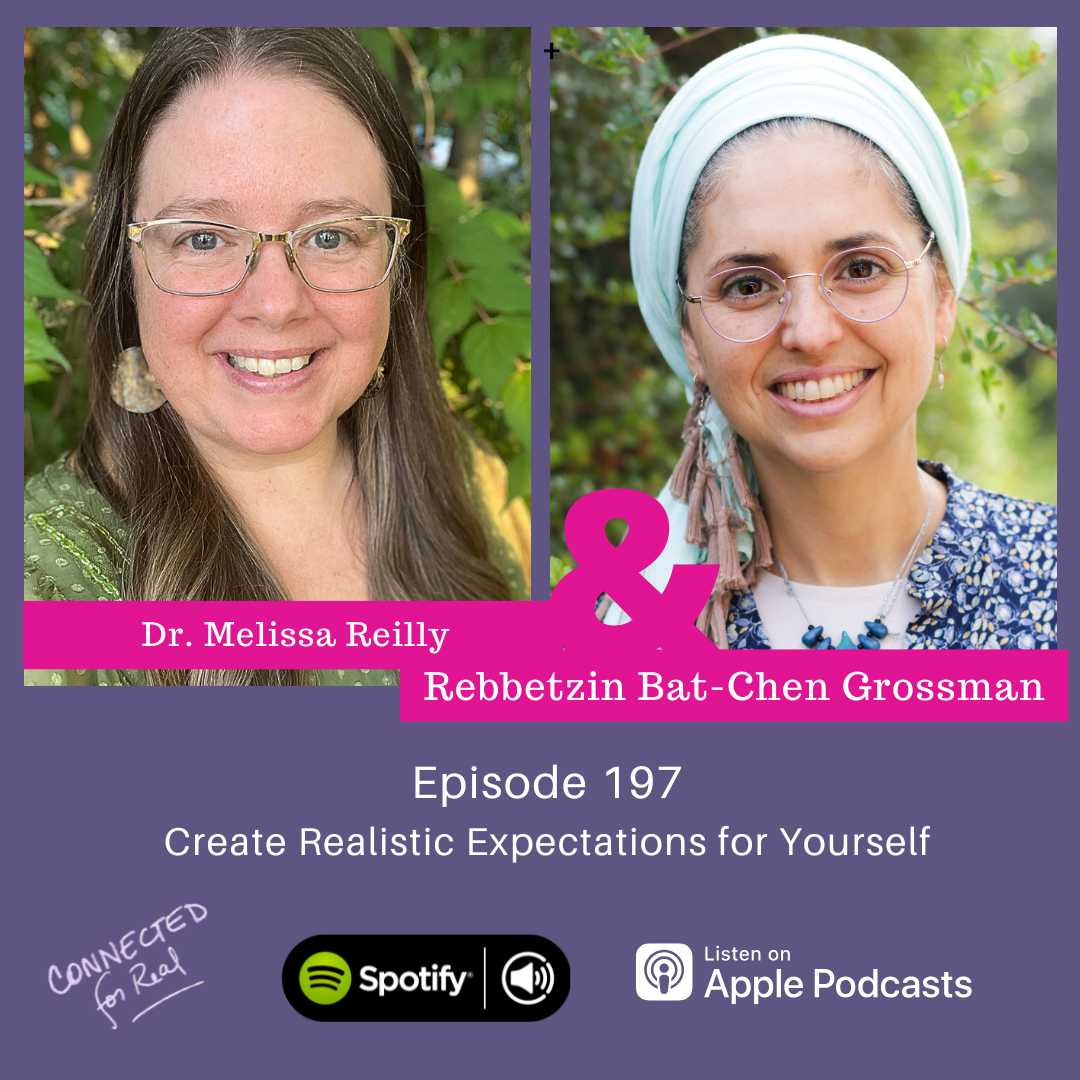
197. Create Realistic Expectations for Yourself
Connected For Real Podcast
| Bat-Chen Grossman | Rating 0 (0) (0) |
| connectedforreal.com | Launched: Jul 27, 2025 |
| advice@connectedforreal.com | Season: 6 Episode: 197 |
Dr. Melissa Reilly is a clinical psychologist, author, and TEDx speaker who combines her personal experience as a mom of two boys and professional expertise to help moms who don't have the support and guidance of a loving mother by their side. With over 25 years in the field, she's designed a personalized coaching program that transforms feelings of loneliness and uncertainty into confidence and resilience. Rebbetzin Bat-Chen Grossman is a marriage coach for women in business. Join them as they talk about expectations and you.
Links:
Get my free guide to Unravel Ovewhelm HERE
Schedule a discovery call with me HERE
Find Dr. Melissa Reilly HERE
SUBSCRIBE

Episode Chapters
Dr. Melissa Reilly is a clinical psychologist, author, and TEDx speaker who combines her personal experience as a mom of two boys and professional expertise to help moms who don't have the support and guidance of a loving mother by their side. With over 25 years in the field, she's designed a personalized coaching program that transforms feelings of loneliness and uncertainty into confidence and resilience. Rebbetzin Bat-Chen Grossman is a marriage coach for women in business. Join them as they talk about expectations and you.
Links:
Get my free guide to Unravel Ovewhelm HERE
Schedule a discovery call with me HERE
Find Dr. Melissa Reilly HERE
Dr. Melissa Reilly is a clinical psychologist, author, and TEDx speaker who combines her personal experience as a mom of two boys and professional expertise to help moms who don't have the support and guidance of a loving mother by their side. With over 25 years in the field, she's designed a personalized coaching program that transforms feelings of loneliness and uncertainty into confidence and resilience. Rebbetzin Bat-Chen Grossman is a marriage coach for women in business. Join them as they talk about expectations and you.
Welcome to the Connected For Real podcast. I'm Rebbetzin Bat-Chen Grossman, a marriage coach for women in business. And my mission is to bring God's presence into your life, into your marriage and into your business. Let's get started.
And we are live. Welcome everyone to the Connected for Real podcast. I'm Rebbetzin Bat-Chen Grossman, and today my mic is not with me. So we are sorry for the difference in sound. If you guys are big listeners around here, you probably will notice, but we'll do our best today with me, I have Dr.
Melissa Riley. Did I say it right? Yes. Great. Yay. And we're talking about expectations, and you and I would love for people to know what you do because they'll understand why I picked you for this specific topic. So, Melissa, introduce yourself. Absolutely. So I am a clinical psychologist and have been one for over 25 years now.
And in the last several years, I've also branched out into a coaching program specifically for moms without a Mom. And I define any woman who's raising her family without the support and guidance of a loving mom by her side as a mom, without a mom. And so today, you and expectations are a perfect topic because for those of you out there who are moms and I know many of you are, we put a lot of expectations on ourselves and in the work that I do with Moms Without a Mom, often those expectations can become even more problematic.
Yes, yes. You know, when I heard what you do, helping Moms Without a Mom, I just stayed. With this look like, wow. You know, like you hit it on the head. And I love how you divined it in such a way that even if you have a living mom, but she lives in a different town or a different country, it still counts because you're really doing it on your own.
And there's so much that we think we know that we don't know, and that we see other people have that we don't have. And there's a lot of that behind the scenes noise that's happening in our heads when. We have certain expectations that aren't being met and we take it on ourselves. It's like, something's wrong with me.
Yes, absolutely. Absolutely. And unfortunately particularly in the Western culture, we have such an expectation that we as moms are able to do it all, not only for ourselves, but for our families. And then if we're, you know, owning a business that we just on our own, make everything work. And biologically speaking, that isn't possible.
We aren't designed to be capable of doing everything on our own, but yet those expectations are out there. And so it becomes really important that we don't accept those expectations for ourselves, that we create ones that are healthier and more accurate. For us to live by, let's get practical. Mm-hmm.
Because we, we like to do that around here. How do we create our own expectations? Aren't expectations something that just like built in, I expect it to be this way and I can't change that. Sure. Absolutely. So if we look at what expectations are, there are beliefs that we have for ourselves and the world, and often we internalize the belief systems that we were raised in.
So that comes from, from parents, it comes from the wider culture and community from which we grew up, and it then becomes our sense of expectation or sense of values and beliefs and so forth. So as we become adults. We now have the ability to reflect and look on what are those expectations and how do they fit within my broader sense of meaning for myself and the world in general.
Now, as children, we don't have the brain capacity to do that reflection or that evaluation. We really are designed to mirror what we see and what we live through. And there's actually a very protective mechanism for us just to simply accept what we are learning from others. Now, in adulthood, we have a fully formed prefrontal cortex, which actually doesn't occur till we're about 25.
But anyway, so when I'm talking about adulthood, I'm really talking about after the age of 25, right? And it's then that we can then make those changes and those differences. But it isn't easy because again, our brain has so many pre-built in mechanisms that make that hard. So there are things like oh gosh, I'm blanking of the name, but there's this bias, right?
Where we will notice things that are consistent with a preexisting belief, right? And it will affirm that. But things that counter a preexisting belief, our brain doesn't notice. It filters it out, right? So it perpetuates. We see what we wanna see and we discount what we don't. All right, so it's so true.
Mm-hmm. Yes. Absolutely. Absolutely. So when we're trying to change our belief system, you know, in today's topic, specifically our expectations, we have to actively do that. And it's not a once and done, it's a repetitive process because actually by doing that, we're growing new neural pathways, you know, so it's, it's amazing.
We can actually change the structure of our brain and the function of our brain simply by doing new things repetitively over time with intention. Right. And so this works really well with my CALM Method. Yes, I have a method that I teach, right? Mm-hmm. So connect to yourself, ask for abundance, listen for the answer.
And then step four is master a higher level of consciousness. And part of that master is being able to find evidence for what you actually want to believe so that you're opening your eyes to the new reality that was always there, but you're training your brain to look for it. So it's fascinating how easily we can do that, but also how hard it is to be intentional because our brain likes to be lazy and wants to just go with the flow and do the whole default thing.
Yes. Yes. And what I find one of the major culprits that get in the way when we start changing our expectations, particularly for ourselves, is the emotion of guilt. So I hear from so many moms when they start prioritizing their self care, they feel guilty. And so guilt as an emotion is like any other emotion.
It is based in our ability to be in community groups, right? So if we think about what is the purpose behind emotion, it's so that we can be social. And if we look at the animal kingdom, you know, mammals particularly higher order mammals, all have a emotion, right? And the higher more complex social groups are the more complex, the emotional emotions are now alligators.
They don't live in groups. They don't have emotion, right? Snakes don't have emotion. They don't live in groups. We as humans. Survive on this planet because we are able to live in community and groups. So our emotions are highly developed. Well, there's a role for guilt, right? So when we are young and we are learning to live within groups, we start doing new things.
And when we do new things, it's the way that people around us treat us, that help us learn, is this appropriate for my group? Is this not appropriate for my group? Right? And, and we just internalize that and that becomes the basis for our sense of, of guilt, okay? Most times guilt. Again, I'm speaking as guilt as an emotion, not the, the, you know, conviction or not conviction of doing something wrong, right?
But the emotion of guilt, right? Most of the time, guilt gets triggered. Anytime we do something that is outside of our norm or comfort zone, it acts as our biological pause button. So it makes us stop and reflect, wait a minute, is this okay? Is this consistent with my conscience and my values? Guilt in and of itself is not an indicator of right or wrong, so I'll repeat that.
I love that guilt. The feeling of guilt is not an indicator of right or wrong. So whenever we are starting to move in a healthy direction, it is normal to experience some feelings of guilt. That is just an indicator that you are doing something outside of your comfort zone. You are pushing your boundaries and it's okay.
Right? So the expectation of. Growing without feeling guilty is just erroneous. It, it doesn't exist. Yes. Aha. So if you're feeling guilt, you're doing something right? Yes. Yes. By all means, right? When that emotion gets triggered, reflect, right. But the vast majority of time you are not behaving in a way that's against your conscience, right?
Hmm. So, you know, I have a silly little example, right? So let's say you are a parent and you are, you know, cooking your family a, a, a meal, but you are not going to share it with your family. You have set up an appointment to go do a yoga class, right? So your family wants you there with them, right?
They want that because they love your company. But you aren't harming them in any way because you are gonna go do your yoga class because you need that to reset. Right? So they're upset. In fact, maybe your little one's crying saying, mommy, please don't go. Right. You're gonna feel guilty. And, and some will even say selfish, right?
Because I am letting my family be on their own while I go to yoga. Right? So you're caring for yourself, even if it's uncomfortable for your family, but you are not causing any kind of harm. Now that's very different than if you didn't provide an opportunity for food for your family, right? And you went out gambling, well, your kids stayed home hungry.
Right? That's something where you are doing something that is to their detriment and has no value to you. Right? Right. See the difference, right? And we as moms sometimes, particularly those that have. Grown up in environments where they are told that their needs come last for a variety of different reasons, right?
When they start prioritizing their care as part of the bigger picture, guilt gets triggered very, very easily. So one of the expectations, I think it's really important that we have of ourselves is that we matter, we are important. We are not less than the people we love and care about. And so that it is appropriate that we care for ourselves equally.
Yeah. You know, I find a lot of times what works is tricking your brain. You know, when they say, when you take care of yourself, you can take care of everyone else. You know, that's a total trick. 'cause in reality, we shouldn't have to talk ourselves into taking care of ourselves, but okay, fine, I'll take care of myself 'cause I have to, you know, for everyone else's sake.
But that's a good way to get yourself into it, but eventually I'd like you to move on to the next level of, oh, I get to take care of myself because I matter. Mm-hmm. And because I, and because I wanna. Absolutely. Absolutely. Another big expectation, you know, is that we should be able to do it by ourselves.
And so particularly moms without a mom, I really work a lot with them with regards to building community and people that they can reach out to for assistance. Now, there's all types of ways that we need assistance, right? We need emotional support. We need somebody to ask questions, right? We need some wisdom, right?
'cause that we aren't born knowing how to parent, right? You mean that, ah. Because like, we wanna be born with it. We're supposed to know exactly what to do. There is this like, you know, this mother instinct that's supposed to kick in and then it doesn't, and you're left hanging because everyone else knows what to do and you're just sitting there going, I don't know.
Right. Well, that's why I got into, you know, this coaching program is, even with my decades of training, education and working with new moms, when I had my son, I was much older. I was almost, you know, I was just day shy of my 38th birthday and I had this, you know, perception that I would be okay, but I struggled so much.
I felt so incompetent. I felt like I didn't know what I was doing and I didn't feel that I had anybody to turn to with my questions or for support. And I felt such intense feelings of shame and isolation. And it took a number of years until I realized after working with you know, continuing to work with moms in my clinical practice, that there were these similarities amongst women like me who didn't have a mom in their life.
Whether it was because she had passed away because she lived far away, or because it was just a toxic, unhealthy, emotional relationship. And so then I started realizing that these expectations we put on ourselves to know everything, to be able to handle everything, to not need assistance in emergencies.
Was really creating a sense of shame and was getting in the way of our parenting. And so, you know, it became really important to me to start talking about, you know, being a mom without a mom and expecting different things because we feel different 'cause we are different. Right? We don't have that built in support.
Yes. We don't have that community that comes with having a, a mother in our life. Yeah. So let's talk about that. What can a person do? I'll tell you what, I live in Israel and there's a lot of women who end up here by choice. Mm-hmm. Because they want to live in Israel and their family lives abroad.
And, you know, there's this like sudden, oh, and I'm all alone. And so, like, you know, you try to make friends with the other ladies who have, you know, nobody around, but you go to the park and you see all these grandmothers helping out and you're like, I wish I had that. What can we do to make it easier besides just believing that we don't have to do it alone.
So what do we do? 'cause we are doing it alone. Right? Well, first and foremost is recognizing that you. Are feeling a heavier load than others. And so that when you are looking at the lives that others are living and you feel like you aren't measuring up well, it's because your starting point is different, right?
So if you have, you know, 10 people starting a race and you're starting from a hundred yards behind, right, it's gonna take you a lot more to get to the same point that they are, even though you're all going in the same direction, right? So recognizing that, that your journey is a little bit harder right now, we all know, being a hard being a mom without a mom is even harder.
So recognize and give yourself some grace around that. The second is to build community. Now, when I talk about building community, there are really four very distinct. People, right, or groups of people I think we need to include in our community. So one is a wise person. I like to call 'em the wise woman because I'm very much about building female communities.
So wise woman, and this is somebody you can ask questions, they don't judge. They give advice, they give you their knowledge, and they're very freeing and open to do that. The second is an emotional supporter. So this is somebody who will listen without trying to cheer you up, without trying to give advice.
They just let you be where you are and even if that's in a difficult place. The third is what I like to call a go-getter. And these are people that are really good at task orientation. They're good at getting things done. And then the fourth is. A late night talker. So this is somebody whose schedule is a little bit different than yours, especially if you are mother and young children, right?
So it's somebody you can reach out to maybe late at night. Now these four people are groups of people can come from all different walks of life. So they can be friends, they can be other family members, but they can also be professionals such as counselors, coaches, the teachers that your children are involved with your religious organization members within that community.
And the other thing that's really important to recognize is no one person fills all four of those roles unless it's a very healthy, close mother-daughter relationship. All right? And. Which is why we're trying to replace a mother with four humans. Yes, exactly. Four groups of humans. Like, okay, let's just take a moment there.
Can we give ourselves a little moment here? You as a mother will, you know, need to be replaced by four groups of people. Mm-hmm. Not even four people. Four groups of people. Yes. Yes. And you're just one. So when we say we have a lot of, you know, high expectations of ourselves, it's because we fill so many roles.
Yes. And it's okay if you're not perfect at all of them. Absolutely. Absolutely. And it becomes important to not only recognize your own strengths, but also to look and notice your strengths of the people around you. Right? So, for example, it's not surprising. I'm a good emotional supporter, and at this point in my life, I also am a good, wise woman, all right?
I am not a good go-getter. I still have laundry in my washing machine from two days ago. I'm not good at that. That's not my strength, right? And I'm not a good late night talker if I, you know, my sleep is kind of my sacred time. All right? So if somebody is seeking me out for support, those are the two areas that I'm best at right now.
The person I call when I have an issue at work and can't get home, and my son is coming home and needs to be let in 'cause he accidentally forgot his key. Is very different than the person I call when I just had a really difficult emotional day and need somebody to vent to. Right? Right. These are different people, and if I didn't recognize the strengths of the people in my life, then I would find myself being disappointed and then I would start feeling like I was doing something wrong.
Right? Because I was asking 'em to do something and they, they weren't able to fill that. So it becomes really important for us to start recognizing who those people are. And these don't have to be best friends, right? So my best friend may feel more of those roles, not all four, but more of them. But it is really okay to have somebody like a neighbor who's simply more of an acquaintance, but can get your mail in if you were away for a couple days.
You see what I'm saying? It's okay to be asking for assistance in different ways from people at all different levels in their lives. They don't have to be, no, I was just closest people. I was just telling my daughter this about high school, that in high school you have the useful friends and then you have the friends that you do like all the, you know, nonsense with.
And then you have the friends that will actually like meet you outside of school and then you have the friends that will take notes for you and share, right? So like. Not everybody has to fill the same roles. And your awareness to that can alleviate a lot of the pressure that we put on like best friends forever and you know, all this girl drama that we have in high school.
So I'm sitting here listening to you going, huh? I'm a wise woman. Yes. Right? So then our expectations of those people in our lives become more accurate. Right. And they're more able to meet those expectations when we recognize what their strengths are. Right. Because we all have our own strengths. We all have our own gifts.
You know, God did not make us to fill every role. Right. He made us to fit our role and then to live into it in the best ability that we can. I love that. And then also you could lower the expectations on yourself. Mm-hmm. When you were saying this, you're like the wise woman and then the one who listens and doesn't talk right, and doesn't give advice.
I have a best friend who calls me and she knows, she knows who I am. She knows what I do. She knows everything about me. She's my best friend. She calls me and like will complain about something and I'll right away jump into advice because I'm an advisor. Like that is my being. I give advice and she will get so upset with me.
Like, why can't you just listen? Why are you so judgmental? I'm like, I'm not judging. I'm giving you advice. I'm telling you what I would do. I'm trying to like fix it. And I've had to train myself to like hold my tongue and take deep breaths and just let her talk and like get through it. And then eventually I'll be like, okay, are you ready for the advice or should I continue listening?
You know? I've started to communicate more before I give the advice, but awareness really saves the relationship because if we weren't aware that this is happening, she, you know, used to get really upset with me and would get like, ah, I can't talk to you goodbye. You know? So now I'm thinking I can lower the expectations on myself knowing that this is not my role.
And if you wanna complain for no reason, you could go somewhere else. 'cause I'm just not good at that. I'm not able to contain so much negativity without fixing it. Right, right. That is its own unique skill, right? Because you have to not only sit with somebody else's discomfort, you have to sit with your own.
Right. And it becomes a double. Experience and so again, especially in the western culture of the 21st century, we are not, rewarded for sitting with other people's discomfort, let alone our own right. We're always, you know, moving towards, feeling better. You know, I think with my kids, whenever they say I'm bored, I'm like, oh, good.
I'm so glad, I'm so glad to hear that you're bored because that is so important for you to become okay with. Yes. And they're like, that is not fair. That's not what I wanted to hear. Right, right, right. So, yes, knowing what your strengths are, right? Knowing what you're able to provide, and then, you know, being real about it, it is always okay to say, you know, I am not the best option.
To meet that need that you're having now. Thank you so much for thinking about me, but that's just not in my wheelhouse right now. Right, right.
Hey, before we continue the episode, I want to ask you something. Are you ready to get answers from God directly, feel more in love with your husband and more supported than ever? Run the business of your dreams without having to sacrifice any other part of your life? That is exactly what my one-on-one private coaching is for, and I want to invite you, just you and me.
For a free deep dive discovery call, this is a 60 minute free call where I ask you lots of questions and we extract the three main things that are holding you back. I then put together a personalized plan for you where I create a roadmap of recommendations. With practical steps, the call is free and so valuable in itself.
So go book yours today. Now back to the show.
You know, it's amazing I love that you brought up the four roles because mm-hmm. Once you realize that there are different roles that you can turn to for different things, it gives us permission to turn to people for help, for not just one thing for four different areas.
Right. So. Just awareness is there, the going, you know, there's like all these pops and, and you know, clicks in my brain going, oh yeah. It's okay for me to ask for help with the physical stuff, with the, you know, just technical things. It's okay for me to ask for help for like, what do I do with this ear ache or with the fact that my kid is complaining about school or whatever is happening in the friend circle of, you know, my daughter.
Like all these things that are coming up that maybe I don't have an answer to, or maybe I'm feeling lacking in my ability to contain this issue. Mm-hmm. I don't have to do it by myself. Yeah. No, not only do you not have to, but you shouldn't. Right? Yeah. Yeah. You know, for all those like rebels out there, you're not allowed to do it by yourself.
Right. Our expectation of doing it all is really not serving us. No. And it is actually a very recent development within human history. Actually. It's not the norm. You know, when we think historically, it is very much just within the last century that Yeah. This idea that moms alone within the house, you know, take care of all of the needs of their family domestically, that just Yeah.
Didn't exist prior to the 19 hundreds. You wanna hear something? What comes up for me is it takes a village to raise mm-hmm. Children. Right? It used to really take a village because a village would all be in it together. And we've, we've lost that even in places where you have community and in places where everybody, you know, gives a hand and, and sort of assisting and, you know, being all exactly what we want and, you know, wish for.
Mm-hmm. Like, we're still at the end of the day, left alone in our own houses with our own kids trying to deal with our own issues and, you know, then you added shame to the whole game and you're like, I'm the only one dealing with these gigantic issues I don't even wanna talk about, because then I'll be, you know, not included.
Like, I'll, I'm gonna lose all my support system if I open my mouth. So then you have this like. What do I do? Right? Right. And that's, we have to take that breath. We need to slow down and we have to look at what are the expectations I'm having for myself and then live according to those, even if that means those around me view me differently.
Right. So we have to feel settled within ourself, which then gives us the strength to take risks. And those around us will either accept that or they don't.
Hmm. So let's talk a little bit about that feeling of inadequacy. Because even if we get the support, and even if technically we're functioning better mm-hmm. It still comes with a lot of weight, emotional weight mm-hmm. Of, oh, I need help and I'm getting all this help and all these people are, you know, helping me.
Mm-hmm. So, you know, my two questions that I always ask when someone's saying, I feel like I'm inadequate, or I'm not doing a good job, or I'm a bad mom. You know, I have two questions, right. One, is everybody in your household breathing Okay. And if they can answer yes. All right. Question two, are you going to continue going on tomorrow?
Right. So is everybody living and are you future oriented? Are you thinking about the next step? And if you answer yes to both of those questions, then you're doing a great job, right?
We don't have to make our family happy, right? We don't have to provide lots of things, right? What we need to do to be a good mother is to love our family, to the best of our ability, even with our own set of baggage that may make that difficult, right? And we need to be present for them. We need to provide them with the basics of life.
So, you know, it's not my job to make my kids happy. And sometimes me making my kids happy is counter to what I believe is right as a mother. Right. So, you know, my son wants the third cookie he's not gonna be happy when I say no. Right? But that's not good for his body. Right? Right. So our expectations of ourselves tends to be this, you know, summit, perfectionistic, unrealistic view.
And so when we hold that, then we're always going to feel less than. Hmm. So again, are you think about are you providing the basic needs for your family? Are you loving them with what you have able to love them? And again, you can't love others if you don't have a sense of love, you know, for yourself if you don't feel loved.
Right. And if those things are lacking, then we need to work on that. Then just keep going. Be present, be aware of what they're experiencing, keep learning, keep moving forward. But it is always okay to make mistakes to not be perfect. In fact, there's all kinds of psychological research that was done decades ago Right.
That talked about, you know, the good enough mother, right? The, the perfect mother, you know, and then the, the not good mother didn't do as well as the kids that had the good enough mother, right? So, you know, making mistakes and being there enough is better than being there all the time, right? Otherwise, there's no resilience.
Hmm. You know what's interesting? I did a lot of work on being enough, a lot. Like I was in a retreat a couple years ago and we were in a meditation and you know, she said whatever it was. Like, find where, where the pain is. Like she did like a body scan. Find where the pain is and then like talk to it, and then ask it what's your name?
And my pain was in my neck, like the back of my neck, like, you know, back here. And I said, what's your name? And it was Neffy. And I was like, Neffy, what's that? And it said, 'cause you're not enough. I'm here to remind you that you're not enough. I'm Neffy. And we had a whole conversation about me not being enough and how I am not, you know, a good enough mother and I'm not making you know enough and I'm not doing enough.
And I'm not whatever, enough, enough, enough. But it's so funny, me and my brain, we have great conversations and I, you know, so much came outta that conversation a lot. Also, like about being a, you know, a good enough wife, which was on the other side, which, you know, jumped up to say hello, mid conversation. And I, I went back to that afterwards. I have a whole episode about this whole conversation and everything that went on, but it really made me think about what does it even mean to be enough?
Mm-hmm. Right. Because my expectations of being a good enough mother is that there is food every day available, like ready, readymade food every single day. The problem is. I do not do things that way. It doesn't work with my, you know, not, it just not, I, I'm unable to get it done. I want to, I would love to.
I, I wish, but every time I either run late or burn it or forget or lose track of time or don't prepare or like, think about it last minute, there's a million reasons why it's just not working out for me. And for years I was beating myself up and I'm not a good enough mother because I'm not feeding my kids.
Like, they come home from school and then what? Do what's there to eat? I don't know. Find something in the fridge, you know? Yep. And there's always food. There is food, right? Exactly. But like, I just didn't think about it. I, and, and then now I, I sort of feel bad 'cause now when my teenagers come home, they're like, oh, let me make a salad for everyone.
And they make, oh, it's like, it feels good that I made such resilient kids. I'm sitting there going, Ooh, look at me. I'm so cool. But like, you know, bottom line, it happened because I wasn't enough and I wasn't filling my role. But then I thought, really, do my kids need food? Or do they need a mother?
Right. Because. You can always go in the fridge, take out a yogurt, eat some cereal, you know, cut yourself a salad. Right. Make yourself cake. They don't need you to prepare it. Right, exactly. It's like, I don't know, you know, and, and it hit me really hard when we had, you know, recently um, there was a tragedy, there was a fire and the mother passed away after she saved all her kids.
She went in and out, in and out, in and out. And then she went back in and didn't come out. And it was really, really painful. And I thought to myself, these kids, they couldn't care less about all the food that they're getting. Like they sat there for the seven days of morning, people were bringing meals and meals and meals and meals.
There was so much food. They had to buy a second freezer just to put the food in there, not to throw out food. That's how much food there was. Do you actually think that they care about all those hot meals? They just want their mommy back. Right? So it made me realize how, oh, all these years I was beating myself up for not having hot meals.
But really what my kids want is me, my presence, my ability to say, Hey, how was your day? You know, I didn't think about what we should eat. Let's think about it together. Or you know, let's, you know, I don't know what make, make a salad, make a soup, make a something right now, you know? And talk while we're doing it.
It's actually served my kids really well, now that I think of it. Exactly, exactly. And usually anytime we have an expectation of ourselves that makes us feel bad, it's an indicator that there's something wrong with it. Right? Because again, we aren't designed to feel bad about ourselves there. There's no survival benefit to that, right?
Mm-hmm. And so, if. We're feeling badly about something. Usually there's something wrong with the expectation. It's based on some, again, internalized message from earlier in life or something. Right? So, ooh, ooh. Can we say, can we say that again? That was good. Absolutely. Absolutely. Any time we have an expectation for ourselves, and it makes us feel bad about ourselves, it's an indication that there's something wrong with the expectation, right?
We have to really expect, start questioning it. Mm-hmm. You know, we had Chana Mason on the podcast in January. She talked about loving your business. Yes, I I heard that. It was amazing. Yes. She's so good. She's so good. And she talks about the lie detector, right? Mm-hmm. Yes. Your body is a lie detector.
When you feel bad and you're suffering, there is a lie. Yes. Ding, ding, ding, ding. And you just said that and it's so powerful. Yes, so powerful. Where you basically made it so clear that if you're feeling bad about yourself, about the way you're mothering, about the way that you're wife-ing, about the way that you're living, about how you're doing your business, about anything, it means that you're actually not the problem.
Your belief is Yes. The thought behind that problem is the problem. Yes, exactly.
Boom. It's so powerful because it takes away all of the weight and all of the guilt and all of the shame about something being wrong with me and about me not doing the thing I'm supposed to do, which about, you know, supposed to is like popping with expectations. Right? Right.
Exactly. Exactly. Wow. Wow. So, yeah, you know, I think it, it's a challenge, but it's so important for us to listen to ourselves, right? To trust, you know, what our bodies, what our minds, what our spirit is, is saying, right? Because then, you know, that is more consistent with truth than, you know, the simple thoughts that pop in based on, you know, again, external messages that we've been bombarded with.
Oh, yeah, let's talk about those external messages because. There's a lot of noise out there. Mm-hmm. Yes. Yes, there is. I remember going to a parenting class where she said, let's make a list of what a good a good mother is. And everybody gave her all the things. You know, a good mother should. A good mother should.
A good mother does. A good mother says, A good mother thinks a good mother feels. And she was like, great. Let's rip up the list now, because there is no such list. But just the awareness of we were able to make a list, right? Mm-hmm. As a group, we came up with a full page. Yeah. Yes, yes. And if we accepted that, then imagine how badly everybody in that room would feel because they couldn't meet every single one of those.
Expectations on that list? I don't meet half of those. Oh, not likely, right? Not likely at all. You know, it's funny because even if we think about the most basic of questions, like I used an example before about the two questions. Is everybody breathing well? But reality is if your child dies, does that mean you were a bad parent?
No. So we take the most basic of benchmarks and we, we can't use that as a definer. Right. It's not even a good, it's not even a good benchmark anymore because it Right. You know, it doesn't exist. Right. Yeah. Yeah. I was in Hannah Mason's course when she said, you know, we were doing the turnarounds by Byron Katie, and someone said I'm not.
Something about, you know, I'm a bad mom. And she said, turn it around. She says, I'm a good mom. It was like, that's still gonna feel like a lie because there is no such thing as a good mom, because, you know, I'm a bad mom, obviously a lie, but I'm a good mom. Also a lie because I'm just a mom.
Right. And as soon as she took any words out of it, it's just, I am a mom. It's like, is that true? Yes. Oh, okay. Right. No judgment. Because the fact that you're a mom is enough. Mm-hmm. This kid has no other mother. Right, right, right. One of the things I say all the time is, there's not a child on this planet who hasn't gotten through.
There's not a human on this planet who hasn't gotten. Through childhood without bumps and bruises, right? We all get bumps and bruises. Now, sometimes we get broken bones, right? And sometimes we get wounds that are even more damaging, and we try to minimize those, right? But it is impossible to get through early life without bumps and bruises.
So it doesn't matter, right? How wonderful your parents are in parenting, they're still gonna do things that are gonna create bumps and bruises for you. So that's not the goal. We are not, again, needing to protect our kids from all harm that doesn't exist, and it's not healthy for them, right? And so, let's just back up.
Let's try and put some, some bumpers around so that they don't, you know, get too many broken bones or wounds that need tending to, but it's okay. That we have bumps and bruises in life. I love that. You know, I used to live in Detroit for a year, and there was this amazing woman, Mrs. White, who used to drive my brothers and sometimes me to school, like, you know, we did carpool and she would drive and make jokes and be funny like first thing in the morning.
This was, you know, our entertainment. And she one time said, my job as a mother is for you to have someone to blame. You know, it's basically, it doesn't matter what I do, it's always going to be wrong. My job is to embarrass you when you're around your friends. My job is to be that person who says no.
And you, you know, you blame it on me, and one day you'll be happy and you'll be like, oh, thanks mom. But like right now I'm just doing my job, right? And like, I thought, how annoying, like how mean, how, you know, as a kid you're like, your job is not to embarrass your kids. Like, who, which kid wants a mother who embarrasses them all the time?
But I grew up and I realized she's right. Everybody, everybody, you can have the most amazing mother, most amazing and still blame her for like, you, you know, your weirdnesses or the way that you do things, right, or how I'm not consistent because my mom wasn't, or, you know, blah, blah, blah. Whatever it is, it's fine.
Right? Exactly.
Ah, I'm taking a deep breath. It just feels so relieving to take off some of the pressure of being of being, right, because.
Because as much as we wanna tell ourselves and, you know, listen to these podcasts and, you know, it's like, oh, it's okay. You're doing a great job. Keep going. It's fine. It's like deep down inside, most of us, especially the ones that want to, you know, achieve more and be more and go, go, go. We have this need for perfection, this need to get it better to like improve.
Why am I, you know, still stuck on step 17 if I wanna get further. And so like, there's a need, like a, you know, a need to, to get it right.
Right. But what we define as right. Tends to be distorted. Yes.
Because that definition is based again, on other people's expectations that we've internalized. Wow. Again, it's about questioning what does that right mean? Right. And if Right. Makes us feel yucky. And again, it's not. Right. Right, right. Yeah. I love it. I love it. You know, I'm also, I love doing this live because there are listeners who are right here with us live and you guys can chime in at any moment in the chat 'cause we're gonna see it and we can actually answer your questions.
It's so fun when people interact during the podcast live. So if you're, if you're here and you want to go ahead and say hi and also ask questions, okay. What else comes up for you when we speak about expectations and you. Is to be flexible and to recognize that expectations change over time, right?
So my expectations of myself and the world around me at the age of 25 look very different than they do for me now at the age of 52, right? Mm-hmm. And so it is always okay to reflect, change, incorporate new experiences and ideas as we grow, as we learn, right? Because I am not the same woman I was now as I was at 25, right?
Yeah. That's so good. That's so good. Our expectations are constantly changing, but we don't register. Like, you know, you're still like with those expectations and you've moved on, but your expectations haven't unless you intentionally adjust them. Exactly. Exactly. And it is not my job to get other people to accept my expectations.
So they have their set, I can inform them of what mine are. Right. But it's not my job to change theirs. Right. So my job is to recognize what mine are and make sure that they're in alignment with my values and my priorities. And so. They're, they're mine. Yes. You know, we were talking about doing it all and I once had a reel where I said, you can do it all, but not everyone else's.
All you get to do your all. So my, the things that matter to me and align with my values, I can do all of it. I could be a mother and a wife and run this business and, you know, go do yoga and go for a walk every morning and talk to God. Like, I can get a lot done in a day when it matters to me, but I cannot do all of everybody else's things.
Right. I can't go on like a weekly date night and like, you know, I don't know, whatever else, because you're supposed to. I just can't. It's not the speed that we are on. So, realizing that you, you said it so beautifully, how we, we get to communicate. Your expectations, but you don't have to you know, you don't have to sell 'em.
Right. Right. Because, you know, other people's expectations are based on their life experience, their background, their psychological baggage. Right. And so, no matter how hard I try, I'm not likely going to change theirs. If my attempt is to change them again, I can invite people into view mine and to understand, but they have to be open and willing to, I love that.
Let's talk about the expectations of the husband of what a mother should be, because, you know, we talked a lot about our own expectations of ourselves. Mm-hmm. But, you know, I am a marriage coach and I can't ignore the obvious. A lot of times we have men who grew up with a certain mother or mm-hmm. You know, a certain.
Expectation of a mother. Mm-hmm. And they would like that to be the same and it's not. Sure. Sure. Absolutely. And so it again, comes down to can you sit with somebody else's discomfort, right? So if you are living out your expectations and really just being kind and loving in the way you communicate that right, they're gonna be disappointed.
They may be angry, they may be frustrated, but that's not yours to do anything about, honestly. Right. So, you know, for example just in my household laundry, this is so embarrassing, but laundry has been a fight in my family forever. Stupid. Right? And finally I just stepped out of it. I was like, so my husband had this expectation that I do laundry for the whole family.
I don't know what it is about me. That needed so imperative to him that that's what I, I do. But, and I would, I accepted that for many, many years. And so I did it, but I did it out of anger and annoyance. Right? And so I took on his expectation, but angrily, right? And then I would get into these battles where I'm not doing it anymore.
And it was just like a punishment, right? And so it's like, nope, that's, I'm not taking that on as, as mine. But again, it was done from that place of, I'm getting back at you, right. Hmm. So fast forward now, you know, you have to see, I just wanna say all those people listening, you have to see her face. She's exhausted just telling the story.
Okay. Because when you do things outta that energy, you're draining more energy. Just not, you know, just, just, just by feeling this way, forget about what you're actually doing. I love it. Keep going. Right, right. So now fast forward, and I don't do anybody's laundry other than my own in my household. You know, I've got a 19 and a 14-year-old and then my husband, but it's not outta anger.
It's like, you know, we are all capable of doing the laundry. Now my husband for quite a while was really upset with me, but I was no longer angry with him that he had that expectation. I was able to step back and I was like, wait a minute. That's. I don't have to be angry that he has an expectation that I'm not fulfilling, right?
Because that was the piece that was so hard. I was struggling with being okay that I wasn't meeting somebody else's expectation. Right? So once I became okay with the fact that I wasn't meeting it and I didn't need to meet it right, to be a loving wife, right, it became okay. Right? And so, of course, you know, I became okay that he was upset.
I became okay that he was angry again. It was not from a place of punishment. And so over time, you know, my husband figured out how to have his laundry done without me being the one to do it and without being angry at me anymore. And again, this is such a silly little example, but it's an easy example to demonstrate, right?
It's okay that we don't meet our partner's expectation, and it's okay that they're upset by. Yes. You know, we don't have to be upset because they're upset. And see, that was where I was having the trouble with and I was upset. This so hard for you know, us people pleasers. Mm-hmm. We're so nice and we wanna fill everybody's expectations.
It's what we do best. So, you know, when you say this is just a little thing and it's so silly or whatever, it's not silly at all. People actually get into gigantic fights and. It explodes because of silly things like this because you're not be, you know, because what does it mean if you don't do my laundry?
It means you don't care. It means you don't love me. It means you don't want to be my wife. It means that you, you know, the, and that means the ATM machine in your brain, and that means is making it worse. Right. It doesn't just, it's not just about the laundry and between you and me, it is, it's just about the laundry.
I just can't do the laundry anymore, but it's not right. Mm-hmm. So, and I love it. Just last week I was recording so awesome, and we talked about laundry and the whole laundry system that we have around here. Anyway, I love how laundry keeps coming up in my podcast,
but Yeah. You know and there is something really beautiful about communicating your expectations. Mm-hmm. Because, you know, instead of. Feeling the need to fill other ations and not having anything to do about it. What if we just sit down and talk about what do you expect? What do I expect? And just be uncomfortable.
You know, sometimes, you know, in sales they tell you, give the price and then be quiet because people will give the price and then right away offer all these reasons why it makes sense that you have to blah, blah, blah, blah, blah. Like, no, no, no. You know, so put the expectation on the table and then be quiet, you know?
Mm-hmm. You expect me to do the laundry and the dishes, and I expect that we work together and figure out a system that works. 'cause honestly, I would just, it all, like if it was up to me, I would just be like, bye. Yep. So. Would you like to be the one I delegated to, or should we hire someone else?
Right. It's almost like the option isn't, should I do it angry? That's not an option. Right, right. Like so when you're able to just put it up on like put it, but in order for you to communicate, you first have to know what you want. And a lot of times when we're doing things angrily and we're trying to get at people and we're resentful and upset, it's because we haven't stopped to think about what we want.
We're just reacting to what they want. Right. Exactly. And you know, another piece that's really important in that is that ours isn't less than theirs. Right? Theirs isn't better or more than. And again, oftentimes I will see women just. Kind of see their position as less than, right. So no, that's not the case.
Right? What different doesn't mean better, less than just different. And you know, yeah, that's okay. And it's okay that others are uncomfortable. Yeah. Uncomfortable doesn't mean, you know, in danger or threatened, it's just uncomfortable. We love our husband so much and we wanna be a good wife. And a good wife makes your husband happy, and we just want him to be happy.
Right? Oh, goodness. It's so complicated when you think about it, but like, bottom line is so simple to undo, right? And it's just with a question, what do you really want? Like, what do I want about laundry? What do I want about dishes? Yeah. Right, right. And again, what I want is no less of value than what my spouse wants, right.
Right. Yeah, yeah, yeah. Wow. This is a good conversation. Absolutely. Okay. This is great. If you guys are listening and you're like, I gotta get more. So where could they find you? Well, they can find me. I'm in a lot of different places with moms without a mom, so my website is Moms Without a mom.com. I'm on TikTok and Instagram, moms without a mom.com and Facebook.
I believe it's actually Dr. Melissa Riley. But yeah, I'd invite you you know, to head to my website actually has everything there. You can link to anything that you want. And, you know, I offer everybody that's interested to have a 30 minute coaching call with me, free of charge. You know, I am very much about supporting others and, and so anytime any mom reaches out to me, I have an open door policy.
I'm here to support you. That's so beautiful. If you're a mom and your mom isn't around, just give yourself a lot of grace. You're amazing. You're doing a great job. It is totally okay to feel this way to a deep breath, celebrate yourself and know that you're exactly where you need to be. Is so beautiful and has been such a blessing to have you.
Thank you so much. Thank you to the listeners for being with us, and don't forget to come back next week. And as always, don't forget to be connected for real.
And that's it! Thank you for listening to the very end. I would love if you can leave a review and subscribe to the podcast. Those are things that tell the algorithm this is a good podcast and make sure to suggest it to others. Wouldn't it be amazing if more people became more connected for real? And now take a moment and think of someone who might benefit from this episode.
Can you share it with them? I am Robinson Bat chen Grossman from connectedforreal. com. Thank you so much for listening and don't forget you can be connected for real.