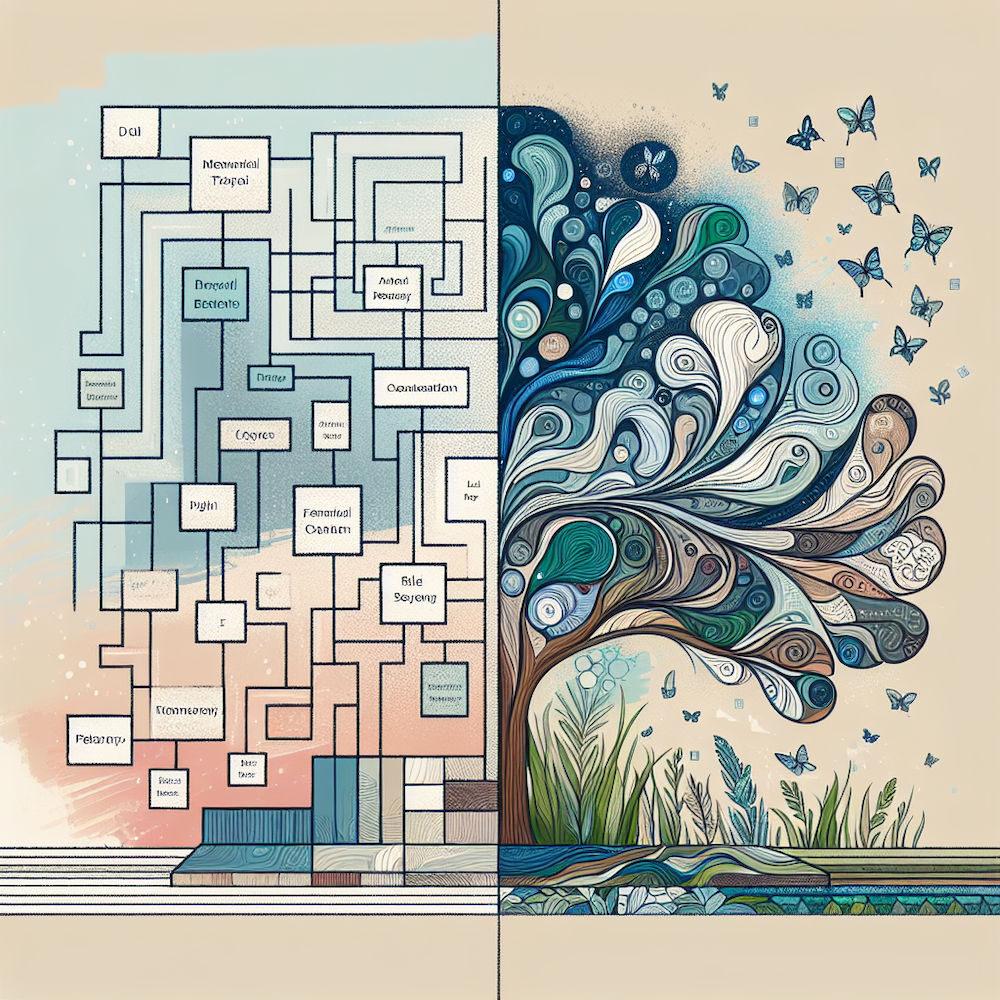
Changing How We Talk About Types: A Necessary Evolution — Part 1
Beyond Personality Types
| Linda Berens and Olivier Caudron | Rating 0 (0) (0) |
| www.BeyondPersonalityTypes.com | Launched: Apr 18, 2025 |
| podcast@interstrength.org | Season: 1 Episode: 5 |
ℹ️ Introduction
Welcome to another intriguing episode of Beyond Personality Types! Today, we embark on a fascinating journey as we explore the evolving landscape of personality type discussions. In part one of our two-episode series, hosts Linda Berens and Olivier Caudron dive deep into the art of moving beyond static personality labels like "I am an INTP" to a more nuanced understanding of our unique patterns and preferences. We'll explore why this shift in language is crucial for personal growth and understanding, how labeling can unintentionally box us in, and the importance of recognizing each individual's unique tapestry. Join us as we unravel the rich dynamics of personality expressions and prepare to rethink what you know about personality types. Stay tuned!
💬 Keywords
-
Personality Types, 2. INTP, 3. Patterns, 4. Preferences, 5. Holistic Discovery, 6. Labeling, 7. Psychological Type, 8. Human Behavior, 9. Myers-Briggs, 10. Typology, 11. Type Development, 12. Stereotypes, 13. Essential Qualities, 14. Living Systems, 15. Dynamic Processes, 16. Therapist, 17. Self-discovery, 18. Enneagram, 19. Type Patterns, 20. Personality Theories, 21. Static Labels, 22. Assumptions, 23. Growth, 24. Nuances, 25. Type Pattern Variations, 26. Temperament, 27. Essential Motivators, 28. Cognitive Functions, 29. Personalities, 30. Expression and Adaptation.
📚 Timestamped overview
00:00 Reconsidering Personality Type Labels
04:42 Critique of Personality Type Stereotyping
08:31 Identity vs. Labels
13:01 Plant Life Processes and Patterns
13:56 "The Pattern in Living Systems"
20:13 "INTP Personality Development Insight"
24:07 Understanding Personality and Temperament Variations
26:18 "Exploring Personality Type Variations"
❇️ Key topics and bullets
-
Introduction to Personality Types
-
Overview of Personality Types and Patterns
-
The use of personality indicators in identifying traits
-
-
Potential Consequences of Using Static Labels
-
Discussion on the limitations of identifying as a specific type (e.g., INTP)
-
The impact of assumptions and stereotypes
-
-
The Importance of Avoiding Labels
-
Cognitive and psychological effects of labeling
-
Distinction between who you are and what you are
-
-
The Concept of Patterns in Personality
-
Definition and explanation of patterns in living systems
-
Differentiating patterns from static labels
-
-
Analogy of Living Systems and Patterns
-
Fritjof Capra’s framework for understanding living systems
-
Components of living systems: pattern, process, structure, and purpose
-
-
Understanding Type Patterns and Development
-
The dynamic nature of type patterns
-
John Beebe’s eight function model in interpreting type patterns
-
Steve Myers's notion of mental muscles in personality patterns
-
-
Naming and Understanding Type Patterns
-
The reasoning behind using names for patterns instead of letters
-
Example of pattern variations and their expressions
-
-
Conclusion and Summary
-
Recap of the preference-based terminology
-
Preview of the next episode’s content on naming sixteen personality themes
-
SUBSCRIBE

Episode Chapters
ℹ️ Introduction
Welcome to another intriguing episode of Beyond Personality Types! Today, we embark on a fascinating journey as we explore the evolving landscape of personality type discussions. In part one of our two-episode series, hosts Linda Berens and Olivier Caudron dive deep into the art of moving beyond static personality labels like "I am an INTP" to a more nuanced understanding of our unique patterns and preferences. We'll explore why this shift in language is crucial for personal growth and understanding, how labeling can unintentionally box us in, and the importance of recognizing each individual's unique tapestry. Join us as we unravel the rich dynamics of personality expressions and prepare to rethink what you know about personality types. Stay tuned!
💬 Keywords
-
Personality Types, 2. INTP, 3. Patterns, 4. Preferences, 5. Holistic Discovery, 6. Labeling, 7. Psychological Type, 8. Human Behavior, 9. Myers-Briggs, 10. Typology, 11. Type Development, 12. Stereotypes, 13. Essential Qualities, 14. Living Systems, 15. Dynamic Processes, 16. Therapist, 17. Self-discovery, 18. Enneagram, 19. Type Patterns, 20. Personality Theories, 21. Static Labels, 22. Assumptions, 23. Growth, 24. Nuances, 25. Type Pattern Variations, 26. Temperament, 27. Essential Motivators, 28. Cognitive Functions, 29. Personalities, 30. Expression and Adaptation.
📚 Timestamped overview
00:00 Reconsidering Personality Type Labels
04:42 Critique of Personality Type Stereotyping
08:31 Identity vs. Labels
13:01 Plant Life Processes and Patterns
13:56 "The Pattern in Living Systems"
20:13 "INTP Personality Development Insight"
24:07 Understanding Personality and Temperament Variations
26:18 "Exploring Personality Type Variations"
❇️ Key topics and bullets
-
Introduction to Personality Types
-
Overview of Personality Types and Patterns
-
The use of personality indicators in identifying traits
-
-
Potential Consequences of Using Static Labels
-
Discussion on the limitations of identifying as a specific type (e.g., INTP)
-
The impact of assumptions and stereotypes
-
-
The Importance of Avoiding Labels
-
Cognitive and psychological effects of labeling
-
Distinction between who you are and what you are
-
-
The Concept of Patterns in Personality
-
Definition and explanation of patterns in living systems
-
Differentiating patterns from static labels
-
-
Analogy of Living Systems and Patterns
-
Fritjof Capra’s framework for understanding living systems
-
Components of living systems: pattern, process, structure, and purpose
-
-
Understanding Type Patterns and Development
-
The dynamic nature of type patterns
-
John Beebe’s eight function model in interpreting type patterns
-
Steve Myers's notion of mental muscles in personality patterns
-
-
Naming and Understanding Type Patterns
-
The reasoning behind using names for patterns instead of letters
-
Example of pattern variations and their expressions
-
-
Conclusion and Summary
-
Recap of the preference-based terminology
-
Preview of the next episode’s content on naming sixteen personality themes
-
In the latest episode of Beyond Personality Types, hosts Linda Berens and Olivier Caudron embark on a thought-provoking journey into personality typology. The episode titled "Changing How We Talk About Types: A Necessary Evolution — Part 1" explores the importance of shifting language from static labels like "I am an INTP" to more dynamic expressions such as "I have a preference for INTP." Linda and Olivier delve into the historical context, potential psychological consequences, and benefits of this approach, emphasizing the richness and diversity of human personalities beyond rigid categorizations. Join them as they challenge listeners to rethink their understanding of personality theories, prioritizing individual nuances and developmental processes. Don't miss part two, where Linda will reveal her unique method of naming the 16 personality themes. Subscribe now to stay updated on this enlightening series.
Linda Berens [00:00:00]:
Types are fascinating patterns that are best discovered holistically.
Olivier Caudron [00:00:08]:
Welcome to Beyond Personality Types, the original interest strengths podcast. Every week we provide you with the better ways to use and talk about personality theories. I am your host, Olivier Codron, a self discovery facilitator. With me is Doctor Linda Behrends, internationally renowned for her innovative typology approach. Come with us beyond the indicator results to rethink what you know about personality types.
Linda Berens [00:00:50]:
If I say I'm an INTP, then you have some understanding of what that means. Somebody else has an understanding of what that means. And then they make assumptions about that, about my behavior.
Olivier Caudron [00:01:06]:
Are we doing more harm than good by oversimplifying our complex natures into four letter personality types? Can there be more depth in saying I have preferences for INTP rather than I am an INTP? Hello and thank you for tuning in. The present episode is the first part of a two episode series on properly addressing type. Today, we delve into the significance of transitioning from saying I am or you are to I have a preference for you have a preference for Linda will explain why avoiding static labels like INTP or ESFJ is crucial. We examine the historical context, potential psychological consequences and benefits of this approach. This discussion will lead us to the fascinating concept of patterns that shape our personalities and an understanding of the potential pitfalls of labeling. Let's dive into part one of our journey towards another way to address types. When someone asks you who you are, normally, you answer, I am Olivier, for instance. We use the verb to be to identify ourselves and others.
Olivier Caudron [00:02:39]:
In the personality types world, it sounds logical to say I am an INFJ, an Enneagram two. Yet, using the verb to be might have unexpected consequences on several levels. Why is it necessary to switch our ways to announce a personality? From what consequences does this protect us? Please Linda, tell us how you realized the importance of changing our way to address personality types.
Linda Berens [00:03:14]:
Oh, wow. It was a long time ago. I think in, like, 1995, there was a conference in, Newport Beach on psychological type. And it was about that time that Bethany Rogers, who was working with me, and I were getting concerned about the labeling. I remember us introducing in a session this concept of talking about I have preferences for or I have a pattern and the dangers of labeling. What we were trying to get at is that people are not fixed. And and then it was the whole issue of don't put me in a box. I'm sitting here looking at my bookshelf.
Linda Berens [00:03:58]:
That is a bookshelf. It's not anything else. Now I could turn it on its side and, I don't know, put some things underneath it and make it a table on the back of it, but that's ugly. But it's a bookshelf. So we're human beings, and we're more than a tangible physical thing that doesn't change and adapt. And even if I took all the shelves out and made it something else, I had to do that to it to change what it was for. So if I say to you, Olivia, you're an INFJ, it is a static thing. That's like saying here a bookshelf or a lamp.
Linda Berens [00:04:42]:
Now I can make metaphors to the importance of a bookshelf and a lamp, but that's not really the point is it's the paradox of the type pattern in our experience and many years stays the same over time, but the way it expresses over time is different. So that was part of it. The other part of it is there were so many stereotypes about the four letter types, the e versus I and s versus n and t versus f and j versus p. This was the worst part. I am a thinker. I'm a thinking type. Technically, in the union the union view, that's my pattern, but I'm way more than a thinking type. We just felt like it does harm because it labels people, puts people in a box.
Olivier Caudron [00:05:35]:
What do you mean by labeling?
Linda Berens [00:05:37]:
By labeling? I think similar to the bookshelf. It's also when we're teaching children to read, we put labels on things so that you know what it is. When you go to the store and buy some fruit, there's a label either on the fruit itself, like an apple, or there's a label on the container that it's in. So the label helps you identify what it is, and that's fine because an apple is an apple, unless it's a variety of apple that's been changed, but that's different. So we wouldn't even call that an apple. We would call it something else. So the big problem with a label is it's limited. It limits you.
Linda Berens [00:06:26]:
And if I say I'm an INTP, then you have some understanding of what that means. Somebody else has an understanding of what that means. And then they make assumptions about that, about my behavior, about who I am at my core, really. Mhmm. And some of those might be pretty accurate about what the type patterns but the type pattern is just the pattern. It just indicates certain characteristics. It can express in a living human being. It can express differently as we develop skills, as we develop, different capacities as we mature.
Linda Berens [00:07:09]:
And there's actually in the theory of type, there is a developmental process that goes on. There is type development and we develop within that pattern. It doesn't mean the pattern changes. It's just it becomes richer.
Olivier Caudron [00:07:28]:
Okay. Got it. And I'm thinking about our listeners because all those notions are clear for you. You work them. You made some research. I am referring to and I think it's the majority of the people who are looking who they are. This is why they went online or took an assessment in order to know who they are, not what they prefer, what they have, but more who they are. You were telling that might be harmful to say you are or I am a INFJ, ENTP, INTP, etcetera etcetera or even Enneagram two, three, four, five.
Olivier Caudron [00:08:23]:
How could you explain to those people that they are looking who they are, that they are maybe wrong thinking like that way?
Linda Berens [00:08:31]:
Well, who you are is really different from what you are, and a noun doesn't tell you who you are. Linda doesn't tell me who I am. I grew up when Linda was a popular name. There were two other Lindas in my small town school with 24 people in the class, three of us. And as individuals, who we are is really different. Now chances are we had different type patterns, but who we are is not the same thing as the type pattern. And when it says you are that, then it can have a label, a labeling limiting quality. Anyway, so that's the challenge with it.
Linda Berens [00:09:19]:
Now if I may be so brave was to go down a little slide chart. Saying I am an INTP when I'm really clear about that, or if I wanted to use temperament to say I'm a theorist, that's not quite as bad as saying I'm a thinker or a feeler or a judger or a perceiver because those indeed are parts and the parts are not the whole. There's a pattern, and nature is in patterns. The pattern, the fundamental pattern, the essential qualities of the pattern stay the same over time.
Olivier Caudron [00:09:57]:
What do you mean by patterns? That sounds logical when you talk about it. That sounds beautiful.
Linda Berens [00:10:06]:
Of course, it's logical.
Olivier Caudron [00:10:08]:
Yet, we can think of pattern for a quilt, for instance, or when you are knitting, you are using a pattern. Are you referring to that kind of pattern or something different?
Linda Berens [00:10:25]:
Well, a pattern is an arrangement of qualities. So if you have a quilt, I have a quilt in my cupboard, my linen closet that my grandmother made for me, that is a double wedding ring quilt. So the pattern of that double wedding ring is these interlocked circles all over there. So a quilt is a quilt. It's a thing. The pattern is a specific arrangement of characteristics. So when we're looking at type, there's a couple of things. Living systems have patterns, and the patterns that describe the essence of it, of what that system does.
Olivier Caudron [00:11:17]:
A living system? Are we human a living system?
Linda Berens [00:11:21]:
Yes. Like plants, animals, people, anything that's living that grows and develops over time. So as opposed to something that's dead or inanimate. So a quilt is inanimate. Right? And so that pattern is there and you can make variations in it, but it doesn't change itself. So living systems can be understood, and this is the work of Khrychev Capra.
Olivier Caudron [00:11:51]:
Fritjof Capra is a physicist and a author who believes we can understand living systems. He sees everything as interconnected, like a web of life. In his book, the web of life, he talks about how everything in life from biology to society is linked. He challenges traditional views and introduces a new way of thinking about life and its complexity.
Linda Berens [00:12:18]:
He said if you wanna understand the living system, you have to understand four things. First of all, the pattern. What is the pattern of the system? And in order to understand the pattern of the system, you have to identify the essential qualities of the the pattern. What makes it what it is? For example, a human being has certain essential physical qualities, various body parts, various systems within us that are usually configured in much the same way. And a system is configured, meaning that things are arranged in certain ways such that they if it's a living system, it it's animated. It moves. It changes, not like the quilt.
Olivier Caudron [00:13:00]:
Mhmm.
Linda Berens [00:13:01]:
Okay. So the living system has a pattern and there are processes that help maintain that pattern. So processes are activities that go on to serve that pattern. Processes can change over time. Volume turned up on one and back down on another. In a plant, the processes are, oh, and I'm not a biologist or a botanist, but there's nutrients come from the soil and as water goes into the soil, comes up through the roots, comes up, nutrients go out, and carbon dioxide is taken in and oxygen's exchanged. Those are the processes, those are activities that maintain a plant. If you stop one of those processes, the plant will die or not work the same way, if you will.
Olivier Caudron [00:13:56]:
And
Linda Berens [00:13:56]:
then there is structure, and the structure is the embodiment of the pattern. Structure of the plant is the stem and the roots and the the leaves and then perhaps the flower or something that produces seeds. Right? And so that's the physical embodiment of the pattern. And there's a fourth thing, which for living systems, there's purpose. Like the purpose of a stock of wheat is to produce this grain and that grain then feeds others and their different aspects of plants. I'm a little out of my field here, but anyway, just to try to give it a little more concreteness. So we have, as human beings, we have tons of physical processes that we can describe, and now they can do with neuroscience, and I'm not an expert in this, but they can actually track how things are happening in the brain and in the whole neurology of the system. So those are the aspects of a living system.
Linda Berens [00:15:05]:
As human beings, there's the physical being, and we sort of artificial that and artificially take apart the physical being and look at that separate from the sense of self kind of being Mhmm. Or the spiritual side of being, the emotional side, whatever that may mean to people these days. It's easy to see the pattern in a human physical pattern. There's the head, shoulders, arms, trunk, legs, feet. Sometimes things happen and the pattern doesn't look like that, but that's atypical. So that's the pattern and we're designed to function that way. I happen to believe, and I think there's evidence to say that there are less tangible patterns and we can name some of those less tangible patterns as types. And so a personality type can be described as a pattern of certain essential qualities.
Linda Berens [00:16:10]:
And what are those essential qualities? John Beebe has taken a look at Jung's work and created a metaphor for us with the stick figure, the head, and the spine, and the arms.
Olivier Caudron [00:16:25]:
John Beebe is a renowned Jungian analyst. He developed an eight function model of personality that builds upon Carl Jung's theory of psychological types. This model assigns archetypes to each of the eight cognitive functions, providing a more nuanced understanding of personality and consciousness.
Linda Berens [00:16:48]:
And so we could take the eight functions that Carl Jung identified and look at what role does that function play in the psyche using that analogy. So one plays what he calls a heroic role, one plays a good parent role, one plays a forever child role, one plays the anima or the anima as I call it, the aspirational role. So that's the basic core pattern using that lens, that aspect of our personality.
Olivier Caudron [00:17:22]:
Which is not the whole utter of
Linda Berens [00:17:25]:
a person. Not the whole at all. No. Not that at all. And that's a little bit like describing my skeleton.
Olivier Caudron [00:17:35]:
Okay.
Linda Berens [00:17:35]:
That's a part of my physical pattern or your physical pattern. And then there are muscles. Steve Myers, years ago, talked about muscles and mental muscles and how when we exercise our muscles, you know.
Olivier Caudron [00:17:51]:
Steve Myers is an independent researcher and writer with expertise in psychological type. He developed the mental muscle diagram indicator, MMDI, which is an analogy comparing psychological preferences to muscles. The MMDI is a free alternative to the Myers Briggs type indicator and is designed to provide insights into one's personality preferences.
Linda Berens [00:18:24]:
I've been exercising the last couple of years, and I go, there's some nice little muscle there. Right? I can see this muscle in my arm. I can feel this. Oh, that wasn't there before. Now I always had a muscle there, but that muscle is much bigger. So it works harder for me than it used to. So I can pick things up in ways that I couldn't pick them up before. But this isn't the whole of me.
Linda Berens [00:18:51]:
The muscle in my arm doesn't describe what I mean as a human being or even as a body. When we look at the eight functions that Carl Jung described, he was looking at some dynamics. I like calling them dynamics because dynamic means that it's moving. I also like to call them processes.
Olivier Caudron [00:19:16]:
Mhmm.
Linda Berens [00:19:17]:
So he called them functions. Each of those has a function. It serves a function for us. It does things. If my heroic is introverted thinking. So that's a muscle, as Steve Myers would say, that's really been exercised a lot. Naturally, I tend to take things in, categorize them, find out what fits, compare other things to them, say, oh, no, that doesn't fit. We'll throw it away, or or we're not gonna look at it now and do this kind of heavy duty internal analysis where my energy is metaphorically speaking, at least in my head.
Linda Berens [00:19:57]:
My daughter doesn't have that pattern. She has access to that pattern. It's her aspirational role, and she does it a fair amount. So that's not what she leads with, not what she just does automatically like falling off a log.
Olivier Caudron [00:20:13]:
Mhmm.
Linda Berens [00:20:13]:
And then and over the years, it's developed a great deal. Now granted that she had a father and a mother and a sibling who had the same preferences, INTP. So she was surrounded by that. So she got a little bit of coaching and to see what it looked like, she can fine tune and correct the best of us as she works in the background while I'm teaching, for example. The pattern is that arrangements of things and the pattern has a theme, which we name. So instead of me having INTP references, I identify as someone where you could name the pattern of a designer theorizer. So it has a name if we're naming something. So it's a noun.
Linda Berens [00:21:03]:
That's like finding a pair of shoes that fits me and we can describe the shoes. We have loafers, we have sandals, we have sneakers or trainers or whatever people call canvas shoes.
Olivier Caudron [00:21:17]:
You said that a pattern has a theme. Right. If we talk about quilt again, there's a theme also. Even the pattern is what makes the quilt, yet old quilts are not the same. And the person quilting chooses a theme, a color. Maybe the theme will be with flowers or different colors. It's just to make it clear that this is why you came with name for those patterns rather than letters.
Linda Berens [00:21:52]:
Yeah.
Olivier Caudron [00:21:53]:
Okay.
Linda Berens [00:21:54]:
Yeah. So I have seen many double wedding ring quilts in my life. None of them look like mine because quilts in the past, at least, were made with scraps of fabric.
Olivier Caudron [00:22:08]:
Mhmm.
Linda Berens [00:22:08]:
So it's whatever was left over from the sewing that somebody was doing. Now you just go buy the fabric.
Olivier Caudron [00:22:14]:
Yeah. Of course.
Linda Berens [00:22:15]:
And I think what I see behind you is a quilt.
Olivier Caudron [00:22:19]:
It's not.
Linda Berens [00:22:20]:
It's not. But it could be.
Olivier Caudron [00:22:22]:
It could be. Let's say that it could be.
Linda Berens [00:22:23]:
And it's something that's woven in a pattern by choosing these different colors.
Olivier Caudron [00:22:27]:
Yeah.
Linda Berens [00:22:27]:
But it's not an organic pattern. So patterns have variations. And for example, INTP, there are four variations that Dario Nardi has described. He says, patterns are a result of development.
Olivier Caudron [00:22:43]:
Dario is an award winning UCLA professor and author who has made significant contributions to the field of personality research. His work combines neuroscience with personality typology, exploring how different brain regions are activated in individuals of various MBTI types.
Linda Berens [00:23:08]:
So you have these patterns, but, basically, the pattern is the same. So I think there's a saying in the type world about this is the way the language goes, it still names it, but every ENFP is like every other ENFP, is not like any other ENFP. So when we're talking about a type name, we just about have to make it a noun to say it's a this, it's a that. And we're talking about the name of the pattern. I think the biggest issue I have is to say I'm an INTP because that is parts. We don't look at the whole, and the whole is not the sum of the parts.
Olivier Caudron [00:23:52]:
Are you telling that someone who took the indicator is actually not an INTP even though the results of the indicator was INTP?
Linda Berens [00:24:04]:
Oh, that's another story.
Olivier Caudron [00:24:06]:
Okay. Okay.
Linda Berens [00:24:07]:
That's the, you know, that's the measurement question. But someone who's identified as having an INTP would not look the same as every other INTP because there are variations or variations. And some of those variations, probably most of them, I believe, are coming from our life experiences and how we've developed. Like, I was trained in temperament first, so there are four temperament patterns. And then when David Kersey looked at those, he found that they related to the Myers Briggs types in a certain way. Mhmm. So four of each of the 16 personality type patterns clustered in certain ways to relate to each temperament pattern. What you say about a temperament, or I call it an essential motivator pattern, needs to be true for all of the variations.
Linda Berens [00:24:58]:
So you can't say a whole lot and you have to be careful because sometimes but that may be another podcast or topic because sometimes you're describing something quite differently. So you're trying to get at what is the essence, what are the essential qualities of the pattern.
Olivier Caudron [00:25:17]:
And that brings us to the close of the first part of that series. To summarize, using phrases like my preferences are or 'I have a pattern' provides more flexibility and space for individual nuances. It acknowledges the dynamic nature of human beings. People aren't like objects. As people grow and change, how they express themselves can adapt and evolve. When you say I am an INTJ, it unintentionally acts like a rigid label potentially limiting your understanding and growth. The statement might lead to assumptions and stereotypes about threats associated with INTJ and could hinder the appreciation of your individual complexities. That's why it's preferred to talk about having particular personality patterns or preferences.
Olivier Caudron [00:26:18]:
It provides more room to account for life experiences, development and the unique variations within each personality type. Also, the notion of personality preferences underlines that while certain tendencies might be more inherent, it doesn't preclude the capacity to develop or utilize other traits when necessary or desired. In the second part of this series, you will discover Linda's special way of naming the 16 personality themes. Don't miss this episode as her unique method brings a holistic perspective to your practice and enhances your ability to discuss different personality types. Thank you so much for listening to today's episode. If you enjoyed this discussion we'd really appreciate it if you could leave a rating and review to help others find the show. Remember to subscribe if you don't want to miss next week's episode. You can also follow us on Facebook and Instagram Instagram at beyond personality types.
Olivier Caudron [00:27:42]:
Thanks again for tuning in. We are Olivier Codron and Linda Berens. Stay curious and eager to learn until we meet again in our next episode.