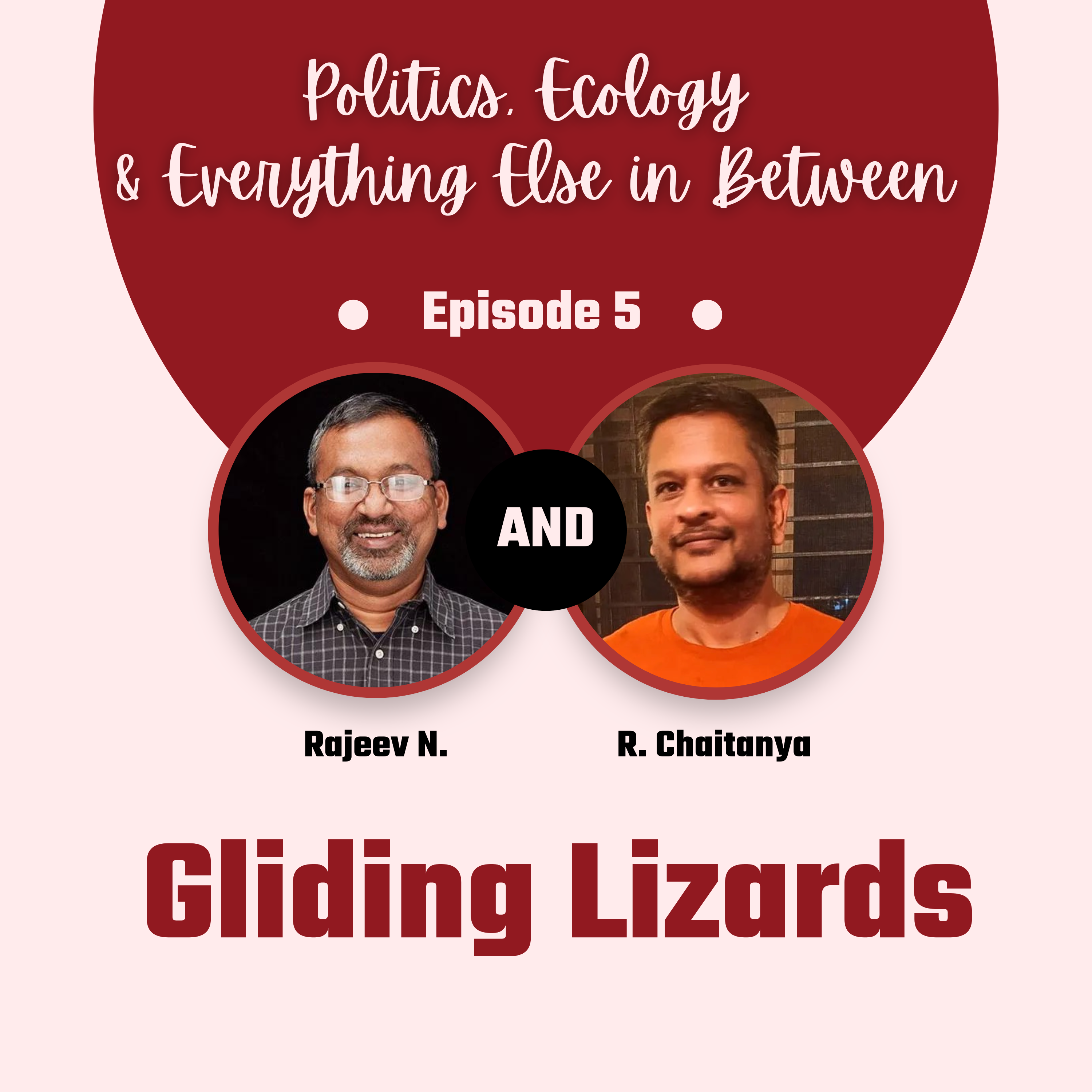

Ep. 5 - The Flight of The Draco - With R. Chaitanya
Politics, Ecology and Everything Else In Between
| R. Chaitanya | Rating 0 (0) (0) |
| Launched: Nov 08, 2024 | |
| rajeev.nedumaran@gmail.com | Season: 1 Episode: 5 |
The Flight of the Draco: Exploring Gliding Vertebrates and Tall Trees
In this episode of 'Politics, Ecology, and Everything Else in Between,' host Rajeev chats with Chaitanya, a former IBM researcher turned evolutionary biologist. They discuss Chaitanya's unique journey from database engineering to the study of gliding vertebrates, particularly Draco lizards. The conversation delves into Chaitanya's research on the correlation between tall trees and the evolution of gliding in vertebrates, spanning different species across Southeast Asia and beyond. Key themes include the impact of deforestation, the role of large datasets in research, and the broader implications of evolutionary biology.
00:00 Introduction to Gliding Lizards
00:53 Podcast Introduction and Guest Background
02:04 Journey from IBM to Herpetology
04:30 Fieldwork and Research on Gliding Vertebrates
05:50 PhD Research and Discoveries
10:08 Evolutionary Biology and Gliding Mechanisms
14:51 Conservation Challenges and Future Research
28:00 Conclusion and Final Thoughts
SUBSCRIBE

Episode Chapters
The Flight of the Draco: Exploring Gliding Vertebrates and Tall Trees
In this episode of 'Politics, Ecology, and Everything Else in Between,' host Rajeev chats with Chaitanya, a former IBM researcher turned evolutionary biologist. They discuss Chaitanya's unique journey from database engineering to the study of gliding vertebrates, particularly Draco lizards. The conversation delves into Chaitanya's research on the correlation between tall trees and the evolution of gliding in vertebrates, spanning different species across Southeast Asia and beyond. Key themes include the impact of deforestation, the role of large datasets in research, and the broader implications of evolutionary biology.
00:00 Introduction to Gliding Lizards
00:53 Podcast Introduction and Guest Background
02:04 Journey from IBM to Herpetology
04:30 Fieldwork and Research on Gliding Vertebrates
05:50 PhD Research and Discoveries
10:08 Evolutionary Biology and Gliding Mechanisms
14:51 Conservation Challenges and Future Research
28:00 Conclusion and Final Thoughts
In episode five of 'Politics, Ecology, and Everything in Between,' Rajeev interviews Chaitanya, a former IBM researcher who transitioned to herpetology and evolutionary biology. Chaitanya discusses his fascination with Draco lizards, their unique gliding ability, and the hypothesis that this trait evolved due to the presence of tall dipterocarp trees in Southeast Asia. The conversation explores Chaitanya's research journey, including his fieldwork across India, his PhD at Tel Aviv University, and the broader implications of his findings on the association between tall trees and gliding vertebrates globally. They also touch upon the challenges of conservation amid deforestation and the potential future directions for Chaitanya's research.
Chaitanya - Audio Version
===
Chaitanya: [00:00:00] So it's a genus of,~ uh, uh, ~lizards belonging to the family, a family called Agamidae. And,~ uh,~ so these lizards are unique in their ~ability to, ~ability to,~ uh,~ be able to glide. there is one species ~in, ~in,~ uh,~ peninsular India, which is called Draco dusumieri, and there are about 39 of 39 species in Southeast Asia. So most of the Draco diversity is in Southeast Asia. ~Right. ~So I wanted to. work on the Indian Draco and possibly see how many species there might be within the, ~you know, ~within Draco Dusmieri. so that's how it started. And then I got interested in,~ uh,~ an old hypothesis that was proposed like maybe 40, 50 years ago. It says that gliding in vertebrates might have evolved because of the presence of tall trees in the region. So to give you some context, Southeast Asia has the most number of gliding vertebrates in the world.
Rajeev: Welcome back to politics, ecology, and everything else in between.
This is episode five. And I'm your host [00:01:00] Rajeev. It's been a while since we did an episode on this podcast, but Hey, here we are.
Today. I have a very good friend of mine. Chaitanya, who has had an incredible journey so far, right. From working at IBM to diving deep in to the world of herpetology ~and.~ And evolutionary biology.
We'll be exploring is fascinating research on gliding vertebretes, the impact of tall trees on their evolution and how his passion for large datasets, has driven his scientific exploration.
This is a conversation you don't want to miss. Stay tuned as we unravel the connections between technology. Nature. And the intricate web of life right in front of you. So let's dive right in to the conversation.
Welcome to the show, Chaitanya.. Good to see you for so many years.
Chaitanya: Good to see you too, Rajiv.
Rajeev: Alright, so it's been what,~ uh,~ more than a few decades, right?
Chaitanya: a couple of decades, I think, and [00:02:00] it's terrible
to think of it that way. So let's not go down that path.
Rajeev: ~So ~really interesting to see your evolution in your career ~as well. So, uh, I really want to start off by, one second, am I recording?~
~It says you are.~
~Okay. Check, check, check, check. Sometimes, uh, this thing, check, check. Okay. All right. So yeah, so it's been interesting, uh, seeing your evolution in your career as well. So want to start off by, um, by, uh, ~You got into IBM, you spent 14 years in IBM, and then what prompted you to,~ um, sort of ~shift into this field?
Chaitanya: I joined IBM, I think in 2001 and ~I was, ~I was there until 2015 or so, 14. ~Um, ~I really had a good job in IBM and a job that I liked. I was doing a lot of research. I was publishing a lot of patents and like writing research papers and so on. So it was fun.~ Uh, ~but somewhere down the line, I got interested in herpetology.
And,~ uh,~ which is basically the, ~you know, it's, it's, ~it's a science that deals with the study of amphibians and reptiles.~ Uh, ~I got really smitten by the herpetology bug, if you will. And,~ uh,~ it was like, like a disease that just wouldn't go away. I thought it's like a, it's like a fad and it's ~like, you know, ~it's going to stick around for a while and then I lose interest, but it just never went away.
So around 2008, 2009, I started,~ uh,~ Maybe meeting some herpetologists in India, [00:03:00] going around, going to the forests with them, trying to understand,~ uh,~ reptiles and amphibians and their natural habitat, how they behave, all that kind of stuff. And,~ um,~ I also got interested in evolutionary biology a lot. So as a ~part of a,~ part of my job in IBM, ~we used to work with, uh, uh, I, I was a, uh, I was a,~ I was one of those guys who built,~ uh,~ database softwares.
~Uh, ~and IBM had this marquee product called DB2,~ uh,~ which was back then,~ like,~ a very key database. This was before Oracle and stuff, right? ~Um, ~and I used to work on graphs a lot, like graph theory. ~Uh, and, ~and,~ uh, you know, ~so because indexes and databases usually ~are, ~are graphs. And so we need, we needed to understand the mathematical basis of graph theory and so on.
And then I started looking at evolutionary trees, which are also graphs, which are also basically,~ uh,~ directed acyclic graphs, as they call them. They're called trees. They're evolutionary trees that show relationships between organisms. So I,~ like,~ I, it was ~kind of ~a natural fit there for me, right? I thought I could understand this stuff,~ uh, well, uh, ~because of my,~ uh,~ background ~in, ~in,~ uh, you know, ~graph theory and programming and so on.
So [00:04:00] all of that happened, and at one point I realized that,~ uh,~ if I want to pursue these interests that I have in evolutionary biology and herpetology and so on, I would have to ~kind of ~quit my job and it's now or never. so in 2014, I think I took the decision to ~leave, uh,~ leave IBM. And,~ uh,~ try and see where I can go with,~ uh,~ with evolutionary biology and herpetology.
So that's how it all started. And by this time, I had already built a kind of a network in India of people who were evolutionary biologists, who were herpetologists. So I started working with all these guys. ~Uh, ~learning the, ~you know, ~the ropes of the trade if you will and, yeah, for about six, seven years, ~I was, ~I was basically,~ uh, uh,~ wandering all over India in the forests and trying to, see and document as many reptiles and amphibians as I could.
Some of these surveys were,~ uh,~ were formal because they were like, ~you know, ~I was helping the forest department to document herpetofauna and certain forests in Tamil Nadu and the Northeast and so on. But most of it was just like, ~you know, uh,~ random fun stuff. I would just go to a forest, try and [00:05:00] find,~ uh,~ Some cool reptiles and amphibians and so on.
And then covid hit and I couldn't go to the forest anymore. and I was getting really buggered at home. So I decided I'll apply for PhD positions everywhere. so I wrote to a lot of people and Tel Aviv University worked out the best because they allowed me to ~work, ~work from India. all the American universities Insisted ~that I, that I, ~that I've been in the States for at least two and a half to three years, So then I joined Tel Aviv University, which is this really fun lab,~ uh,~ that works on this field of biology called macroecology.~ Um, ~though not directly related to the kind of stuff I would like to do, or I wanted to do for my PhD, but my PhD guide was kind enough to allow me to do whatever I want. ~But, ~and we've been collaborating since then, and we've,~ you ~come out with some cool stuff, I think.
~So, you know, ~so ~it's, ~it's been good since then. And,~ uh,~ I still am doing my PhD. It's probably my final, hopefully my final year this year. so yeah, so that's the long and short of it, ~I guess.~
Rajeev: ~ ~So,~ uh, ~why,~ uh, uh, uh, ~gliding vertebrates,
Chaitanya: So I,~ uh,~ started off, ~I started~ my PhD off thinking I'll work on these really cool lizards from the Western Ghats in [00:06:00] India called Draco. ~Uh, ~it's a genus
Rajeev: the Draco lizards, yeah, I was looking at them,
Chaitanya: yes. So it's a genus of,~ uh, uh, ~lizards belonging to the family, a family called Agamidae. And,~ uh,~ so these lizards are unique in their ~ability to, ~ability to,~ uh,~ be able to glide. there is one species ~in, ~in,~ uh,~ peninsular India, which is called Draco dusumieri, and there are about 39 of 39 species in Southeast Asia. So most of the Draco diversity is in Southeast Asia. ~Right. ~So I wanted to. work on the Indian Draco and possibly see how many species there might be within the, ~you know, ~within Draco Dusmieri. so that's how it started. And then I got interested in,~ uh,~ an old hypothesis that was proposed like maybe 40, 50 years ago. It says that gliding in vertebrates might have evolved because of the presence of tall trees in the region. So to give you some context, Southeast Asia has the most number of gliding vertebrates in the world.
And when I say gliding vertebrates, ~I mean ~geckos, draco lizards ~ I mean ~squirrels, [00:07:00] frogs, and ~this, ~this insanely cool animal called Colugo,~ uh,~ which is a mammal and it is,~ uh,~ evolutionarily related to all the primates,~ uh, which, ~and Colugo is,~ uh,~ there are just two species of Colugo in Southeast Asia and both of them glide.
So ~I started, ~I started trying to look at why are there so many species of gliders in Southeast Asia, right? Why that particular region. Then a cool story started emerging. ~Uh, ~which basically,~ uh,~ took my PhD in a completely different,~ uh,~ trajectory. So I realized that,~ uh,~ Southeast Asia also has the most number of tall trees in the world. the tropical forests of Southeast Asia are the tallest in the world. And they're chiefly composed of ~this, ~this family of trees called ~dipterocarps, ~dipterocarps, right? You might have seen dipterocarps,~ uh, like, ~you've been to forested regions in India and, ~you know, ~Papua New Guinea and so forth, so on and so forth, or Southeast Asia for that matter.
~So these trees, they, uh, then they, uh,~ so their seeds have two wings, right? So that's why they're called dipterocarps and, ~you know, they fall, the, the, ~the seeds disperse and fall in a very peculiar manner. ~They have this, you know, they,~ they ~spin in the ~spin in the air and basically ~the, ~the wings ~on the leaves, the wings~ on the seeds help them, ~you know, kind of ~disperse.
They're [00:08:00] very common trees in the Western Ghats too. So I wanted to make this correlation that it's because of the tall trees, tall diphtherocarp trees that are, that there are so many gliding animals in,~ um,~ in Southeast Asia. So the story goes like this. So there's the context,~ but,~ but the story itself goes like this.
So ~many, many, ~many million years ago, ~so~ Southeast Asia~ was, uh, Southeast Asia had like, ~did not have too many tall trees. It had short treed evergreen forests, right? It had evergreen forests nevertheless, but the trees were not ~too, ~too tall, let's say 40 meters, and ~that's, ~that's that. And there were a lot of these organisms that were already occupying canopies of these ~tall trees, of these~ short trees in Southeast Asia.
~Beg your pardon. ~ So there were snakes, there were lizards, there were frogs, and all these animals that would, ~you know, ~use the canopy as a unique niche. and would, ~you know, uh, ~just persist and live there. And then around 50 million years ago,~ um,~ this is,~ uh,~ 50 million years ago, India basically, which was an island at that point of time, started coming closer and closer to Asia until it started docking,~ uh,~ with mainland Asia, where it is, ~I mean, ~where we are presently right now in India, right?
~So, uh, ~so that event was around 50 million years ago, and India brought with it [00:09:00] some really tall trees, right? ~Uh, ~so India had separated from Africa around 100 odd million years ago, and it started rapidly,~ uh, uh, you know, ~ascending the latitudes, and it crossed the equator, and around 50 million years, it came and docked with Asia.
And India brought with it these tall trees called diphtherocarps, And what happened when India docked was these diphtherocarps, they just dispersed or migrated into Southeast Asia. And they started colonizing Southeast Asia. And by about 30 or 20 million years ago, The diphtherocarp trees were the most dominant trees in the evergreen tropical forests of Southeast Asia.
So now what happens to all these organisms ~that, ~that were occupying short tree canopies, right? ~Like, ~like your lizards and frogs and so on, snakes and all that. Now they suddenly had to deal with trees that are 80 meters tall or maybe even 100 meters tall. The tallest tropical tree has been reported from Saba in Borneo, which is about,~ it's,~ it's a hundred meter tall shoria. so these organisms suddenly had to deal with ~like these, ~these,~ uh,~ monuments ~of, ~[00:10:00] of nature, if you will, right? Because they were not used these tall trees. So over the course ~of, ~of a few million years, evolution, ~you know, ~took its toll on these animals. And these animals basically, evolved the ability to glide, because locomoting between tall trees, if you have to climb down a hundred meter tree~ and then walk ~and then walk the ground for a certain distance and then climb up another hundred meter tree to get to the next canopy, it just makes no,~ uh,~ sense in terms of energy expenditure and so on. So all these organisms, they started evolving the ability to glide.
So let's say ~I'm a, I'm a, ~I'm a tiny lizard sitting at 80 meters ~on a, ~on a tree and right next to me is another tree on which there are ants,~ right, which, ~which is my favorite food. And to get to that food, I have to climb down 80 meters and climb up 80 meters again. It just makes no sense. So~ what I,~ what did I do?
I just evolved the ability to glide from one tree to the other. So I can completely,~ uh, you know, ~bypass this whole,~ you know, uh, ~climbing down and climbing up business, right? So this is how,~ uh,~ Gliding is hypothesized to have evolved [00:11:00] in all these vertebrate animals. ~Um, ~so I thought that was a really cool,~ uh, you know, uh, ~scenario to test many questions that I had about gliding ~and, ~and their association with,~ uh,~ tall canopy trees, right?
~Uh, ~so basically this has It's made up two chapters, at least of my PhD work. so for my first chapter, I show that basically, gliding lizards like Draco, they are not able to disperse into regions in India where there are no tall trees. I built statistical models to show that, ~you know, the, the, ~the distribution of ~uh, ~an organism like Draco, which is a glider, is constrained by canopy physiognomy. so they need a lot of canopy cover and really tall trees. So regions that are bereft of tall canopies, these animals just cannot disperse into. And then I also showed that during the course of my PhD that,~ uh, uh, ~whenever there have been crises, in the history of tall trees, like the evolutionary history of tall trees, like for example, a mass [00:12:00] extinction event, which essentially says that a lot of the tree diversity went kaput in a very short period of time. So that's the,~ uh, uh, ~essential definition of a mass extinction event. So when such crises happened in tall trees, a similar crisis happened in the gliding vertebrates at the same time, because the gliding vertebrates were ecologically so closely associated with tall trees. So it's basically ~how, ~ how a crisis in an organism cascades into a crisis on another organism ~that's, ~that's entirely ~dependent, ~dependent on the former.
~Um, so, ~so this is the kind of work I've been doing so far ~for my, ~for my PhD. so ~this is a, ~this is specifically a case with the Southeast Asian gliders and the Southeast Asian diphtherocarp trees. But this story can be extrapolated over space and time. ~You know, uh, ~I further realized now that,~ uh,~ this is work that I've not done.
Maybe I should do it at some point, but,~ uh,~ I further realized that wherever there are gliding vertebrates across the world, like for example, in Australia, you have the gliding marsupials, right? You have the [00:13:00] sugar gliders, you have the greater glider and all those. Is it, there's a good diversity of gliders in Australia.
Similarly, you have,~ uh, ~the flying squirrels are,~ uh,~ predominantly in South, Southeast Asia,~ which,~ which has about 52 odd species of them. And there are just a couple of species in North America ~that go all the way down to, I mean, that, that, that, you know, come back to Europe~ and so on. then there are,~ uh,~ an interesting group of rodents called the Anomalutes in Africa that also glide.
and then there is, ~there are, ~there are a couple of frogs in South America that glide, and there is also this lacerated lizard in Africa that glides called the holaspis. And it does look like across space,~ uh,~ globally, wherever there are gliding vertebrates, ~you know, ~there are tall trees in those regions.
For example, in Australia, ~the gliding, ~the gliding marsupials seem to have evolved because of the presence of eucalyptus trees, ~which are ~which are phenomenally tall, as ~you know. Uh, ~similarly in Africa and South America, there are, ~you know, uh, ~equally tall trees that have probably triggered the evolution of gliding ~in these, ~in these groups. so basically ~this, this, ~this association between gliding vertebrates and tall trees, ~you know, ~can be extrapolated over space. [00:14:00] And I believe it can be extrapolated over time as well, over deep time. Primarily because there have been a lot of extinct gliding vertebrates. There have been a lot of reptiles that have gone,~ uh,~ glider, gliding reptiles that have gone extinct.
A lot of gliding mammals that have gone extinct and frogs too. And I believe that every instance of the evolution of gliding in the vertebrate tree of life has been triggered by the presence of tall trees in the region. one day probably I will try and, ~you know, uh, ~test all of this, maybe for a postdoctoral,~ uh, uh, ~position or something like that.
But yeah, so that's something that I have in my head.
Rajeev: ~Yeah, I think, uh, the other thing was, uh, you know, ~when DJ and I were going to the forest during our college time, we were very interested in the,~ uh, in the, you know, this ~great pied hornbill. And that interestingly nests in tall trees and many of these areas, which were losing these trees were consequently ~was, uh, you know, ~it affected the population of the hornbills as well. ~Yeah. So~ is that happening for these vertebrates as well?
Chaitanya: I'm sure it is happening. I'm sure it's going on. Just that, no one has quantified it. ~So, uh, ~[00:15:00] usually it's,~ um, it's, ~it's ~kind of ~common sense that ~when, ~when,~ uh,~ the habitat,
~uh,~
goes for a toss, then animals that are dependent on that habitat, show rapid declines and so on. so I'm sure ~that's, ~that's true for all the gliding vertebrates.
So if you start, ~you know, ~chopping off tall trees or primary forests,~ Um,~ in the Western Ghats in Southeast Asia, where, ~you know, ~all this deforestation is quite prevalent. ~Uh, ~all these animals are going to go,~ uh, you know, ~they're going to start facing massive,~ uh,~ crises. And with the likely risk of going extinct. so ~it's, ~it's a true and present danger.
Rajeev: from,~ um,~ from IBM to gliding vertebrates, one thing I think. Which is common is your skill with your database and datasets and, ~you know, ~all the this, ~you know, ~large datasets,
Chaitanya: I love large data sets. Yes. I love large data sets. And ~I think, ~I think, ~you know, it, it, it, it, ~it, to a large extent, it helps being an engineer because ~It's, ~it's helped me in a lot of ways,~ uh,~ in terms of thinking analytically and writing code, especially, I never thought I'd write code,~ uh,~ being a biologist, but the amount of code I've written in the last few years, just for my research ~is, is, is, ~is quite,~ uh, you know, ~appalling to say the [00:16:00] least.
~Uh, ~yeah. So all that really helps. And also ~it's, it's, it's a, ~it's a paradigm shift from,~ uh,~ from,~ uh,~ a kind of a mathematical background, if you will, because engineering is a lot of maths,~ uh,~ to a biological, framework where you want to do research. So in computer science,~ it's, it's, ~it's largely zero and one, right?
So ~it's, ~it's all binary. It's quite easy. So ~you have,~ you either have a right answer ~or, ~or you have the wrong answer. but in biology,~ uh, the, one of the,~ one of the things I had to adjust to,~ uh,~ I think I'm still adjusting to it is the fact that,~ uh,~ there is no real right or wrong answers. Okay.~ It's, ~it's all like a gradient of gray in between and,~ uh,~ so it, it takes a little getting used to that fact coming from a, ~you know, ~from a strictly binary background, ~you know, uh, uh, ~
Rajeev: ~Yeah, but, uh, I mean, uh, coming from, uh, you know, ~you did your MCA, am I right? In MKU?
Chaitanya: yeah, I did a master's in science and computer science, not technically MCA. ~Uh,~ yeah,
Rajeev: shifting from that to a science background, did you have any,~ like,~ challenges? ~Um, I mean, ~there's, it's like black and white, right? ~Like, ~it's like studying biology and zoology is so much different from
Study C and Pascal and whatever.
Chaitanya: Yeah. ~I mean, ~[00:17:00] thankfully my course was not very,~ uh,~ it was not too applications oriented,~ like,~ like an MCA course or a be course would be. ~It was a, ~it was a little more,~ uh,~ theory oriented, in fact, we got a good understanding of the theoretical basis of computer science.
so that way it was ~kind of ~helpful in a sense. ~Uh, ~biology In terms of being another science, it is quite similar, right? The way you approach addressing a scientific problem is very similar, whether it's computer science or biology. However, like I said, biology involves Very rarely are there right and wrong answers in biology. It's always like a gradient and,~ uh, uh, ~ biggest challenge was getting, getting used to that gradient. In fact, not a lot else, everything else comes because you're just deeply interested in all this stuff.
So you just learn as you go, you don't find it that hard, ~but it's the fact that there ~
Rajeev: ~Okay, so, and you, so, and you, yeah, and you study, um, is it, uh, you know, ~ which are the forests that you study? Is it,~ uh, um, ~restricted to India or is it across Southeast Asia?
Chaitanya: ~so, uh, for my, ~for my PhD,~ it's,~ it's been across Southeast Asia. But I don't, I didn't really have to visit those forests because a lot of this data was already there in the internet. there's a big push and increase in the amount of [00:18:00] citizen science data ~that's, that's, that's, ~that's being published on the internet,~ uh,~ over the last decade or so.
~Right. ~And that's being really helpful for researchers like me, where we actually don't have to go and collect all this primary data, which will probably take us decades to do. So essentially use all the citizen science data that is flagged off as research grade and,~ uh,~ and come up with interesting questions, repurpose this data and just use it.
So that's the way I've been going about it so far. But,~ uh,~ in India, I've done a lot of fieldwork, with, the gliding lizard in India, the Draco dosumiari. ~And that involves,~ that involved traveling from right from Kanyakumari up to, say Maharashtra, where ~these, ~these Dracos are found. yeah.
So in terms of fieldwork,~ uh,~ I've been all over the Western multiple times,~ many,~ many times over. I've also been to the like Eastern Ghats in the Northeast of India and the Andamans and so on and so forth. So wherever there are wet forests, I just generally like to go there because it just makes me happier, ~you know?~
~So, right.~
Rajeev: tell me something, is it,~ um,~ this Draco lizard, is it found only in forests or do they, [00:19:00] are they, ~you know, ~because increasingly, ~you know, ~cities are encroaching, people are encroaching into forests and, ~you know, ~development is happening.
Chaitanya: Yeah.
Rajeev: How does that work? ~Um, ~how does it affect ~the ecosystem?~ these lizards or are they adapting to these changing,~ uh,~ dynamics,
Chaitanya: No. So like I said, they need tall trees to persist. So in regions without tall trees, they just cannot survive. So in,~ uh,~ in urban, semi urban areas You won't see them at all, even if these places are within nestled within~ you know, ~proper evergreen forests. you will see them in plantations that are surrounded by primary evergreen forests.
Like you will see them in areca plantations, sometimes tea plantations and so on,~ coffee,~ coffee plantations and so on and so forth. ~Uh, ~but that is not their primary habitat. They just opportunistically use these plantations for whatever they need and so on, but they primarily live in the forests.
Rajeev: And do they live~ live~ in the canopies or do they come down at all?
They don't come down?
Chaitanya: that's an interesting question. So they live in the canopy, they are in the canopies, but they do have to come down for various reasons. [00:20:00] Because when you're in the canopy, your visibility is ~not, ~not great, right? So for things like, courtship,~ when, when, ~when a male wants to court a female, the male has to come down and start flashing his,dewlap. So o a dewlap is basically ~this, ~this ~Uh, ~this appendage,~ uh,~ on the neck of the animal and,~ uh,~ these lizards,~ uh,~ like Draco, they flash the dewlaps to attract females. And to be able to do that, it's, so that's a visual cue, which means that a female has to be able to see this male flashing ~his, ~his dewlap, right?
And because it's a visual cue, the organism has to come down from the canopy where it gets exposed. so they do come down, but they never come to the ground. They never ever in their lives have to come to the ground, except for a gravid female who wants to lay her eggs, right? ~Uh, ~a female Draco would come down, maybe once in her life, dig a little hole in the ground at the bottom of the tree, lay her eggs.
close that hole, like basically close her pseudonest and climb the tree back up. And that is just exactly once in the life of a female Draco. A male Draco never, ever has to come [00:21:00] down on the ground.
Rajeev: And talking about evolution, how did it actually evolve? ~Like, uh, I mean, ~of course,~ um,~ you talk about natural selection ~and, and sort, ~ but how did it actually ~have, you know, ~developed those wings?
Chaitanya: That's an interesting question. I presume, ~I mean, ~I'm just speculating here, but,~ uh,~ I presume that,~ uh,~ it is mostly the canopy dwelling vertebrates that evolved the ability to glide. ~Right. ~I don't think it was other arboreal vertebrates that were in the lower canopy or somewhere mid trunk on the tree, or, ~you know, ~that were occupying smaller trees or shrubs and things like that.
~It's, ~it's always the upper canopy animals that have evolved to glide across time and space. That said, then there has to be an underlying genetic mechanism. to why,~ uh,~ these vertebrates amongst so many other vertebrates evolved the ability to glide, right? So that is something no one has studied before.
And there's probably something I'd like to do in the future. I don't know how feasible it will be. that would involve comparing the genotypes of all these gliders across, the world. Because if [00:22:00] you,~ uh,~ if you get the drift of what I'm saying, gliding is something that, that, that is not,~ uh,~ evolved because of ancestry and descent across the vertebrate tree, right?
~What that I, what,~ what I mean by that is lizards like Draco are completely unrelated to squirrels, the gliding squirrels. The gliding squirrels are completely unrelated to gliding frogs,~ right,~ which are completely unrelated to the rodents in Africa that glide. So gliding, as you would say, is a convergently evolved trait, which means it's not ~come, ~come down because of ancestry and ~descent, uh,~ descent, but ~it's, it's, ~it's happened because all these organisms at different parts of the world were reacting ~or, or, uh, yeah, reacting~ to very similar ecological pressures.
~right, ~in the areas that they live in. And this ecological pressure, as we know today, is the presence of tall trees, ~right?~ So the presence of tall trees has essentially triggered the evolution of gliding convergently across the vertebrate tree of life over 30 times, To give you another example of convergence, it's, a classical example is the ~ability to,~ ability of powered flight.
between birds and bats, and insects to a lot of insects. So these are completely unrelated [00:23:00] groups. Birds are not related to bats immediately, or these groups are not related to insects, but why did they evolve the ability to fly? Because they were. reacting to certain common ecological pressures that they all had.
So these organisms evolved convergently across, across time and space, but what is the underlying genetic mechanism that allows them to do ~so? ~So that's a very interesting question that I would like to answer at some point in my life. ~Uh, ~but we'll see how that goes. So what I suspect is that there must be some, some genotypic character ~in their, ~in their genome,~ which,~ which allows them to naturally select the trait of gliding. Whereas other,~ uh,~ vertebrate organisms don't have that.
So ~that's, ~that's what I suspect. And,~ uh,~ if, and when I do the study, ~that's what, ~that's what I would hypothesize and expect to find.
Rajeev: are these, ~uh,~ endangered by any chance,~ by any chance, or are, are they abundantly, um, ~
I mean, what's the situation?
Chaitanya: a lot~ of, ~a lot of the animals in Southeast Asia are endangered and most of the gliders live in Southeast Asia. So I presume a majority of them are endangered. ~Um, ~especially because Southeast Asia ~has been, uh,~ the [00:24:00] various countries in Southeast Asia, especially Indonesia. going at it when it comes to logging and, ~you know, uh, uh,~
arm oil cultivation, which is like threatening orangutans as we know, but people usually talk about, ~you know, ~great apes and the tigers because when a great apes are more closely related to humans.
So we somehow have this, ~you know, ~this,~ uh,~ visual connection with,~ uh,~ with apes and monkeys, but not as much with, let's say squirrels or. Or lizards of, or frogs, because they don't look anything like us. but with all the deforestation that's going on ~in, ~in, in Borneo and other parts of Java, Sumatra and all these places.
A lot of these gliders are likely to quickly go extinct, ~you know, ~
Rajeev: ~Because what, why, guess ~ this is not in the, ~you know, the, the in, um,~ mainstream, media or information, right? Claver, the, you have the orango dance and like you said, but,~ uh, uh, ~is there anything being done to, to bring it to top of mind? Other species, which has been similarly threatened.
Chaitanya: So unfortunately what happens is the money is where the fur is, as I say very often, right? ~So, uh, you know, ~when you talk about tiger conservation, there's a lot of money pumped in. I [00:25:00] mean, if you know the scene in India, there's so much of money with tiger conservation, ~but you know, ~elephant conservation, similarly with,~ uh, you know, ~giant pandas in China and, ~you know.~
~Uh, ~orangutans and great apes, because wherever there's fur, there's a lot of money. ~Uh, ~but with reptiles and amphibians, smaller mammals, no one actually cares. And ~so, ~and because there's no money, there's not a lot of research that happens. and because of that, we don't know,~ uh,~ as much as we know about ~the, ~the large charismatic iconic animals or mammals like tigers and elephants and so on.
~So, um, so that's the sad, I mean, that's, ~that's how it is. That's the state of affairs. But,~ uh,~ so we have to live with it, ~you know, ~you can't do much about it.
Rajeev: Okay.~ But of course, I mean, ~if you look at the, big tree hypothesis that you have,~ um,~ what's happening on that side of it? Because,~ um, like I said, ~the presence of those big trees are, Getting reduced day by day, right?
Chaitanya: That's true. Yeah. so ~I, ~I can talk for India, talk about India because I'm not really aware of,~ uh,~ what's happening in Southeast Asia,~ what,~ what their conservation policies are,~ uh,~ in India, I'm quite certain there are none, because,~ uh,~ recently there was,~ uh,~ an amendment to the forest act,~ uh,~ very [00:26:00] recent amendment that was passed in the parliament, which basically says that the government ~can, ~can deallocate any amount of land, any amount of forest land for things like mining and industrialization, urbanization and whatnot.
So that's going to spell doom.~ And, uh, that's like, uh, you know,~
Rajeev: that's disaster man,
Chaitanya: yes, it's complete disaster. ~And, ~and I would recommend anybody who loves the forest ~to be, to, you know, ~to spend as much time in the forest right now, because we're not going to have them maybe in a decade or decade and a half. so ~it's, ~it's quite a bad situation in India. and it's exacerbated by population growth and the demand for, ~you know, uh, ~all these highly depletable resources. it's a combination of all these things ~that's, ~that's leading to all this deforestation. so I'm not an expert to talk about all these things, but I know that this is the surface ~of, ~of the problem. someone who's an active conservationist will be able to tell you in greater details, the horror show that's going on in India right now.
Rajeev: ~Another I mean follow up question to that is Um, I mean if you're talking we were talking about Bertie, right? So when I was talking to him He was he was saying he's involved in I think some organization which, uh, tries to and in science communication, ~
Chaitanya: ~Right. ~
Rajeev: ~um, and the other thing is, you know, science is sort of because of the advent of these conservative governments and especially in India and, you know, this Republicans in the U.~
~S. and stuff like that, this science is sort of getting a, you know, They don't believe in science. You know what I'm saying? Uh, there's a lot of these conspiracy theories going on, people not believing climate change, uh, and even in India, you know, All of these guys talking about, uh, um, not believing in evolution and all of these things happen happening.~
~How do you think, uh, you know, we can communicate these issues better in order for it to, uh, be reach the layman, you know, what can one do? Have you thought about~
Chaitanya: ~I, look, I have given it a lot of. subconscious thought, you know, it's never been at the top of my mind because, uh, you know, the world is, I think, getting, getting, uh, collectively stupider and, uh, you know, we're, we're completely neglected science. For example, in India, uh, there is absolutely no funding for the pure sciences.~
~Uh, if there is an industry backing a certain science, like pharmaceutical science, for example, or, or, uh, or, or, or engineering or something like that. Then there's a lot of, uh, investment from the government, but pure classical sciences like physics, chemistry, and biology, nobody cares because there is no industry.~
~So therefore, there's no money. And I guess that's one of the reasons why we are not, not doing so well, uh, globally. And a lot of it has to do with the fact that, uh, uh, governments are propagating religion, uh, across the world these days. And, uh, and religion and science are antithetical to each other. You can't, you can't say the same, you can't use both words in the same sentence.~
~Uh, so that's the way I see it. And the more religious you are, the more unscientific you get. You tend to believe in, uh, uh, fairy tales, uh, fables and so on. And there is hard evidence, tried and tested evidence with reproducible results right in front of you, but you choose to ignore it because, you know, uh, your imaginary friend who lives up in the sky said something else, right?~
~Um, so, um, yeah, so that's the way I see it. But I've not really given, given the serious thought about how I'm going to communicate stuff.~
Rajeev: ~Because I mean, uh, ~these are like interesting stuff that you're doing in terms of gliding vertebrae and stuff, which normally ~is, is, ~is not in the, mainstream media, ~right? It's, ~ it's not a common story, right? But it's an interesting story nevertheless, because, just the [00:27:00] thought that,~ um, uh, ~gliding has originated in different species. Unrelated species because of an ecological response to a phenomenon which they're interacting with is fascinating to me,
Chaitanya: Correct. Correct. And ~it, it, ~it ~kind of ~ties into your podcast. Like it says everything is connected, right? So
Rajeev: exactly. ~I mean, ~you have gliding lizards and you have gliding squirrels and you have gliding frogs.
Chaitanya: ~yes, ~yes. So they're all completely unrelated and, but yet they're connected in, in, in the way they respond to the same ecological pressure the same way.
Rajeev: ~I mean, it would be great if you, once you finish your PhD. sort of maybe write a book which somebody like me can read it. Like I read one book called Fossil Men. I don't know if you read it. It was very interesting. It's the, it's not actually about the search for the first hominid.~
Chaitanya: ~Yep.~
Rajeev: ~It's, it's, it's about the journey of the scientist Who actually went after it~
~in in the afar region in Ethiopia.~
~It's that journey~
Chaitanya: ~Yes. I've heard of the book. Yes. And I've heard a lot of great things about the book. Never read it though.~
Rajeev: ~It's fascinating. You should read it. So it's a really interesting take because it's normally books are written about the discovery, right?~
Chaitanya: ~Correct.~
Rajeev: ~But here it's the human story of scientists fighting with each other and all that nonsense, the politics. So it is very interesting to read and how for many years they didn't actually reveal the discovery. Oh, you know, of the opposing thumb, ~
Chaitanya: ~right?~
~Right.~
Rajeev: ~So it is, uh, because they felt that somebody will steal the story from them.~
Chaitanya: ~Right.~
Rajeev: ~So it is very fascinating, right? So it is great reading because I was saying, you know, it's, uh, you're reading about the human condition,~
Chaitanya: ~Correct. Correct.~
Rajeev: ~So, I mean, I would, you know, it'd be great if you actually, um, wrote a book about this, but not the science, but the story, essentially, that'd be~
Chaitanya: ~Yes. I mean, yeah, well, I at least wanted to write a popular article in the Hindu. I have contributed to the Hindu on and off.~
Rajeev: ~Right,~
Chaitanya: ~I wanted to write a popular article and I think I just got busy with something else. I have to get back to that and, and, you know, write the story up. for people to understand. So yeah, that's, that's in plans.~
~So a book, I'm not really sure, but yeah, definitely a popular article.~
Rajeev: one of the objectives of this podcast is talk to scientists like you and ~sort of ~demystify these because I'm asking stupid questions, which I really don't know. I'm probably the typical, ~you know, ~layman.
Chaitanya: there's no such thing as a stupid question, right? ~I mean, ~it just doesn't exist. ~I mean, uh, ~if, I'm not able to answer that question, then ~it's, it's, ~it's really, ~you know, my, uh, Uh, you know, my,~ my shortcoming and not yours. That's the way I see it.
Rajeev: And that's the objective of this podcast as well, right? It's purely Trying to, deconstruct ~the, ~the science ~and, you know, ~so that people can [00:28:00] understand it,
Chaitanya: ~Right. Right. ~
Rajeev: ~you know, ~so ~where do you and~ what is the next step for you in terms of the research going? So once you completed, ~will you,~ will there be follow up studies that you will be doing?
Chaitanya: ~I, ~I'm not sure yet. ~Um, ~because I've been talking about or thinking about gliding and tall trees for the last four years. So that's taken a toll. ~You know, ~ I'm a little bored of that,~ uh,~ right now. So I probably want to move on to,~ uh,~ answering other questions that I find interesting, but if the right opportunity comes by, I think,~ uh,~ I will try and answer some of these other questions related to gliding and tall trees that I have in my head.
but ideally I'd like to move on to other things. ~Uh, ~I'm very interested in macroevolution, which essentially,~ uh,~ looks at evolution from a larger scale ~as, ~as the name implicitly suggests,~ uh,~ and trying to find out how different organisms may have evolved different traits or the, or similar traits ~Uh, ~though they're completely unrelated across, ~you know, uh, ~the tree of life. I also like to,~ I, I, I like, ~I like to unearth patterns in evolution, the [00:29:00] evolutions of unrelated organisms,~ uh,~ where they have similar patterns and so on, which is quite fascinating. quite interested in biogeography, which is the study of, the distributions of extinct and modern species across the world.
~Um, ~and what governs their distributions, right? Because,~ uh,~ there has to be a reason why an animal just stops. at a certain place. Its range just ceases to exist. So why does that happen? ~What, ~what prevents an animal from moving from place A to place B? Things like that. so hopefully in the future that I get to do a lot of significant work on macroevolution and biogeography specifically.
where I want to go.
Rajeev: And would you be,~ uh, uh, ~will you be a researcher through and through or ~are you in, or~ you will you be going to teaching as well?
Chaitanya: I want to be a researcher through and through. I don't think I have enough patience to be able to teach. ~I mean, ~I mean, I can, I do teach, but it's once a month or something, which is fine, but it can't be my daily job. Not the way I see it. So I just want to continue doing research till people kick me out and tell me I'm too [00:30:00] old.
Rajeev: Cool, man. Nice. Good stuff. A lot of interesting stuff. Thanks for your time.
Chaitanya: Thank you, Rajiv. Thank you. It was very nice to connect with you after so long.
Rajeev: So that was a wrap for episode five. Thanks Chaitanya for coming on this podcast. It was great chatting with you. So listeners would love to learn what you think of this episode. Subscribe to this podcast. And listen in on some interesting discussions. Till the next one. Take care.