- "Exploring Mental Wellness: Insights from Dr. Claire Green-Forde"
Transforming Lives Panel Podcast
| Sharmin | Rating 0 (0) (0) |
| Launched: May 29, 2024 | |
| info@tlpod.com | Season: 1 Episode: 19 |
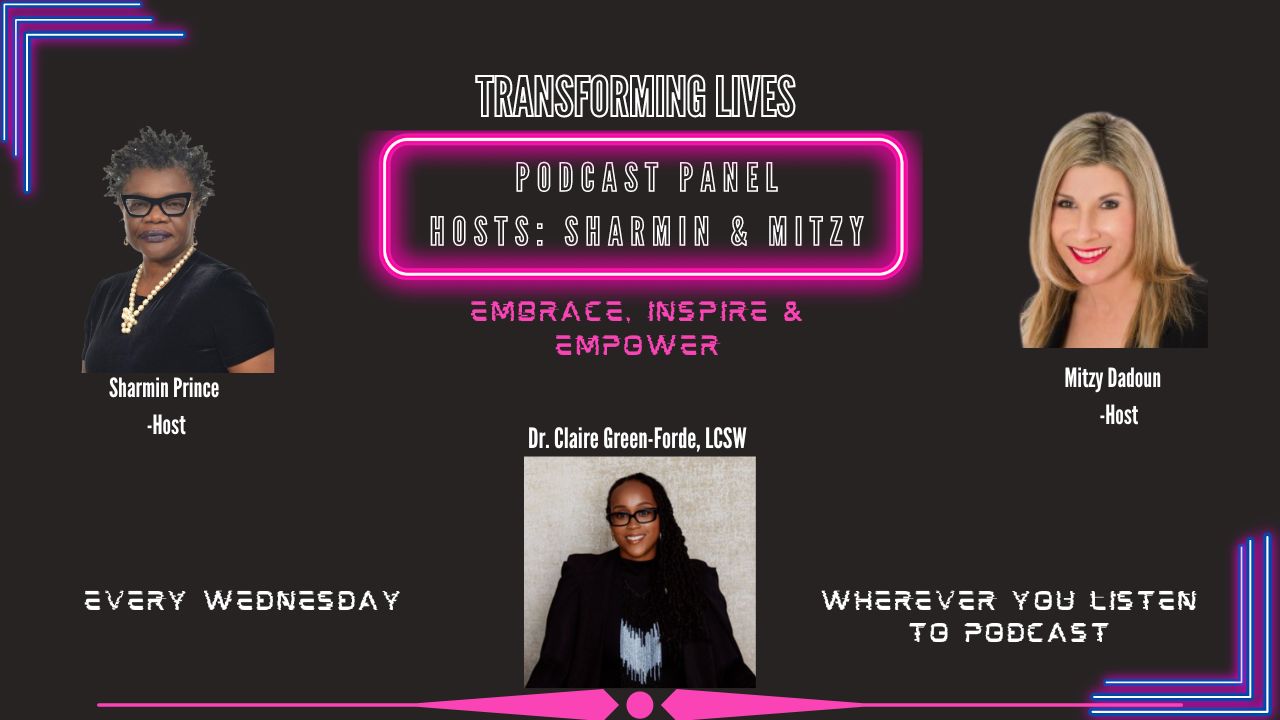
Welcome to the Transforming Lives Panel Podcast, where we strive to equip you with insights into the ever-changing realm of healthcare and well-being. In this episode, we're stepping into the significant yet often overlooked world of mental health with Dr. Claire Green-Forde. A staunch humanist and trailblazer in mental health, racial, and social justice intersections, Dr. Green-Forde gives us a wealth of insights into the pivotal connections between mental wellness and overall health.
Dr. Green-Forde's philosophy treats mental health as an integral part of everyday wellness. Rather than treating it as a separate entity. She argues that mental health affects our physical well-being, our social lives, and our ability to handle life's daily demands. Addressing mental health concerns as she advocates, can be a game-changer in improving our overall quality of life.
Sharmin Prince Host
Self–Discovery Coach, Entrepreneur, Gender Based Violence & Gender Equality Changemaker.
Facebook: https://www.facebook.com/SharminVanPrince
https://www.facebook.com/eaglessoarN413805Y
https://www.facebook.com/profile.php?id=100088212
X: https://twitter.com/SharminPrince
LinkedIn: https://www.linkedin.com/in/sharminprince/
https://www.linkedin.com/company/eagles-empowered-to-soar-inc-eets
Website: https://www.sharminprince.utobo.com
https:www.eaglessoar.org
Instagram: https://www.instagram.com/eagles_soar_inc/
https://www.instagram.com/sharmin_vp/
Mitzy Dadoun Host
Travel, Insurance, Seniors, Teens, Spirituality, Manifestation, Gratitude, Business, Real Estate, author of 6 books
http://www.wealthcreationconcepts.com/
http://www.smartseniorsrealty.com/
https://mdsocialsavvy.com/home
https://mitzydadoun.wearelegalshield.ca/
https://www.loveitreviews.com/
Dr. Claire Green Forde
https://www.drclairespeaks.com/
https://www.linkedin.com/in/dr-claire-green-forde/
**Connect with Us:**
- Follow the Transforming Lives panel podcast for more episodes featuring inspiring guests and transformative stories.
Youtube: https://www.youtube.com/channel/UCvHpiH1ROjGb8qP9MqAAFVQ
Facebook: https://www.facebook.com/profile.php?id=61578282042447
**Disclaimer:**
- The views and opinions expressed in this episode are those of the guest and do not necessarily reflect the official policy or position of the podcast.
SUBSCRIBE

Episode Chapters
Welcome to the Transforming Lives Panel Podcast, where we strive to equip you with insights into the ever-changing realm of healthcare and well-being. In this episode, we're stepping into the significant yet often overlooked world of mental health with Dr. Claire Green-Forde. A staunch humanist and trailblazer in mental health, racial, and social justice intersections, Dr. Green-Forde gives us a wealth of insights into the pivotal connections between mental wellness and overall health.
Dr. Green-Forde's philosophy treats mental health as an integral part of everyday wellness. Rather than treating it as a separate entity. She argues that mental health affects our physical well-being, our social lives, and our ability to handle life's daily demands. Addressing mental health concerns as she advocates, can be a game-changer in improving our overall quality of life.
Sharmin Prince Host
Self–Discovery Coach, Entrepreneur, Gender Based Violence & Gender Equality Changemaker.
Facebook: https://www.facebook.com/SharminVanPrince
https://www.facebook.com/eaglessoarN413805Y
https://www.facebook.com/profile.php?id=100088212
X: https://twitter.com/SharminPrince
LinkedIn: https://www.linkedin.com/in/sharminprince/
https://www.linkedin.com/company/eagles-empowered-to-soar-inc-eets
Website: https://www.sharminprince.utobo.com
https:www.eaglessoar.org
Instagram: https://www.instagram.com/eagles_soar_inc/
https://www.instagram.com/sharmin_vp/
Mitzy Dadoun Host
Travel, Insurance, Seniors, Teens, Spirituality, Manifestation, Gratitude, Business, Real Estate, author of 6 books
http://www.wealthcreationconcepts.com/
http://www.smartseniorsrealty.com/
https://mdsocialsavvy.com/home
https://mitzydadoun.wearelegalshield.ca/
https://www.loveitreviews.com/
Dr. Claire Green Forde
https://www.drclairespeaks.com/
https://www.linkedin.com/in/dr-claire-green-forde/
**Connect with Us:**
- Follow the Transforming Lives panel podcast for more episodes featuring inspiring guests and transformative stories.
Youtube: https://www.youtube.com/channel/UCvHpiH1ROjGb8qP9MqAAFVQ
Facebook: https://www.facebook.com/profile.php?id=61578282042447
**Disclaimer:**
- The views and opinions expressed in this episode are those of the guest and do not necessarily reflect the official policy or position of the podcast.
Sharmin Prince:
[00:00:30 - 00:01:25]
30 to 45 minutes and we can be in unison. Thank you for this opportunity. Take a deep breath with me and as you exhale, let go of all the tension, the stress, the things to do, and anything that can be a distraction to you for the next 45 minutes, just let it go, take another deep breath and just be present. And when you're finished, join us back and thank you for being with us. Thank you for spending your time with us and thank you for supporting the podcast.
Sharmin Prince:
[00:01:26 - 00:01:30]
Welcome Doctor Claire Green Ford.
Dr. Claire Green-Forde:
[00:01:31 - 00:01:35]
Thank you. I'm really honored and happy to be here. You know I love sharing space with you.
Sharmin Prince:
[00:01:36 - 00:02:36]
Thank you so much for being here and honoring us with your presence, especially because May is mental health awareness month here in the US. And before we continue, I'm going to read a short bio for Doctor Green- Forde Doctor Claire J. Greenford is an unapologetic humanist, an intersectional mental health and racial and social justice thought leader, speaker, practitioner and advocate. She's barbadian born and is a firm believer in the power of advocacy and community, and is passionate about public health, travel, art, culture, soccer, and people.
Sharmin Prince:
[00:02:36 - 00:03:31]
Health equity. It is the core of her work and she is a strong advocate for elevating equity and leading with empathy and authenticity. With almost two decades in organizational leadership, health equity, social impact, and mental health, Doctor Clare is the founder and CEO of Doctor Clare Speaks, LLC, an advisory and speaking consultancy dedicated to dismantling systemic inequalities in healthcare and healthcare education, advancing racial and social justice, and fostering organizational wellness. Join me in welcoming doctor clear.
Dr. Claire Green-Forde:
[00:03:32 - 00:03:34]
Thank you so much.
Sharmin Prince:
[00:03:35 - 00:03:40]
Is there anything that I missed in that bio that you would like to add?
Dr. Claire Green-Forde:
[00:03:40 - 00:04:01]
No. I appreciate you sharing. I do have an extensive background in providing mental health treatment for children and adolescents and adults. I have an extensive background in working in the criminal justice system as well. And so I've seen so many different things and I absolutely love, love, love sharing space with you.
Dr. Claire Green-Forde:
[00:04:01 - 00:04:09]
And I only would say just highlight again that I'm a soca warrior. I love that.
Sharmin Prince:
[00:04:11 - 00:04:32]
So Doctor Clare, with raising awareness during this month of mental health awareness within the US, what is a good starting point for us to begin our discussion?
Dr. Claire Green-Forde:
[00:04:33 - 00:05:17]
I would say starting that mental health is every day. I know that we have awareness months all the time. There's more issues and causes that exist in days of the year, but mental health is every day. I think we often separate our mental health from our physical health and well being, and we also don't understand or give enough attention to the different aspects of our lives that impact our mental health, whether that be worked, whether that be our families, whether that be our own childhood and lived experiences, our own stressors, whether you're a caregiver, whether you're taking care of a child, your parent, whoever. There's so many things that impact our mental health and well being, and so often we are told to just keep pushing past it.
Dr. Claire Green-Forde:
[00:05:18 - 00:05:49]
And I am so saddened when I continue to see this narrative that we should push past it. Even though we are talking about mental health more in America, we still see a lot of stigma connected to mental health. We still see a lot of shame connected to mental health, and we still see a lot of societies and systems that can actually be supportive, almost chastising people for saying, I'm human, too. I have this challenge, too. And so I would like for us to normalize that.
Dr. Claire Green-Forde:
[00:05:49 - 00:06:15]
To be human means that you will have mental health experience at some point in your life, regardless of your socioeconomic background, regardless of your gender, regardless of any factor that we think divides us. We will experience a mental health need because we experience health needs every day. And mental health is health. It's not separate. Your brain is the computer of your body.
Dr. Claire Green-Forde:
[00:06:16 - 00:06:20]
If your brain is not well, no other system in your body can function.
Sharmin Prince:
[00:06:23 - 00:06:33]
How can we help our listeners join the fight to normalize mental health?
Dr. Claire Green-Forde:
[00:06:34 - 00:06:59]
I think one of the biggest things that we can do is humanizing ourselves. In order to give empathy to someone else, you have to have empathy for yourself. In order to celebrate someone else, you have to celebrate yourself. And I would say, particularly depending on our cultural backgrounds, the way we were raised, we are taught not to do that. We are told it is selfish to celebrate yourself.
Dr. Claire Green-Forde:
[00:06:59 - 00:07:36]
We are told it is selfish to consider your well being before someone else. We always use this saying, an analogy, but it is true. If we have ever had the privilege of flying, and I recognize that many people have never had the privilege to fly. When you get on an airplane, before they even take off, the flight attendants will go through the spiel of exit doors and everything else. But one of the primary things they tell you is that should the cabin lose pressure, there will be oxygen masks that will drop down in front of you and secure your mask before you put on someone else's, even if it's your child.
Dr. Claire Green-Forde:
[00:07:36 - 00:08:10]
Because if you are trying to put your child's mask on and you lose oxygen, then you're both not okay. And we somehow believe that if we put our well being in front and center that we are not helping someone else. You have to recognize your own needs. There's no person that's listening right now that has not experienced discrimination. There's in some way, shape or form, whether it's because of their age, their gender, the way that their skin looks, the way that their hair looks, the money they have or don't have.
Dr. Claire Green-Forde:
[00:08:10 - 00:08:29]
We have all experienced some form of oppression. Every single person has an intersecting identity, which means different aspects that make us who we are. There's no way that we can even experience the world and not have those. So when we think about, how do we start being an advocate for mental health? Start with you.
Dr. Claire Green-Forde:
[00:08:30 - 00:08:47]
When you need to rest, take the rest. When you can't take up the phone call because you're tired of being the person listening to the same issue over and over again from the same friend who won't break up with that person. That's horrible for them. You need a break. And it's okay to say that I need to go take a walk, I need to sleep.
Dr. Claire Green-Forde:
[00:08:47 - 00:09:09]
I need to rest. I need water. I need to get up and stretch. When you start recognizing and celebrating your own humanity, it is so much easier to extend that to other people. So we have to first start with fighting the myths that we are not deserving of the care and the self celebrations that we are entitled to.
Dr. Claire Green-Forde:
[00:09:10 - 00:09:14]
Our goal is to thrive. It's not merely just to survive.
Mitzy Dadoun:
[00:09:15 - 00:10:35]
You know, I love the analogy that you gave because it's really, I think, simplifies it for people and helps them be able to picture it. As far as that, putting your own oxygen mask on first, because, as you say, if anyone's flowing, you know, you've heard that every single time you're on a plane, you know, but it really does apply through life, which is that, you know, we have to keep our own mental health in check and be aware of, acknowledge and give ourselves permission to take that ten minute break or go for that walk, or say, no, I'm sorry, today I can't help you. It's not convenient for me. I'd love to, but no, I can't. Because I think that that's one of the hardest things, especially for people who are compassionate of other people, is still learning how to be able to say no, but still feel like you're being there for the person and you are being compassionate, but recognizing that you may not have the strength or fortitude to deal with whatever that particular issue is today.
Dr. Claire Green-Forde:
[00:10:36 - 00:10:37]
Absolutely.
Sharmin Prince:
[00:10:41 - 00:10:57]
What are some signs and symptoms that we should pay attention to?
Dr. Claire Green-Forde:
[00:10:58 - 00:11:43]
I am going to do this in twofold because often what we look at in terms of signs for mental health. And I always say mental disease because it's a dis ease in our bodies, a dis ease in our souls, a dis ease in our minds is the blending of symptoms for children and adults, and they're not the same. So we typically will see in adults, we may see challenges with sleeping. So whether you are sleeping too much or you're sleeping too little, but still always feeling fatigued, you can sleep for hours and still feel extremely exhausted. We may see changes in appetite.
Dr. Claire Green-Forde:
[00:11:43 - 00:12:03]
Either I'm really, really hungry all the time, or I'm not hungry at all. I'm having to remind myself by a calendar to eat, or I'm eating all the time and I'm still not feeling full. Right. Those kind of absentminded things. We may see depressed mood in people.
Dr. Claire Green-Forde:
[00:12:04 - 00:12:27]
We may see, people may feel sad or down a lot, they may isolate a lot. So one of the big things we look at is changes in our social functioning. Are you the person that used to hang out, you go to all the fats, you go to whatever, but now you're not hanging out with people much or you're not really interested in doing those things. We see a loss in interest in things that used to bring us pleasure. Right?
Dr. Claire Green-Forde:
[00:12:27 - 00:12:44]
So I used to love running. Now I don't really run anymore. I'm not getting that pleasure from not even motivated to do it. When we look at other areas of our lives, we then see challenges with concentration. So are you having more difficulty at work, focusing on this project, getting this task done?
Dr. Claire Green-Forde:
[00:12:44 - 00:12:56]
You know, you're making more mistakes. You're forgetting a lot of things. You know, you have this, this game for your child. You wrote it on the calendars, you put it on the fridge, you still forgot about it. You are feeling overwhelmed.
Dr. Claire Green-Forde:
[00:12:56 - 00:13:13]
You're not able to catch up with a lot of things. Irritability, outburst of anger, aggression. Those are very common telltale signs of depression. But we don't look it that way because we only look at anger. It's a big scary thing, right?
Dr. Claire Green-Forde:
[00:13:13 - 00:13:29]
Anger is an emotion. I don't believe that there's thing if we can manage anger, because that means we would need to manage all the 3000 plus emotions that we have so far discovered that we have. And we don't do that. We don't have a happiness management class, right? We don't have a fair management class.
Dr. Claire Green-Forde:
[00:13:29 - 00:13:44]
Right? We have to recognize too that what we see in children is not the same. A lot of times. If you've seen any commercials for medications for depression, it's always the person who looks really sad. There's a rain cloud over them.
Dr. Claire Green-Forde:
[00:13:44 - 00:13:54]
Kind of think of Winnie the Pooh. Eeyore. I am a huge Winnie the Pooh fan, so eeyore is my reference. You think of Eeyore if you are aware of that cartoon. He's sad, he's melancholy.
Dr. Claire Green-Forde:
[00:13:54 - 00:14:29]
He's always saying, the world is always upside down. But depression can also look like someone who's spending a lot of money all the time and making really risky decisions, having a lot of sexual partners just out of nowhere, doing some really extreme behaviors at a high risk. And we tend to see those behaviors in children a lot more. We also tend to see a lot of aggression in children, a lot more irritability, the difficulty concentrating. So the child that you're getting mad at and screaming and yelling at because they're not passing their exams, that's the child that may be living with depression, and you're thinking they're just not listening.
Dr. Claire Green-Forde:
[00:14:29 - 00:14:40]
The child that seems absent minded. And, yes, we have to balance normal childhood development and adolescent development. They're going to get on your nerves. They're going to talk back. These are all very normal.
Dr. Claire Green-Forde:
[00:14:40 - 00:14:53]
We have to go through this stage. Even if we say, I didn't talk back to my parents because I know they would take me out this world, all the things that we say. The reality is that when we got with our friends, we said all the things that we couldn't say in front of our parents. We did do it. We just didn't do it in front of them.
Dr. Claire Green-Forde:
[00:14:53 - 00:15:14]
So we are doing these things. But children tend to take a lot more risk. And you will also see, perhaps sometimes changes in appetite and changes in sleeping. But a lot of what we don't focus on is the irritability and the outburst of anger. And that is something that I will say is common for both children and adults.
Dr. Claire Green-Forde:
[00:15:14 - 00:15:51]
But when it's a child, we tend to particularly I'm caribbean. It's particularly from the Caribbean. We think somehow it's a disciplinary issue and not recognizing that it's a medical issue, because one of the things I do want to also highlight is that mental health is a health condition. Just like diabetes, hypertension, you name it, it is a medical condition. And if you're going to go to your doctor to manage your a one c because it's elevated and you have prediabetes or you're diabetic and you need metformin or you need medications to help address that or lifestyle changes, because it's not always medication and maybe life, child changes.
Dr. Claire Green-Forde:
[00:15:51 - 00:16:18]
It's the same thing. If you're going to go to the doctor because you broke your arm to get a cast, why, if your mind, which is mental health, is a, can be very much a brain disease because it has to do with chemicals in our brains, hormones, things not being imbalanced. If you would go get a cast because you broke your arm, why would you not go seek help because you feel broken inside?
Sharmin Prince:
[00:16:20 - 00:16:26]
I want you to repeat that phrase, that mental health is, please do.
Dr. Claire Green-Forde:
[00:16:27 - 00:16:37]
Mental health is a health condition. That's why it's ending with health. Right? Again, it's. There's no difference between mental health and physical health, because it's all health.
Dr. Claire Green-Forde:
[00:16:37 - 00:17:06]
At the end of the day, we're talking about the fullness of our humanity and embracing the fullness of our humanity. You cannot embrace the fullness of your humanity. If you decide that some aspects of your humanity are not worth paying attention to, because society has told you that, it means you're not strong enough, that you're not good enough, that you can't get through things, that you need to bounce back. One of the things I always tell people is that I do not believe in the term resilience. To the extent that we overuse it.
Dr. Claire Green-Forde:
[00:17:06 - 00:17:14]
We are resilient. We are. We are literally wired that way. It's how our species has survived. But resilience is like a rubber band.
Dr. Claire Green-Forde:
[00:17:15 - 00:17:35]
If you use a rubber band and you keep putting stacks of paper, over time, that rubber band gets a little micro tears. And it will stretch. Absolutely. They're made to stretch. And you may not notice those micro tears in the rubber band for a while, but there's going to be one day where you put one more sheet of paper and it breaks.
Dr. Claire Green-Forde:
[00:17:35 - 00:18:07]
That is the overuse, to me, of the term resilience, that we keep telling people that they need to keep bouncing back, and they can do it, and they can find it within themselves. No one is an island, and we don't get through things without support. And the way that you can't build a house with one trade, you need carpenters, you need masons, you need plumbers, you need electricians. What's the difference with needing a cardiologist, with needing a primary care doctor, with needing a gynecologist, and needing a mental health specialist? You can't build your house and maintain your house with one specialty, if none at all.
Dr. Claire Green-Forde:
[00:18:08 - 00:18:32]
And even if you are a trades person, the likelihood that you know every single trade very low. And so I think that until we can fully embrace the fact that it is health. And truly, there's such connections between our mental health and our physical health. Depression and anxiety are very highly correlated with diabetes. And we're from the Caribbean and I'm from Barbados.
Dr. Claire Green-Forde:
[00:18:32 - 00:19:11]
Barbados has an exponential challenge with diabetes. There's a high correlation with depression and anxiety. If you have medical conditions and you're physically in pain a lot, there's a high correlation that you will have symptoms of mood disorder, depression, whether it's major depression, whether it's dysthymia, or what we also call persistent depressive disorder, which is a milder form of depression that is lasting at least two years. At least two years. So you're having a depressed mood for at least two years and with two other diagnostic criteria or two other symptoms.
Dr. Claire Green-Forde:
[00:19:11 - 00:19:56]
But I want to also emphasize that this then also comes with the reality that you could then experience a major depressive episode where it might be a struggle for you to even get out of bed or even take a shower or even eat. Then you cycle the challenges that we look at someone and we think, because they are still functional in our mind, that they're okay. The other thing I will say about depression and other forms of mental health dis ease. Whether it's schizophrenia, which is a psychotic disorder, which there's a detachment from reality, may have hallucinations, you may see things, whether or not it's anxiety. And we know what that feels like in our body, that nervousness, that fight or flight response, whether or not it's any, whether it's related to trauma.
Dr. Claire Green-Forde:
[00:19:56 - 00:20:32]
And a lot of people are walking around or living with trauma and severe trauma. We know that there are ways that we can help mitigate those challenges, but we know that they can be incredibly debilitating. And so much so that there's a correlation between maternal health and the health and well being of a child in utero and after they're born. We know that there's a correlation between the health and wellbeing of caregivers and their ability to caregive. Right.
Dr. Claire Green-Forde:
[00:20:32 - 00:21:00]
Whether, again, that is a child or you're taking care of a family member, a loved one who may need support. We know that stress wears on every part of the body. And what we call is something called weathering, or the allostatic load as well as another, is another term when the stress demands of your life outweigh your capacity to deal with them. It has nothing to do with how strong you are. It has to do with the reality that the rubber band got stretched too long and too much.
Dr. Claire Green-Forde:
[00:21:00 - 00:21:26]
And it finally popped. But unlike rubber bands, there is not a pack of a thousand to go back and get another rubber band. When it comes to you, there's only one you. There is no other person on the planet at this point in time or ever in the history of the world. That will be the gift you are to the world right now, to your family, to your friends, to your community, to yourself.
Dr. Claire Green-Forde:
[00:21:27 - 00:21:46]
There's only one you. There is nobody else that can fill those, those giftings that you have. And so why, if you're such a precious gift, why, if I am such a precious gift? And I say to myself, too, because I am not going to say that as a mental health practitioner, I am above the challenges. I too have lived with depression.
Dr. Claire Green-Forde:
[00:21:46 - 00:22:14]
I too have lived with anxiety. I, too live with medical conditions that impact how I feel. And it is very challenging. But I also have been with my therapist for three and a half years, and I have therapy every week and sometimes twice a week because I cannot help heal people and help people if I am not healed and if I am not well and if I don't have those tune ups. And so I just want that we can understand that it is health.
Dr. Claire Green-Forde:
[00:22:15 - 00:23:16]
And as we have annual physical appointments, if we are privileged enough to have healthcare, and if we're privileged enough to have access to healthcare, because I'm very clear that not everybody does. Just as you may need to go to the dentist every six months for good checkups and cleanings, you need tune ups, cars need tune ups, houses need maintaining, your dishes need to be washed. This is a constant thing. And so I hope that people can, if nothing else, take away that depression, anxiety, schizophrenia. Any mental health condition is a health condition and requires support from trained professionals, not your friends, not your family, not the fact to help you navigate and address the root causes it, because oftentimes we're using the friends, the family, the parties, the alcohol, the sex, the whatever it is, to fill and fix those voids.
Dr. Claire Green-Forde:
[00:23:16 - 00:23:20]
And it's just putting a band aid on a wound, and you have to clean that wound out.
Mitzy Dadoun:
[00:23:22 - 00:24:04]
I wanted to circle back a little bit to something you said, which you were talking about with children. And if they're not getting good marks as an example, you know, the parents discipline because they're not behaving. So, and you said, you know, often it could be maybe they're having some kind of mental health issues. So how can a parent sort of ascertain whether it's a mental health issue or if it's a just a behavior issue or, you know, something else right. Because not all times when a child is misbehaving, as in a mental health issue, the same way as not all times, it's not.
Mitzy Dadoun:
[00:24:04 - 00:24:09]
So how, what are some of the ways that you could identify whether it's one versus the other?
Dr. Claire Green-Forde:
[00:24:10 - 00:24:25]
So I think it is a matter of being fully present and observation. And the first thing is ask what is it like to be you? What does it feel like to be a kid these days? What is it? What is it like to be at school?
Dr. Claire Green-Forde:
[00:24:25 - 00:24:42]
What is it like at home for you? Are there things that I'm doing? Are the way that I speak to you that you love and are there ways that I speak to you that you don't? Are there things that you're not comfortable talking to me about? How do you feel in the morning?
Dr. Claire Green-Forde:
[00:24:42 - 00:24:57]
You're sleeping a lot. Why are you sleeping so much? We have to get curious. I am from a culture where children are seen and not heard. And many people are from cultures where children are seen and not heard.
Dr. Claire Green-Forde:
[00:24:57 - 00:25:14]
Children are human beings. We are all children at one point. That is something we all share, regardless of our gender, regardless of our sexual identity, regardless of our religion. We all share the fact that we were children at one point. What did you need as a child?
Dr. Claire Green-Forde:
[00:25:14 - 00:25:33]
What may have been helpful for you as a child? If you had the teacher that you were really close to? What made that something that you were someone you could talk to? We have to get curious. I would also say ADHD is a mental health condition.
Dr. Claire Green-Forde:
[00:25:33 - 00:25:45]
Right. Attention hyperactive disorder is an attention. Right. It's a mental health condition. Autism is a mental health condition.
Dr. Claire Green-Forde:
[00:25:46 - 00:26:14]
There's so many mental health conditions. Dyslexia, which is a processing disorder where you may read words and they may be mixed up for you, or letters may be mixed up for you. And many people live with this. One in five people, it is assumed at least one in five adults has a mental health condition in the United States. And that is information that we can extrapolate to the larger world.
Dr. Claire Green-Forde:
[00:26:14 - 00:26:38]
Because of research in other countries, like Europe and other countries. Right. Very close and similar, it is estimated that at least one in six children has a mental health condition. I would say that that's a pretty high stat, particularly because, again, we know there's a lot of underreporting. And so let's just go with the thing that an estimated 20% of the population has a mental health condition.
Dr. Claire Green-Forde:
[00:26:38 - 00:27:40]
That's a very high percentage. We also know that most of the mental health conditions that we live with as adults first show signs in adolescence and then typically it takes at least ten years between somebody first having symptoms, but when they get help. So if I am experiencing a mental health condition at 14, the likelihood of me getting help and intervention is not until I'm 25, 26, 27, if at all. We know, particularly when it comes to, and I'm always going to center race and social and racial justice and equity. We know that there's a growing number of women, particularly black women and women of the global majority, who are now being diagnosed with ADHD, in their forties, in their fifties, in their sixties, because we ignored those behaviors and we told them it was something to do with their lack of discipline, their lack of focus.
Dr. Claire Green-Forde:
[00:27:40 - 00:28:09]
They're not paying enough attention, they're not trying hard enough. And now it is like, oh, these people got through school life, parenting, all of this stuff, living with a mental health condition that no one paid attention to. We also know that women tend to have depression two times more than men. Is that a function that men don't typically tend to access mental health services as much as women? It could possibly be.
Dr. Claire Green-Forde:
[00:28:09 - 00:28:58]
Men tend to access substance abuse services on a lot higher rates than women. But I want to be clear that substance abuse is also a mental health condition. Addiction is a mental health condition. Whether that is alcohol, whether that is drugs, whether or not that is shopping, whether or not it's sex, whatever it is, it's a mental health condition. And so if we go with the assumption that most people will have a mental health condition at some point in their life, and depression is the leading disability in the world, according to the World Health Organization, I think it makes it a little bit more palatable to lead with how do I help and support my child?
Dr. Claire Green-Forde:
[00:28:58 - 00:29:27]
What is happening to my child, what is happening to my mother, what is happening to my husband, what is happening to my son, my brother, my friend, my cousin, my aunt, my uncle, versus what is wrong with them. If we lead with what is, what is happening instead of what is wrong, it creates a lot more space for people to share and for you to see and celebrate who they are, as well as hopefully get support for their needs.
Mitzy Dadoun:
[00:29:28 - 00:29:48]
I think that that's a really great point, is that what is happening to someone versus what is wrong? Because I think that that's, we have to educate and continually be reframing that. So that becomes the normal, that becomes the most common said thing versus what's wrong.
Dr. Claire Green-Forde:
[00:29:48 - 00:29:50]
Yeah, right.
Mitzy Dadoun:
[00:29:50 - 00:30:26]
So it has to be continually put out there to help make that shift. So what are some of the strategies or tools that somebody could use if they realize that they are having some issues. What are some of the things that they could be doing to kind of help themselves work it through? Because, as you say, not everybody has access to help. So what are some things that somebody could do on their own that could possibly help them when they're feeling like this?
Dr. Claire Green-Forde:
[00:30:26 - 00:30:53]
So I think one of the most important things is what you said, when they recognize, right. So I think the first thing is even recognizing that something is going on or that you may not be feeling the way that you want to feel, and also knowing that it's okay because you're not alone. This is the story of millions of people every single day. This has been the story of people throughout history. I know that we, particularly, again, in the Caribbean, we, a lot of the countries are christian based.
Dr. Claire Green-Forde:
[00:30:53 - 00:31:15]
I can give you many examples of people in the Bible right now that have diagnosable mental health conditions that are very clear in the Bible. We're having mental health conditions. And so recognizing how common this is and that you're not alone, I think, is the first thing. Being in community with people that celebrate you and listen to you is another. A lot of times we tend to dismiss people, oh, you should just be happy.
Dr. Claire Green-Forde:
[00:31:15 - 00:31:27]
Oh, firearm. Go to the party. Depression has nothing to do with just being happy. It's a chemical imbalance in your brain. Schizophrenia is a chemical imbalance.
Dr. Claire Green-Forde:
[00:31:27 - 00:32:09]
ADHD is something with chemicals, like they're all having to do with things that are well outside of your control. So the other thing is recognizing that you don't have full control over this, because I cannot think of anyone in the career I've had, and I don't do direct practice anymore, but I've met and treated some of their mental health needs. I can't think of any of my patients who, if they could just snap out of it, they wouldn't have, because they lost their marriages, they lost their jobs, they lost their careers, they lost their children, they lost their homes, they lost themselves. No one would choose that. And so being a community with people that will validate and acknowledge and listen to you is really important.
Dr. Claire Green-Forde:
[00:32:09 - 00:32:34]
I will say, I know it is hard to get professional help. I will never say it's not. But if you can, and if you do, at least have a primary care physician, at least speaking to your doctor about what's happening. All medical doctors have to go through, at least in the United States, and I will speak about the Caribbean separately, because it does upset me what we do. Medical doctors in America have to go through rotations.
Dr. Claire Green-Forde:
[00:32:34 - 00:33:09]
They all have to go through gyn rotations, psychiatry rotations, general health rotation, you name it, then they decide to specialize. There's unfortunately, though, in America and in the Caribbean, very little attention is paid to educating providers about the mental health conditions, whether it's mental health conditions that come out because of menopause. We didn't talk about that. For women and perimenopause, there's significant correlations between mood changes and when someone who has a womb is going through perimenopause and menopause. And we don't talk about that.
Dr. Claire Green-Forde:
[00:33:09 - 00:33:55]
We don't talk about the realities of what it is to just live in the bodies that you live in. If you're in a country that is very impoverished and you're struggling every day to just survive, whether you're in a war torn country, whether you're in a country that you're being persecuted because of your religious identity, whatever the reasons are, we don't talk about those things. So being in community with people, that can validate seeking out providers or different people that can be helpful, and that may be a doula if you are carrying a child, because doulas, a lot of them, are trained in a vast amount of services. I know that in some parts of the world, that's much more common than it is here. If it's your spiritual leaders, if you have any.
Dr. Claire Green-Forde:
[00:33:55 - 00:34:13]
But I will. We can also touch about the challenge within spiritual spaces, because sometimes those spaces can be more harmful than helpful. Are there other people in your networks, if you're a student? Is there someone at your school? If you don't feel you can talk to your parents, that a trusted adult that you can talk to and share?
Dr. Claire Green-Forde:
[00:34:13 - 00:34:30]
I have a mentee. She's very, very young, and we spoke a while ago about some of the challenges she was dealing with, and she wasn't able to talk to her parents. And she's dealing with some serious things, and I'm not where she is. I can't provide the mental health services for her. That would be unethical.
Dr. Claire Green-Forde:
[00:34:30 - 00:34:50]
But then I started talking through with her. Are there any teachers who, who do you have? And she was able to identify, oh, my teacher from two years ago that I still talk to. I can talk to her about what's going on through talking to her teacher. The teacher then connected her to the counseling services in her school.
Dr. Claire Green-Forde:
[00:34:50 - 00:35:27]
She's still talking to her teacher because this is a safer place. Those people were then able to help as adults now bridge the gap with her parents to talk to her parents about what she's going through, you have to be invested. So being in community with people who are invested, there's some other things that we can do. There's a lot of research that shows that exercise and movement can be incredibly helpful in helping to mitigate, not erase for everyone some of the particularly mood disorder features. But I want to say, if you're dealing with depression and have low mood, it's really hard to be motivated to do those things.
Dr. Claire Green-Forde:
[00:35:28 - 00:35:39]
It's a cyclical challenge. But exercise and moving, being out in nature, we learned throughout the pandemic, which many of us knew. I am from the islands. The water is where I feel. Closest to God is where I feel healing.
Dr. Claire Green-Forde:
[00:35:39 - 00:36:22]
Being in nature, particularly in the water, is where I feel healing. There's a lot of research around how just being in nature, being in the, walking around the trees, walking around the beach, walking in a park, how helpful just being in that environment can be. Even if you're not walking, if you're reading a book, if you're just sitting and just in that space, how calming it can be for your nervous system. And so those are some things that people can do. But I will say that if you do have access to at least one type of healthcare provider, not the friend across the street, if you do, speaking to your healthcare provider can be extremely helpful.
Dr. Claire Green-Forde:
[00:36:22 - 00:36:31]
But some of the other things, such as movement and going into nature, if you have access to those things, can also be really helpful. But you have to speak up and say what's going on.
Mitzy Dadoun:
[00:36:33 - 00:36:58]
When you were talking, I was thinking, you know, as a kid, when I was stressed, I would always go down and go for a walk along the beach. And the other thing would be, I would get on the swings and I would swing. And I still, as an adult, will go, and I'll sit up like we've got a porch swing, but I'll actually go, like on the kids swings as well. And I remember reading somewhere that that movement, that swinging movement can be very beneficial. I can't remember it is, but I remember reading that.
Mitzy Dadoun:
[00:36:58 - 00:37:02]
And I find for me personally, that that is one of the things that works.
Dr. Claire Green-Forde:
[00:37:03 - 00:37:07]
Yes, I love that. Thank you for sharing that. Absolutely. Swinging, right? That back and forth.
Dr. Claire Green-Forde:
[00:37:07 - 00:37:39]
There's something calming about that low that happens, right. It also brings your mind back to a time where you were not as stressed, where you were having less things on your mind. And so you are able to activate your amygdala, which is, I call it the little control center of your life, because it's a very small part of your brain and takes over everything. It's your emotional command center in your brain. Now you're recreating, unconsciously, a time and period where your mind and your body feels more relaxed and you're calming down.
Dr. Claire Green-Forde:
[00:37:39 - 00:38:03]
Breathing is another way that we can help mitigate. So Charmaine started with, can we take some breaths? Box breathing cycle breathing, breathing deeply, sighing. All of those things can help regulate. I always tell people when you sigh, you automatically have to take a breath because it's now forcing oxygen back into your body because you just let it out.
Dr. Claire Green-Forde:
[00:38:03 - 00:38:11]
It's not even something you control. It's literally your primitive brain is going to do it. Because we don't control breathing. We don't control body temperature. That's the back of our brains.
Dr. Claire Green-Forde:
[00:38:11 - 00:38:22]
That's our primitive brains. It's going to automatically do that. So breathing is another thing, another thing that you can do. For some people, we call it grounding. And there's different ways.
Dr. Claire Green-Forde:
[00:38:22 - 00:38:50]
You might have a little rubber band, you know, the fidget spinners that were driving parents and adults cuckoo bananas before. Those are things that can help when you're doing this kind of repetitive motion or you're squeezing something, a stress ball, a cotton ball, those types of things. That kind of repetitive action can be very soothing for some people. And you can have your hand in your pocket, and no one knows that you're playing with a rubber band or that you're playing with, you know, a little ball or whatever it is.
Mitzy Dadoun:
[00:38:50 - 00:38:51]
Right.
Dr. Claire Green-Forde:
[00:38:51 - 00:39:15]
And so there's a lot of different techniques. But I will say that while there's a lot of different techniques, you have to find the thing that works for you, because walking in the park for me with my allergies is not calming. It's not. I will be sneezing and itching and miserable. But I know that when I do have the opportunity to go back home or go to the Caribbean or go to places that have beaches that mirror mine, I feel calm and I feel rested.
Dr. Claire Green-Forde:
[00:39:15 - 00:39:29]
And if I don't, working out is something that is really helpful for me. Prayer is something that can be very helpful for me. Meditating, you know, taking a walk, stretching, all these different things. And none of those things require money or resources.
Mitzy Dadoun:
[00:39:30 - 00:39:39]
Listening to music also can be because you can kind of get yourself lost in the music and go back to different times and memories and things.
Dr. Claire Green-Forde:
[00:39:39 - 00:39:49]
Absolutely. It's why I love soca. I'm going to put on soca and jump around. I'd say getting the energy out, but, yes, absolutely. Music is incredibly healing for so many people.
Dr. Claire Green-Forde:
[00:39:49 - 00:40:02]
And, in fact, there's an entire discipline of licensed and creative arts therapists who provide mental health support and therapeutic interventions using music and movement and dance.
Sharmin Prince:
[00:40:05 - 00:40:14]
Well, Doctor Clare, we have to have you back because you raised a few topics, women, mental health and menopause.
Dr. Claire Green-Forde:
[00:40:15 - 00:40:16]
Absolutely.
Sharmin Prince:
[00:40:17 - 00:40:41]
And we still need to talk about how socialization impact our mental health. So we would need you to return and share your knowledge. This has been so informative. Thank you so much for your time. Thank you for your wisdom.
Sharmin Prince:
[00:40:41 - 00:41:02]
Thank you for your knowledge. Thank you also for your self disclosure. I know that's a great impact, that's going to have a great impact on our listeners because it did for me. Do you have anything else that you want to leave? with our listeners?
Dr. Claire Green-Forde:
[00:41:03 - 00:41:22]
I just want you to know how valuable and important you are. And the only person that can celebrate the gift of you is you. You are worth healing. The journey of healing can be painful, but the choice to remain the same is even more painful. You're worth healing.
Sharmin Prince:
[00:41:25 - 00:41:26]
With that.
Mitzy Dadoun:
[00:41:27 - 00:41:29]
Thank you so much for joining.
Sharmin Prince:
[00:41:33 - 00:41:36]
And we will see you next time.
Mitzy Dadoun:
[00:41:38 - 00:41:38]
Bye.