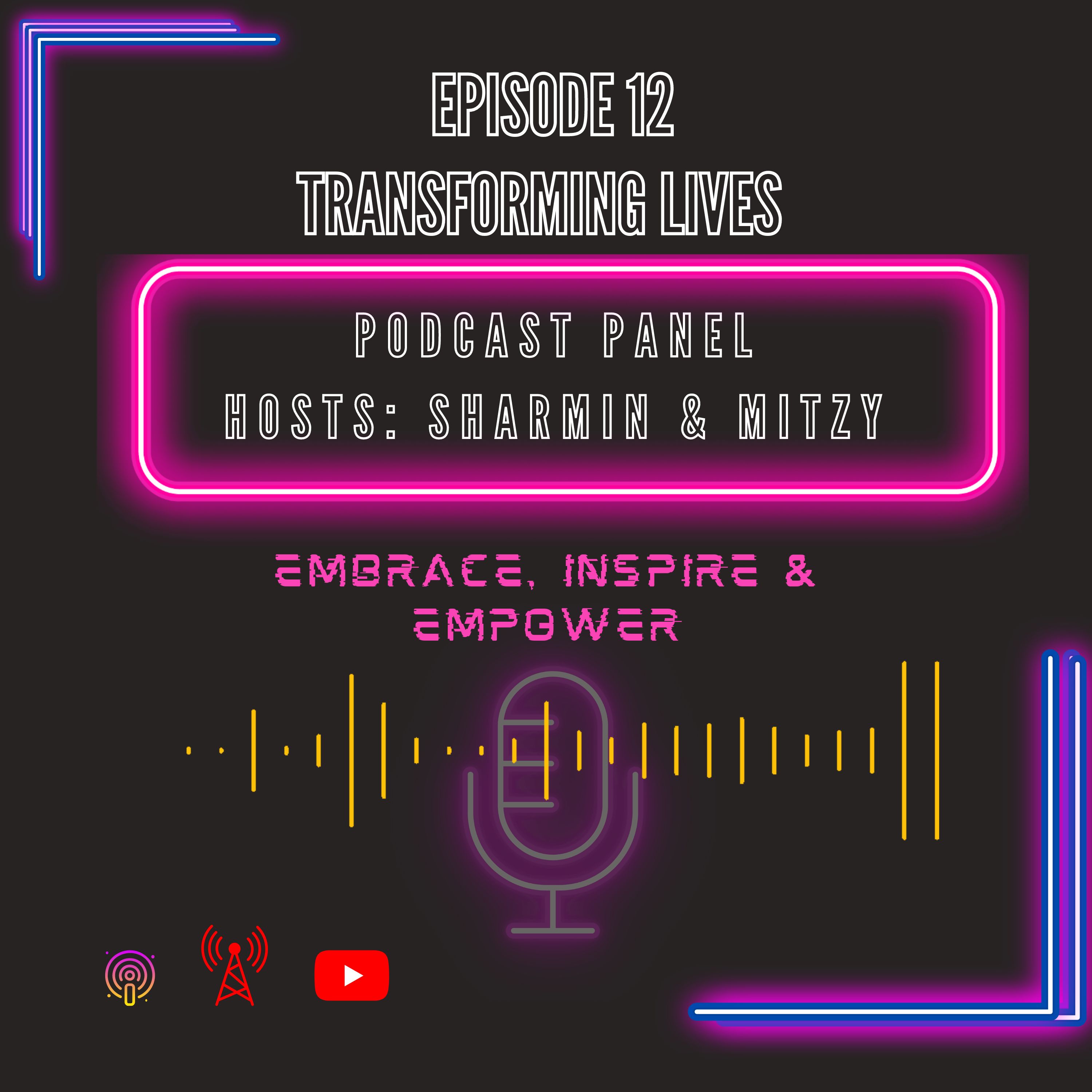
From Theory to Practice: Dr. O
Transforming Lives Panel Podcast
| Sharmin Prince & Mitzy Dadoun | Rating 0 (0) (0) |
| Launched: Aug 28, 2024 | |
| info@tlpod.com | Season: 2 Episode: 12 |
how Notes for Transforming Labs' Panel Podcast Episode with Dr. Mary O'Connor
Episode Title: Transforming Musculoskeletal Care: Insights from Dr. Mary O'Connor
Hosts: Charmin & Mitzi
Guest: Dr. Mary O'Connor
- Co-founder and Chief Medical Officer of VORI Health
- Professor Emerita of Orthopedic Surgery at Mayo Clinic
- Former Professor at Yale School of Medicine
- Olympian, U.S. Women's Rowing
- Chair of the nonprofit Movement is Life
Key Takeaways:
- Health disparities exist in orthopedic and spine care, especially among marginalized communities.
- Collaborative care models can enhance patient experiences and outcomes.
- Behavior change is challenging but essential for health improvement.
- Community resources are crucial for promoting wellness and preventing illness.
- AI can be a valuable tool in healthcare, but it must be used thoughtfully and ethically.
Connect with Us:
- For more insights and to connect with our guest or hosts, check the show notes for contact information and resources.
Thank You for Listening!
We appreciate your support and hope you found valuable insights in today's episode. Please share this podcast with others who may benefit, and stay tuned for our next episode!
Host: Sharmin Prince
Coach, Entrepreneur, Consultant, Trainer, Content Creator, SoulHealer.
Facebook: https://www.facebook.com/SharminVanPrince
https://www.facebook.com/eaglessoarN413805Y
https://www.facebook.com/profile.php?id=100088212
X: https://twitter.com/SharminPrince
LinkedIn: https://www.linkedin.com/in/sharminprince/
https://www.linkedin.com/company/eagles-empowered-to-soar-inc-eets
Website: https://www.sharminprince.utobo.com
https://www.sharminprince.com
https:www.eaglessoar.org
Instagram: https://www.instagram.com/eagles_soar_inc/
https://www.instagram.com/sharmin_vp/
Host: Mitzy Dadoun
Travel, Insurance, Seniors, Teens, Spirituality, Manifestation, Gratitude, Business, Real Estate, author of 6 books
http://www.wealthcreationconcepts.com/
http://www.smartseniorsrealty.com/
https://mdsocialsavvy.com/home
https://mitzydadoun.wearelegalshield.ca/
https://www.loveitreviews.com/
Guest: Dr. Mary O'Connor MD
Email: mary.oconnor@vorihealth.com
Website: https://www.vorihealth.com/
**Connect with Us:**
- Follow the Transforming Lives panel podcast for more episodes featuring inspiring guests and transformative stories.
Youtube: https://www.youtube.com/channel/UCvHpiH1ROjGb8qP9MqAAFVQ
Facebook: https://www.facebook.com/profile.php?id=61578282042447
**Disclaimer:**
- The views and opinions expressed in this episode are those of the guest and do not necessarily reflect the official policy or position of the podcast.
Episode Highlights:
-
Introduction of Dr. Mary O'Connor: Charmin introduces Dr. O'Connor, highlighting her extensive background in orthopedic surgery, her role at VORI Health, and her commitment to health equity through Movement is Life.
-
Health Disparities Discussion: Dr. O'Connor discusses the significant disparities in orthopedic and spine care, particularly affecting communities of color and individuals of lower socioeconomic status. She emphasizes the challenges these groups face in accessing quality healthcare.
-
Innovative Patient Care Model: Dr. O'Connor explains VORI Health's approach to patient care, where the initial visit includes both the physician and physical therapist working collaboratively with the patient, streamlining the process and enhancing patient experience.
-
Behavior Change in Healthcare: The conversation touches on the challenges of motivating patients to make health-related behavior changes and the importance of health coaches in facilitating these changes through SMART goals.
-
Reimagining the Healthcare System: Dr. O'Connor advocates for a shift from a "sick care system" to a "well care system," emphasizing the need for community empowerment and access to healthy living resources.
-
Role of AI in Healthcare: The discussion includes the potential benefits and risks of AI in healthcare, stressing the importance of clinical judgment and shared decision-making with patients.
-
Final Thoughts: Dr. O'Connor shares her gratitude for the opportunity to discuss these important topics and expresses her willingness to return to share research findings once available.
Speaker 1
00:00
Hi, I'm on transforming Life's panel podcast. I'm 1 of your hosts, Sharmin, and I'm here with Mary O'Connor, who is the co-founder and chief medical officer of VORI Health, the pioneering nationwide virtual first physician-led musculoskeletal medical practice. Dr. O'Connell and her multidisciplinary team are revolutionizing the healthcare system by effectively reducing the high rates unnecessary spine and orthopedic surgeries.
S1
Speaker 1
00:51
An advanced medical imaging creating immense value for both patients and peers. Dr. O'Connell is a professor, is Professor Emerita of Orthopedic Surgery at Mayo Clinic and a former professor at Yale School. I'm going to bleep that out.
S1
Speaker 1
01:21
She is also a former professor at Yale School of Medicine, beyond her remarkable professional accomplishments. Dr. O'Connor, she's also an Olympian, U.S. Women's rowing, and she brings her passion and her power of sports to us today.
S1
Speaker 1
01:54
Dr. O'Connell, welcome. Sharmin, that was such a lovely introduction. Thank you so much.
S1
Speaker 1
02:03
You are welcome. Is there anything you want to add to your bio? No, that's enough. It's an amazing bio.
S1
Speaker 1
02:14
Well, Actually, I will add something. I'm honored to chair a nonprofit called Movement is Life, and we're a multidisciplinary coalition focused on health equity, particularly eliminating the well-known disparities in orthopedic and spine care. So yeah, I do that on the side too. Oh wow.
S1
Speaker 1
02:40
Yeah. Can you elaborate on the well-known Disparities? Disparities that you just mentioned? So we know that for example knee pain is much more common and more significant knee pain is more common in communities of color, African-American and Hispanic Latino communities.
S1
Speaker 1
03:04
And we also know that individuals of lower socioeconomic status, whether they're an individual of color or someone who lives in rural America, oftentimes face a lot of challenges with accessing health care, with good expert specialty care. So, you know, there's just so many problems with our current health care system. And actually, probably 1 of the main reasons I left the comfort and career in academia, which I had my entire professional life until 2021, when I left Yale, go co-found Boree Health, which is where I'm at now, because fundamental change that we need in the healthcare system to be more patient-centered, value-driven, is extremely challenging to do in the traditional system. Dr.
S1
Speaker 1
04:08
O'Connor, what was that moment, that thing that propelled you into making the transition? Well, after a very long career at Mayo Clinic, I retired from Mayo Clinic in 2015 when I was recruited to Yale. And I had already done a lot of work basically on kind of a multidisciplinary model of care for orthopedic and spine patients when I was at Mayo. And I was recruited to Yale to actually create that model there and worked very hard on it and had some early success but always there were a lot of challenges, internal challenges with resistance to change and people wanting to have more control of I'll say the patient the process of the patient as opposed to a more multidisciplinary collaborative approach And so when the opportunity came to entrepreneurial Sharmin and Mitzi and say, okay, I'm gonna make this big radical change in my life, I had an interesting moment.
S1
Speaker 1
05:32
So 1 of my coaches just called me out of the blue. This was in the pandemic. We were in COVID time, COVID lockdown time. And I started, And my co-founder had reached out to me and said, hey, what do you think about this?
S1
Speaker 1
05:49
Should we do this? And I realized that I would go from making being paid when an orthopedic surgeon gets paid, which is a very nice income. You work really hard for it, but you get paid a lot of money, to not making much money in a startup. And my coach just called me out of the blue to just just check on me and she said as all coaches do that they always kind of distill it down to the essential question.
S1
Speaker 1
06:21
And she said, so what are you afraid of? And I thought, wow, that's actually the right question. What am I afraid of to make this change? Like, I don't need to do anything else in academic medicine.
S1
Speaker 1
06:34
I've done lots of things. I've had lots of success. And you know, what's holding me back? And I said, the money.
S1
Speaker 1
06:43
You know, I won't make as much money. And I am the breadwinner for the family and we have 3 children, they're adults, but you know, there's still some financial support that we give them and you know, I will help my mother. You know, there's just obligations. And she said, well, are you gonna be able to pay the bills?
S1
Speaker 1
07:05
With a startup salary? And I said, yes, we can pay the bills. We should have to curb some discretionary spending, but yeah, we can pay the bills. She says, well, then what's the problem?
S1
Speaker 1
07:17
And that was the most, I said, exactly right, what's the problem? Why would I not embrace this opportunity to continue to pursue my vision of transforming medical care? We'll be able to pay the bills. It will all work out.
S1
Speaker 1
07:34
What an amazing opportunity I have to do this. And so that was it. Then I was good. Well, there really was that defining moment in your particular case.
S1
Speaker 1
07:47
And it was her question of what was I afraid of that was the critical question, which I think you know the answer could have been different, right? I was afraid that maybe I'd have to relocate or it could be for anybody in any situation the answer to that question could be different but the question it's probably the most essential question when you're faced with a decision that involves such a substantial change like what are you afraid of if you make this change? And it really helped me clarify, right, what was important to me in terms of my authenticity, my personal values, my goals for the remainder of my professional career, what else did I want to accomplish, and that I was okay taking the risk. So, You know, I think you really brought up a really good point, which is for so many people that are looking at opportunities or wanting to make a change in their life or try a different business venture, there's some kind of a fear that is holding them back and often they don't take the time to kind of work it through as you did looking at, okay, you know, asking follow-up questions of themselves in a way of, well, okay, you know, will we be able to pay the bills?
S1
Speaker 1
09:24
Yes. And then sort of keep taking it and digging deeper and going down and figuring out really what is that core feeling and that core need of what you are now ready to achieve and facing your fear and doing it anyways. Exactly. You know, I tell my children, especially my daughters, you know, you're here to be brave.
S1
Speaker 1
09:47
You know, you're here to be brave. You know, you're here to be brave. Brave is good. Be courageous.
S1
Speaker 1
09:53
You know, fear, I don't want them to have fear as a dominant factor in their lives or their decision making. Now, I mean, that's obviously different if you're in a dangerous situation, right, where fear is your aid, fear is essential to your protection. But when we're talking about these kinds of career and professional decisions, it's really like, be brave. Don't be afraid to go after your goals.
S1
Speaker 1
10:29
And you know what? If you fail, you fail. But the worst thing is to not try. So don't let fear paralyze you from trying.
S1
Speaker 1
10:42
They say as people go through their life, 1 of the things is it's not the things that people do, it's the things that people didn't do when they reflect back and wish that they had that are the things that just eat away at them or what have you. Exactly. So now I'm living the entrepreneurial dream and we're growing our company. We're a series A startup.
S1
Speaker 1
11:07
We're actually starting to raise our series B funding now and it's good. And it's really been fun and challenging and a real growth opportunity for me to learn new things and innovation. And 1 of the things that's great about a startup company is you make decisions quickly. Like you don't have to go through 55 committees at your academic medical center.
S1
Speaker 1
11:36
You can pilot things. You try things out. You say, is this going to work? Well, let's try it.
S1
Speaker 1
11:42
If it doesn't, we're going to change. So I enjoy the flexibility that we have, you know, to be innovative basically and then find what we think is working better and adopt. Teaching moment and challenging moment as an entrepreneur? That's a great question Sharmin.
S1
Speaker 1
12:17
I would say that probably 1 of my most important teaching moments was the realization that I needed to control my emotions, and that controlling my emotions was not just important for me in terms of, you know, how I was enjoying the work or, you know, getting through the challenges, but it was also really important to my team. So I'm the chief medical officer so I lead the clinical team but of course I'm also in our C-suite and so you know you have I think in a startup highs and lows that happen more quickly and that can happen even the same day. You know, like, okay, we just signed this great contract. Oh, no, getting eligibility files, numbers like they said we were going to and it's going to delay us, right?
S1
Speaker 1
13:17
There's just this much more rapid sequencing of really good things and really tough things. And so I discovered that Maintaining kind of my more level set in terms of my own internal emotions was really important for me and for how I interacted with the team. Now, I mean, Most clinicians, doctors, physical therapists, health coaches, registered dietitians, those are the kinds of clinicians that we employ, that we have at VORI to take care of our patients. Most aren't used to being in a startup.
S1
Speaker 1
13:59
They're used to traditional medical settings. I'm very blessed that we have such a wonderful group of clinicians acquiring kind of the skill set and resilience that's needed in the startup is not something that I say a lot of clinicians innately have or have experience with. So all the more important that, you know, I don't project like, oh, woe is me, this is just a really challenging thing that happened. No, it's here's, you know, this is really good.
S1
Speaker 1
14:38
Okay, we've got a challenge, we're going to figure out how to how to get around it. And we do, you know, I mean, when you have the mindset of that a challenge or a failure is actually 1 of your most important learning moments, it changes, at least for me, it changes the way I see things. And that perception, I think, is so important. Well, it's very true, right?
S1
Speaker 1
15:12
The things that we try that didn't work, we learn from the same way as we can learn from the things that we tried that did work. Exactly. And I've learned that, you know, when we're trying new things that I try to pair the team that we're going to have these bumps. And these are not, these are, we plan something, we start to execute on it, and then we find that there's a glitch, that there's something that's not going exactly right.
S1
Speaker 1
15:44
And those aren't failures, those again are our learning moments with how we then regroup to figure out how to get back on track or even improve the process in a way that we hadn't originally considered. And that I enjoy, right? I enjoy the, I guess like the challenge of the race, you know, overcoming the obstacle, achieving the goal. That gives me a lot of satisfaction.
S1
Speaker 1
16:19
Oh, thank you. Thank you for responding to that question. How difficult or how easy was it to translate or transform your skills to be a successful entrepreneur? Well, Sharmin, we're still an early startup.
S1
Speaker 1
16:44
So while I believe with every fiber of my being that we are going to, you know, make it so to speak. You know, nothing's guaranteed in the startup world. But I don't actually think it was that difficult because the skills that you need are all the same skills you need for everything else, right? Do you, How well do you listen?
S1
Speaker 1
17:17
How well do you take feedback? How well do you give feedback? Do you have a growth mindset? Do you look at problems and challenges as opportunities to innovate as I mentioned?
S1
Speaker 1
17:31
So like all of those things I believe are the skills that you need to be successful regardless of whatever the business is or the you know the actual scope of work. Yeah so now I've had opportunities to get better at those things of course and you know I am still very much a work in progress as we all are but that's That would be my response. Thank you. Thank you.
S1
Speaker 1
18:05
Can you tell us what you do and what services you're offering to the kids? So at Vory Health, We are, as you mentioned, a virtual first physician-led, nationwide musculoskeletal medical practice. So we're the only company like this in the country. And what that means is we're a telemedicine company and we see patients through telemedicine, meaning through Zoom or a Google Meet or you know some video platform.
S1
Speaker 1
18:40
Our patients come in and see, have a physician, a physical therapist, a health coach, and then sometimes we'll pull in a registered dietitian to the care team if the patient needs more advanced nutritional support than what the other clinicians can provide. I've had a lot of fun with our clinical model and we've evolved it. So in an earlier version, the patient would come in for a 45-minute visit, initial visit, and the first 30 minutes was with the physician. And then they would come in and there would be what we call a warm handoff between the doc therapist where the doctor would say, okay I've just seen you know Miss Prince and she's got low back pain and here's what's going on and the physical therapist would then have you know another 12-13 minutes with you to give you some initial exercises for you to do on our platform where we have a really kind of high tech, It's called sensuous motion tracking program, which is very more technical description, allows you to do the exercises and your phone or your laptop or your desktop, what we can see you and count the number of repetitions that you're doing, give you some feedback as to how well you're doing the exercises, right, you're not squatting that.
S1
Speaker 1
20:09
And of course that's not enough time, 12 or 13 minutes for the physical therapist to really do a proper evaluation. And so then the patient would be scheduled to see the physical therapist for kind of the first physical therapy evaluation. And we looked at that and said, I wonder if there's a way we could do that better. That would be both meaningful to the clinical team and to the patient.
S1
Speaker 1
20:34
So we did a rapid cycle test to change and piloted, saying that first visit is gonna be 40 minutes with both the physician and the physical therapist on the visit at the same time with the patient. Wow, but nobody's ever done this, okay? And that way, the patient only has to tell their story once, right, it's 1 history. The physician or the physical therapist can ask some additional questions if they want more information.
S1
Speaker 1
21:05
It's 1 physical exam that is led by either the doc or the physical therapist. And again, they're both collaborating and contributing to this. And then there's the physician saying, okay, here's our working medical diagnosis of Ms. Sharman and the physical therapist saying okay I know what exercise is to give you And having it be much more collaborative and interactive, not just between the physician and the physical therapist, but with the patient.
S1
Speaker 1
21:40
Now, in, I'll say, real life, meaning in-person traditional care, this kind of collaboration honestly doesn't exist. I've been an orthopedic surgeon for decades, okay? And the surgeons or physicians and the physical therapists, both taking care of the same patient, rarely speak to each other about the patient. So we are actually finishing up collecting research survey data on the experience of our patients with this new visit.
S1
Speaker 1
22:17
And I'm anxious to get the close the research survey out and then analyze the results and then we'll publish the study and we'll see. I don't have a bias that I think this is really wonderful. I need the voice of the patient and the survey data from the patient to really help us be data driven in terms of understanding, Well, do patients actually like this? Do they actually have a perception that it's more effective?
S1
Speaker 1
22:53
Is it more engaging for them? You know, why does medicine have to be such a dull and boring experience? Now, I mean, most of the time people have serious issues or they're in pain and maybe it's not cancer but it still matters to them. So we somehow equate that with, okay, that means we're not going to care about your experience interacting with the healthcare system very much.
S1
Speaker 1
23:23
And I think that's a huge opportunity, a big big missed opportunity in the traditional system because if the patient has a better experience, they're going to be more engaged, they're much more likely to follow a care plan that has been collaboratively created with the patient at the center and the physician and the physical therapist and the health coach or you know whoever else is involved and we like that is beyond important because if the patient doesn't do what they should do to help themselves get better then they won't get better and then you know what happens they go see people like me an orthopedic surgeon and they're more likely to have surgery. When in fact, they could have probably improved and avoided surgery. And so we are not anti-surgery. You know, my co-founder, Ryan Grant, is a spine neurosurgeon and I'm an orthopedic surgeon.
S1
Speaker 1
24:28
So this company that focuses Vory Health on non-surgical care founded by 2 surgeons, which people often find interesting. And it's not because Ryan and I don't understand the power and the value of the right operation and the right patient at the right time. It's just that we know there's a lot of inappropriate surgery happening out there because patients are not getting good non-surgical care and a more integrated holistic approach that's going to engage them and help them modify behaviors, improve health behaviors that are going to directly impact their musculoskeletal condition. And I'll translate that to a simple example, because I just used a whole bunch of medical jargon.
S1
Speaker 1
25:21
If I took a whole bunch of patients who had low back pain, which is, as we know, so common, right? And I did nothing but improve the quality of their sleep, I would improve their pain, okay? That's all. We took the back clinic and we said, okay, we're gonna kind of make this a sleep clinic and improve your sleep.
S1
Speaker 1
25:42
Guess what? We're gonna improve your back. Now, in the traditional world, spine surgeons, physical therapists, I mean, people don't, those clinicians don't often think about things like that, about your sleep and what we can, you know, can. We have a health coach work with you on helping to improve the quality of your sleep.
S1
Speaker 1
26:06
Because if we do that, we know that that's going to help your back. And that's not the only thing we're going to do, right? We're going to do physical therapy. We may do some non-opioid medication.
S1
Speaker 1
26:16
We're going to work on getting you on a better anti-inflammatory diet. I mean, we're going to pull on all of these things that we know can help you. And we can do that through the convenience of telemedicine so that you can have these visits in your home, right? Or I mean, your office, if we would ask that, you know, be a private place, obviously, but It's so much more convenient and so time-saving for people.
S1
Speaker 1
26:52
You know, you brought up a really good point, which is so much of this system is almost, in order for people to get help, they almost have to get to the crisis point versus, as you say, the start doing things like eating healthy or sleeping better, doing exercises to strengthen your abdomen and your back and all of these things that coordinate to make the whole person better, then you can prevent them getting to that point of that crisis mode. But so much of the way the current medical system is, even with all the stuff that's going on there with women's healthcare. I mean, it's like, no, no, you have to get to like crisis mode before any help can be there. And it's the exact opposite, because it's so much less expensive and so much healthier for the person and for the system if you do it at the front end rather at the back end.
S1
Speaker 1
27:52
So Mitzi, I'll get a little more radical on you. But the first comment I'll make is you're absolutely correct. But oftentimes, people, because we're humans, we were not motivated to make those I'll call them health behavior changes wellness changes until we feel motivated and now I'm motivated because my back hurts or my knee hurts pain so now I'm motivated. Whereas I could have prevented the whole back pain from developing if I had done core strengthening and kept my weight down and slept better and had an anti-inflammatory diet, right?
S1
Speaker 1
28:36
So we're just human beings and we're not necessarily going to all have the motivation and the drive to make these changes which are hard, right? Like people underestimate how hard behavior change is. It's tough. And our health coaches, I just love our health coaches because like they are so good at helping patients, you know, make these changes because they start with, you know, smart goals, specific, measurable, actionable, timely, etc., right?
S1
Speaker 1
29:11
So that you make small changes and each of those changes subsequently augments the next until you end up with the bigger goal. So, but fundamentally, this more my more radical statement, right, which I think you'll appreciate. We need to change the way we think of the system because the health care system is not a health care system, it's a sick care system as it should be. Okay, and the well care system needs to be moved into communities.
S1
Speaker 1
29:50
Communities should be empowered to promote health and wellness. Safe places for people to walk in the evening or early morning. Grocery stores with fresh fruits and vegetables at reasonable prices, because we know a lot of individuals, lower socioeconomic individuals live in food deserts where they don't have good access to fresh fruits and vegetables, healthier food, or they're higher priced, which is kind of like mind boggling to me when I first realized this. Like why is the same grocery store chain charging a different price for apples where I live compared to apples in the poor neighborhood.
S1
Speaker 1
30:43
I mean, I still don't get it, but So there are these systemic barriers, right, for communities to be healthier. And that's something that we as a country, and in terms of policy making, need to address. Because you know what? Clinicians, doctors, nurses, physical therapists, they can't do that.
S1
Speaker 1
31:06
They can't go out there and help make a community safer or healthier in terms of those are system issues that need to be addressed. So, wellness in the community, sick care in the sick care system. Thank you for your candidness. And No, honestly, thank you for being so candid and open and honest.
S1
Speaker 1
31:41
I think while I'm listening to you, I am comparing it with wraparound services like you have in the substance abuse or mental health space. Medical wraparound services for persons who are an alternative to surgery or to pedic surgery and I am so fascinated about it with it because I have seen the results of the wraparound services Because if you can walk into 1 building and you're receiving all your services there, you're gonna trust your provider, you're gonna love them, you're gonna wanna stay with them because everything is in the same place. So congratulations on that. And because of its uniqueness and its effectiveness, I know nothing but success will follow you and viral health.
S1
Speaker 1
32:52
Well, Sharmin, thank you very much. I mean, our success is patients improving. That's really our measure of success. And the second measure would be, did they have a good experience?
S1
Speaker 1
33:09
Health care remains a relationship business. And I'm not surprised, but I think some people are surprised, that you can develop a very empathetic and trusting relationship with somebody over a video call. I have people in our company, I've worked with them for 2 or 3 years now. I've never yet met them in person because we're a virtual company.
S1
Speaker 1
33:43
People live all over the place. 1 of the things that I think surprises patients about their interaction with us is, you know, the doctor is looking at you. The doctor's looking at you on the Zoom call. There's not the distraction when you're in an in-person setting and the physicians there and the computers kind of between the patient and the doctor and You know, it's just so much more convenient So those all those services that you talked about where, you know, a patient is going to be more engaged if they can go to 1 place and have all those wraparound services.
S1
Speaker 1
34:25
Well, for us, you know what that 1 place is? It's your home where you can get all those services from the comfort and privacy of your home. Yeah, that's phenomenal because it also makes it available to people no matter where they live. So those people in the suburbs or in the social economic, it makes access available where it wasn't available, which is huge and so important.
S1
Speaker 1
35:02
And you know, Mitzi, I'll just make another comment. You know, most people are really busy people. You know, so for example, several years ago, I had to have shoulder surgery because I tore my rotator cuff, which is a common occupational hazard for orthopedic surgeons. So I have my arthroscopic rotator cuff repair, and now I have to start on my post-operative physical therapy, right?
S1
Speaker 1
35:27
I'm going to be a good patient, not try and be the surgeon, but be the patient. And I start going to my physical therapy sessions. So I have to drive to physical therapy office, which wasn't that far away, but it's still a 20, 25 minute drive. I've got to be there for a 30-minute appointment and then I have to drive back.
S1
Speaker 1
35:51
So I have to block an hour and a half out of my day for what is essentially 25 minutes with my physical therapist.
S2
Speaker 2
36:01
Now
S1
Speaker 1
36:03
I mean, I had a great physical therapist, I had a good result, but you know what? I could have used that hour. It would have been really nice if I was just 30 minutes out of my day instead of an hour and a half out of my day.
S1
Speaker 1
36:19
So that you know the more convenient and easier that we can make it for patients the more likely they are to engage and actually do the thing will help them get better. Now how do you deal with the, I mean some parts of what physical therapy is, is the actual person moving you into a position that you can't get to on your own. And so how do you deal with those types of things? That's a great question, Mitzi.
S1
Speaker 1
36:52
So you would actually be surprised how infrequent what I'll call manual physical therapy. So something which involves the physical therapist actually laying hands on you, right? Now, for some patients, we know that that's something that's gonna be important to them. So we actually have what we call a hybrid program.
S1
Speaker 1
37:16
We have a partnership with several nationwide physical therapy groups, so clinics, physical therapy clinics all over the place where we can send that patient and they can get some in-person physical therapy and continue with virtual physical therapy with us. So that's why we call it a hybrid model, right? Because we want to meet the patient where they're at and deliver to the patient what they need. So some patients do benefit and need some in-person PT.
S1
Speaker 1
37:50
Okay, we got that covered. But it's surprising. I've always been surprised that there's not that many patients that actually need that. I'm glad that you answered that question because I'm sure that that was something that might pop into people's minds is because when you think of physical therapy, you think of physical, like somebody else there and stuff with you.
S1
Speaker 1
38:19
2 questions that I wanted to ask you. 1, talk a little bit about getting ready to go to the Olympics. And I mean, we just had the Olympics. So, like, the mindset and the, like, just, I don't know, just give us some insight that you wouldn't normally get unless you were talking to somebody who'd been there done that.
S1
Speaker 1
38:43
Well I was on the I was honored to be selected for the 1980 Olympic team women's rowing. That was the year that we boycott, didn't actually go and compete, which of course was a huge disappointment. I did stroke the US women's 8, which is kind of the bigger prestigious boat at the world championships the year prior. We won a bronze medal.
S1
Speaker 1
39:07
That was an extremely impressive showing for us. That was a time when Russia that won the gold, East Germany won the silver, we won the bronze, Romania came in fourth, all those countries were doping. So this was before more stringent doping regulations at elite level athletics. But I would say that kind of the same mindset that and a lot of lessons that I learned in athletics and sports absolutely translated into, you know, a career as an orthopedic surgeon and a career as a, you know, a healthcare leader.
S1
Speaker 1
39:56
Because they're all the same skills that you need. It's like regardless of what you do. These are the skills you need you teamwork, right Motivation drive you need to be able to recover from frustration and loss Okay, things don't always go exactly like you want them to. All right, you know, cry for a day and then get back on the horse, right?
S1
Speaker 1
40:24
You gotta move forward. So these are, and this is another reason why I'm so passionate about sports for girls in particular. All children should be in sports. The girls in particular need to develop these skills that they learn so well through sports.
S1
Speaker 1
40:45
And we know from research that if you look at companies with women CEOs, almost all of them, it's like 90% of these women were in high level college athletics or even athletics beyond college. So these skills are so important for everyone, but particularly for girls and young women. That's really interesting. I was not aware of that particular fact.
S1
Speaker 1
41:14
So Thank you for sharing that. I found that quite interesting and informative. 1 other question I wanted to ask, I mean, artificial intelligence that's everywhere, everywhere in it. So how is it impacting in your business?
S1
Speaker 1
41:31
So AI is fascinating and scary all at the same time, right? I write a column for 1 of the publications every quarter called Equity 360, Gender, Race, and Ethnicity. And I will focus on topics And like 1 column I just published a short time ago was on AI. Some people think of AI as, oh, this is gonna be the solution.
S1
Speaker 1
42:00
And there's no question that AI is going to help us improve health care, but we have to be really careful. Because all of the bias that we have in our current system, we have to guard against that bias being embedded in AI programs. And we also have to understand, which I will say we don't really, what AI can do and what it can't do in terms of what are called deep neural learning networks. And Mitzi, just don't ask me to explain that more because you're going to reach the limit of my technology on this.
S1
Speaker 1
42:44
Okay. But When I was writing this column, I was looking at some medical publications on AI programs, and I came across this fascinating study that was done by a radiologist, and I actually called her and said, hey, could you zoom with me? I mean, I would like to ask you about your study. And she's very gracious.
S1
Speaker 1
43:07
And so we got on Zoom for like 30 minutes because I'm like, I have some real questions about this paper of yours. I don't understand this. Here's what happened. They would take a bunch of x-rays, CT scans of the chest, and they would input those images and some pertinent clinical data, the patient's age, their sex, if they had medical conditions, into create this database.
S1
Speaker 1
43:36
Okay? And then they would take other images and say, okay, now computer program, tell me what you find. Now those images are just images. They have no, you don't know the sex of the patient, you don't know their race or ethnicity, you don't know these things.
S1
Speaker 1
43:58
Okay? These programs basically have the ability to learn on their own, and this program was able to predict with 98 or 99 percent accuracy if the patient was white or if the patient was black. Now, there are a few things, like a few lung conditions, diseases, like sarcoidosis, that would be more common in an African American population. But like not to the extent that you could say this program could predict the sex of the patient race, and race meaning they only had enough data to say like white and African American, they didn't get into Asian, Hispanic, Latino, okay?
S1
Speaker 1
44:54
And why is that an issue? Well, it's an issue because if you then have this computer neural learning, machine learning network starting to say, well, I'm going to use my program to make a recommendation for who would benefit from surgery and maybe outcomes aren't as good for somebody who's African-American, then maybe I'm going to say this is likely to benefit this patient. It can get really scary and even when they pixelated the images, that means I'm taking an x-ray, a chest x-ray, and I'm pixelating it so that if you and I looked at it, we wouldn't even recognize that it was a chest X-ray, okay? The program would still recognize that it's a chest X-ray and be able to say it's a chest X-ray of a female and she's white.
S1
Speaker 1
46:03
This is, to me, like this is really scary stuff because it is not just our biases that can be brought into the AI environment, but potential biases that I think the program itself could learn to create. Now, that's why it's like, yes, AI is a tool that can help us and we should use it, but we have to be really careful with how we're developing it. Yeah, you brought in such a good point, which is with everything in life, there needs to be those checks and those balances and someone looking because things can be used for good and things can be used for bad. And, you know, there's, especially with AI, with so much unknown, it's definitely, there's unfortunately opportunities for the not so nice people.
S1
Speaker 1
47:04
Yes, and you know, there's still a lot of need for clinical judgment and clinical discretion and more importantly, shared decision making with patients, right? So shared decision making means that I, that together collectively, we're going to incorporate your values and your preferences into the decision-making process for your treatment plan. Right? So you may say, I know that I should eat more, I know I should eat better, But you know what?
S1
Speaker 1
47:46
I just really love having that big steak. And I eat steak 2 or 3 times a week. I mean, I don't I'm making this up, but you get my drift, right? And that is so enjoyable for me.
S1
Speaker 1
48:00
Okay, guess what? That's not something that we should put as a goal in your treatment plan. Right, let's focus on other things because that is something that is so meaningful and valuable to you that you enjoy so much that brings you enjoyment in your life. Okay, let's just accept that and let's look for other others.
S1
Speaker 1
48:25
So Dr. O'Connor, thank you so much for your knowledge, your insight, your openness and honesty. I know that we have not captured your true essence and knowledge, and we will have to do this again because you have brought so many points, raised so many points, I have so many questions but Time would not allow us. I wanna thank you.
S1
Speaker 1
49:04
And what would you like to leave with our listeners? Well, Sharmin and Mitzi, I've really enjoyed being with you ladies today. Thank you. I'm honored with the invitation to join you.
S1
Speaker 1
49:18
I'll close with a for my book that I co-authored with Kanwal Haque, a medical anthropologist that I met when I was at Yale. It's called Taking Care of You, The Empowered Woman Their Health. And it's a book that we authored with 111 women contributors, all experts in their respective areas, for women to be able to use for all kinds of everyday medical issues and common clinical conditions that oftentimes we don't think about the sex differences that occur because Some diseases impact female differently than males. Some diseases we know have more impact in terms of disparities between a white woman, African American, Latina.
S1
Speaker 1
50:16
So we talk about 55 common clinical conditions that aren't focused on the bikini areas, right? Because everybody thinks about women's health as being breast and reproductive. But you know, we're like whole body people, right? So we got all kinds of clinical conditions that oftentimes impact women differently than men.
S1
Speaker 1
50:39
And so I like to think that my passion for health equity, particularly for women and those in underserved communities, that this book will really help them. And you can get the book on Amazon or Barnes and Noble or, you know, just Google it and you can find it. We'll make sure we put it in the show notes so that people can reach out and get it. We'd love to have you back after you close out your study and analyze it and everything on the whole care person and everything because I think that you know I don't know I'm sure Sharmin's the same I'd really like to find out sort of after you do that study, what you find out and what they know that that would be really, really interesting.
S1
Speaker 1
51:26
Well, we're probably actually at our 200 completed surveys. So, you know, you always have people that, like I'm like, God, you did like 7 of the 8 questions why couldn't you have just answered the eighth 1 I want to have complete data for analysis but so we're we're either at closure or very close and then you know I'll get the data and analyze it. And I'm excited to see what it shows. Well, certainly, I'll come back and show you when you have it so that we can get you back here.
S1
Speaker 1
52:00
Because I know our listeners and viewers would be really interesting to find out what the results are. Happy to. All right, thank you ladies. Thank you so much.
S2
Speaker 2
52:21
Thank you so much for joining us today on Transforming Labs' panel podcast. We hope that you received some nuggets of wisdom and seeds to plant along your journey of transformation. If you enjoyed what you heard today, we encourage you to let us know and to share us with those that matter in your lives.
S2
Speaker 2
52:57
If you would like to connect with anyone from the panel or our guest speaker, you can find all of the ways to connect in our show notes. We have so much gratitude for you, And we are so thankful to be a part of your day. Until next time, take great care.