Unpacking Racism: Insights from Personal Experiences and Systemic Structures in Society
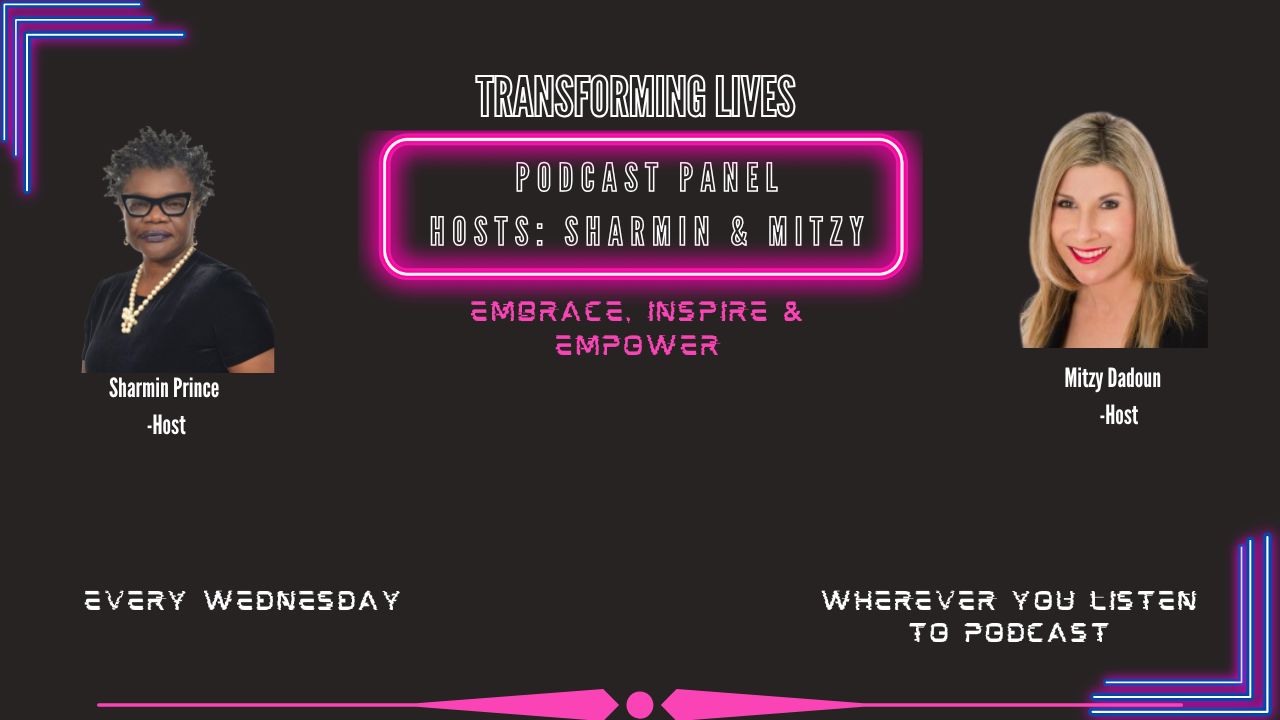
Transforming Lives Panel Podcast
| Sharmin Prince & Mitzy Dadoun | Rating 0 (0) (0) |
| Launched: Feb 26, 2025 | |
| info@tlpod.com | Season: 3 Episode: 7 |
Welcome to the Transforming Lives panel podcast. I am one of your hosts.
Episode Overview: In this episode, Sharmin and Mitzy engage in a profound discussion about racism, drawing from their personal experiences and the systemic issues that perpetuate discrimination. They explore the differences in their backgrounds, the impact of colorism, and the importance of allyship in combating racism.
Key Topics Discussed:
- Grounding exercise to center listeners before the discussion
- Personal introductions and backgrounds of the hosts
- The prevalence of racism and discrimination in society
- Experiences of colorism and racism in different cultural contexts
- The impact of childhood socialization on perceptions of race
- Systemic racism and its manifestations in policies and practices
- The role of allyship in addressing racism
- The importance of empathy and understanding in combating discrimination
- The need for policy reforms and equitable resource distribution
Notable Quotes:
- "Hate is just trained and baked into them." - Mitzy
- "In order for us to address systemic racism, it is important for us to lobby for policy reforms." - Sharmin
Resources Mentioned:
- Tim Wise's lectures on systemic racism
- Discussion on the historical context of racism in the U.S. and Guyana
Call to Action: Listeners are encouraged to reflect on their own experiences with racism and colorism, to educate themselves on systemic issues, and to engage in conversations that promote understanding and allyship.
Connect with Us:
-
Host: Sharmin Prince
Coach, Entrepreneur, Consultant, Trainer, Content Creator, SoulHealer.
Facebook: https://www.facebook.com/SharminVanPrince
https://www.facebook.com/eaglessoarN413805Y
https://www.facebook.com/profile.php?id=100088212
X: https://twitter.com/SharminPrince
LinkedIn: https://www.linkedin.com/in/sharminprince/
https://www.linkedin.com/company/eagles-empowered-to-soar-inc-eets
Website: https://www.sharminprince.utobo.com
https://www.sharminprince.com
https:www.eaglessoar.org
Instagram: https://www.instagram.com/eagles_soar_inc/
https://www.instagram.com/sharmin_vp/
Host: Mitzy Dadoun
Travel, Insurance, Seniors, Teens, Spirituality, Manifestation, Gratitude, Business, Real Estate, author of 6 books
http://www.wealthcreationconcepts.com/
http://www.smartseniorsrealty.com/
https://mdsocialsavvy.com/home
https://mitzydadoun.wearelegalshield.ca/
Connect with Us:**
- Follow the Transforming Lives panel podcast for more episodes featuring inspiring guests and transformative stories.
Youtube: https://www.youtube.com/channel/UCvHpiH1ROjGb8qP9MqAAFVQ
Facebook: https://www.facebook.com/profile.php?id=61578282042447
**Disclaimer:**
- The views and opinions expressed in this episode are those of the guest and do not necessarily reflect the official policy or position of the podcast.
Next Episode Teaser: Join us next time as we continue to explore the themes of impact on our transformation.
Thank you for listening!
SUBSCRIBE

Episode Chapters
Welcome to the Transforming Lives panel podcast. I am one of your hosts.
Episode Overview: In this episode, Sharmin and Mitzy engage in a profound discussion about racism, drawing from their personal experiences and the systemic issues that perpetuate discrimination. They explore the differences in their backgrounds, the impact of colorism, and the importance of allyship in combating racism.
Key Topics Discussed:
- Grounding exercise to center listeners before the discussion
- Personal introductions and backgrounds of the hosts
- The prevalence of racism and discrimination in society
- Experiences of colorism and racism in different cultural contexts
- The impact of childhood socialization on perceptions of race
- Systemic racism and its manifestations in policies and practices
- The role of allyship in addressing racism
- The importance of empathy and understanding in combating discrimination
- The need for policy reforms and equitable resource distribution
Notable Quotes:
- "Hate is just trained and baked into them." - Mitzy
- "In order for us to address systemic racism, it is important for us to lobby for policy reforms." - Sharmin
Resources Mentioned:
- Tim Wise's lectures on systemic racism
- Discussion on the historical context of racism in the U.S. and Guyana
Call to Action: Listeners are encouraged to reflect on their own experiences with racism and colorism, to educate themselves on systemic issues, and to engage in conversations that promote understanding and allyship.
Connect with Us:
-
Host: Sharmin Prince
Coach, Entrepreneur, Consultant, Trainer, Content Creator, SoulHealer.
Facebook: https://www.facebook.com/SharminVanPrince
https://www.facebook.com/eaglessoarN413805Y
https://www.facebook.com/profile.php?id=100088212
X: https://twitter.com/SharminPrince
LinkedIn: https://www.linkedin.com/in/sharminprince/
https://www.linkedin.com/company/eagles-empowered-to-soar-inc-eets
Website: https://www.sharminprince.utobo.com
https://www.sharminprince.com
https:www.eaglessoar.org
Instagram: https://www.instagram.com/eagles_soar_inc/
https://www.instagram.com/sharmin_vp/
Host: Mitzy Dadoun
Travel, Insurance, Seniors, Teens, Spirituality, Manifestation, Gratitude, Business, Real Estate, author of 6 books
http://www.wealthcreationconcepts.com/
http://www.smartseniorsrealty.com/
https://mdsocialsavvy.com/home
https://mitzydadoun.wearelegalshield.ca/
Connect with Us:**
- Follow the Transforming Lives panel podcast for more episodes featuring inspiring guests and transformative stories.
Youtube: https://www.youtube.com/channel/UCvHpiH1ROjGb8qP9MqAAFVQ
Facebook: https://www.facebook.com/profile.php?id=61578282042447
**Disclaimer:**
- The views and opinions expressed in this episode are those of the guest and do not necessarily reflect the official policy or position of the podcast.
Next Episode Teaser: Join us next time as we continue to explore the themes of impact on our transformation.
Thank you for listening!
Welcome to the Transforming Lives panel podcast, where hosts Sharmin and Mitzy dive into the pressing issue of racism. In this episode, they explore their personal experiences with racism and colorism, drawing from their diverse backgrounds—Sharmin hailing from multicultural Guyana and Mitzy from Kingston, Ontario, Canada. They discuss the impact of systemic racism, the importance of allyship, and the need for empathy in understanding one another's experiences. Join them as they engage in a thought-provoking conversation that highlights the significance of education, awareness, and policy reform in the fight against racial discrimination. Tune in for an enlightening discussion that aims to inspire change and foster understanding.
Welcome to the Transforming Lives panel podcast. I am one of your hosts.
S1
Speaker 1
00:10 - 00:11
And I'm one of your hosts.
S0
Speaker 0
00:12 - 01:23
And we are Sharmin and Mitzy. And today we have a very interesting topic that we are going to be discussing. But before we continue, just join us in a grounding exercise so that we can be together for the next 30 minutes. Take a deep breath in through your nose and out through your mouth. Another breath in. And as you take this breath in, let go of everything that did not serve you today and all the plans that you have for the remainder of the evening. Just let it go with the exhale. Take another deep breath in and hold that breath and feel the freedom of not having stress, tension, or anything that can worry you and let go of anything that can prevent you from participating with us.
S0
Speaker 0
01:24 - 01:46
And we wanna thank you for joining us, for subscribing. Thank you for sharing and downloading. And today our topic is on racism. Mitzi, what do you think about our topic today?
S1
Speaker 1
01:48 - 02:13
Well, sadly, I think it's a very hot topic because I think that racism, discrimination, and, what's the word I'm looking for? Almost, you know, white supremacist stuff, it seems to be rearing its ugly head in massive droves. So I think it's sadly very topical and timely.
S0
Speaker 0
02:15 - 02:39
And you know what I like about this topic? The two of us are in different parts of North America. You're in Canada. I am in the U S and we are different races. So I think that's what made this topic so interesting. I don't know about you, but I I'm excited, um, about this discussion.
S1
Speaker 1
02:40 - 02:54
Me too. I'm really looking forward to getting a better understanding of the experiences that you've gone through. I think, you know, the experiences which go through are very different. Even, you know, somebody could experience completely different things in different parts of the country, let alone in different countries.
S0
Speaker 0
02:56 - 03:12
So in order to put some context to our discussion, maybe we can introduce ourselves, like our personal backgrounds, who we are, where we're from. How do we identify?
S1
Speaker 1
03:13 - 04:03
Sure. So I'm Mitzi and I'll give you a little background of myself. I grew up in a great city in Kingston, Ontario, Canada. That's where I grew up as a kid. And it was a little bit multicultural. There was, I never ever had growing up any feeling of anyone was different than me. Like everybody was very accepting of everybody. As I grew and as I moved away from Kingston and was in Toronto and in some of the big cities, then I started to see and experience some different things. I'm Jewish. And as you can well imagine with everything that's gone on in the last few years, I've definitely had some experiences over the last few years, but even growing up, there were some times where people said some things that just like blew my mind.
S1
Speaker 1
04:03 - 04:38
Like I remember going into a business meeting and somebody said, you know, Oh, she tried to do me. And I was like, what on earth does that even mean? Like, I didn't know what it meant at the time. And then I found out and it was just so offensive. Um, and I had some really interesting experiences, which I'll talk about, even as a kid, when I had a friend that I met at the playground and how very differently we both reacted to the exact same situation because of our different backgrounds. So I will let you tell everybody a little bit about yourself and then let's get into this.
S0
Speaker 0
04:39 - 05:35
Thank you. I'm Charmaine and I'm originally from Georgetown, Guyana. That's the only English speaking country in South America. And usually when we hear of Guyana, persons are aware of the history and the geography would say, Oh, so you guys are multicultural, multiethnic, multiracial. In Guyana we have. Six races, Afro-Ghainese, Indo-Ghainese, the original people. Indians, it's like the native Indians, so we call them Amerindians. We have Europeans, Chinese, and Portuguese. That's the races that I grew up and I learned about, and you had small pockets of Europeans, Portuguese, Chinese, a lot of Indogainese, a lot of Afrogainese.
S0
Speaker 0
05:37 - 06:38
My, my introduction to racism, it was more of a cult of colorism. Afro-Guyanese and Indo-Guyanese, they're Indo-Guyanese darker skin than I am. So I would say it's colorism, but the social disparity, you have the economic disparity because in Guyana, the Afro-Guyanese were taken to Guyana as slaves. Indo-Guyanese were indentured laborers. They were not slaves. So they came from India as indentured laborers. So there is a difference. So the slaves were taken from their homes in chains and they were not paid. They would have to work without receiving a stipend or a salary. Indentured laborers were hired servants.
S0
Speaker 0
06:40 - 06:47
So after slavery, they came and they did the work that the Afro Guyanese were doing, but they were being paid.
S1
Speaker 1
06:48 - 06:49
I see. OK, thank you.
S0
Speaker 0
06:49 - 07:56
Yeah, you're welcome. I knew growing up that an Afro Guyanese girl cannot marry an Indo-Ghainese boy or vice versa. And if let's say an Indo-Ghainese girl is interested in a Afro-Ghainese boy and her parents said no, oftentimes it ended in suicide. Oh, wow. Yeah, so I grew up within that separation. But coming to the US, it was totally different. I understood that What I experienced with colorism was not racism. It's totally different because here you have the whites and persons of African descent and some of the discrimination that you experienced was so palpable. And then you also had colorism.
S0
Speaker 0
07:56 - 08:25
and the colorism that I experienced is between persons of African descent and persons of Hispanic descent. We needed to give you some background and some context of who we are and where we're coming from. But would you want us to talk a little about our personal experiences with racism?
S1
Speaker 1
08:26 - 09:09
Yeah, you know, one of the first things that I ever remember as far as any kind of experiencing, I guess, racism, but, you know, through the eyes of a child. So when I was around, I know, maybe like five, six years old, I was playing at a playground, I was visiting my grandparents, my grandmother. And I met a little girl, and she was from Florida, and she was visiting her grandmother, right? So we're playing in the playground, whatever. And then she invites me over to her grandmother's place. And we're riding up in the elevator. So, you know, we push to go in the elevator and we get on the elevator and shortly after we get on the elevator.
S1
Speaker 1
09:10 - 09:47
These 2 gentlemen get on the elevator as well, and they happen to be gentlemen of color. And they're, I'm guessing, maybe in their 20s kind of thing. And. To me, it's just other people getting on the elevator, I don't think anything of it, but I look over and I see my friend, and she's literally shaking like a leaf like like she's shaking and she, you can just see fear in her eyes. We go up a few floors, the two gentlemen happen to get off before us and she grabs me and she's like, oh my God, weren't you terrified?
S1
Speaker 1
09:47 - 10:30
Wasn't that just so scary? Oh my God, thank God we're okay. And I was looking at her and I'm like, I just didn't understand what you, and I'm like, what are you doing? And she goes, weren't you terrified? I mean, those black men got on the elevator with us. And I was like, you know, so what? Like, for me, it didn't register it at all. And she wasn't trying to be mean, but she had obviously been brought up to be absolutely terrified of people of color. And that was the first time that I really remember seeing it, experiencing it and being completely bewildered by it because it was just not the way we were brought up at all.
S1
Speaker 1
10:30 - 10:41
Like, and it was just so foreign to me. And like I say, she wasn't trying to be mean. She was terrified. So that was my very first experience with racism.
S0
Speaker 0
10:43 - 11:53
I think what she exhibited is common because she was socialized to be afraid of black men. Exactly. Right. Or black people in the whole, and I can share, it's the same way between Indogainese and Afrogainese because the Indogainese were taught that our founded leader or the very first president or Lyndon Fobbs Thompson Burnham was such a terrorist and he did so much evil to Indogainis and those families who perpetuate that narrative It's ingrained, like structural racism. And so you as a child, you don't know how to decipher truth from fables. So I can understand her reaction.
S0
Speaker 0
11:53 - 13:11
And it still happens today in certain parts of the United States, and I'm sure in Canada too. have any childhood experience of colorism. I attended a school, my primary school, there were a few Indian students. I think I experienced more of them in secondary school, and I lived in neighborhoods where there were a few Indians. They stayed to themselves, but during their particular religious holidays, that's when they became more open to the community. So I don't have any any real issue other than during election time. Guyanese vote by race. Afro-Guyanese vote for the Afro-Guyanese party and the Indo-Guyanese vote for PPP.
S0
Speaker 0
13:11 - 14:00
That time it was just PNC and PPP, and then the WPA came by. And so you would be friends with an Indian person for four years. or three and a half year. But then when the election comes around, y'all are no friends because of politics. I lost one of my very first best friends because of politics. Her mother was PPP and we were PNC. And during the referendum time, there was a lot of, and problems and we lost our friendship during that time. I experienced colorism and racism in the United States.
S1
Speaker 1
14:02 - 14:42
It's really interesting. You were saying about the division. I remember a girl that I worked with and she was Irish. I think it was. And so when, She came here, she said her mother came to visit, and the mother got very upset because, and I may have the parts wrong, but you know, there was Catholic and Protestant, I think it was, and they were one or the other, and her mother couldn't believe that she was friends with a neighbor who was whatever the other one was. It was like, no, if you're a Catholic, you only hang around with Catholics, and if you're Protestant, you only hang around with Protestants.
S1
Speaker 1
14:43 - 15:29
And of course, her daughter was like, no, that's not the way it is in Canada. In Canada, we all get along, and we accept each other. Like I say, I grew up not seeing Color or racism or having any. issue with anyone of a different religion. It was just that's what's good for them. This is what's good for me. And that's fine. But then, you know, when you see things like what's gone on in Gaza, right, I mean, from birth, those children were taught and brainwashed to hate Jews, and they were taught and camped and have rifles and that they to heaven and get a bunch of virgins if they killed.
S1
Speaker 1
15:29 - 15:37
I mean they're brainwashed from birth and and it's that same sort of thing as I saw with that little girl in the elevator.
S0
Speaker 0
15:37 - 15:38
Hate
S1
Speaker 1
15:38 - 16:15
is just trained and baked into them. They don't even realize that there's any other possibilities where thankfully I was so blessed that I grew up where it was except everybody and I mean at our school even you know we had special needs kids and they were fully integrated with us and we didn't see them as different. It was just, they needed a little extra help. There was people of all different nationalities. It was, they were just people who happened to look different or practice a different religion. Like, so what? That's what's good for them. This is what's good for me.
S1
Speaker 1
16:16 - 16:58
But like you say, politics and racism and you know, people trying to lift themselves up by pushing others down. That's what I see that bewilders me. It's like, no, lift yourself up by lifting others up, not lift yourself up by pushing others down. And I think that that's the fundamental part of what racism is that it's, you know, in order for me to look good, I have to make you look bad. No, that's not true. But that's unfortunately what is out there in media and for what a lot of people think and behave like.
S0
Speaker 0
16:59 - 18:16
And this is the perfect place for us to segue into systemic racism. And in some literature, they call it institutional racism. Some persons think there is a difference, but it usually refers to like racial discrimination that is embedded within policies and practices and institutions. Even in Guyana, the information that some families hand down as legacy to their families about what happened in politics. And it usually extend beyond our individual acts of prejudice and discrimination because it is pervasive and ongoing. The structure of inequality while preparing for this session, I was listening to a professor called Tim Wise on YouTube.
S0
Speaker 0
18:17 - 19:39
And I learned so much about structural racism here in the United States. You know, how it started and where we are today. We. I don't know about Canada, but I can say for us in the US, and even in Indiana, the legacy of slavery and colonization is a big part of structural racism. Their discriminatory policies and practices that holds African-American and even Afro-Guyanese that causes them to be subjugated, their laws, their regulations, their institutional practices. I worked in an organization that all of the executives were white. And then you might have one person of African descent and then eventually It became a whole lot of Hispanic and you may have four Hispanics to one African American.
S0
Speaker 0
19:39 - 20:02
So there are all these laws and policies that subjugate minorities. And then you have the socioeconomic disparities that exist in systemic, more institutional racism. I just wanted to highlight that, and I don't know if you want to add anything to that.
S1
Speaker 1
20:03 - 20:50
Yeah, I mean, when you were first mentioning systemic racism, what came to mind was some of the things that we'd seen as far as, for example, them restructuring where the electoral boundaries are in the states so that it makes it harder for people of color in those areas to be able to get to the polls and things. So, like you say, systematically redefining things so that it makes it harder and harder for them to achieve equality and to get there. And of course, as women, we also have not a racism, but a genderism that comes as well.
S1
Speaker 1
20:50 - 21:19
When you were talking about, you know, all of the executives, it's, you know, I remember going for an interview at a company and, you know, the person interviewing me, this was in, this would have been around 1984. You know, say, asking me questions like, how do you feel when you're in a room full of men? When are you planning on having children? How many children are you planning on having? They did not ask me a single question that had anything to do
S0
Speaker 0
21:19 - 21:21
with the job. But is that even legal?
S1
Speaker 1
21:21 - 22:01
No, but back then they got away with that. I don't know if they would still get away with it today, but literally, when I was leaving that interview, I saw an award in the lobby of how they were supporting women's rights. And I'm like, yeah, well, not that guy. Because, like I say, that was the second interview. I had passed the first interview, and I was now going to meet the vice president. And I still remember his name. And it was like, I left there and I said, he was like, I know I have no hope in the heck of getting that job because he didn't ask me a single thing that in any way related to the job as a mortgage lender.
S1
Speaker 1
22:01 - 22:32
All he asked me about was, you know, those types of things, how I feel in a room full of men. I mean, what the crap? Right. So, you know, all of that, unfortunately exists in our society. And we just have to work on trying to educate and teach people to be accepting of each other. And just because somebody likes something different or looks differently than you, that's not bad. It's just different.
S0
Speaker 0
22:35 - 23:43
I totally agree. While listening to the professor that I mentioned earlier, he highlighted of the criminal justice disparities here in the US, like the racial profiling and over-policing in minority communities. He made a comparison with the policing and the overseering during slavery and the current police system. And honestly, Mitzi, that was like an aha moment for me because I I never knew that. You know, in Guyana history, we don't have that and I've never done American history. So it was an aha moment. It was surprising that here we are, how many centuries after slavery, that there are still policies being enacted the same way that they were back then.
S1
Speaker 1
23:44 - 23:48
Yeah, it's really sad and it's really scary.
S0
Speaker 0
23:49 - 23:50
Yeah.
S1
Speaker 1
23:50 - 23:53
What was that professor's name again for our audience?
S0
Speaker 0
23:53 - 23:58
Tim Wise. He is so good. Yeah, I
S1
Speaker 1
23:58 - 23:59
have to go listen.
S0
Speaker 0
23:59 - 24:56
Yeah, he gives you history and he compares it with today. And one of the videos that I listened to, I think it's six or seven years old and it's still applicable to today. You know, I think one of the important Intervention for racism is allyship. And when I thought of us doing this, I thought of allyships. Both sides, whites and blacks, be it Indo-Ghainese, Afro-Ghainese, there must be allyship in order to destroy some of the embedded racism, discrimination, and prejudices that we experience on a daily basis.
S1
Speaker 1
24:58 - 25:08
Definitely. We have to work together to lift each other up and to help others understand and look at things differently and have that paradigm shift.
S0
Speaker 0
25:10 - 26:20
That is so true. And also reflecting on the impact of any positive change that has been made and we've seen the progress of it and how it has helped the groups that are minorities all over the world. We can look at apartheid and look at South Africa and how they are actually coming together to heal to the point where four to seven offered white farmers asylum and they refused. Interesting. Yeah. Yeah. Because they're all about healing as opposed to the division, you know, um, That is an interesting thing that happened only two weeks ago or a week ago.
S1
Speaker 1
26:22 - 27:04
Interesting. Well, I mean, it's very much, you know, in Israel, you know, there are tons of Muslims and they are free to practice their religion and they live and they're integrated and they're part of, you know, of the country. Unfortunately, that's not the case in all of the world. But as I say, thankfully, it is democratic and it doesn't matter what religion, what race you are, people are accepted and help each other and strive for it the same way as it is here in Canada. I mean, Toronto is one of the, I think it's one of, if not the most multicultural cities in the world.
S1
Speaker 1
27:05 - 27:36
And as I say, I was just brought up, and I'm so thankful that I was, where I didn't see any difference between somebody of any different skin color, any different religion, different sex. It was just, we're all people, we're all good. You know, I might not agree with you on this, but if it's good for you and it doesn't hurt someone else, then go for it. You know,
S0
Speaker 0
27:36 - 27:36
very
S1
Speaker 1
27:36 - 27:53
similar to with sexual preference. You know, I happen to be a woman and I like men and, but I have lots of Female friends who like girls and male friends who like guys and you know what, if that's what makes them happy. It's not hurting me.
S0
Speaker 0
27:53 - 27:55
Exactly. Be
S1
Speaker 1
27:55 - 28:39
happy and enjoy. And as I say, I know I was really blessed to grow up. that way and that unfortunately there are people who that hate or that discrimination or that violence is passed down from generation to generation. It's hard if somebody is very economically depressed and doesn't have the resources to not see all of the injustices that are done. And it's hard to break out of that cycle. We have to, as I say, try to lift each other up rather than push each other down.
S0
Speaker 0
28:40 - 28:50
Yeah. I mean, you mentioned the economic disparities. We can spend all day discussing that.
S1
Speaker 1
28:53 - 28:55
Yeah, that could be 25 podcasts in and of
S0
Speaker 0
28:55 - 29:04
itself. Exactly. But in closing, what would you like to leave with our listeners?
S1
Speaker 1
29:05 - 29:53
I think I'd like to leave with the listeners to try and put yourself in someone else's shoes. Put yourself in that other person's circumstance. and think about what it would be like experiencing life as they are. Because I think the biggest problem is people not having empathy and not having the ability to, you know, so to speak, walk a mile in somebody else's shoes and look at that. And I think when people, if they take the time and they do that, they can really see that there's a better way, as I say, lift each other up rather than push somebody down to build yourself up.
S1
Speaker 1
29:54 - 29:55
That's what I'd like to leave them with.
S0
Speaker 0
29:56 - 31:13
Thank you. Thank you. And I would just like to add that in order for us to address systemic racism, it is important for us to lobby for policy reforms. Also, for fair distribution of resources like education funding and healthcare services to vulnerable communities. And awareness and education is very, very important for us. Raising awareness about systemic racism through education and public discourse. Now with, you know, the removal of D, E, and I here in the U.S., we have to think about educational curricula that will highlight our histories of racial discrimination and its impact. So this has been the Transforming Lives panel podcast with Sharmin and Mitzi, and we will see you during the next episode.
S0
Speaker 0
31:13 - 31:13
Thank you.