The Six Foundational Movement Patterns
Strong Principles
| Rob DelaCruz, Larry Medina, Zach Bragg | Rating 0 (0) (0) |
| Launched: Aug 18, 2025 | |
| trips91@gmail.com | Season: 1 Episode: 6 |
Key Discussion Points:
-
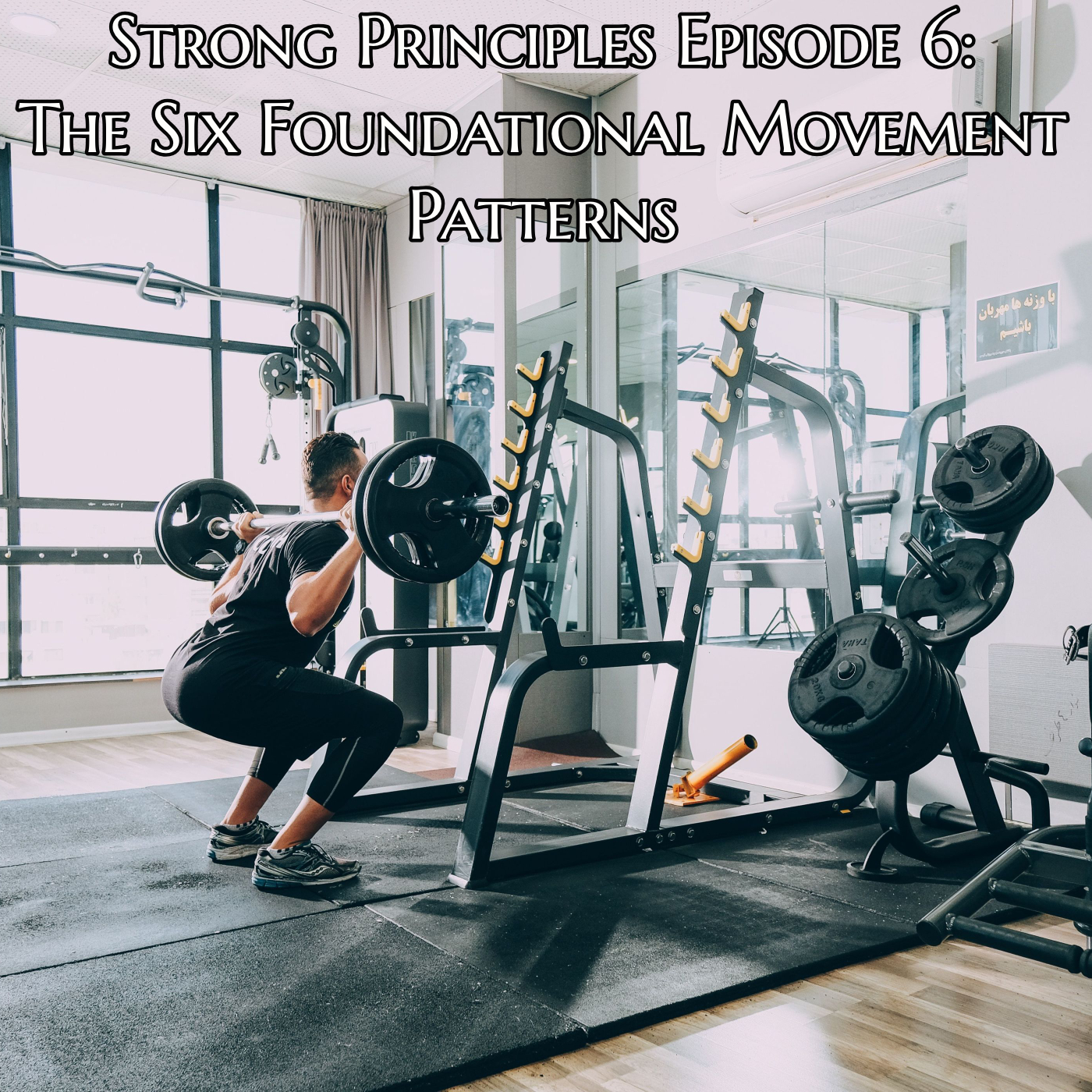
Squat: The hosts agree that the barbell back squat is their favorite due to its systemic strength benefits. However, they emphasize the importance of using variations like the goblet squat, box squat, and Zercher squat for beginners, individuals with mobility issues, or those with back concerns. They also touch on why they don't consider the leg press to be a true squat pattern.
-
Lunge: The Zercher reverse lunge and single-arm front rack reverse lunge are highlighted as favorites. They explain how the reverse lunge is easier on the knees and promotes better posterior chain development compared to the forward lunge.
-
Pull (Horizontal): The seal row is their top choice for a horizontal pull, praised for its ability to build a strong upper back and its low-impact nature on the lower back. They also mention advanced variations like the bird dog row.
-
Press (Horizontal): The hosts differ slightly on their top pick. Rob favors the single-arm kettlebell floor press for its stability benefits, while Zach's current favorite is the dumbbell incline bench press, citing new studies on chest activation. They also give an honorable mention to push-ups for their shoulder health benefits.
-
Hinge: The trap bar deadlift is the shared favorite for the hinge pattern. They discuss how it's a safer and more user-friendly alternative to the traditional barbell deadlift, allowing for better force application and reducing the risk of injury.
-
Carry: The farmer's carry is unanimously chosen as the favorite carry exercise. Zach adds a twist by preferring a mixed-weight farmer's carry for greater core engagement. They emphasize the functional nature of carries and give an honorable mention to the heavy sandbag bear hug carry.
SUBSCRIBE

Episode Chapters
Key Discussion Points:
-
Squat: The hosts agree that the barbell back squat is their favorite due to its systemic strength benefits. However, they emphasize the importance of using variations like the goblet squat, box squat, and Zercher squat for beginners, individuals with mobility issues, or those with back concerns. They also touch on why they don't consider the leg press to be a true squat pattern.
-
Lunge: The Zercher reverse lunge and single-arm front rack reverse lunge are highlighted as favorites. They explain how the reverse lunge is easier on the knees and promotes better posterior chain development compared to the forward lunge.
-
Pull (Horizontal): The seal row is their top choice for a horizontal pull, praised for its ability to build a strong upper back and its low-impact nature on the lower back. They also mention advanced variations like the bird dog row.
-
Press (Horizontal): The hosts differ slightly on their top pick. Rob favors the single-arm kettlebell floor press for its stability benefits, while Zach's current favorite is the dumbbell incline bench press, citing new studies on chest activation. They also give an honorable mention to push-ups for their shoulder health benefits.
-
Hinge: The trap bar deadlift is the shared favorite for the hinge pattern. They discuss how it's a safer and more user-friendly alternative to the traditional barbell deadlift, allowing for better force application and reducing the risk of injury.
-
Carry: The farmer's carry is unanimously chosen as the favorite carry exercise. Zach adds a twist by preferring a mixed-weight farmer's carry for greater core engagement. They emphasize the functional nature of carries and give an honorable mention to the heavy sandbag bear hug carry.
In this episode of Strong Principles, hosts Rob Dela Cruz, Larry Medina, and Zach Bragg dive into the world of fitness and strength training by sharing their favorite exercises for each of the six fundamental movement patterns. They discuss the squat, lunge, pull, press, hinge, and carry, explaining their top picks and the reasoning behind their choices
Rob (00:02)
All right, guys. Welcome to Strong Principles. I'm Rob Dela Cruz.
Larry (00:06)
I'm Larry Medina.
Zach (00:07)
And I'm Zack Bragg. All right. And this is Strong Principles. Been doing this for a little bit. We're based out of Vero Beach, Florida. And Rob, you are?
Rob (00:17)
I'm the owner of Vero strength. Yeah.
Zach (00:19)
And I also work at Vero strength. I'm the head coach.
Larry (00:22)
And I'm just a dude that hangs out with Rob and Zack. I get to ask the questions that go over in my head.
Rob (00:30)
But you do have some background in training? Yeah.
Larry (00:33)
All right. What's the topic of today?
Rob (00:35)
Well, today we're going to go over our favorite exercise for six fundamental movement patterns. The movement patterns are squat, lunge, hinge. Then you have a press, vertical, horizontal, pull, vertical, horizontal, and then you got to carry. That's the six different movement patterns. There's an array of exercises that you can do for each one of them. We're just going to go down a line and just say which ones are our favorite and why.
Larry (01:01)
Okay, let's go. What was number one? Squat?
Rob (01:04)
Yep, squat. We'll start with that because a lot of people call it the squat, the king of all exercise, especially the back squat, which the back squat, personally, is my favorite. There's several reasons why. One of them is just the load on the body causes a response to the body. It creates a ton of strength, not only in the legs, but throughout, systemically throughout your entire body. Now, saying that, I'm not married to exercises. I just want to put that out there because some people just doesn't work really well. But the back squat is one of my favorites. What about what you got, Zack?
Zach (01:36)
Yeah.
Rob (01:38)
The barbell back squat.
Zach (01:39)
The barbell back squat, yeah. I was thinking about this, and I was going back and forth on what I would say my favorite, but I have to agree. I like the goblet squat a lot. I use it a lot just for teaching and training, especially from a beginner level. But if we're looking at this from the aspect of what's your favorite, meaning what do we see the most benefit of what carries the best stimulus, I would also agree back squat, the load it creates and the amount of force you have to create from the ground. I would also agree. I would say back squat would be the number one. Why would we say it's number one? For me, I think it should be instilled in every single program. There's some squats where you could say It doesn't necessarily need to be in a program, but I think for me, probably for you too, it should be in every single person's program when it comes to strength and when you're looking at the movement patterns.
Larry (02:23)
Yeah, and that makes total sense to me because to me, I've been fortunate enough to I take care of elder folks that lived with us. I see the deterioration of when they get into their 70s, 80s. It's going to It's not weird, but even scooting across the bed, they couldn't do it because their legs just slip. They couldn't get enough power out of their legs to scoot over to the other side of the bed. I can see where the back squat becomes super important there because you need your leg strength. I can totally see the back squat being something that's super important. It should be... One thing that I feel that I did recently because of you guys, actually, from one of our episodes. I think I'd mentioned where my left knee just balloons up, and you guys were talking about, Well, maybe you should do a back squat, maybe not go all the way down.
Zach (03:28)
Yeah, or do a box squat.
Larry (03:30)
Yeah, do a box squat. You don't have to go ask the grass. You can just go either parallel or maybe even higher, just training your body to do that.
Rob (03:43)
Yeah, my knee did not balloon up. Yeah. The thing with the back squat, for some people, the load on the spine could be an issue. There's a whole host of things that could not be the best exercise. But if you can do it, I believe it's one of the best exercise that you would see some of the best results. But doing a back squat to a box or to a bench is a great option.
Larry (04:05)
Especially if you're starting, right?
Rob (04:07)
Correct. Starting or even if you're advanced, it transfers over both ways.
Zach (04:13)
Perfect. It requires a lot of mobility, too. When you think about the mobility it requires in both the hips, ankles, and the shoulders, too. A lot of people are like, Yeah, I could just have you go up squat. There's not really much mobility required in the shoulders for that. But in a back squat, your arms have to be in external rotation. It creates a lot of mobility. Sometimes Because the best mobility program is a good strength program. Also, too, it's not just the legs, it's also the core. The core has to be able to stabilize a lot. That's why you see guys wear weight belts when they start going really, really heavy. Yes, it supports the spine, but also it allows for more core engagement. There is an age range that I wouldn't have back squat, though. If you're listening, we work with a lot of teens and a lot of youth. Anybody whose spine is still developing, really young guys, I wouldn't give them a back squat just because that load on the spine. Personally, you could have them probably go super, super light with it and just do it, but I would have them probably work on a lunge or work on a split squat or work on just a goblet squat.
Rob (05:06)
To build that up, because you want to remember the back squat, it is a complex exercise that takes a long time to go ahead and Develop that skill. You got to work on it over time. People spend a whole lifetime working on that squat.
Larry (05:21)
Yeah, that makes sense. Now, what if, and obviously, we might be getting too far into the weeds, but what if you have a scoliosis synapses scenario, right? Because that essentially, you could be perfectly fine, and then all of a sudden it curves out a little bit, comes back in. In that scenario, would you recommend a back squat?
Rob (05:42)
Well, so I've worked with several people with that. Like I said before, that's one of our favorites, but we're not married to the exercises. Now, it's super dependent on the individual because one of them, I do have them back squat. The other one, I mostly have them belt squat, where the There's a belt around your waist where the spine doesn't get compressed. A trainer shouldn't understand which one makes sense to use and which one not, regardless of how good the exercise is.
Zach (06:11)
Go ahead. Let's say they're really strong. That's why we have all these different clients. Maybe if they all had scoliosis, but you have one who's really strong, has great hip mobility, great ankle mobility, great shoulder mobility. When you watch them squat, you'll be able to tell if it's causing any issues with the spine versus somebody who maybe is a beginner doesn't have great mobility. They wouldn't be necessarily a good candidate for it.
Rob (06:35)
That makes sense.
Zach (06:36)
Yeah, because you got to remember-It's definitely individually based.
Rob (06:38)
Yeah, correct. Because all exercises, like anthropometrics, like limb length is huge. Some people just don't have the right hip to femur ratio. And so when their spines are bending over, some other exercise might be better options.
Zach (06:53)
And so when we program it in a class, so it's like that's why we believe, again, in movement patterns, not married to an exercise. So in a class, the base of the class is a squat. We have back squat written down because that's, we could say, the pinnacle of what we want everybody to do. But then you may have some individuals who can't. So now just what falls in line with that movement pattern that can give a close enough stimulus to see growth and development, and you would give them whatever the variation is.
Larry (07:17)
Makes sense, yeah. That's where maybe, again, getting too far into the weeds. But I feel like in that scenario, maybe just if you're just starting out, you have a lumbar or some scoliosis, just do regular squats, no weights at first, get some strength in your legs, then maybe progress into a goblet squat, build that core, and then go into the back squat.
Rob (07:37)
That's exactly how we do it. There's several options that we… We'll get this to out real quick. I mean, the goblet squat's amazing. Double kettlebell front rack squat is really amazing. Then you could go into what is called the Zercher squat. Zercher, yeah. That's when it's in the crease of the elbows and you're holding. That uses a lot of core there, and that works really well for people. Some people now it's a little uncomfortable in the crease. Then you have a front squat, which is even a tougher option. Then there's always safety bar, like different implements that you could use.
Zach (08:07)
Now, real quick, then, what's not a squat movement pattern? For me, and this might catch some hate, but I wouldn't put a leg press in there. I would give them a different variation. So we wouldn't say leg press, personally.
Rob (08:22)
That's legs. But that's to me, that's not the squat pattern. I like to pick on the leg press because it's a good exercise. I I think last time we picked on a little bit. The thing is, there's a lot of research of the leg press and the back squat going against each other. And the leg press looks by far better quickly because it's a very low learning curve. So people get better at it because it's on a fixed plane. It just moves. You just push it up and let it come back. But after a while, if it goes out further enough, it's not even close.
Larry (08:53)
Yeah, that makes sense. It's a machine.
Rob (08:55)
Well, correct. Hey, Larry, take someone that could squat 400 pounds and put them on a leg press. They can move a lot Take someone that moves a lot of weight on a leg press but doesn't squat, they're not going to move a lot of weight on the squat. Correct. So it goes one way over. Yeah, makes sense. Yeah. All right. So next one. So next one, lunge. Okay. So honestly, my favorite lunge is probably the Zercher lunge, reverse lunge. Zercher reverse lunge.
Larry (09:19)
Okay, so you're holding the weight? Yep.
Rob (09:20)
In the crease of the elbows, you got it close to the body. A lot of core stimulation. You could feel it, and you can load it up fairly heavy. I like reverse Why reverse versus forward?
Larry (09:33)
It seems to be-Easier than knees?
Rob (09:35)
Yes. I would say yes, it is. But you want to work both forward, back, step-ups, everything. You want to work them all. But as far as I think as far as on that one that I like is because when you go in reverse, it's not as tough on the knees, but it works loose in the hamstrings really well.
Zach (09:52)
Post-ear chain much better. Yeah. We tend to see a lot more anterior development when we start to do walking lunges or forward lunges, so they start to get a lot more quad. Also, it's much easier to teach a proper position in a reverse lunge. When you're looking at somebody's front knee and that shin can stay a lot more vertical versus a forward lunge, maybe the knee starts tracking over the toe too much, maybe they get on their toes too much. It's much easier to teach them to stay on the heel, basically push through the posterior chain, much more ham string development, much more glute development in the reverse. I would agree. Mine would also be reverse lunge. I like a single arm front rack, which, again, very similar, but I pick single arm just because, again, going back to episode two when we talk about my golf-specific stuff. So there's a lot of unilateral development that are involved there.
Rob (10:35)
So when you say signal, you're talking about a kettlebell in a front rack position. A kettlebell in a front rack. And this one side.
Zach (10:40)
Just one side.
Rob (10:41)
So is it contralateral or the same?
Zach (10:43)
Contralateral. Okay. Contralateral. So, yeah, I like- Which means it's a cross pattern, the leg that's moving. Exactly. And so it applies a little bit more to athletes better. But again, we're talking about favorites, not like... So that's my favorite. So just one arm, step back with a reverse lunge. And then also, if we can, we'll develop it to have a deficit. So have them stand on a plate or have them stand on something a little bit higher. And so when they step down, they're getting even lower. So they're getting a little bit deeper. So that would be the next variation of it. So that's my favorite.
Larry (11:15)
That would be the advanced. Yeah. Okay. That's interesting.
Zach (11:18)
Zercher is going to create a lot more tension, and it's going to be a lot harder for people versus a single arm front rack, I think. Yeah, 100%. So we're looking at it from trying to just build us building strength, I would probably say Zercher, but we're talking about favorites.
Larry (11:34)
Do you feel, and I'm keen off of the comment you made about the ham string, where going backwards versus forwards, you're going to develop more ham string than you would quad, because obviously, I do see some people and they have the huge quads, but then they have ham string issues or other issues. Do we feel that development of ham string is more important than the quad? I know I might be getting into the weeds here, but...
Rob (12:00)
I wouldn't say that. It's just when you start changing angles and start changing your position when you move, it just changes a little bit of where the signal is being sent. When you're lunging or you're squatting, everything is being used. It depends on a person if they're using more glutes or not and how deep the squat is and the same thing. When you go reverse a lot of times, and you can change the angle of your body position, too, to make it more glute or more hamstrung, too, instead of being straight up and down, you're leaning over a little forward. That's all there. But when you take a step backwards, you can just feel more the muscles in a posterior chain work. Now, the quads aren't working, too. So I'm not saying they're not working as much. But if you went forward, the quads would be a little more on.
Zach (12:43)
Yeah, and I think that's very That question is very individual dependent because depending on their background, okay, so what are they? Do you have an athlete? Do you have a young kid? Do you have a mom who's trying to get stronger? But then also it's dependent not just based off their background, but it's dependent on how they move. We can almost just tell right away. If you come in and you're a quad dominant person, we call them, I always say quad dominant squatters, so they tend to engage the quads first. That's the mind muscle connection is whenever they do an exercise for legs, their quads activate first. They need more ham string work then. Versus somebody who maybe, and we don't see it too often, but somebody who's very posterior, developed, strong, so like very strong hamstrings, very strong glutes, then yeah, you would say, then we need to do some more quad work. But I don't know. I tend to lean towards the posterior chain just because I work with a lot of athletes. That has to be strong. Controls a lot of motor skills in the hip, controls a lot of stability in the knee.
Zach (13:42)
I tend to lean with my training more towards hamstrings and glutes. We don't do any quad-focused work much, but that's just me.
Rob (13:49)
Yeah, and I just want to put this out. We're just saying our favorite exercises. It doesn't mean that's the only ones we use because you want to use all the different exercises. That's a big That's the thing about having an exercise library. Makes sense. Yeah. The next one, so that was the lunge, and then we're going to go ahead and move to the pull.
Zach (14:08)
Okay, so we did squat, we did lunge, and then we'll do pull.
Rob (14:11)
Yep, we're doing pull. My favorite pull by far is the seal row. I don't know what that is. Okay, so now think about... Not everybody does, but if you see a seal row bench, it's a higher bench. It's usually thinner. You can prop it up. You can do this yourself, too. It's a higher bench. It's up there. You are going to lay on top of it. Okay. Your stomach's on the bench, and now a barbell is beneath you. So think like the opposite of a bench press, but you're pulling it to the bottom of the bench. Okay. That's called a seal row. And so that's a really good horizontal row because you We got vertical and horizontal. Now, I focus more on horizontal rowing.
Larry (14:49)
Are you laying flat down?
Rob (14:50)
Yep, you're laying completely flat on the bench. It's called the seal row because when you pull hard enough, your chest arches and your feet come up and it looks like a seal a little bit.
Zach (14:58)
So why you pick barbell over dumbbell?
Rob (15:00)
I would say, yes, I do like the barbell because you can load it up. Also, I like that. I like all chest supported rows because it saves the lower back. Because we use the lower back a lot in squatting and other movements and hingeing movements. That makes sense. Okay.
Zach (15:17)
This one was tough for me when I was trying to figure out what it was. I would say my favorite is also a seal row, but I'll put it like this. I like a single arm. Again, going back to athletic We've been playing around a lot more with single arm work. I'll say this, it falls underneath this tier. Bird dog row, quadruped single arm row. You'd set up two benches and then have the knees on one side and one hand on the other bench, and then the kettlebell right in between the two benches and you row it. So bird dog row, single arm seal row, so chest supported row or the quadruped row.
Rob (15:50)
So now he's getting into all these words that people are going to be like, What are we doing here?
Zach (15:54)
What's a bird dog? Okay, so bird dog is really advanced athletic type of row. I I'm going to have them start off with chest-supported steel row. I'll say that that's my favorite because anybody and everybody can do that. So you lay on a bench, take a cattle ball or dumbbell, one arm, and you row it. And what you're going to find is it wants to pull you over. So now the tension that you have to create in your core and in the opposite side of your body to be able to stabilize to not fall over and row it. Then I tend to see a lot more lat engagement with that. Bird dog row then is the next variation of that. Well, actually, the next variation of that would be a quadruped row. Like I talked about, you got the two benches, knees down on one side, hand down on the other, and then you row. That's the next variation. Requires some A little bit more stability. Bird dog row would be where you have one single bench. If you were to put your knees on top of the bench and put both hands down on the bench, now you're in this.
Larry (16:38)
Like a regular weight bench?
Zach (16:39)
Yeah, regular weight bench. Now you're on hands and knees. What you would do is you would take the dumbbell Okay, so let's say you're working your right arm. You got both knees on the bench, one hand down on the bench. You would take the opposite leg, so my left leg, and lift it up in the air behind me, and then row from there. You only got one knee down and one hand down. That's the only point of contact on the and you're rowing it and your back leg's straight.
Rob (17:01)
There's a ton of stability you got to create.
Zach (17:02)
Ton of stability and balance. I like that one a lot, but basically any form of those variations. If we're looking at it from the most, I don't want to use the term basic standpoint, but the starting standpoint would be single arm seal row. But then any of those that fall underneath the advanced variations is my favorite.
Rob (17:18)
Larry, we picked a horizontal row to go over first because to me, that's one of the most important. One is because the posture, how it builds in the upper back, the stronger... You can always tell an individual, the stronger that upper back is in with those rear delts in the shoulder, the stronger their front pressing is going to be. You can always tell. That's why we focus on that a lot. Then we focus on the horizontal. Then we look at the vertical, which is like pulling up and down.
Zach (17:45)
Cull down, pull up. Correct. Yeah.
Rob (17:46)
Okay, that makes sense. The pull-ups are great. But the reason why that wasn't my favorite was because one is pull-ups can actually affect your posture because the way that lat connects, it can turn them shoulders a little forward. Yeah.
Larry (18:01)
Oh, really?
Zach (18:02)
Yup. If you just put your arms like this, and so you think about your chin coming above the bar, and your arms are... If your hands are in front of you, and you're at that top position where your hands are above the bar, your shoulders can still move forward. For people who are weak in the back, and we have them try to do a pull-up, now they're getting a lot of bicep, they're getting a lot of shoulder, even some chest. It's not exactly targeting the upper back the way we want. We would put them on a horizontal type of row or pull first.
Rob (18:28)
Yeah, I'm probably two in one of those rows to one vertical. Yeah. And not that I don't think vertical is important, but especially with individuals, when I look at them and they're tight in their shoulders, I'm going to minimize using that, that movement pattern. Interesting. Okay. That makes sense. Yeah.
Zach (18:44)
It puts the humor in a much better position. So when you're pulling, then you're actually pulling the shoulder back versus doing a pull-up, which could pull your shoulder back if you do it correctly, but there's still a chance that those shoulders round forward, which would then put the shoulder girdle in the wrong position.
Larry (19:00)
A lot of thought into this.
Rob (19:01)
Yeah.
Larry (19:02)
That's a lot of thought into this. It's funny because for me, I was thinking, pull up.
Zach (19:07)
Most people would think pull up.
Larry (19:08)
I would have thought pull up because that's the standard, right? In my estimation, if I'm in a life-saving situation, I want to be able to do a pull up. So in my head, that makes sense. But I never thought about, well, as you're working out and doing different things, what is good overall? Because Because to your point, you do use your lower back for almost everything. And then most people suffer with a lower back issue because they sit all day or they don't do... There's a lot of thought into what you guys are saying here.
Zach (19:41)
Well, and think about it. You work basically a desk job, right? Everything that, and most commonly in society, everything everybody does is forward. We look down on our phones, we move forward, our hands are forward when we're typing or whatever we're doing. So not many people pull to go backwards. So working the opposite way. So that's why horizontal pull, I think, is king.
Rob (20:02)
Yeah. I mean, that's the one we concentrate on the most. Awesome. Okay. Now we're going to presses now. So then the same thing, you got horizontal, and then when you got vertical press on both of those. Okay.
Zach (20:15)
This is where we're going to start getting a little different, I think. So we were pretty similar leading up to this point. But go ahead.
Larry (20:19)
Before we do, I know we tried to keep this to about 20 minutes. Do we want to make it a part two?
Rob (20:26)
Do we want to jump into it, too?
Zach (20:28)
It doesn't matter.
Rob (20:28)
It's up to you guys. We're almost there. We'll probably move through these other two quick. Yeah, let's go. Let's go. All right. Twenty-five minutes. Yeah. We'll start out. I'll go quickly to horizontal press. I like dumbbell a lot, but probably one of my favorites, to be honest, is a single arm kettlebell floor press. Okay. Yeah, because the kettlebell is a really unique position.
Zach (20:54)
A lot of stability. Yeah.
Rob (20:56)
Don't get me wrong, the barbell bench press is the king of the upper body, and you need to do it, and you need to be strong at it with most people, especially if you're an athlete. But one of my favorites.
Larry (21:04)
Kettlebell over. Yup.
Rob (21:06)
Okay. And you're laying on the ground.
Zach (21:08)
So if you asked me a year ago, I would have said barbell bench press. Now I'm going to say dumbbell incline bench press is my favorite because studies have shown just recently how much more activation you get in the chest on an incline press than you do on a flat press. So I've switched to incline. So now incline is my favorite. Okay. Yeah.
Larry (21:25)
So you don't ever do flat?
Zach (21:27)
I do flat. We do flat. But my favorite is now incline because it gets a lot more- These are our favorites, not that we only use them.
Rob (21:33)
Okay, I got you.
Zach (21:33)
We do flat. I'll do barbell bench press a lot in my own routine. But incline has become my new favorite. And like I said, if you asked me a year ago, it would have been barbell. But with looking at these new studies, much more chest activation and incline. Interesting.
Larry (21:48)
Is it still true that you have the upper and lower chamber of your chest muscle?
Rob (21:52)
There's three of them.
Larry (21:53)
Three of them?
Rob (21:54)
Yeah. There's a clavicle corner, and then you have a sternum head that comes across, and And then there's a bottom sternum head that comes across. And some people actually almost have another layer. It's like a fan it looks like, that comes across.
Zach (22:08)
So we can get into another episode. But basically, when people talk about inner and outer chest, the muscles are not laid out like that. They're just laid out from top to bottom. So I'm working the inner chest.
Rob (22:19)
It's like, not really.
Zach (22:21)
But we can get into it later.
Rob (22:23)
Yeah, and I like that. I want to make an honorary mention push-ups, all versions of push-ups. And the reason why is because your scaps are free and it's not pinned down. And so for most people, that's better for their shoulders. Yeah, makes sense. And any version of push-up, make it a banded, everything. And then what we got next, we're going to...
Zach (22:43)
We got hinge.
Rob (22:44)
Oh, The Hinge. One of my more favorite is the Trap bar deadlift.
Larry (22:50)
Yeah. How do you feel it's going to be deadlift? Because you got to be able to pick shit off the ground.
Rob (22:54)
Yeah. The Trap bar just seems to be safer for most individuals. I like the way it feels. It actually It feels that you could apply more force through your feet and really feel that compared to the barbell, which pushes you forward. I like the barbell, but it's set up a little different. It can cause some issues if you're not set up really well for it. Yeah.
Zach (23:11)
I'm actually surprised. I thought you were going to go barbell deadlift. I was going trap bar, too. Trap bar deadlift's also my favorite. My honorary mention, though, would be a single leg RDL. But again, that's getting more advanced. But I have a lot of clients do single leg RDLs, especially off of BOSU, so there's a little more balance involved.
Larry (23:27)
Rdl is where you have a stiff leg.
Zach (23:30)
So the knee would be soft. It's not dead straight.
Rob (23:32)
Yeah, it's almost like a reverse. You would come up and then you go down, reverse past the knee. Stiff leg is like when your shins are more straight up and down. And what's a trap bar? Trap bar, it looks like a hex. Okay. And you stand in the middle of it?
Zach (23:45)
State in the middle of it? Yes. And the two on each side? Yeah.
Rob (23:47)
It's amazing.
Zach (23:48)
A little easier to set people up in a good hinge position on a trap bar than a barbell. Yeah, barbell is difficult.
Rob (23:53)
People have a hard time. What's in front of you?
Larry (23:55)
I used to when I was doing it back in the day, I had scars up against my shin just because I was like, I got to hit the shins. It literally, you could kick me in the shins and it wouldn't hurt.
Rob (24:07)
Yeah, I mean, trap bar is my favorite, and you can apply that force. You can feel that force through your feet standing. And barbell is good, but we like trap bar.
Larry (24:15)
It's funny because I found one in Melbourne for like 30 bucks.
Rob (24:18)
Oh, yeah. You get it for a decent price.
Larry (24:19)
I think I'm going to go get it today.
Rob (24:21)
That's a good call. I would definitely get it because I tell you what, we used to use them way back when, but they would just sit in the corner. No one would ever use those things back When I was younger.
Zach (24:31)
All right, so we did squat, push, pull, hinge, lunge.
Rob (24:34)
Last one's carry. Carry. Farmer's carry. Heavy farmer carry is my favorite. Okay.
Larry (24:41)
All right, so what's yours?
Zach (24:43)
Okay, so mine's also farmer's carry, but a specific way. I like mixed weights. So I like one kettlebell heavy and then the other kettlebell at half the weight. So it'd be a mixed farmer's carry.
Rob (24:54)
Zack's always trying to up me. I got to see. He's trying to make it more difficult. What's wrong with the regular farmer's carry? Yeah.
Larry (25:00)
And then why you switch?
Zach (25:02)
And then you switch. Let's say you got 100-foot mixed grip farmer's carry. You got one kettlebell heavier, one lighter, or you walk down 100 feet, switch, walk back. The reason why is actually, so this is for me personally, I get more activation in my oblique, so it's a little more unilateral than I would with just dual. With a dual heavy carry, I tend to get a lot of grip and a lot of shoulder. I personally have a harder time engaging the core. That's just me. Rob could probably engage the core no But with the mixed grip, I feel a lot better there. It depends on what you're trying to do, again.
Larry (25:35)
I see what you're saying. Now, it's funny because I heard you guys talk about farmers carry recently. I started incorporating that into my own workout routine.
Rob (25:43)
I think it's an underutilized tool by a lot of people. Like, legs, shoulders, core, grip, everything's involved. It's all involved.
Larry (25:52)
It's as functional as it gets. If you want your clean to get better, your grips got to get better.
Zach (25:58)
You want any exercise to getYour grips got to get better, your grips got to get better.
Larry (26:02)
But the day was thundering, and I just had a little small garage. I just was like, We'll just hang out in here.
Rob (26:08)
Yeah, and also, don't forget about holds. They work just as well.
Larry (26:13)
Yeah, so that's actually what we ended up doing is I just did a hold.
Rob (26:16)
I was like, sit there for a couple of minutes, see what happens. Yeah.
Larry (26:19)
Then until you get tired, then rest, do it again.
Rob (26:22)
Yeah, and my honorarium mentioned for carries is sandbag. Sandbag. Front bear hug, heavy sandbag.
Zach (26:31)
Okay, so it's like a ruck, heavy loaded.
Rob (26:33)
Yeah, it's just right in front.
Zach (26:35)
You'll be in front of you.
Rob (26:35)
Yeah, you bear hug. The thing is, the farmers carry in the sandbags, they transfer over to real-world application. Big time. Yeah. And the Olympic lifts and all this and squatting heavy, that's great. But there's a lot of skill development in those. And not that there's not skill in those other ones, but if you can pick up a 200-pound sandbag and move it to the other side over there, you're strong. There's no way around it.
Zach (26:59)
And there's a certain way you have to pick it up, too. But yeah. Yeah. It's a good exercise.
Larry (27:03)
Strong man stuff. All right.
Zach (27:05)
All right. That was great. Those are our favorites. Thanks for tuning in. This has been Strong Principles. Thanks, everybody.