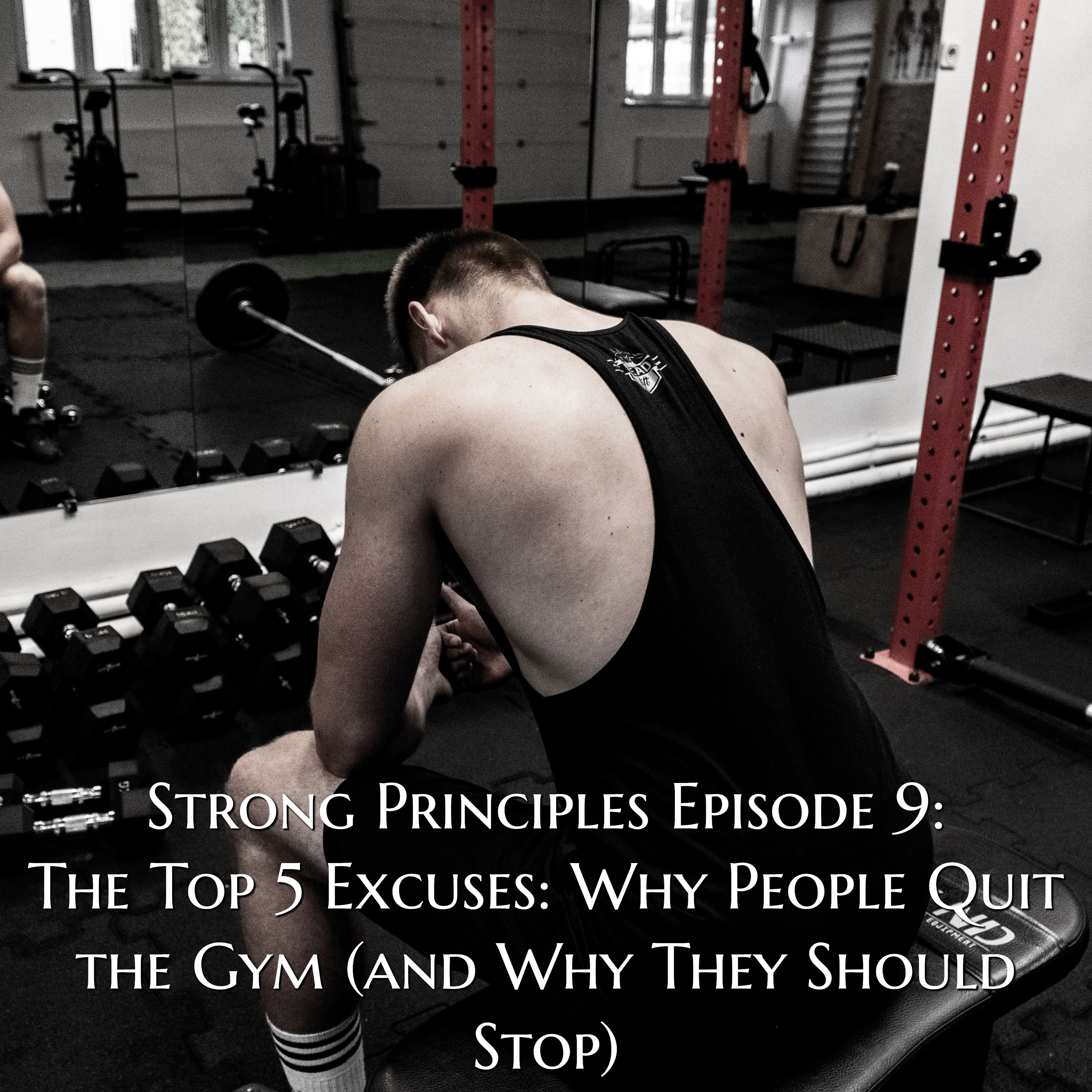
Strong Principles: The Top 5 Excuses: Why People Quit the Gym (and Why They Should Stop)
Strong Principles
| Rob DelaCruz, Larry Medina, Wendy Shafranski | Rating 0 (0) (0) |
| Launched: Sep 29, 2025 | |
| trips91@gmail.com | Season: 1 Episode: 9 |
Episode Highlights:
-
(00:13) The Top 5 Reasons People Quit: An overview of the common quitting points, which the hosts often re-frame as excuses.
-
(00:34) Why Start? Discussing the shift to strength training and longevity as key motivators for fitness in an aging population.
-
(01:34) Excuse #1: Time: Wendy challenges listeners to do a "time audit" and explains how even one or two strength workouts a week can drive significant progress.
-
(03:55) Excuse #2: Expense & Prioritization: Why money is often a matter of priority. The hosts argue that spending on fitness now is preventative healthcare for the future.
-
(05:22) Healthspan vs. Lifespan: A discussion on the importance of living a better, higher-quality life for longer, rather than simply extending years.
-
(06:46) Excuse #3 & #4: Boredom/Losing Motivation & Not Seeing Results (Plateauing): The trap of instant gratification and why fitness takes time.
-
(08:16) Shifting Goals: How transitioning from aesthetic goals (e.g., fitting a dress) to performance goals (e.g., lifting more) can make workouts more engaging and results-driven.
-
(09:07) Setting Yourself Up for Success: The importance of changing your lifestyle—like going to bed earlier—when you commit to new morning workouts.
-
(10:12) Excuse #5: Feeling Out of Place (Gym-timidation): Tackling the fear of being judged and the realization that everyone starts somewhere.
-
(11:27) Group Program Pitfalls: How comparative environments (like timed workouts) can reinforce negative self-perception, and why a personal program might be a better start for some.
-
(15:15) The Power of Community: The hosts conclude with the Louis Simmons philosophy: bonding with a workout partner or a strong community is often the key to long-term accountability.
SUBSCRIBE

Episode Chapters
Episode Highlights:
-
(00:13) The Top 5 Reasons People Quit: An overview of the common quitting points, which the hosts often re-frame as excuses.
-
(00:34) Why Start? Discussing the shift to strength training and longevity as key motivators for fitness in an aging population.
-
(01:34) Excuse #1: Time: Wendy challenges listeners to do a "time audit" and explains how even one or two strength workouts a week can drive significant progress.
-
(03:55) Excuse #2: Expense & Prioritization: Why money is often a matter of priority. The hosts argue that spending on fitness now is preventative healthcare for the future.
-
(05:22) Healthspan vs. Lifespan: A discussion on the importance of living a better, higher-quality life for longer, rather than simply extending years.
-
(06:46) Excuse #3 & #4: Boredom/Losing Motivation & Not Seeing Results (Plateauing): The trap of instant gratification and why fitness takes time.
-
(08:16) Shifting Goals: How transitioning from aesthetic goals (e.g., fitting a dress) to performance goals (e.g., lifting more) can make workouts more engaging and results-driven.
-
(09:07) Setting Yourself Up for Success: The importance of changing your lifestyle—like going to bed earlier—when you commit to new morning workouts.
-
(10:12) Excuse #5: Feeling Out of Place (Gym-timidation): Tackling the fear of being judged and the realization that everyone starts somewhere.
-
(11:27) Group Program Pitfalls: How comparative environments (like timed workouts) can reinforce negative self-perception, and why a personal program might be a better start for some.
-
(15:15) The Power of Community: The hosts conclude with the Louis Simmons philosophy: bonding with a workout partner or a strong community is often the key to long-term accountability.
In this candid episode of Strong Principles, hosts Rob Dela Cruz and Larry Medina are joined by Wendy Shafranski to tackle the most common reasons (or, as they call them, excuses) people stop going to the gym.
Drawing on years of industry experience and personal coaching, the team breaks down the Top 5 pain points—from not having enough time to dealing with "gym-timidation."
They explore the critical difference between lifespan and healthspan, discussing why prioritizing fitness now is essential preventative healthcare for the future. You'll hear practical advice on conducting a "time audit," shifting from aesthetic goals to performance goals, and overcoming the biggest mental barrier of all: negative self-talk.
If you're struggling with consistency, motivation, or feeling out of place, this episode offers the perspective and tough love you need to push past the plateaus and commit to your long-term strength.
Rob (00:00)
All right, guys, on the next episode of Strong Principles. I'm Rob Dela Cruz.
Wendy (00:05)
I'm Larry Medina. And I'm Wendy Schafransky.
Rob (00:09)
We got Wendy here today joining us, and we will be covering...
Wendy (00:13)
We're going to talk about the top five reasons people quit the gym. And this is based on our personal experience as well as metrics that are in the industry. I talk to a lot of gym owners and their same pain points and reasons why people quit the gym. I want to say that a lot of people call them reasons, but many of them are excuses.
Larry (00:34)
Now, I'm already throwing a wrench into this, but can we also talk about why you would want to start a gym?
Wendy (00:42)
Why you would want to start a gym? Yeah. So there's reasons why people want different body composition. They know it's good for their health. Finally, in the mass public now, you hear messages of strength training. Before, it was just like, Do cardio. And now, especially with aging population, you want to be capable. So that message is out there. And those are a lot of the reasons that when people come in for an assessment and we say, What are your goals? It's always to get stronger.
Rob (01:10)
Always. Yeah, and what we're seeing now, too, which I really like. We went through an age of go real hard and no rest days, and now it's more longevity thought process, which is way better. Which is way better. Now you're thinking of the future, and what do I do now and how is it going to affect me later on? Is Is it going to benefit me or is it going to hinder and take something away from me? Perfect. Okay.
Wendy (01:34)
The number one excuse is time. People say they don't have enough time. I say to that, How many Netflix shows are you watching? Maybe you just need to change your schedule. There's people that say, I don't want to get up at 5: 00 in the morning. Well, you know what? If you're not available in the afternoon, you might just have to have a lifestyle change. I ask some people to do a time audit. So in a day, time block, where how are you spending all your time? And really, you don't have to be at the gym every day. Even if it's two strength training workouts a week, I think most people can find the time for that. We've had single mothers who have a full-time job and are in school, and they've made the time. And that's an extreme case. So sure, there are people that maybe commute and they don't have the schedule, but the vast majority can find the time.
Rob (02:23)
And I think we spoke some of this on some other podcasts that we've done some episodes, is that it's a lot less time than you think you need. As long as you're getting in there, I've seen people progress with one or two days a week, and everybody is going to run into busier times and less busier times. But as long as you're still trying to make an attempt and getting in there at least once or twice, you'll still see a lot of benefits.
Larry (02:46)
Yeah, I agree with that because I'll tell you, since it started coming here, right? And I'm like, I got to do something, right? I'm just a little bit more consistent. So I do commit myself to two times a week, three If I'm lucky, but I try to go four days. I can tell, honestly, I'm moving better as far as... It's weird, right? Because I felt aches and pains that I had on my shoulders, my knee. Thanks to some tips that you've given me on my knee, I have started to use them, but I can tell I'm moving better. I don't feel as achy. Does that make sense?
Wendy (03:31)
I don't know why, but-Yeah, no, lifting helps with your mobility. You're actually getting less rigid if you're working through full range of motion. So that makes sense. It's almost like... I almost think it like hypertrophy.
Rob (03:45)
Hypertrophy? Yeah.
Larry (03:46)
Where if you don't use it, you're just becoming like,.
Rob (03:49)
Yeah, you're going to atrophy.
Wendy (03:50)
Atrophy, yeah.
Rob (03:51)
Yeah, 100%. Wendy, would you say that with their time, is that that's not that important to commit to time.
Wendy (04:01)
Yeah. So this is a good segue to number two, which is expense. And a lot of times it's the prioritization. So prioritization of time, yes. You'd rather go out to happy hour than come to the gym. The regular guy, Larry, speaks. And then there's the expense. And I'll start by saying, because our gym is based on service, on coaching service, we are more expensive than a Planet Fitness, and it's not in everyone's budget. So I completely get that. But we'll have people quit saying that they can't afford it, yet they have the latest iPhone. They go out to dinner and drink expensive bottles of wine, all these things. So again, that's the prioritization. And I am never one to say, Well, this is how you spend your money. It's not my business. But I see it. I see their posts on Instagram and their unlavished dinners or vacations or whatever, and that's great. And those are great time spent with loved ones, and we need that. But I think we all waste a lot of money on things like subscriptions or what have you, and we could... Daily coffees. You could bank that money and put it towards yourself.
Rob (05:12)
Because, Larry, like what you're talking about why go to the gym, I think the information that's out there now and the data is, it's almost irrefutable. You got to do something. We know now you have to do something.
Wendy (05:22)
Yeah, and I say, if you're not spending money on fitness now, you're going to be spending on health care later.
Larry (05:27)
Yeah, it's preventative, right? I look at the preventative side of the business. Because really, whether you're in health care later or in the gym today, it's really-It's a cost. It's a cost.
Rob (05:41)
Yeah. I think now we're starting to see that there was a thought at one time that you could get away with not doing anything. That time has gone away. Now we know we have to do something and be active.
Larry (05:54)
The other thing to think about, too, honestly, is that we are living longer as human beings.
Wendy (06:01)
But not necessarily better.
Larry (06:03)
But not necessarily better. If you want to be able to be better at a later age, you should work out.
Wendy (06:11)
That's the whole point of it. I like to think of it as, don't think about lifespan, think about health span. Yeah, exactly.
Larry (06:18)
Because there's a book by Peter Thia out there where he is Outlived, I think his name of the book, where he talks about longevity. I think people misunderstand his meaning longevity, where it's not longevity in the sense of living longer, longevity in the sense of being able to live a better life longer. Yeah.
Rob (06:39)
Like, better quality in that time. All right. But we digress.
Wendy (06:46)
All right, number three. So we said time and expense. Number three would be boredom or losing motivation. And to that, I think a lot of times that's a mindset. And it It happens when people feel like they're plateauing, which I'm going to lump number four in there with not seeing results. So boredom and not seeing results, they're plateauing. A lot of times, it's they haven't found that sweet spot of training where they're pushing themselves hard enough. They're using the same 10-pound dumbbells for everything over time. Their body is not adapting or changing. They're not having, quote-unquote, fun. But lifting more is fun. Seeing your body change is fun. So if you're making effort, I think the workouts become fun and they become less boring.
Larry (07:34)
The problem is that it's not instant gratification, right?
Wendy (07:39)
Very true. That's a great point. It took 20 years for All of a sudden, you look down and you have 20 pounds in your stomach. It's not going to go away overnight. We're a microwave society. Chatgpt, all these things happen so quickly, but fitness does not.
Larry (07:57)
Yeah, it says all time because I've gained weight, right? If I try to lose it, I shouldn't expect it to come off tomorrow because I didn't gain it overnight either. It took years to get this body, right? It should take years to get the other body.
Wendy (08:16)
Sometimes if you feel like you're not seeing results, a lot of times there should be a mindset shift. Instead of saying, I want to look like this or fit in this dress or whatever, start having more performance goals. What can your body do? And then the esthetics start to track along after that.
Larry (08:37)
That's interesting because I literally have been thinking about this in the past couple of weeks. I'm like, Okay, I don't want to get into running just yet or doing the morning workout just yet. I want to wait a couple of weeks because I have a couple of things going on. And after that, then I'll probably shift to waking up early. And with It's that, right? It also changes your lifestyle of like, Well, I can't really have that drink at the end of the night. Because now I got to get up early and be able to perform.
Rob (09:11)
You have to set yourself up for success. A lot of people don't sometimes. They go and they sign up for the gym to get up in the morning, but they didn't change anything. So now they're switching their whole day to an hour to two hour difference. But they didn't set their self up at night for success and shift it and maybe go to bed early, not have that drink, stay up the same time late, and then try to get up the next morning.
Larry (09:33)
Yeah, it's no different than if you are a desk jockey, where if you want to relieve some stress of your workday for tomorrow, maybe sometime in the evening, look at your calendar to see what that looks like, prepare your sofa the day. It's no different.
Rob (09:48)
Yeah, and start it out. And that's the whole thing with starting out with one or two days. So then you can prepare yourself. Can I do that one or two days and reinforce that? And then you start going further in it. But another thing I wanted to get into on this last one is maybe you're doing an ineffective program to see results.
Wendy (10:03)
True. But a lot of people that say, I'm not seeing results, I'm like, But you haven't been in. It doesn't happen just because you signed up.
Rob (10:10)
When it comes in here, yes.
Wendy (10:12)
So yeah, boredom/losing Seeing motivation, that's number three. Number four, not seeing results. But again, it's are you pushing yourself appropriately? Are you showing up? Do you have too much emphasis on the esthetics and not the performance or what your body can do? Those are some message Which points there. And then the final one is feeling out of place. We hear this quite a bit. There's a real thing called gym timidation, and it's people are scared to even set foot in the gym for the first time. And even our members who feel very comfortable here. They don't want to go to another gym when they travel or something like that. They're comfortable here. So props to someone to overcome that and come in for that free assessment with us and then start. But there's an attitude a lot of times of people are looking at me, people are judging me. I can't do what she's doing and not realizing they started at the same point you did. And we have a very welcoming community, but some people can't get it out of their own way. And they have negative self-taught, and they're very judgmental on themselves, and so they feel out of place.
Wendy (11:17)
And so we have lost members for that. And we hate that because our coaches and our members are just so welcoming, and they love seeing people start. But again, a lot of times, it's between your own two ears.
Rob (11:30)
Yeah, we run into it. And recently we've had to... Because we do group program, and then we do personal training and small group. But sometimes a group program is not the best set up for some individuals. Even though they want to sign up for it, a personal program with them is a better set up to be more effective for them. And a lot of times what happens in a group program because it's set up for a bell curve. And so the majority of people can do this, but the outliers have to do something different. And sometimes it makes someone feel inadequate or bad about themselves because they can't do what other people are doing instead of looking at what they can do.
Larry (12:04)
Yeah, to that point, it takes me back to the CrossFit days because I could never do a muscle up. I did one muscle up ever, and then I couldn't replicate it. You did one. I did one, but I couldn't do it. If a workout called for it, I can't do it. I would scale it down. But honestly, I never looked at, Rob can do 100, and Wendy can do 100, and I can't do one because it had nothing has nothing to do with me, with you. What you can do has nothing to do with me.
Wendy (12:34)
Right. And what I don't think people realize, too, is we don't do things like muscle ups and stuff like that now, but we have a lot of women, 50 plus, that can do a strict pull up. And I'm like, If you go to Walmart or Disney or the airport and look around, you can do way more than most people can do. But they're comparing themselves to other people in the gym that have been here for years and have worked really hard for it.
Rob (12:56)
And Larry, we realized that. One of the things, too, and I like of muscle ups. But the thing is that certain type of workouts, maybe for time or something, is comparative. And so that reinforces a certain type of behavior. But if there was a workout and there was rest between and it's either pull ups or you do a strict muscle up or you do whatever, no one would be worried about it. They're like, Oh, this is me, and this is what I do over here, and this is that guy goes over there. But if you're going for time and this is the only way to do it, and if not, you got to go on a band and whatever, that creates that feeling. That makes sense.
Larry (13:32)
But yeah, the gym timidation, I'm with you on this because I know some people who are not strong at all. They don't even want to step into a Planet Fitness because they just feel inadequate. But the truth is, The message to those people would be like, Everybody started somewhere. It just happened that somebody started younger. That's it, right? It's okay. Yeah.
Wendy (13:55)
I mean, just to recap, then we've got time, which if that's you, I would do a time audit and see where you have some opportunity, even if it's twice a week to do some strength training. Expense, I would look at how many subscriptions you have, how many dinners you go out. What are expenses that you are incurring that aren't impacting your health in a positive way?
Larry (14:17)
Maybe do an audit of what does my life look like in the future? Cost-wise, pharmaceutical.
Wendy (14:24)
True. Yeah, I love that. Look at that, right?
Rob (14:27)
There's inexpensive ways even not to You could buy a program online. That's just a pretty smart program. You pay one time through and maybe even pay a trainer just one time to see them to help you understand these movements and then go and do it on your own somewhere cheap. There's ways to get around it, too.
Wendy (14:43)
Yeah, for sure. Then we've got the boredom, losing motivation, not seeing results. That's are you showing up? Are you pushing yourself appropriately to see an adaptation? And are you maybe focused a little bit more on the esthetics than the performance? Because getting stronger feels great, and it's not boring at all. Yeah. And then number five is the feeling out of place. And just know, whether it's our gym or other gyms, I mean, the most welcoming gyms or sometimes those done in power lifting gyms. People are just happy to see other people working out. So try to get over yourself and know that people aren't judging you. They're happy that you're here. Yeah.
Larry (15:27)
Because one thing that always sticks with me Back in the day, Louis Simmons.
Rob (15:31)
Yeah.
Larry (15:32)
One of his biggest things was it's not even the workouts that keep you going. It's the people that you form bond with while working out, and then you hold each other accountable. So if you can find yourself a good workout partner, right? That's the key. When you have a community here, everybody's your workout partner.
Wendy (15:51)
I can speak for our members and ourselves. When we see the person that is severely overweight or maybe very old, and they're trying, that's freaking awesome.
Rob (16:03)
It's a mindset. It's less about the abilities and more about a mindset, because we have all different types of abilities in there. Some of the people that their mindset wasn't set up right, and they were being self-deprecating, had pretty decent abilities. They were just comparing themselves too much. Yeah. Yeah, exactly. All right.
Larry (16:23)
Awesome. That was it. Thank you so much. Yeah. All right. Thanks.