Cardio vs. Muscle: The Real Principles of Lasting Fat Loss
Strong Principles
| Rob DelaCruz, Larry Medina, Wendy Shafranski | Rating 0 (0) (0) |
| Launched: Oct 06, 2025 | |
| trips91@gmail.com | Season: 1 Episode: 10 |
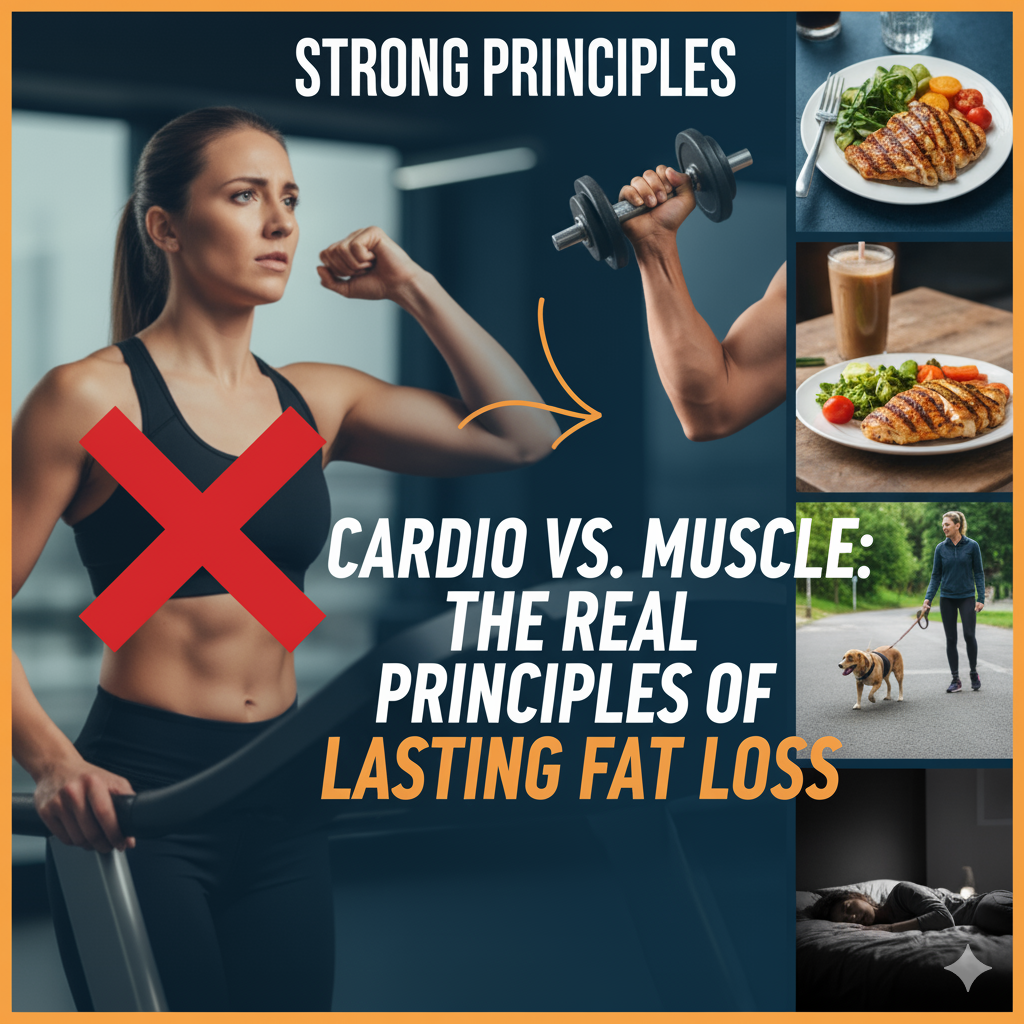
Cardio vs. Muscle: The Real Principles of Lasting Fat Loss
This week on Strong Principles, Wendy, Rob, and Larry tackle a client question that's on everyone's mind: How much cardio should I add to lose fat quickly?
The hosts unpack the common trap of relying on calorie-burning cardio, explaining why it's a short-term fix that can actually slow down your metabolism. If your goal is sustainable, long-term fat loss, the answer isn't more hours on the treadmill—it's building muscle and optimizing your daily habits.
Key Principles Discussed:
-
The Metabolism Myth: Why focusing on calories burned during a workout is less important than your Basal Metabolic Rate (BMR), which is shaped by muscle. Rob explains how muscle makes your body "more expensive to operate" all day long.
-
Protein is Priority: The team emphasizes that nutrition, specifically protein intake, is critical for supporting muscle and keeping you full. They discuss the target of aiming for 0.8 to 1 gram of protein per pound of goal body weight.
-
The Power of NEAT: Wendy breaks down Non-Exercise Activity Thermogenesis, explaining that all those little movements (walking, standing, fidgeting) throughout the day add up to more calorie burn than you think—and why a great workout shouldn't lead to a sedentary day.
-
The "Powerful Pill" of Sleep: Larry admits his struggles, while Rob and Wendy explain why sleep deprivation is a major stressor that pushes your body to hold onto fat. They share how an extra hour of sleep can actually change your body composition.
Actionable Takeaways:
-
Prioritize Strength Training: Focus on lifting weights to increase your BMR.
-
Boost Protein Intake: Track your intake for a few days and start inching toward your goal.
-
Move More All Day: Increase your steps, use a standing desk, and move every 15 minutes to increase NEAT.
-
Get 7+ Hours of Sleep: Treat sleep as a non-negotiable component of your fat loss strategy.
SUBSCRIBE

Episode Chapters
Cardio vs. Muscle: The Real Principles of Lasting Fat Loss
This week on Strong Principles, Wendy, Rob, and Larry tackle a client question that's on everyone's mind: How much cardio should I add to lose fat quickly?
The hosts unpack the common trap of relying on calorie-burning cardio, explaining why it's a short-term fix that can actually slow down your metabolism. If your goal is sustainable, long-term fat loss, the answer isn't more hours on the treadmill—it's building muscle and optimizing your daily habits.
Key Principles Discussed:
-
The Metabolism Myth: Why focusing on calories burned during a workout is less important than your Basal Metabolic Rate (BMR), which is shaped by muscle. Rob explains how muscle makes your body "more expensive to operate" all day long.
-
Protein is Priority: The team emphasizes that nutrition, specifically protein intake, is critical for supporting muscle and keeping you full. They discuss the target of aiming for 0.8 to 1 gram of protein per pound of goal body weight.
-
The Power of NEAT: Wendy breaks down Non-Exercise Activity Thermogenesis, explaining that all those little movements (walking, standing, fidgeting) throughout the day add up to more calorie burn than you think—and why a great workout shouldn't lead to a sedentary day.
-
The "Powerful Pill" of Sleep: Larry admits his struggles, while Rob and Wendy explain why sleep deprivation is a major stressor that pushes your body to hold onto fat. They share how an extra hour of sleep can actually change your body composition.
Actionable Takeaways:
-
Prioritize Strength Training: Focus on lifting weights to increase your BMR.
-
Boost Protein Intake: Track your intake for a few days and start inching toward your goal.
-
Move More All Day: Increase your steps, use a standing desk, and move every 15 minutes to increase NEAT.
-
Get 7+ Hours of Sleep: Treat sleep as a non-negotiable component of your fat loss strategy.
Ditching the Cardio Craze: Why Your Treadmill Strategy Is Sabotaging Your Fat Loss
When you need to drop weight, your first instinct is probably to hit the treadmill—hard. But on this episode of Strong Principles, Wendy, Rob, and Larry reveal why adding more cardio is a short-sighted trap that can ultimately slow your metabolism and sabotage your long-term goals.
It's time to shift your focus from burning calories in the gym to being a better calorie burner all day long. The team breaks down the non-negotiable principles for lasting body composition change: strength training, high-protein nutrition, maximizing NEAT (daily movement), and the "powerful pill" of quality sleep.
Learn why building muscle makes your body "more expensive to operate," how sleep dictates your food choices, and the simple steps you can take outside the gym to get results. If you feel like you're running harder but getting nowhere, this episode is your metabolic reset.
Wendy (00:00)
All right, guys. Welcome to another episode of Strong Principles. I'm Wendy Shafranski.
Larry (00:04)
I'm Rob Dela Cruz.
Larry (00:05)
I'm Larry Medina.
Wendy (00:06)
All right, guys. Today, we are going to talk about a topic that I know is on a lot of people's minds, and it came about from a conversation I had with a client of ours recently who is looking to fit into a dress in a month. So she said, How much cardio should I add? And that was her mentality of like, All right, I need to add more cardio to burn more fat, lose some weight. All right, I'll have you take it first, Rob. What do you think?
Rob (00:32)
What she should do or what about it?
Wendy (00:34)
Okay, if I came to you saying, All right, I need to fit into this dress. I'm almost there. I'm just going to add a bunch of cardio.
Rob (00:39)
What would you say to me? Well, in a time crunch, there's things you can do, but it's not the best approach, basically. What people run into issues with the cardio is they'll look at the calorie burn and you're not paying attention to the fat loss. Those are two different things. When you go and you do a big signal of cardiovascular training, it tends to actually pare down muscle, and you could possibly slow down your metabolism, which is most likely going to happen.
Wendy (01:06)
Yeah. I see quite a few issues, obviously, with this. I mean, yeah, they focus on the calorie burn in that hour long session, which if you're an hour on the treadmill, you're going to burn more calories than an hour lifting weights. But if you're constantly doing cardio, your body is adapting. So that same hour is not as effective as it was when you first started. So now you have to go to an hour in 15 minutes, and then you adapt, and then you got to go. You can't continually add and add more cardio. Like Rob said, it's going to pair down muscle, but your metabolism is shaped by muscle. So even though you're burning less calories in that strength training, workout, you are burning more all day long the more muscle you have.
Rob (01:49)
You're basically becoming more expensive to operate your body all day long.
Larry (01:54)
Yeah, I understand your client's question, right? Because in the layman, I would think calories burned versus calories taken in, right? Correct. If I'm in a deficit or whatever, then theoretically, I should lose weight.
Rob (02:08)
Correct. It's still true to a certain extent, definitely.
Larry (02:13)
But it's hard to track how much you're actually burning. Correct. Yeah. That's really the crux, right? You don't know.
Rob (02:20)
You're wearing wearable, but it's not accurate. It could be up to 60% off.
Wendy (02:27)
I was at a fitness conference, and there was a guy that I listen to, and he looks at all the trackables for military, for NBA, and he was just saying, Use it as a tool for looking at trends, but don't put all your eggs in that basket. But let's talk about basal metabolic rate. So that's the amount of calories you burn when you just say you just lay in bed for 24 hours. So your body naturally burns that. Say I'm almost 150 pounds. So say I'm a 150 pound woman, but I have a lot of muscle. My basal metabolic rates, when I tested, it was about 1,700 calories. But say there was a 150 pound woman that has not a whole lot of muscle, it might be 1,000, 1,200. So my body is a lot more efficient. It's burning calories naturally because I have more muscle. So that's what you want to put your focus on. Cardio is great. We do it. We think it's important for your heart. But if you trying to lose fat, building muscle long term is the way to go.
Larry (03:33)
By the way, that means you can eat a whole other hamburger.
Rob (03:36)
Yeah, you definitely could.
Wendy (03:37)
That's a delicious hamburger.
Rob (03:38)
There's no way around good nutrition. But also you want to think the heart of those workouts and the long of those workouts are, your body is going to figure out how to go ahead and bring down its energy it's using. People don't realize that. You go and burn a ton of calories in a workout, you do some big old hit workout, your body is going to try to slow itself down through motivation or through the way it moves during the day. Your body is pretty smart when it goes to do that. Also is when you're using those trackers, it does not tell you how your body is adapting to that cardiovascular training. In a very short amount of time, you're not burning the same amount of calories. So what happens is you end up having to do either more cardio or eat less food. So you run into that trap of all of it together, trying. So now you're hardly burning any calories. You're doing a lot You're not in movement, and you're hardly eating any food. That's a bad place to be in. Because once you go away and you go and eat some food and go on vacation, when people say they blew up, all of a sudden, you have no metabolically room.
Larry (04:43)
Yeah, your deficit is just insane at that point.
Rob (04:45)
Yeah, you're stuck. You're stuck. There's only a few ways to increase your metabolism. One is strength-trained. It's sending a signal for your body to produce more tissue, more muscle. Also, neurologically, for you to get stronger, your brain is so expensive to send a signal to get stronger. So that right there increases. The other way would be to eat more food. Your body automatically has an uptick, but then you're eating more.
Larry (05:11)
But then you're eating more. Yes, and that's the confusing part, right? I'm running into that today, right? Losing... I don't eat a ton. At least, I don't think I eat a ton.
Rob (05:23)
Well, see, that's the thing you want to see sometimes. You might not be because there's a lot of people we've worked with over the years, and you could swear they're lying. Then you look at it and they're not, but they've moved their metabolism down.
Wendy (05:34)
But then we have the clients that are like, No, I swear. I'm tracking and I'm hardly eating anything. Then they're not weighing and measuring. Then they, What does a table spoon of peanut butter look like? It's like a quarter of a cup. That's a big difference.
Rob (05:49)
Because, Larry, you're trying to give yourself like metabolic flexibility. You're trying to give yourself some room. What happens a lot of times with people is they don't have that much room. They might be in a little bit of deficit during the week, and then they go on the weekends and they're like, Well, I've been pretty good. I'm going to go have a few drinks, and I'm going to eat. Well, you only had an extra couple of calories in there, and actually you ate 800 extra. So now we just blew the whole thing in the weekend.
Larry (06:12)
Yeah, I'll tell you what a typical day is, Monday through Friday. Okay.
Wendy (06:18)
See, right there, we are-That's the problem.
Rob (06:20)
I already know what's going on here.
Larry (06:23)
But yeah, so Monday through Friday, I'll do… It'll spill into the weekends, but But as far as my typical day would be, I'll have some coffee, right? Like a splash of heavy cream. No problem. Well, but yeah. This is a splash. It legit is like a splash. My wife will be like, You didn't throw anything in there. I'm like, It's plenty. So coffee, maybe one, two cups. I don't eat breakfast, and then I'll eat like a... I do sous vide chicken, so it's fancy. Yeah. But it's nice because it's not fried. It's not anything.
Rob (07:04)
What time is your first meal at? Noon. Okay.
Larry (07:07)
So 12-ish. And then I don't eat again. I'll have a chicken sandwich. So it's full disclosure. It'll be this wheat bread, slice of chicken that is not fried, nothing, maybe a piece of cheese on it. That's my lunch.
Rob (07:27)
Any sauce, mayonnaise?
Larry (07:29)
A little bit of mayonnaise. Some mustard. Then for dinner, I'll have, again, sous vide chicken, of some sort with a veggies.
Wendy (07:41)
It sounds like you're not getting enough protein.
Larry (07:44)
Yeah, potentially. Yeah, for sure.
Rob (07:47)
The scary part is eating more. It's scary because you feel like you're going to put on weight. But a lot of times what happens is when you're eating more, it's sending a... When you don't eat that much, Having fat is an insurance policy to the body. When it doesn't get a little more of an abundance of calories for a while, it tends to want to hold on to things. It'll burn the more expensive or try to get rid of the more expensive tissue first if you're not eating. The more expensive tissue is muscle. Then you're in this weird thing trying to build muscle, and then your body's trying to get rid of it because you're not giving it that much to work with.
Larry (08:27)
All right, so saying what I just said, what would you add to it?
Wendy (08:31)
Well, I would have you track three days, and it's a pain in the ass, and I don't like it long term because I think a lot of times people get too wrapped up in it just like they do wearables or whatever. But let's see what you're at on a typical day. And then I would say, if you're eating 120 grams of protein, I would say, Try to get about one gram per pound of body weight or even per pound of goal body weight. So I would start there. I'd probably have you add more vegetables. Whole Foods, you feel full because there's so much more volume than when you're using-You just don't feel stuffed. Right. You feel good. Last night, I made skirt steak, rice, and roasted broccoli. It tasted so damn good. I'm like, Why don't people like to eat this way? It was so good.
Rob (09:22)
And I had a chicken pie with that. It was so good. Yeah.
Larry (09:24)
On top of that? Yeah.
Wendy (09:26)
He eats a pound of beef at a time. Jesus.
Larry (09:30)
Yeah. But yeah, look at you.
Wendy (09:33)
I mean, he had to maintain what he has. Yeah, but no, I would say definitely look at your protein intake and then overall calories. You could be a little low on things, but Protein is going to keep you feeling full. It's going to support muscle building.
Larry (09:48)
There's just-The masscuitis then, right? If we're talking about a gram of protein for the goal body weight, right? That's what you said. Yeah. Let's pretend that I want to make my body weight 175. Not possible, but let's say I want to do 175. I don't feel like I should aim for that first. I should probably aim for, let's say, I'm 220, 205.
Wendy (10:20)
Yeah, well, it depends on where you're at now.
Rob (10:21)
Have you ever tried to hit it? First thing, I would say 100% with Wendy saying, but maybe if it's too much of a pain to track everything, just do the protein by itself. And have you even aimed for the 170? No. Okay, because that might see... Wait, weight-wise?
Larry (10:37)
No.
Rob (10:37)
No, no, no. The protein grams. No. Because that alone, Whole Foods, like Good, that might be hard to get to in the first place. And that alone could keep you full enough where somebody other stuff might go by the wayside a little bit and you don't eat it as much.
Wendy (10:53)
Because 200 is a lot. Do that experiment and see where you're at. If you're at 120 and you want to get to 175, I don't expect you to get there overnight. Start inching it up. Because Larry, think about it. Then, like he said, track just protein only, and then the rest of your diet, or 80% to 90% is wholefoods. You don't have to worry about the calories. It's just not going to hit you like a processed food would.
Rob (11:17)
Because Larry, I don't know where you're at, but you got two meals in. I'm just throwing it in my head thinking, you're probably at like 80 grams. Now you got to find almost 100 another 90 grams. That's the same as that you're eating in the day. That's not going to be that easy to do. You're either going to have to eat another meal or add to the meal you are and take away from somewhere else.
Wendy (11:41)
You're over 40. Sarcopenia muscle loss happens. Protein is so much more... Older people, a lot of them eat smaller amounts. But in actuality, the protein demands for someone older is more than the younger person. Okay. Yeah.
Rob (11:58)
That's like, Try Try it first before you think. Because it's going to be harder when people think, Is he eating a lot of protein?
Wendy (12:04)
Some other considerations. We're talking about cardio for weight loss, and we're saying that's not the way to go. You can do some cardio, but build muscle, Get your protein intake up. So lift weights, focus on wholefoods and protein. The other consideration is called NEET, and that stands for non-exercise activity thermogenesis. So this is beyond that basal metabolic rate we just talked about when you're just laying in bed. This is all the calories you burn all day long. A lot of people come and they crush themselves in the gym for an hour, and then they sit the rest of the day. They sit at the desk, they sit on the couch. So NEET is, I like to think of it as steps. You got to get those. You got to always have your body just working in your favor.
Rob (12:46)
Yeah, and the harder you go in the gym, the less motivated you are to do anything else. So that goes hand in hand with that.
Larry (12:53)
So you're saying, don't go ham or go ham at the gym, but then continue?
Rob (13:00)
Well, no. You want to do a sustainable approach. Go and ham once a week is fine, but that shouldn't be all the time.
Wendy (13:07)
No. I mean, say I work out in the morning. Okay, I'm going to work out in the morning, but I'm going to make sure I take walks during the day. I have a standing desk and I fidget all the time. So I know I'm getting a lot of activity. But if you're at a desk and you're in an office, set your Timer for every 15 minutes and stand up and move around a little bit. Walk after dinner, take your dog for a walk every morning. Park farther in the parking lot, use the stairs. All these little things over the course of a day add up. Because we've had people that wear the wearables in our gym, and they're consistent in the gym but not seeing anything. But then you look and they have like 3,000 steps a day. Because they're a lawyer and they're sitting at their desk. Super sedentary. Yeah. Just because you're in... Great, you're working out, but you need to think about just staying active. There's been some studies, and people who fidget tend to be leaner than people people who don't, and they're just getting more.
Rob (14:01)
Because, Larry, you want to think about it. Even the hardest gyms, take a hard cardiovascular training, 400 calories, maybe that's a lot. You're out of there for a long period of time going at it, and that's not very hard to eat. Then a strength training, a couple of hundred to 300, maybe. But you can easily eat that. If you're not moving the rest of the day, so too many people rely on the workout to use the calories up, but you actually have to rely on the movement that you're doing during the day. That helps It's hard to overcome being sedative no matter what your workout is.
Larry (14:34)
Yeah, no, I totally agree with you. I feel like that's a big part of my issue, personally. But yeah, I totally agree with you.
Rob (14:40)
Seditary, I meant to say.
Larry (14:41)
Yeah, I got you. Sedative.
Wendy (14:43)
Speaking of sedative, the last thing is you need to sleep.
Larry (14:49)
That's a big one. I'm terrible with that.
Wendy (14:51)
Okay, that's a big one. When you're sleep-deprived, you make bad choices in food. It affects your It affects your insulin sensitivity. There's been studies where people, all they did, they did everything the same in their life, but they got an hour extra sleep, and they saw their body composition change.
Rob (15:11)
Yeah, I got one for you, too. It's super important.
Larry (15:14)
Just an extra one hour?
Wendy (15:15)
Yeah. I think, well, everybody is different, and I know people can operate on less sleep, but it's usually seven hours is the minimum that you need to get consistently per night. We're at 8: 00 to 10: 00 every night. We go to bed at 7: 00. What?
Rob (15:34)
It's disrupted a little bit. Remember everything Wendy said? But Larry, when I said that having body fat is an insurance policy. When you have low sleep, it's a big stressor. It wants that insurance policy, and it's going to push you to gravitate to wanting to hold on to the fat. Also, there's been some studies that they've seen that they've had people have seven and above hours, and then it was six and below to five. The percentage in body fat, and they were all doing the same thing, was huge. Some people cannot lose weight no matter what you're doing or what you're eating, if your sleep is too low.
Wendy (16:11)
You can repair and recover so that your workouts are that much better, too. It's like this It's all linked.
Larry (16:16)
That makes sense. That makes sense. Yeah. Okay. I was listening to an MMA guy who is a huge wrestler, and you're talking about his all day training. Obviously, they're outliers, and I wouldn't recommend this to anybody, but they would work out so hard in the morning, they would take a nap and then get back at it.
Wendy (16:37)
Pro athlete.
Rob (16:37)
Yeah. I mean, that's pro athlete. That's totally different than a longevity-based program.
Wendy (16:41)
You think about pro athletes, and yeah, they train a lot, but they are doing everything perfectly to put them in a perfect situation to perform. They prioritize sleep.
Larry (16:52)
All of them. That's number one. I was surprised to hear like, Oh, yeah, I take a nap every day. I was like, Oh, okay.
Rob (16:58)
I think it's under six or five hours. I think it's under six. It's almost like 40% more likely of an injury. Yeah, it's crazy.
Wendy (17:07)
Again, your insulin sensitivity is out of whack. Your food choices are bad. It's a lymphatic flushing for the brain for clarity.
Rob (17:16)
There's a ton of stuff that's going on.
Wendy (17:19)
All right. I think we've covered it all. But just to put it all out there again, if you are wanting to lose body fat, don't add more cardio. Cardio It's fine, but your priority should be on lifting weights. It should be eating wholefoods with an emphasis on protein. If you want to track, try to get around a gram per pound of bodyweight, maybe 0. 8 per pound of bodyweight. Worry about non-exercise activity thermogenesis, which is called NEET. So the steps you're getting all day, try to be active there, and then get seven or more hours of sleep. It's a powerful pill.
Larry (17:58)
Agreed. Getting a walking pad.
Rob (18:00)
Okay. Yeah. Doing your strength training, because what you do is just make yourself more expensive just all the activities that you're doing, including cardiovascular training. Yeah. Awesome. All right. All right.
Larry (18:12)
Until next time, guys. Thanks, guys., guys.