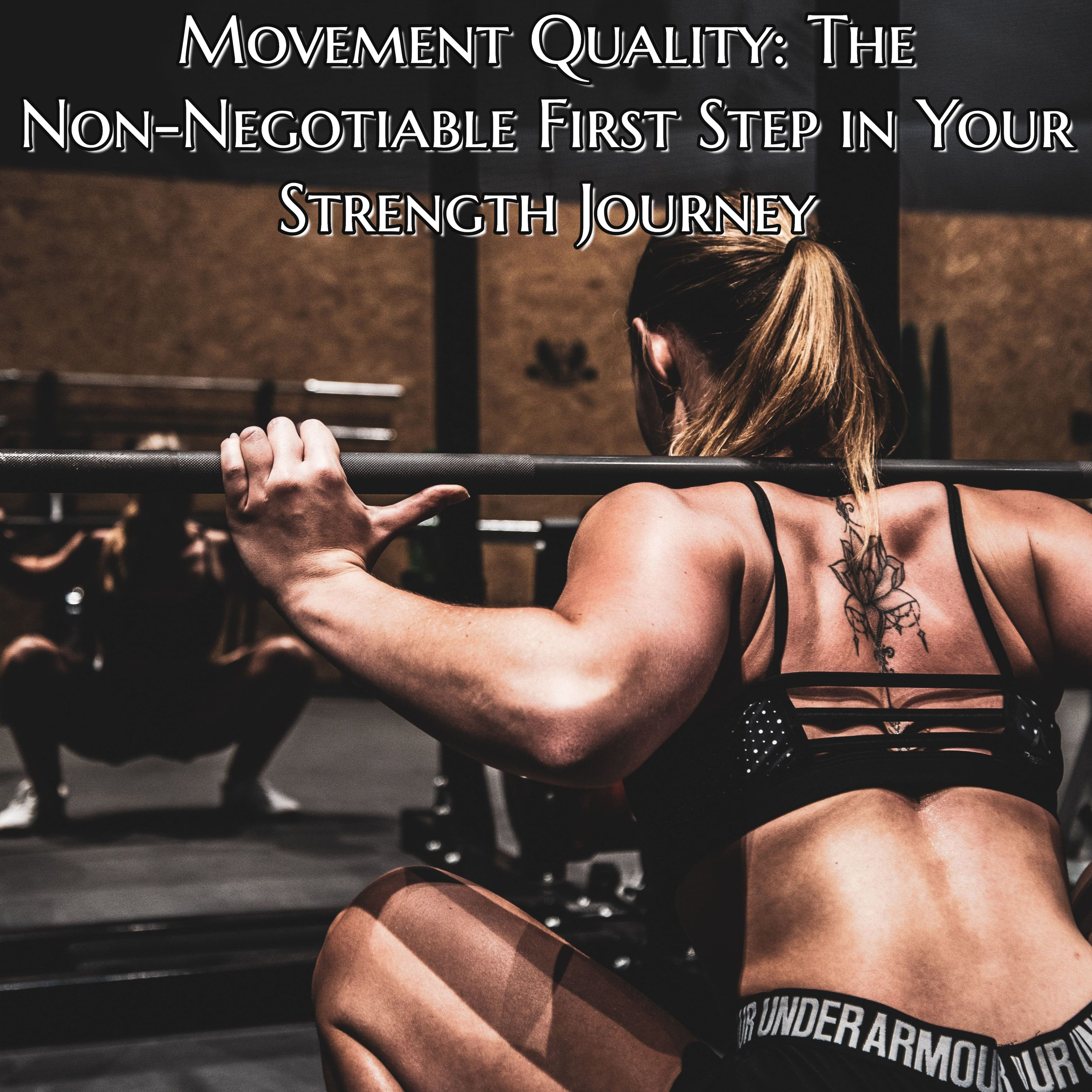
Movement Quality: The Non-Negotiable First Step in Your Strength Journey
Strong Principles
| Rob DelaCruz, Larry Medina, Wendy Shafranski | Rating 0 (0) (0) |
| Launched: Oct 13, 2025 | |
| trips91@gmail.com | Season: 1 Episode: 11 |
In this episode, Larry, Wendy, and Rob discuss the paramount importance of movement quality as the foundational first step in any strength training journey.
Key Takeaways:
-
Safety First: Prioritizing good movement quality, proper range of motion, and correct execution is the immediate path to a safer training environment.
-
The Three-Month Principle: A general guideline for new lifters:
-
Month 1: Focus on learning and practicing the movements.
-
Month 2: Start using the movement patterns consistently.
-
Month 3: Begin building strength and progressing the load.
-
-
Building Muscle Effectively: You can build more muscle and achieve better long-term results by using a full range of motion, even if it means reducing the weight initially. (0:48)
-
The Six Fundamental Movement Patterns: The hosts highlight the key patterns that form the basis of all functional strength:
-
Squatting (sitting down/standing up)
-
Hinging (like a deadlift or bending)
-
Lunging (stepping back/forth)
-
Pressing (vertical/horizontal)
-
Pulling (vertical/horizontal)
-
Carrying
-
-
Mobility is Crucial: For many people, especially those with desk jobs ("forward society"), poor movement stems from limited hip and shoulder mobility. Addressing mobility issues with dedicated warm-ups and exercises must happen before loading the movement heavy. (3:52)
-
Avoid "Loading the Flaw": Doing movements under high fatigue (e.g., in a typical boot camp) or with improper form only reinforces bad patterns and increases the risk of injury. (4:33, 9:20)
-
Progressive Overload for Movement: If you can't squat well, start on a higher object (like a 20-inch box), strengthen that position, and then gradually lower the target over time—it's not about forcing "ass to grass." (5:26)
-
Program Structure for Success: The hosts' gym programming separates strength/practice days (Monday, Wednesday, Friday) from conditioning/test days (Saturday) to ensure members master the movement in a low-fatigue environment before testing it under stress. (10:14)
SUBSCRIBE

Episode Chapters
In this episode, Larry, Wendy, and Rob discuss the paramount importance of movement quality as the foundational first step in any strength training journey.
Key Takeaways:
-
Safety First: Prioritizing good movement quality, proper range of motion, and correct execution is the immediate path to a safer training environment.
-
The Three-Month Principle: A general guideline for new lifters:
-
Month 1: Focus on learning and practicing the movements.
-
Month 2: Start using the movement patterns consistently.
-
Month 3: Begin building strength and progressing the load.
-
-
Building Muscle Effectively: You can build more muscle and achieve better long-term results by using a full range of motion, even if it means reducing the weight initially. (0:48)
-
The Six Fundamental Movement Patterns: The hosts highlight the key patterns that form the basis of all functional strength:
-
Squatting (sitting down/standing up)
-
Hinging (like a deadlift or bending)
-
Lunging (stepping back/forth)
-
Pressing (vertical/horizontal)
-
Pulling (vertical/horizontal)
-
Carrying
-
-
Mobility is Crucial: For many people, especially those with desk jobs ("forward society"), poor movement stems from limited hip and shoulder mobility. Addressing mobility issues with dedicated warm-ups and exercises must happen before loading the movement heavy. (3:52)
-
Avoid "Loading the Flaw": Doing movements under high fatigue (e.g., in a typical boot camp) or with improper form only reinforces bad patterns and increases the risk of injury. (4:33, 9:20)
-
Progressive Overload for Movement: If you can't squat well, start on a higher object (like a 20-inch box), strengthen that position, and then gradually lower the target over time—it's not about forcing "ass to grass." (5:26)
-
Program Structure for Success: The hosts' gym programming separates strength/practice days (Monday, Wednesday, Friday) from conditioning/test days (Saturday) to ensure members master the movement in a low-fatigue environment before testing it under stress. (10:14)
Stop chasing a new max lift until you master the basics. On this episode of Strong Principles, Larry, Wendy, and Rob break down why movement quality—not just moving weight—is the absolute foundation of long-term strength, muscle building, and injury prevention.
The hosts discuss the common frustration of new gym-goers who are told to 'back up' on the weight and focus on form. They explain the critical three-month principle (learn, use, then build strength) and how improving fundamental movement patterns like the squat, hinge, and lunge is a gradual process.
If you've been discouraged by feeling "weak" when transitioning to full range of motion, or you're wondering how to safely progress your training, this episode offers a clear, structured roadmap for building strength that lasts. Plus, the team reveals how their weekly gym programming reinforces good movement before any high-fatigue "test."
Tune in to understand why being patient with your form is the strongest principle of all.
Larry (00:00)
All right, everybody. Welcome back to another episode of Strong Principles. I am Larry Medina.
Wendy (00:04)
And I'm Wendy Shafransky.
Rob (00:05)
And I'm Rob Delacruz. On today, we're going to talk about, it's basically strength training and why we're the movement quality.
Rob (00:15)
Why movement quality is the first step in your journey for weight lifting?
Wendy (00:19)
Yeah, and what's most important. The movement quality is really important is because when you're going through, one, it's safer. That's the first thing you want to focus on. It's safe. But you want to make sure it's good range of motion. You're doing the movement correctly, and then you're going through it because you're basically practicing. The more you practice it, the better you're going to get at it. Then as you get better at it, then you could start adding stuff and progressing at what weight. But before that, it's the movement quality. Are you moving well?
Rob (00:48)
When new people come into the gym, a lot of them are experienced, but maybe they haven't done it correctly, so they have some movement patterns that need to be adjusted, for one, so they don't get injured. But two, you can actually build more muscle if you do full range of motion. And so a lot of times it's a little bit defeating at first because we're saying, Whoa, back up on the weight. Focus on movement quality first. We'll get there. I've even put articles out about this is what to expect the first three months of your gym. You're not going to have six-pack abs. You're not going to be in a bikini show, but you're going to move better. That's going to set the foundation for everything else.
Wendy (01:28)
Yeah, because I always say this thing, it's three months. First month, you're just learning the movements, just focus on that and getting the quality there. Second month, you're starting to use the movement and getting used to it. The third month, you start building to strengthen it. It's about a three 10-month range.
Larry (01:46)
At first, if I'm hearing this correctly, I'm a new member, I come in. The main thing that I may see is that when I walk in the first three months, it may be discouraging in the sense that, Hey, I used to be able to bench 135 pounds, now I'm benching 100 because my movement range is different. I'm not saying that we teach bench or whatever, but that could be the mentality of somebody who walks in and has been doing something a certain way incorrectly.
Wendy (02:16)
Or a certain program.
Larry (02:17)
Or a certain program. Now you walk in, you're like, Oh, shit.
Rob (02:20)
Yeah. I would say the squat is probably the biggest one. People are used to doing quarter squats and just getting through it in a boot camp or something, or maybe they've never squatted before. They actually have to push themselves out of a chair to get up from a seated position. We really want to work that movement pattern to full range of motion, considering they don't have knee injuries or things like that, but if they're healthy. Over time, they'll get stronger in those positions, and that's where the magic happens, and they're off to the races.
Wendy (02:51)
Yeah, and we talked about there's movement patterns that we focus on, and there's six of them. One of them is squatting, sitting down, standing up. The other one is hinging, which is like a deadlift or bending. Then we have lunging and stepping back and forth for going upstairs. You have pressing and vertical and horizontal. We got pulling vertical, horizontal. Then you have carrying. We focus on nose. As you get better at them, then you could start progressing it. But the movement quality is the most important. The better your movement quality is and good ranges of motion for an individual, the more effective the exercise becomes. Because we all squatting and doing the same thing all the programs, but what makes it effective is how it's set up in an intent, and you're doing it. A lot of times what we tend to do is, first, we're going to do this away from a certain environment. You're going to work on it, we're going to go through it slow, good range of motion, you're going to build strength. Then we're going to go ahead and add a little bit of load, and then we might actually add a little bit of fatigue somewhere with that.
Wendy (03:47)
But the last thing you want to do is add a bunch of fatigue and movement and not be able to practice this.
Rob (03:52)
Then there's two camps, too, when people come in. It's either they haven't done this before, so they weren't exposed to it, so it's a new pattern for them. And then sometimes it's mobility. And so at that time, we do a lot of mobility here, but we may prescribe something that they do on their own and add it into the gym warm up every day. Shoulders and hips tend to be things that... Because people sit all day, and it's a forward society. So a lot of hip mobility, a lot of shoulder. A lot of people can't press directly overhead. It's a little bit in front of them. Over time, that could turn into an injury, so we need to work mobility and then movement quality and don't load it heavy.
Wendy (04:33)
Yeah, you want to take your time on that, and you don't want to force it. You want to build up that pattern where they're capable of doing it. It might not be as low as range as you want, but over time it can be. But doing it under fatigue only reinforces a bad pattern. So that's why we're really careful with that.
Rob (04:53)
Right. Yeah. Let's give an example then. So say someone comes in and we did a... It It was called strength 101. It was a free little seminar we did end of last year, and we had people who had never strength-rating their lives interested in it. Rob took them through the six functional movement patterns and said, All right, let's just try these. And there were people that didn't even realize that they plopped down on a chair and got momentum or pushed themselves up. Rob, we get somebody in. How do you start progressing them towards full range of motion squatting?
Wendy (05:26)
Yeah, you'd be really surprised when people... They think they're fine. It's like, No, I'll have the six fundamental movement patterns. Like, Oh, I'm fine. All these. And now it's like, you're missing all of them except for one. We're about ready to go to a hole. No, I'm just kidding. Basically, they sit down and they use the momentum of their hand or something to assist them to get up. You start with something, an object that's higher, strengthen them up in that position, properly squat, and then you start lowering and then building that range over time. Then eventually, you possibly, it depends on the individual, take that away and then have full range of motion. But it's steps, little by little, and you strengthen those steps, and then you progress it.
Larry (06:05)
You would go with full range of motion. I don't know. On a squat position, is it like ask to grass? No.
Rob (06:13)
Well, it's your hip crease is below your knee. Yeah.
Wendy (06:16)
Some people can do, but not everybody. It just depends on because like, enterprises is real. Some people just can't get that low. You can get at a decent for an individual. But for instance, if someone, we put them on a bench and had them sit down?
Larry (06:30)
Without going on your toes. Correct. Right. Correct.
Wendy (06:33)
Like a proper squat. Nees are out, hips are on, chest is up.
Rob (06:38)
Everything. Rob's saying if they were plopping down on a chair and helping themselves up, say the bench is, what's a bench? 16 inches?
Wendy (06:45)
Yeah, I think they're 18.
Rob (06:46)
18 inches? So we may say how they do on a 20-inch box. Okay, you can do that. Let's strengthen that position. Now, after that's keyed in, let's go down to the bench. Then let's go a little lower. And so over time, and you can even weight that, do a goblet squat, sandbag squat, something like that to make them stronger. But it's not just get below parallel by any means, no matter what it looks like. It's like, let's progress a little bit to progress.
Wendy (07:15)
You don't want to force it. Yeah, you want to take your time on it. Let's say someone has a knee issue and lunging is really tough on them or going down a stairs or a step down. What you do is you work that position in such a small range of motion at first to strengthen them, and then you start increasing that range of motion over time until they have full range of motion with no pain.
Larry (07:36)
I feel like this goes back to a previous episode that we did where we talk about the gym Timidation, right? Where it's okay if you don't have full range of motion, right? Yeah. What's good is that you're recognizing that you have an issue right now, right? And now we can look towards getting you better. And then in a year from now, you'll see new people coming in who are potentially in your spot, but you've been doing it for a year, and now you're not in that spot anymore. Yeah.
Rob (08:04)
And I mean, the average age at our gym is over 50. And what we see a lot of, especially, is the lunging, not being able to. And that helps you get off from the floor if you fall. It has to do with balance for sure, but there's strength as well. I think that's probably the most frustrating movement for people.
Larry (08:25)
I'll be honest with you. As I told you, I started a workout program again, whatever. I did a lunge, and it was fine. One, two. Then the third one, I was like, Oh, I lost my balance there for a minute. I was like, Okay, I didn't... You just don't realize. If you don't do it, you do lose your balance. I didn't eat it, but I had to catch myself for a second, and then like, okay.
Wendy (08:51)
Yeah, in a lunge, a lot of people had knee issues throughout life, and they have tendonitis or some injury. So when they go to do a lunge, It affects them and hurts them, and it affects their balance, and so they stop doing it. So then all of a sudden, you can't do it, and you lost your balance. So now we got to build that up over time, either holding on to something or taking really small steps, and there's other ways to work it. But we love full range of motion, but we have to work the proper steps to progress people to go through it.
Rob (09:20)
A problem I see with a lot of boot camp style things is someone doesn't necessarily squat correctly, but let's squat jumps or switch lunges, but they can't... So that quality of life circle, you want to have all those movements keyed in full range of motion before you add complexity to it.
Larry (09:43)
Problem I see with the boot camp is that they're just trying to get you through a workout. Correct. Regardless of what the hell is going on.
Wendy (09:49)
Yeah, and a sign of a good program is movement quality and working on it. Listen, a boot camp workout or whatever workout it is, it's like a hit workout. There's nothing wrong with them, but that's not where you want to spend a majority of time with those movements, because what you end up doing is you're doing these movements under a certain stress and fatigue. That ends up just making the movement not look really well, especially if you don't move well in the first place.
Larry (10:14)
I just got a light bulb from you guys. So okay, I think I understand what you're programming, because I think you go with strength Monday, Wednesday, and Friday, and then some like a hit workout.
Wendy (10:27)
Yeah, like a conditioning interval based on Tuesday.
Larry (10:30)
And Thursday.
Wendy (10:31)
Yeah, and Thursday is a longer cardiovascular training.
Larry (10:34)
And then Saturday is your advanced day. Yeah. Okay. I understand what you're doing here because basically Monday, Wednesday, Friday is your days of recognizing proper form, getting some strength. When you do your workout of conditioning, that includes maybe some a lift.
Rob (10:55)
We don't. No. Tuesdays and Thursdays is machines, like cardiovascular type machines, and it's interval-based, and you're hitting a target rate of perceived effort, you're resting between sets. It's a lot more. It's not like-It's a little different, but you're on the right track of what we're doing.
Wendy (11:12)
What we're doing throughout the week, and we're focusing on and putting people in an environment for them to get better and reinforce those movement patterns. The better they get at that, the better they're going to be able to move when you do put them in some stressful environment or something that's going to fatigue them.
Larry (11:28)
And less likely It's likely to get hurt. Correct. Yeah.
Rob (11:31)
And Saturday, we call it a test.
Wendy (11:32)
It takes a while to be able to do that.
Larry (11:33)
100%.
Rob (11:34)
Yeah, we call it Saturday a test. So we train all week and practice movement, and then we put it all together at a little more high-intensity type program on Saturday. There's going to be some slop, people going fast. But if you've practiced really good movement, it doesn't really look that sloppy when you get that way.
Larry (11:55)
That's exactly it. Yeah. Okay. It literally just hit me as you guys are talking because we've been talking for a few episodes now, so I'm like, Oh, okay. That makes sense. You guys have really put a lot of thought and effort into your programming.
Rob (12:07)
We'll even say if we brief a workout on Saturday, and we've done back squats on Monday, and then we're here on Saturday, and we're like, All right, remember how you felt at the bottom of that squat on Monday? That's what I want to see when you do these wall balls on Saturday. So they can make that connection.
Wendy (12:24)
And what it is, Larry, is we want people, we want to set them up in an environment, and that they spend the majority of the time that they can practice these movements, get stronger at them, and have better quality movement, and only spend a little bit of time of either testing them and using them in environments that are more stressful and fatiguing. Usually, most programs are the opposite. You want to spend most of the time on your movement patterns in the optimal ideal environment for those.
Larry (12:52)
Makes sense.
Rob (12:53)
You want to wrap it up, Rob?
Wendy (12:55)
Yeah, I mean, that's it. We discovered why and how we do it and the best way to do. But you start small, and then you start progressing through time with it. But full range of motion will always build more muscle and have better quality of movement for people.
Rob (13:08)
Be patient.
Larry (13:09)
And keep you safe. Correct. Absolutely. All right. Thanks, everybody.
Rob (13:12)
All right. Thanks.