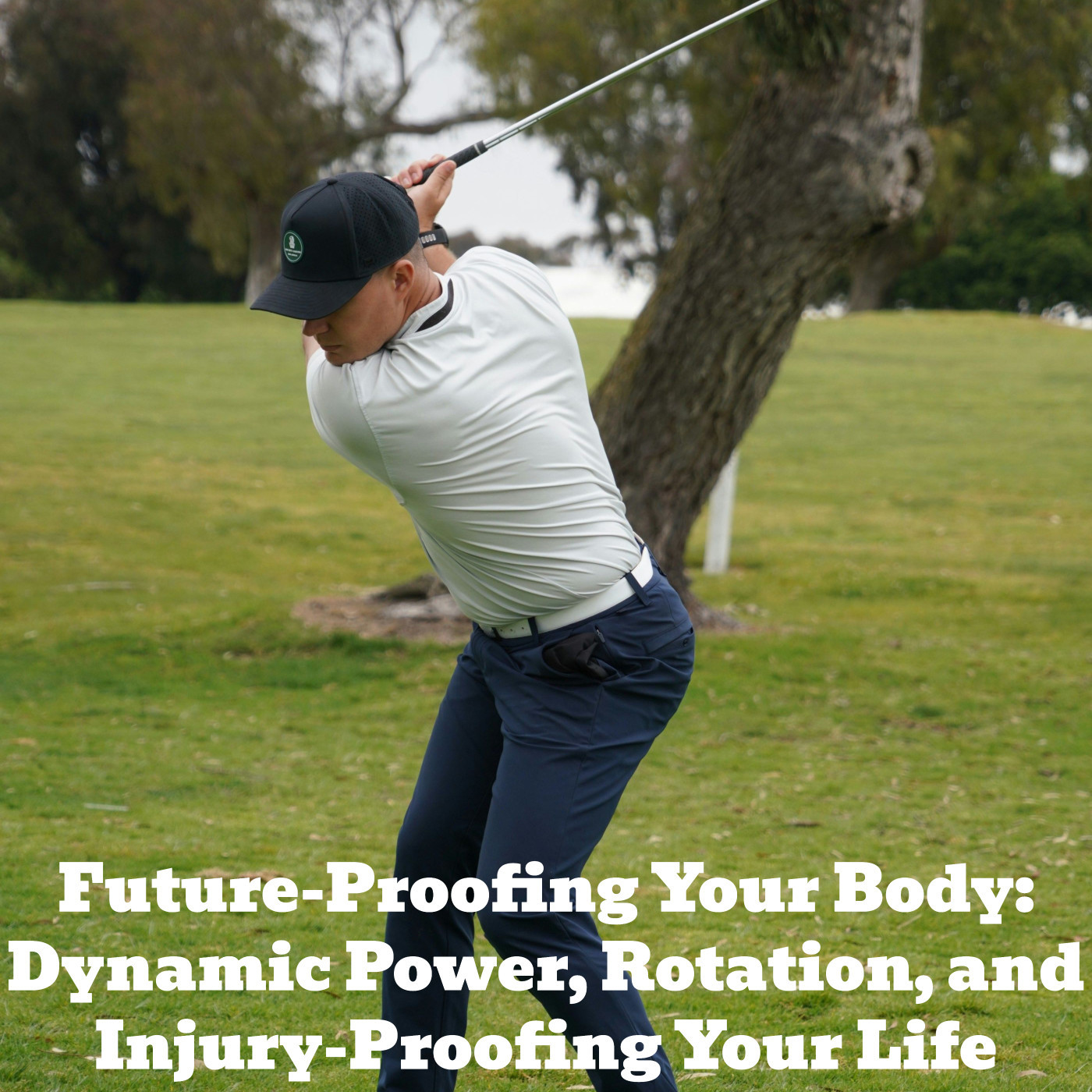
Future-Proofing Your Body: Dynamic Power, Rotation, and Injury-Proofing Your Life
Strong Principles
| Rob DelaCruz, Larry Medina, Zach Bragg | Rating 0 (0) (0) |
| Launched: Nov 24, 2025 | |
| trips91@gmail.com | Season: 1 Episode: 17 |
Zach Bragg, Rob Delacruz, and Larry Medina discuss the necessity of incorporating dynamic and rotational movement training for the general population to improve functional fitness, power, and long-term joint and tissue health.
Key Takeaways:
-
Life Moves in All Planes: Daily life (twisting, reaching, picking up objects sideways) requires movement in all planes, yet most training focuses only on straightforward movements (squat, hinge, push, pull). (0:20)
- The Power/Speed Deficit: Adults and the general population tend to lose the ability to create power and speed first. Training these qualities specifically (not just strength) is vital for longevity. (1:14)
-
Dynamic Work Must Be Treated as a Skill:
-
What it's NOT: Dynamic movements (like box jumps) should not be done under high fatigue or in timed workouts, as this teaches the nervous system to only fire enough to barely complete the movement. (2:03)
-
The Protocol: Dynamic work requires low reps, long rest periods, and a specific focus on power and speed in each repetition. (3:56)
-
Contrast Training: Dynamic exercises pair well with strength work (e.g., deadlift right into a box jump) to reinforce nervous system firing. (6:17)
-
-
Tissue Pliability and Injury Prevention: Training dynamically prepares connective tissue to absorb force quickly. Strong individuals who skip dynamic work risk injury (tears) when they are suddenly forced to move fast (e.g., catching a fall or sprinting). (8:18)
-
Rotational Training:
- Deceleration is Key: Rotational exercises (Med Ball Tosses, banded rotations) not only build the ability to create rotational force but also the strength to decelerate that rotation, which is critical for injury prevention (e.g., in golf/tennis). (13:31)
-
Anti-Rotation: Isometric holds like the Pallof Press and suitcase carries are vital, as they train the core and obliques to stabilize the trunk and prevent the lower back from snapping during asymmetrical loads. **(17:15, 18:38) **
- Deceleration is Key: Rotational exercises (Med Ball Tosses, banded rotations) not only build the ability to create rotational force but also the strength to decelerate that rotation, which is critical for injury prevention (e.g., in golf/tennis). (13:31)
-
Rotation as an Assessment/Accessory: Rotational movements are complex skills that expose weaknesses in foundational movements. For example, rotation can reveal an inability to control the pelvis (anterior/posterior tilt), which is often the root cause of issues in the squat or deadlift. (20:15)
-
Basic Starter Movements (40+ Age Group):
-
Dynamic: Simple jumps in place, lateral bounding, med ball slams, or very low box jumps on a pad.
-
Rotational: Basic banded rotation, kettlebell pull-throughs, or light med ball tosses against a wall. (9:32, 23:02)
-
SUBSCRIBE

Episode Chapters
Zach Bragg, Rob Delacruz, and Larry Medina discuss the necessity of incorporating dynamic and rotational movement training for the general population to improve functional fitness, power, and long-term joint and tissue health.
Key Takeaways:
-
Life Moves in All Planes: Daily life (twisting, reaching, picking up objects sideways) requires movement in all planes, yet most training focuses only on straightforward movements (squat, hinge, push, pull). (0:20)
- The Power/Speed Deficit: Adults and the general population tend to lose the ability to create power and speed first. Training these qualities specifically (not just strength) is vital for longevity. (1:14)
-
Dynamic Work Must Be Treated as a Skill:
-
What it's NOT: Dynamic movements (like box jumps) should not be done under high fatigue or in timed workouts, as this teaches the nervous system to only fire enough to barely complete the movement. (2:03)
-
The Protocol: Dynamic work requires low reps, long rest periods, and a specific focus on power and speed in each repetition. (3:56)
-
Contrast Training: Dynamic exercises pair well with strength work (e.g., deadlift right into a box jump) to reinforce nervous system firing. (6:17)
-
-
Tissue Pliability and Injury Prevention: Training dynamically prepares connective tissue to absorb force quickly. Strong individuals who skip dynamic work risk injury (tears) when they are suddenly forced to move fast (e.g., catching a fall or sprinting). (8:18)
-
Rotational Training:
- Deceleration is Key: Rotational exercises (Med Ball Tosses, banded rotations) not only build the ability to create rotational force but also the strength to decelerate that rotation, which is critical for injury prevention (e.g., in golf/tennis). (13:31)
-
Anti-Rotation: Isometric holds like the Pallof Press and suitcase carries are vital, as they train the core and obliques to stabilize the trunk and prevent the lower back from snapping during asymmetrical loads. **(17:15, 18:38) **
- Deceleration is Key: Rotational exercises (Med Ball Tosses, banded rotations) not only build the ability to create rotational force but also the strength to decelerate that rotation, which is critical for injury prevention (e.g., in golf/tennis). (13:31)
-
Rotation as an Assessment/Accessory: Rotational movements are complex skills that expose weaknesses in foundational movements. For example, rotation can reveal an inability to control the pelvis (anterior/posterior tilt), which is often the root cause of issues in the squat or deadlift. (20:15)
-
Basic Starter Movements (40+ Age Group):
-
Dynamic: Simple jumps in place, lateral bounding, med ball slams, or very low box jumps on a pad.
-
Rotational: Basic banded rotation, kettlebell pull-throughs, or light med ball tosses against a wall. (9:32, 23:02)
-
Do you train exclusively with forward and backward movements like squats and presses? If so, you're missing a critical piece of the longevity puzzle.
On this episode of Strong Principles, Zach, Rob, and Larry break down why dynamic and rotational training isn't just for athletes—it's essential for the general population. From picking up a child sideways to catching yourself during a fall, everyday life requires speed, power, and movement in all planes of motion.
The hosts explain the fundamental difference between training for power (moving fast) and training for strength, and why putting dynamic exercises (like box jumps) into a timed, high-fatigue workout essentially negates their benefit.
Learn the specific protocols for developing these skills: low reps, long rest periods, and high focus on intent. Plus, they detail how rotational exercises—including anti-rotation work like the Pallof Press—improve joint health, make tissue more pliable, and even help fix foundational movement patterns like the squat and deadlift.
Tune in to understand how to train your nervous system to move quickly and ensure your body is ready for anything life throws at you
Zach (00:00)
All right, guys. Welcome to Strong Principles. Thanks for tuning in. You are here with Rob Dela Cruz, Larry Medina, and I'm Zach Bragg. So welcome. And today's subject matter that we're talking about is the benefits of dynamic and rotational movement for the general population. So why do we think the general population should be doing that? Why everybody should have that in their program? And a lot of people think of dynamic and rotational movement as something that is only for athletes, but it's not. As human beings, pretty much everything we do tends to be in all planes of motion. So we rotate, we twist, we reach around to grab something out of the back of our car, we go to pick our kid up sideways, we bend over sideways. So we're doing all these different rotational movements, going through all these planes of motion everyday life. And then what we see quite often is then people's training is only straightforward. Pushing, pulling, hinging, squatting, and not much rotation involved. And it shouldn't be that way. We do have connective tissue. Our body responds to rotation in different ways. And so when we do that, we're actually able to train those everyday functional patterns that we use, which is rotating, twisting, picking things up in a turned position.
Zach (01:08)
And so that has to be trained, but it has to be trained a certain way. So I think we're going to go into a little bit of how that should be trained.
Rob (01:14)
Yeah, because we want to go into what it specifically looks like and what it doesn't look like. But one of the things is as adults and as we get older, especially with general population, we tend to lose our ability to create power and speed. And without strength, you're not going to be able to have power and speed. But once you have some strength, then you need to train that because that is the first thing that happens is adults start to lose their ability to move fast. And what it looks like is not... Let's go into what it doesn't look like. What it doesn't look like is 50 box jumps in a time workout or some boot camp, or we're just doing some twist under fatigue after 30 minutes of moving. Now, those are all movements that we're going to use or we do use, but not in that specific, because that not training the dynamic movement or even rotational really well.
Larry (02:03)
Do we feel that that's because if we're doing those movements, are we doing them specifically without any real rhyme or reason? Or do we feel-Some of it.
Rob (02:16)
And I'm not saying you never train those things under fatigue because like MMA, certain people need to do things when they're tired. But the majority of your stuff needs to be trained like a skill. And especially with dynamic and even in rotation, The skill, that skill would degrade if it's under fatigue too much and there's not enough rest period. Your body is not going to receive it as trying to move quickly.
Zach (02:40)
Correct. Yeah. So when it comes to dynamic, Dynamic movement or speed or power, it's your body's ability to create force. And so what happens oftentimes is I think it just gets confused. So if you throw a box jump, just use it as an example, which is a dynamic movement. You're creating force, you're creating power jump on the box. What happens is they think, okay, that's a dynamic movement. Let's put it in a time to workout. But then what occurs is your jump, which is you creating force and lifting your body in there, jumping your body into the air, becomes more of just try to get off the ground and lift my knees up and land on the box because I have to go as quickly as possible. So you're not getting the full benefits of what a box jump is supposed to be. And so when you're creating that under fatigue or for time, the dynamic effect minimizes exercises. So that's why you wouldn't want to put it in one of those workouts. Yeah.
Rob (03:32)
What you're doing is you're teaching your nervous system to only fire your muscle fibers to create enough power to barely get up there. And that's the movement you're reinforcing. Yes. And that should be a small part of doing it under the fatigue. I'm not saying never do it, but the majority of it should be what should it look like when we're doing it? How do we break it out?
Zach (03:56)
Yeah. So A, you have to have set rest periods. Rep schemes shouldn't be too high. It should be low. It should be lower rest periods, and it needs to be paired properly. One of the ways that I like to do it with my personal training, I like to pair it with strength work, especially because in a lot of our strength work, we're very focused on contraction. There's a mind to muscle connection. So let's say you have, and we do this all time, let's say you have a bench press, obviously, chest exercise, pushing exercise. That's just, for example, you're learning to engage your chest, and then you could move to a MedBed chest pass or an explosive pushup. Reps are really low, but now that muscle group is active and contracted. So you understand what that muscle group feels like. And then you move it through a dynamic movement where you're creating a lot of force really quick and then resting for a second, creating a lot of force really quick, resting for a second, Then you take this long break before you'd repeat the entire circuit. So I like to pair it like that. You don't have to.
Zach (04:50)
You could pair it at the end of a strength workout. You could have just a dynamic day. We don't tend to tend to do that. We'll have some strength mixed in, but you could just have a dynamic day where you don't have any strength in there. But it needs to have proper rest periods. Reps shouldn't be too high because, again, if the reps get too high, fatigue is created, and then you're not getting the proper output that you would want for that exercise.
Larry (05:13)
Yeah, I can tell you on a box jump, what I've done in the past. When I worked out of my house, I always do that. So I had a metal box jump. Why that noise, Rob?
Zach (05:28)
It's a little scary.
Rob (05:29)
Listen, I've been doing this a long time.
Larry (05:31)
So I would...
Rob (05:32)
You're walking the plank every jump, basically.
Larry (05:35)
A hundred %. So I remember the one time, I fatigued. It's like 50 box jumps or something like that at the end. And I was doing the 50, and I was just tired and I missed.
Rob (05:46)
I'm looking at your shins for any scars.
Larry (05:47)
Oh, I have a couple. I have a few. So, yeah, I literally hit my shin, and you could see it just started bleeding immediately. And it was like... It was like, oh, shit. It was awful. It was so bloody, and it wouldn't stop a whole day. It literally wouldn't stop. I had stuff to do with my wife and my kid. I walk around bleeding.
Rob (06:09)
It was awesome. When you're under fatigue, that happens. Like I said, I'm not saying never do it, but One, get patted boxes. Two, only do that. So not that often. But I want to reinforce what Zack was saying. So a lot of times with dynamic movements, it's small amount of reps, and each one is focused on the power and the speed of it with long rest periods. And Zack was talking about what we do is when we pair it with strength, and then you go into something dynamic, it's contrast. It's a version of contrast training. And so what that does is it makes the nervous system fire a lot of the fibers with the strength, and then you go and move fast. And then there's another version where you go dynamic, and then you go strength. So either one is nervous system firing or muscle fiber firing, and then they reinforce each other. There's smart pairings, and there's ways to do that. It's like a trap bar deadlift concentric right into a box jump. That reinforces that box jump position, and the feet apply the force through the ground.
Larry (07:09)
Yeah, that makes sense. So help me out here. So we're talking about rotational.
Rob (07:13)
Right now, we're talking dynamic.
Zach (07:14)
Both dynamic and rotational, but we're focused on dynamic.
Rob (07:17)
We're going to get this rotation real deep. Okay.
Larry (07:18)
I just want to make sure where does rotational fit into all this?
Zach (07:22)
Maybe it's a good way. I don't know. And rotation can be a form of a dynamic exercise. Or a dynamic exercise could also use rotational It can be dynamic. So it can fit into that picture, but yes. Okay. All right.
Rob (07:35)
Yeah. And so the way your nervous system works because dynamic is being able to elicit your power fast in a Fast. Now, there's a lot of strong people, like some power lifters that can't move that fast. And then there are some that can. Football players have a ton of power, and they can move really fast. So it has to be trained specifically. And for older adults, where we're working in general population, it doesn't have to be very complex. No. Just a little bit of like, hey, either jumping or some med ball throws or even fast kettlebell swings or some ball slams. That's training their nervous system to be able to do it. And over time, you see them be able to move things and move faster and get more coordinated with those movements.
Zach (08:18)
It also helps their tissue a lot. I'll never forget when I learned this. So what happens oftentimes is if you have somebody who works out and is strong and they continually work out. As they get older, They still have an ability to create a lot of force. But what happens is that tissue is not used to moving dynamically or quickly. So they can create a lot of force. And then what happens is if they're in a situation where they all of a sudden have to move quickly, maybe they are falling and they go to catch themselves really quick, or they're going upstairs and they trip a little bit and go to catch themselves quick, or, Hey, I'm going to go run and catch a ball that my son just threw, so I'm going to go to sprint real quick. So you have somebody who can create a ton of force, but that tissue is not used to absorbing that force at all because they If you don't do any dynamic work. We tend to see injuries. The tissue goes, you get a tear, you get some injury. That's also why it's so important to train that is because especially if you're somebody who does work out, you don't do any dynamic work, you can still create a lot of force, but your tissue is not prepared to absorb all the energy that you can create when you go to do something quickly for a dynamic exercise.
Rob (09:20)
To reinforce what Zack was saying, the less pliable those tissues become, and the more you need to touch that type of movement to keep them It would have that ability.
Zach (09:31)
The pliability, yeah.
Larry (09:32)
So let's say, what's a good beginning workout or a movement, I should say, for dynamic? Let's just say you're 40 years old, you're like, You know what? It's time for a change. I'm going to go ahead and get started on this. What's a good starter?
Zach (09:47)
So what I do with a lot of my assessments, and I tend to do this with my assessments because I work on a lot of rotational focuses, my tennis athletes and golf athletes, but this applies to the general population, too. One of my assessments is just a small jump, and I just want to see how high you can jump, see how you jump. Then another one is just to jump off one foot, land on two. Let's see how each side produces force. Then we'll take them through a push-up or a band row. I would just start with really, like Rob said, really basic dynamic stuff. Even if it's just jumping in place or lateral bounding or a med ball slam, something where you know they're in a really safe environment and exercise that can't really hurt them. You're starting to get that tissue used to that movement pattern, that dynamic movement pattern. And then you're also starting to get that tissue more pliable. And then over the course of the next three or four weeks, you should pretty much just stick with that before you start progressing more advanced stuff. Lateral Med ball tosses, box jumps, a seated box jump, single leg landing box jump.
Zach (10:45)
There's some more advanced methodologies you use. But even just the simple stuff, just keeping it super simple will help. And it'll help in everyday life, too.
Rob (10:53)
And you'd be surprised how many people thought they can jump, and then all of a sudden it comes up. And like what Zack was saying, we keep it really super simple. It depends on where they're at, but really low box jump on a small pad, and then let them get used to jumping on top of something so their perception gets a little better because sometimes they go to jump and they slam their feet because they don't know where they're at in space at all.
Larry (11:13)
Honestly, what's coming to mind is, did you guys ever see the Tom Segura when he tried to dunk and he landed and broke his arm? Believe everything out.
Rob (11:22)
His knee, his arm. But you got it, yes, 100%. But he also was on... That was like his fifth game, and he was playing for hours, and he's under fatigue. And so all those tissues were just getting beat on, and he's older and heavy and overweight, and then boom.
Larry (11:35)
Yeah. But all that, I feel like, is pretty relevant, right? To exactly what we're saying.
Zach (11:39)
Correct. 100%. Okay.
Rob (11:40)
So let's go into rotation. Where is that? Yeah.
Zach (11:44)
So when it comes to rotation-based training, there's obviously a lot of different ways to do it. But what rotation-based training is not, again, is something where you put it in a for-time emphasis or something where it's... With rotation, you can use higher reps. When I say higher reps, I'm talking 10. You can use it. Once you start getting really high reps, it starts to lose its benefits. But some of my favorite rotational exercises, obviously without any type of pairing, is just a banded rotation. Again, you're learning to rotate your hips. Your obliques are beginning to fire a med ball toss. Anything with a landmine is really good. A row to press, a rotational landmine. And then you can get more basic with it all the way down to kettlebell pull-throughs. But when it comes to rotation, and we touched on It was in the episode before, but there's three different ways to create force. There's vertical force, horizontal force, and a lateral force. And so vertical force, obviously, is pushing up and down, which goes back to that dynamic. So when I turn, I can squat, and then I can rotate and stand. And you're using vertical force, you're going down and up.
Zach (12:47)
There is a lateral force, which is basically the ability to turn side to side. And then there's a horizontal force, which is how much you side bend. And so like your banded rotation, your standard banded rotation, which would be taking a band turning with a band in both hands. Okay, all you're doing is you're doing a horizontal rotation, but then you could also turn sideways to get more obliques. Also, you're allowing that tissue to be more pliable because it's extending more, it's flexing more on the opposite side. And so when it comes to rotation, basically, what you're trying to do, again, similar to the dynamic, is you're allowing your body to become more pliable, and you're allowing your body to understand how to rotate properly.
Rob (13:31)
And deal with those forces. I want you to jump in to some more things, too, Zack. Sometimes we use med ball. So when you go, med balls are great. But now the med ball is adding. Because not only a rotation is your ability to be able to create the force to rotate, you have to be able to slow that down, too. Med ball is great because now it's not no more weight. But if you were to hold on in a med ball or a golf club, now there's forces that you need. You need to have the strength to be able to decelerate that rotation, too. So that's how important is that? Yeah.
Zach (14:02)
And that comes a lot with injury, too, is people don't know how to slow themselves down. They don't know how to deaccelerate. And so then we see a lot of injuries, a lot of injuries with that. And most of your dynamic work and a lot of your rotational work, it's only the concentric part of the exercise. And so you have to keep that in mind is there's no eccentric loading. And so eccentric loading, basically, if you do a squat, it'll be on the way down. Concentric is pushing on the way up. So like when we do a trap bar deadlift, sometimes we'll do a concentric only trap bar deadlift. You got the trap bar sitting on the ground. You grab the trap bar or the hex bar, stand up with it, and then you drop it. You never lowered it. You never did an eccentric. With that in mind, with it only being a lot of concentric work, there is some deceleration that goes into it when you concentrically contract. So when you go to throw a med ball or when you go to stand up with a trap bar and then drop it. And so it's very important to know how to decelerate properly, which again, a lot of that does come down to strength work, too, being Being strong enough to be able to decelerate.
Zach (15:02)
So it's one of those things where we'd start off really small, light med ball, very low amount of reps. Just throw a ball against the wall sideways, learn how to throw it properly, and we look for certain positions that you're in. But yeah, you have to know how to decelerate, and then you have to understand how to basically rotate to the proper muscle.
Rob (15:21)
Because all those rotational golf, tennis, all them are going to rotate. And there's golf got a lot of... There's force that you got to slow it down. Or else the club would just keep going.
Larry (15:32)
Yeah, no, that makes sense. That makes sense. So even for the general population, though, we practice that a lot in the regular classes today.
Zach (15:40)
We do it a lot in our classes.
Rob (15:41)
We do. We're trying to always add in little components. Then sometimes in some training phases, we have more of it in there, but we never let it completely go. If it's not an emphasis, we're not really emphasizing dynamic stuff at all, then we'll touch it from time to time. You just don't forget it. Your body basically doesn't forget about it. I'll try to prune it. It's called when your body shuts down pathways. But then there's times where we're specifically working in a phase that's around that. And then that's when we put more effort, more time, we get better. We try to implement maybe new exercises because we have a time to progress over the weeks.
Zach (16:22)
So we don't have a set rotation day, but we will have some days where we just do some dynamic work. But again, I like putting rotation in, mixing it with strength work, because in rotation, when you think about the muscle groups that are involved, and like I talked about the three different forces that you can create. So if you're rotating and throwing a med ball against the wall, there's a small squat involved when you're going to turn back with the ball. And then as you throw the ball, let's say, to the side at the wall, so you're bending. So there's a lot of quad and glute involved. So if you do a glute bridge prior. So a person is throwing a med ball, it's like, Oh, it's really just in my lower back. All right, let's go do a glute bridge. Get your glutes firing. Maybe we do a box squat with a kettlebell. Now let's throw the ball. Okay, so now your legs are active. And when you're throwing the ball in rotation, those muscle groups are now firing. We don't feel in our back. Or let's go do some core work. And then this is where we can talk a little bit about anti-rotation.
Zach (17:15)
A Pal off press is basically where you have a band to the side. You're holding the band out and you're resisting it from pulling you in. So that band is pulling you laterally. So if the band was on your left, tension's on the left, that band is trying to pull you to the left. You're trying to hold it in the dead center of your body. You're going to get a lot We have oblique, a lot of transverse abdominals. And so let's go do a couple of anti-rotation movements and then throw the ball. Okay, so now it takes the tension away from the back. Or when you're creating force horizontally, or excuse me, laterally, where you're side bending, there's a lot of lat involved. Those lats have to be able to fire. And so what's a good lateral force movement? You think of anything where you're bent over, where you have a landmine. There's a small turn, your left shoulder moves lower than your right, and you're pulling the landmine up and maybe turning your chest or a dumbbell row even can turn into a form of a rotational movement. Okay, your lats are involved with all that.
Zach (18:09)
Then when you go to throw a med ball or rotate with a band, now I can feel my lats takes away from the lower back. So pairing it with strength work works really well because then we start to get the right muscle groups involved. And also that connective tissue and tissue in general understands, okay, now when I go to do everyday life things, I go to turn and pick up my kid, I go to throw a med ball. That connective tissue is much more responsive, much more pliable. We see a lot less injuries, so it should be involved in the program.
Larry (18:34)
Cat litter or anything, right? Really, anything is heavy, you just got to...
Rob (18:38)
Yeah. I was just going to say is that a lot of rotational work is anti-rotational work, and it's picking things up that are maybe heavy or on one end. Or like Zack said with the pale off press is that anti-rotation work has got a lot to do with the ability to be able to move too. Because it's also like the way the obliques work in the interdominal, they rotate and they move concentrically and eccentrically, but they also are set up to isometrically hold things so that trunk doesn't snap your back. So that's why we will do a lot of isometric work. Maybe not only payoff, but suitcase holds where you're holding on the one thing on one side and the other side is really active. Those things are just as important for rotation as actual rotation and throwing things and moving quickly from side to side.
Larry (19:28)
Okay.
Zach (19:28)
It should be in every program, especially for the general population. But I would recommend having it in there the way we talked about, as well as with dynamic work. I like pair it with strength work. You can have just a more dynamic focus day where you're just working on some of those things. But again, they're skills. They're skills that you got to work and their skills that are going to improve. One thing that I was going to touch on with the rotation, though, too, is there's a lot of pelvis involved. And so when we're putting rotation into a class, it's good because we can see them and make sure their positions are right. I don't want to say it's funny, but you can tell who's an athlete and who's not, because you can tell who can rotate well and who doesn't. And that's, again, a skill that has to be taught. So if you're an athlete and you rotate or you go to rotate with a band or anything, you're going to rotate pretty well versus somebody who maybe never played sports growing up and they're just new to the gym and they go to rotate with the band.
Zach (20:15)
They're trying to use their body weight to turn the band and not the forces that they can create within their muscle groups. And then what I was going to touch on with the pelvis is your pelvis can have posterior tilt or anterior tilt. And so basically it's tucking and arching. Your pelvis can move back and forth. This is an assessment that I do. But for somebody who has a lot of arch in their back, when they go to turn, their back is going to feel very crunch. It's going to feel very tight. Then we have to take a look at the pelvis. Again, that's why I'd like pairing it with something like a glute bridge is, can you tuck your pelvis? Almost like a cat-cow if you're on the ground, if you were to arch and then round. Are you able to tuck your pelvis, be able to squeeze your glutes, and then rotate? There's a lot of muscle groups. There's a lot of joint components that are involved in Again, that nobody would have exposure to unless they did it. You go to do a squat, you're not thinking about what position your pelvis is in.
Zach (21:06)
Although you should be. You go to do a hinge, you're not necessarily thinking about what position your pelvis is in, but you go to rotate and you can tell right away because a person says their lower back's bothering them. Okay, you're in extreme anterior tilt, we got to get you to more posterior tilt. We got to be able to tuck the pelvis, squeeze the glutes and turn. These are all things that you don't think about. But then you go to pick something up off the floor and your extreme anterior tilt and your lower back pulls and it hurts.
Rob (21:27)
And that's why you got to treat them as a skill.
Zach (21:29)
Yeah, and that's why it's a skill.
Rob (21:30)
And not just as movement that you're going to use mindlessly just to throw into a workout.
Zach (21:33)
You can't just throw it into a time. Someone told you to. You'll never learn the skill. If it's in a time to workout, you'll never learn the skill because you're not able to take the time and get into those proper positions to be able to do it.
Larry (21:43)
Yeah. So this is going beyond the actual just squat, the movements of squat hinge, et cetera. This is the accessory to-Yes.
Rob (21:53)
That's how we look at it. So we look at the six fundamental movements, and then after that is the dynamic dynamic/rotation. You have all those pillars underneath, because if you can't do the fundamental movements, it's going to be really hard to move quickly on some other stuff.
Zach (22:11)
And the accessory movements can help your foundational movement patterns, too. So again, going back to the pelvis, if somebody rotates and we know that they have an extreme arch in their back and they're a terrible deadlifter, well, now we know why you have excessive arch. We can neutralize that pelvis, get the core more engaged, get the glutes more engaged, and then it can help them hinge. So it's a great accessory. It works both ways. If you don't have the fundamental movement patterns down, your rotation is going to be really bad. Once you have those down, your rotation is going to get better. You're going to learn new things about how to move properly, and it's going to improve your foundational movement patterns. So they work together really well, too. But just to recap, going back, what we'd recommend, dynamic work should be in every program, even for the general pop. It should start small, be very basic, small jumps, and then you slowly progress. Keep your reps low.
Rob (23:01)
Med balls work great.
Zach (23:02)
Med balls work great. Jumps work great. Even a kettlebell swing can work great. Any of those exercises work good. Keep your reps low. Keep your rest periods high. Really focus on your positions. Make sure it feels good. You're not in any pain. And then make sure it's explosive. You can just do a jump off the floor and make sure it's explosive. But are you landing on the ground nice and soft? You're not planting on the ground. You're not falling over the place. You have good balance. Start very basic with your dynamic work. And then we use that same protocol for rotation. Start very basic, just a banded rotation, just a banded hold. Hold the band out and resist the rotation. Then start getting some Med ball tosses that are maybe a little bit more advanced or some landmine work that's a little bit more advanced. But start very basic. And you never even have to get into the advanced work. I mean, your body will get better. Pliability will get better connective tissue, even with just the basic stuff, especially if you follow a really good strength program. Yeah.
Larry (23:50)
Awesome.
Zach (23:51)
All right. Awesome, guys. This has been Strong Principles. Thanks for tuning in.