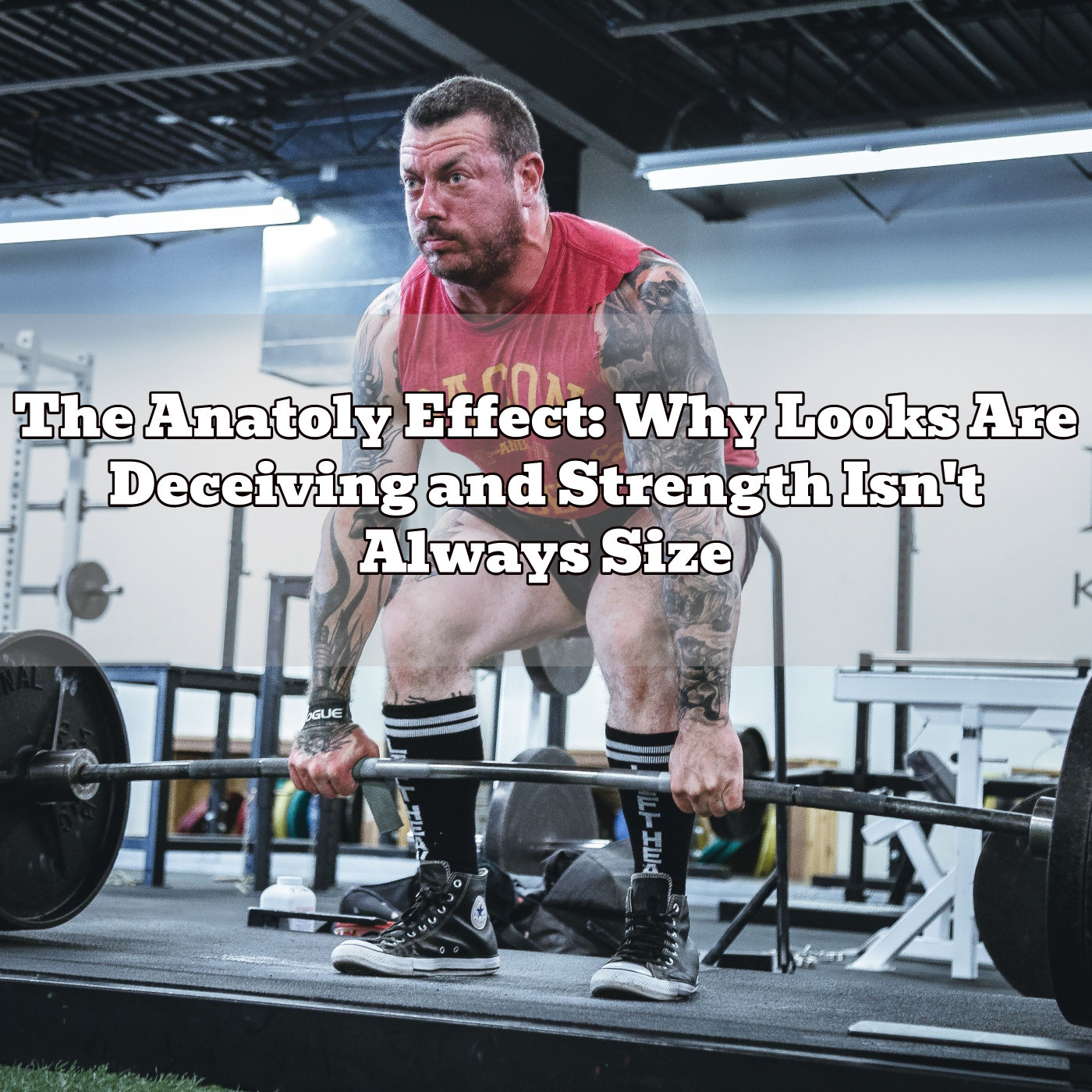
The Anatoly Effect: Why Looks Are Deceiving and Strength Isn't Always Size
Strong Principles
| Rob DelaCruz, Larry Medina, Zach Bragg | Rating 0 (0) (0) |
| Launched: Dec 01, 2025 | |
| trips91@gmail.com | Season: 1 Episode: 18 |
Rob Delacruz, Larry Medina, and Zach Bragg discuss the difference between muscle size (hypertrophy) and true strength, offering insights into body composition and why most people's fear of getting "bulky" from lifting is misplaced.
Key Takeaways:
-
Strength is Neurological: The example of Anatoly (the strong, lean janitor) illustrates that strength is often more about neurological efficiency and muscle fiber contraction than visible size. Specialized strength programs (low reps, high weight, long rest) prioritize strength without major tissue development. (1:17)
-
Body Fat is the Main Factor in "Bulk": A perception of "bulk" is highly correlated with body fat percentage. When body fat is high, adding muscle makes one look bigger; when body fat is low (e.g., 10% for males, 15-18% for females), the added muscle creates a lean, shaped look. (2:23, 7:56)
-
The InBody Scan Misconception: Due to the way some body composition scans (impedance) measure volume, a client actively building strength may appear to have lost muscle. This is often fat (marbling) leaving the muscle tissue, making the muscle look "tighter" or denser, but they are not losing actual strength. (3:39)
-
Hypertrophy vs. Strength:
-
Hypertrophy (Size): Classic rep schemes (3x10, 3x12, 2x15) focused on fatigue and "chasing the pump" (intracellular fluid swelling). This is common in bodybuilding.
-
Strength (Density/Skill): Lower rep schemes (5x5, 5x3, 5x2) focused on heavy loads and skill execution. This results in the "granite look"—a hard, dense, less-fluctuating size (like Anatoly). (10:26, 11:46)
-
-
The Difficulty of Gaining Muscle: For the average person or adult, gaining significant muscle (more than a few pounds per year) is very difficult and requires consistent effort, proper programming, and a high caloric intake. The fear of suddenly becoming bulky is usually unfounded. (6:19)
-
Strength Training is Best for Shape: Resistance training is the strongest tool to change the body's actual shape and sculpt muscle, far more effectively than conditioning or cardio alone. (17:21)
SUBSCRIBE

Episode Chapters
Rob Delacruz, Larry Medina, and Zach Bragg discuss the difference between muscle size (hypertrophy) and true strength, offering insights into body composition and why most people's fear of getting "bulky" from lifting is misplaced.
Key Takeaways:
-
Strength is Neurological: The example of Anatoly (the strong, lean janitor) illustrates that strength is often more about neurological efficiency and muscle fiber contraction than visible size. Specialized strength programs (low reps, high weight, long rest) prioritize strength without major tissue development. (1:17)
-
Body Fat is the Main Factor in "Bulk": A perception of "bulk" is highly correlated with body fat percentage. When body fat is high, adding muscle makes one look bigger; when body fat is low (e.g., 10% for males, 15-18% for females), the added muscle creates a lean, shaped look. (2:23, 7:56)
-
The InBody Scan Misconception: Due to the way some body composition scans (impedance) measure volume, a client actively building strength may appear to have lost muscle. This is often fat (marbling) leaving the muscle tissue, making the muscle look "tighter" or denser, but they are not losing actual strength. (3:39)
-
Hypertrophy vs. Strength:
-
Hypertrophy (Size): Classic rep schemes (3x10, 3x12, 2x15) focused on fatigue and "chasing the pump" (intracellular fluid swelling). This is common in bodybuilding.
-
Strength (Density/Skill): Lower rep schemes (5x5, 5x3, 5x2) focused on heavy loads and skill execution. This results in the "granite look"—a hard, dense, less-fluctuating size (like Anatoly). (10:26, 11:46)
-
-
The Difficulty of Gaining Muscle: For the average person or adult, gaining significant muscle (more than a few pounds per year) is very difficult and requires consistent effort, proper programming, and a high caloric intake. The fear of suddenly becoming bulky is usually unfounded. (6:19)
-
Strength Training is Best for Shape: Resistance training is the strongest tool to change the body's actual shape and sculpt muscle, far more effectively than conditioning or cardio alone. (17:21)
Do you shy away from lifting heavy because you're afraid of getting "too bulky"?
Inspired by the famous YouTuber Anatoly (the seemingly slight janitor who out-lifts massive bodybuilders), Rob, Larry, and Zach dive into the fascinating science behind body composition. They explain why strength is largely neurological and how specific programming allows athletes to lift massive weights without significant bulk.
The hosts break down the two main training styles—Hypertrophy (size) vs. Strength (skill/density)—and explain why, for the general population, the fear of getting "too big" is usually unfounded. They emphasize that nutrition and body fat percentage are the biggest factors influencing a "bulky" look, not just the weights you lift.
Tune in to learn why strength training is the most powerful tool for changing your body's shape, why the "long and lean" muscle myth persists, and why true, dense muscle is hard-earned.
Larry (00:00)
All right, everybody. Welcome back to another episode of Strong Principles. My name is Larry Medina.
Rob (00:05)
I'm Rob Dela Cruz.
Zach (00:06)
And I'm Zach Bragg.
Larry (00:07)
All right. Today, we're going to be talking about how looks can be deceiving in the sense of body composition, people that don't want to look bulky and really just get into the nuances of really looks can be deceiving. And really what comes in mind for me, specifically in this discussion, is there's a YouTuber Instagram guy. His name is Anatoly. And a lot of times, he'll go up to a bodybuilder-looking guy who's just massive, right? And they're struggling with this 600-pound deadlift.
Rob (00:42)
He's a janitor, and he's acting like he's a janitor, and he's all covered up.
Larry (00:45)
He's all covered up. So you can't see him, right? He doesn't look as big as these guys. And so looks to be deceiving. He walks up and he lifts the 600 pound deadlift that this guy is struggling with. He does it in like...
Rob (00:59)
For reps.
Larry (00:59)
For reps. And pretty easily, and guys get amazed. So really, what I want to get into is really the difference in the looks, and people also that have the thought process of lifting means that you're going to get bulky.
Rob (01:17)
So we'll get into the simple form of it, and then we get a little bit complex, and then Zack will go back and forth on it. The first thing is, nutrition is huge. So you got it, that's number one, no matter No matter what. If your body fat percentage is low, you look lean, no matter what. And then genetics is a little bit is like how people's skeleton is set up. Are they a little more thinner, their hips a little tighter, shoulder's a little wider, so it gives them a look. Those things are all contributing factors. But a lot of it has to do with, especially with that particular person you're talking about, is strength is very neurological. You have a lot of athletes that are powerlifters and MMA and whatever They are, but they're weighted sports, so they have to be a particular weight. So they're always trying to get stronger without putting on weight. And there's ways to do that. And it has a lot to do with the programming and the training. There's specific styles of strength training you do. And that's towards the lower rep and explosive repeats real low compared to more hypertrophy work where you're trying to develop tissue.
Rob (02:23)
That being said, that eventually, you can only go so far neurological, and eventually your body will put on tissue if you keep on pushing and try to get strong. What people run into, like I said, it's mostly a nutrition and a body fat. A lot of times, if you look at a steak, there's a lot of fat in the tissues of a steak. So there's marbling in them. That's fat that's inundating the muscle. We all have some of that. Resistance training/strength training is the form that uses that as energy the most. Conditioning and cardio doesn't use that as So that's why you see a skinny fat endurance athlete. They can run and they do things for hours, but they're not very real tight. A lot of times what people tend to see is that their muscle tissue actually gets a little tighter because it's burning that fat up. And in some scans, that looks like they lost muscle and their body fat went up higher because the muscle got a little tighter because some of those scans are only impedence that are looking at volume. On some people, we've seen that happen. So a lot of times what you end up doing is you end up getting tighter, and sometimes you get smaller.
Rob (03:31)
But if your body fat percentage is high, then it's going to seem like you're getting bulky. It's got a lot to do with that. We run into it.
Zach (03:39)
Yeah, big time. And I'll touch base on what Rob was mentioning. I had a client who there was no way he lost muscle. He was getting stronger. He was moving better. He looked way better. And then we put him on an in body scan and they said he lost muscle. And at the time, I was a little bit like, I don't even know why. And then that was actually explained to me by Robin. He's like, there's some fat that comes out of the muscle when you begin to strength train. And so it can... Because it's only measuring volume, basically. It's not measuring what's actually within the muscle. And so then it can look like you lost muscle. So that can happen. But then I think a lot, too, is what Rob was saying is people talk about, well, I don't want to get too too bulky or I don't want to get too big. It's like, I can't get you too big. I'm not even there yet myself. But what happens is there's two different types of way to train. And this is the Anatoly thing. Is there is strength training. So you can get the current amount of muscle fibers you have now to get stronger, to be able to contract harder and lift more.
Zach (04:39)
Or you could train hypertrophy, which is getting those muscle fibers to grow bigger or building new muscle fibers and getting them larger. So there's two different types of ways to train, which would cause two different looks, basically. So if somebody is just strength training, which like Rob mentioned, a little bit lower rep, heavier weight, long break periods versus what you look like, what a bodybuilder does, where it's very high rep, everything's to fatigue, and it causes this hypertrophy where you grow a little bit bigger. So it depends on the way you train. But with a body composition scan, like what Rob said, your body fat percentage comes down, it's going to change the way you look. Now, there's two different ways to get body fat percentage down. You can lose body fat, and that's what everybody thinks of. A lot of people correlate, All right, my body fat percentage is lower. I just lost fat. Well, you could lose no fat and get your muscle higher, and your body fat percentage is going to drop, right?
Rob (05:26)
You're going to look different. You're going to look different. Muscle is more shape. And I'm going to touch on a couple of things that was Zack said. So that particular case, what happened is they looked like they lost muscle. I'm not saying it can never happen, but it is really rare that an individual is getting stronger, and and can lose muscle. It doesn't... Your body doesn't do that. So when an individual is like, Well, I've been getting stronger every week, but it's a scan said, one, we got to see because those scans trend and make sure they're good.
Zach (05:58)
And there's water involved in hydration. Correct.
Rob (06:00)
But two is you're getting stronger, you're not losing muscle. We're going in the right direction. Nothing to worry about. You got to just calm the individual down a little bit. The thing is, Zack was touching on, yeah, we work on... We do a lot of things, what we call power building. It's a mixture of high Hypertrophy/strength work together. Food is definitely involved. Nutrition is definitely a big factor that when it comes to it. But in very rare cases, people can hypertrophy and just develop a lot. Most of the time, it's hard to put on a couple of pounds of muscle, especially in adults. Takes a long time. Yeah, a long time. A lot of food. A lot of times. I mean, you got to remember for your body to go ahead and want to partition energy, it's already got to go It's going to get through all the organs, all the skin, everything. And then it's going to partition a little bit of energy to building muscle and strength, neurologically and then actual tissue.
Larry (06:57)
So in that regard, Realistically, somebody trains really hard, balls to the wall, how much do you think that they can gain in a year? If they're going hard-Are they new or there's someone that's been doing this for a while? Been doing this for a while.
Rob (07:14)
Okay. Doing this for a while, you're looking at like-It's harder.
Zach (07:17)
Yeah. It's not harder, but the pounds of muscle are not going to be as high.
Rob (07:21)
Yeah. And you got to remember, it's not a linear. It's like you see some progress, and then there's a plateau, and then you lose a little. But you're trying to set new set points, but they're small and they go up. The other thing I was going to get into was that if your body fat percentage is low, if someone, if a male is at 10% body fat or a female is at 15 to 18, no Nobody really thinks they're very bulky. Very rarely, some people, they might hypertrophy. Their legs are thick and it's real tight in jeans. But most of the time, if you're not lean, you got really good shape, and it's really hard to get there.
Zach (07:56)
It doesn't look bulky. It's the It's the fat that's creating the bulky look. So if somebody is explaining, I'm worried about getting bulky, well, your body fat's high, and then you got to put on some muscle, and then you might look a little bit bulky, and you could just bring that body fat down.
Rob (08:09)
Also, can I contribute a little bit to that? You got to build muscle and strength. The loads have to be at certain places. It's like, well, if I just lift heavy, but in actuality, you're not lifting heavy. Even though it might be heavy for you, you're not lifting heavy. We're all made out of the same tissues. So if someone One can squat 90 pounds and another person, they're 70%, that's your 70, and the other person is 70%, it's 300 pounds, and they both can do 10 reps. Well, they're like physiological adaptation difference. And the person is doing the 300 It's not the same, like the stimulus and the signal that comes to them.
Zach (08:50)
And we can fall down a rabbit hole with this because it can turn into, I guess, for lack of better terms, a rat race of what people... Because you get people who are concerned about being bulky, and then you look at somebody like Anatoly, super strong, and he looks fantastic. And nobody would say that guy's bulky. But then what happens is they don't want to get bulky. Okay, so then what their workouts tend to look like is they say they're lifting weights, but they're lifting super light weights, really fast and doing a lot of reps. So you're not actually building much muscle. And then what happens is your body gets really good at not burning as much calories because you're so used to doing so much work. So So then what happens is, okay, you're not building muscle. Muscle burns calories. Muscle is your best fat burner, right? So the more muscle you have, the more fat you're going to burn. You're not building muscle and you're expending a lot of calories day by day because you're doing these long workouts with light weights because you think it's going to tone you up. And then your body gets really good at doing that.
Zach (09:48)
Then what happens is, well, I'm not going to burn as much calories because I know I have to do that every single day. And so they fall down into a rabbit hole, which we see. And then we don't see any body composition changes because their body's metabolism is slowed. And so that can happen, too. But strength is key. Building muscle is key, too, because if you want to get to a certain body composition, the more muscle you have, the more fat you're going to burn.
Larry (10:10)
So let's say a bodybuilder, the body building composition If you wanted to... Somebody came in and was like, Hey, I want to do bodybuilding competitions. We would be talking about basically high reps, low weight?
Rob (10:26)
Yeah, no.
Larry (10:26)
So I'm going to throw some-I just want to make That's what I understand. Yeah, okay.
Rob (10:31)
So hypertrophy. So there's like classic thought of rep schemes that contribute to certain things. They all contribute to each other a little bit. So five reps is like seven, basically like five reps and down is a little bit contributed to hypertrophy, which is muscle building, but contributed a lot to strength. Lower reps, twos and threes, like at heavy percentages, more contribute to strength and a little bit to hypertrophy. Higher reps of three sets of 10, 12s, two sets of 15, two sets of 20 contribute more to hypertrophied muscle building. That being said, if you're sitting in one of those for a long period of time, you go and move, it's going to change. And then all of a sudden, one thing is going to build strength and muscle compared to the other. But those are classic. So a bodybuilder would do more classic rep schemes closer to three sets of 10, three sets of 15, 12, two sets of 20 on exercises at certain percentages. Strength athletes would do more five by fives, five by threes, five by twos at heavy percentages with long rest periods between. Bodybuilders chase the pump. Yeah, I was just going to say that.
Rob (11:46)
Strength athletes chase the skill. And so when you... So for instance, in Italy, there's a little bit of debate about, so when you bodybuild, you're chasing a pump. So there's fluid, there's intracellular fluid that goes into the body. So you get this pump, but then eventually it goes away. So bodybuilders are real famous for looking pretty big after the gym, and then size goes down. Shirts are tight, and then they're not. Power lifters, strong men, people that do strength work, it's called a granite look. They don't fluctuate. They never go for the pump very often. And the way their tissue is developed, it's a hard look. Denser. Yeah, it's more dense. And I can dive into this, like all that, but that's I think we're going to go way over. That's why you want to... When you're having a group class or you're working on just fitness and healthy, doing it all. Okay.
Larry (12:41)
Well, and for the general population, which one's better?
Zach (12:45)
It depends on what your goal is, I think. Correct. So that does come down to an individual basis. So for the general population, if you have a class, like Rob was touching on, you need both. You need both doing some hypertrophy work, training for that pump, like Rob said. It can really help with a neurological connection to the muscle. Okay, now I understand where my lats are. Now I understand where my pecs are. Now I understand how my quads flex. So it can help with that neurological connection. But then, like Rob said, if you spend too much time there, your look begins to change. Maybe you're not building as much strength. And so then you need the other one as well, where it's more strength-based program. So you need both, but it does depend a lot on their goals, what they're trying to achieve.
Rob (13:25)
It boils down to programming. If someone wants to do a show, like a figure show physique, then you're really going to focus on the hypertrophy. You're probably going to use some of the fundamental compound movements, but it's going to be a lot of machine-based and single joint movements. It's going to look in specific rep schemes. It's going to be If someone's doing a strength sport or strength-oriented, whatever they want to do, then it's going to look a little different on the program. For general health, then we're going to tie in here and there. It's called power building. You tie them both together. There's ways to program them both together. And that's what we mostly do, actually.
Larry (14:03)
Okay. Yeah. And so in reality, the big guy that's chasing the pump, are we saying that there's a lot of fat in there, too, or no?
Rob (14:13)
No, not necessarily. Their tissue, there's fluid that goes in there and gives it a pump. In the way that tissue gets developed, it could swell out when it's being used, and there's a swelling in the pump for a period of time, and then goes away after a period of time. Like, strength athletes, they're just like, they get very little bit of that, but they mostly just hard as a rock. You ever get a real high level, a really good strength athlete to look at is something like a strong man, like a smaller one, not the big ones that are real lean. They're like mid out of granite. They're hardest to beat.
Zach (14:52)
It's like Anatoly.
Rob (14:53)
Yeah, real functional. Yeah, because he played a lot of power lifting.
Zach (14:56)
Yeah, he's not that big, but he's really strong. Yeah.
Rob (15:00)
I mean, the people that have to worry about getting too bulky are usually the people that shouldn't even worry about it. The people that are worried about it, they're never the ones that have to worry about it. I already know if you have potential of getting too bulky, as soon as I see you walk in, because you are already bigger than most of the people that's naturally. Those are the people that have... So bodybuilding.
Zach (15:23)
You can get jacked, Larry. You can get huge.
Rob (15:26)
So, Larry, so think about that.
Zach (15:27)
You know what I mean?
Rob (15:28)
The percentage... You got white shoulders. The percentage of people that are seven foot tall that walk around is so low. The NBA has them all over. So they're all in one place. That's the same percentage to be high level bodybuilder. So that's so low. You've never seen a person in real life that has the potential to be a high bodybuilder, even with a ton of drugs.
Larry (15:53)
It's a good point because as you're saying this, what comes to mind is the picture of... Have you ever seen the picture of Charles Barkley and Shaq and The Rock in the same picture?
Rob (16:03)
Yeah, The Rock is pretty small compared to The Rock.
Larry (16:05)
The Rock is tiny compared to Charles Barkley. I knew Shaq, right?
Rob (16:10)
He's just-7'300. And The Rock is 6'4, it's 2'70.
Larry (16:14)
Yeah, Yeah, he's big. Yeah. And by the way, Charles Barkley doesn't look like he lifts weight. But he's just a big boy. So I was like, wow.
Rob (16:22)
Yeah. I mean, the genetic factors are in there. And I get what people are saying. But to put on that much tissue for them to really have to worry about, you'd have to go real hard. Where they run into issues and women get scared a lot because the fitness industry has been terrible the way that I promote things to them. It's like you see whatever class or whatever they're doing, the instructor is real long and lean, and they tell you, You want long lean muscles. And that's not how the body develops.
Zach (16:47)
Genetically, they were already like that. Correct. They didn't train that way to be that way. 90% of the time, they-They were just really good. You looked like that. And then you started working out and you looked better. You know what I mean? It's not really trained that way.
Rob (17:00)
There's a body bias in some of that. So you just got to be aware of that a little bit.
Larry (17:04)
Yeah. So with that, right? To wrap it up as far as the body composition. The way to look at it is you'll You're already that, right? You're already a big person. And if you're not that big a person, then don't really worry about it.
Rob (17:21)
Well, basically, it's nutrition and then the components of programming. But There's only a few ways to change your shape. And one of them, and the strongest way to do it is strength training and resistance training. All the other forms of exercise, conditioning, don't change your shape for your look as much. Those are the ones that you can actually sculpt and shape. Yes.
Zach (17:48)
So if you get to a lower body fat percentage, but your muscle mass didn't go up, your shape is not going to change. If you put on a bunch of muscle, dropped your body fat percentage and lost your fat, your shape is going to change because the muscle is going to change the way you look. When it comes to body composition, I think like Rob said, nutrition is huge. That'll be a big part of how you look.
Rob (18:08)
The program you're doing.
Zach (18:09)
Yes.
Larry (18:11)
All right. Well, I appreciate it, gentlemen.
Zach (18:14)
Awesome. Thanks, guys.
Larry (18:15)
Thanks for the for the lesson there.
Zach (18:19)
This has been strong principles.