Less Stress, More Clarity: A Roadmap to Your Happy Place
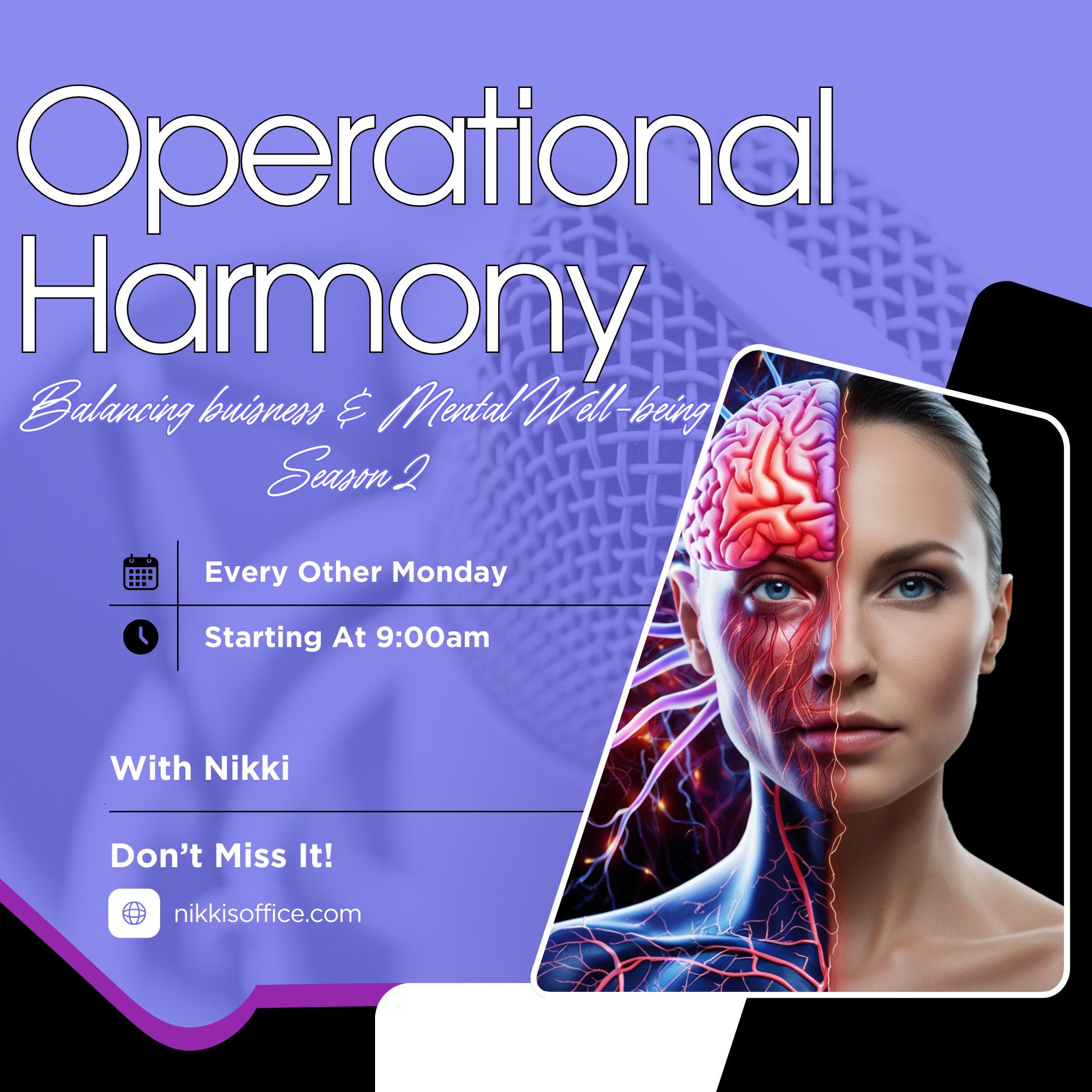
Operational Harmony: Balancing Business & Mental Wellbeing
| Nikki Walton / Dr. Gary Sprouse | Rating 0 (0) (0) |
| http://nikkisoffice.com | Launched: May 05, 2025 |
| waltonnikki@gmail.com | Season: 2 Episode: 18 |
⏱ TIMESTAMPED SHOW NOTES
00:00 – Introduction to Dr. Gary Sprouse and his background
01:10 – Why “less stress” is needed now more than ever
02:30 – Debunking good vs. bad stress and a musician’s anxiety story
05:00 – The podcast dance: matching rhythms with new guests
07:30 – Can science be entertaining? Gary's dream of singing seminars
09:00 – Helping people identify fear, not just anxiety
10:50 – Panic attacks vs. phobias explained
13:20 – Nikki shares her own agoraphobia experience
15:10 – What does it mean to feel safe? (Spoiler: it's not a feeling)
17:30 – You can’t eliminate uncertainty, but you can manage it
19:00 – Panic attacks = smoke alarms with faulty wiring
21:00 – Hypnosis and NLP as tools for reframing fear
23:45 – What’s in Highway to Your Happy Place and how to get there
26:00 – Human stress as side effects of our best traits
28:00 – Why boredom is more dangerous than we think
29:10 – Tech stress: subscriptions, software waste, and overwhelm
32:15 – Rocket Money, budgeting apps, and passive spending leaks
34:50 – Tools Nikki recommends for running a lean business tech stack
38:45 – Website mishaps and how to avoid sales vs. tech mismatch
42:00 – How to avoid getting stuck with the wrong software
45:10 – Free trials: friend or trap?
47:00 – Closing message: You don’t have to stay stuck in stress
SUBSCRIBE

Episode Chapters
⏱ TIMESTAMPED SHOW NOTES
00:00 – Introduction to Dr. Gary Sprouse and his background
01:10 – Why “less stress” is needed now more than ever
02:30 – Debunking good vs. bad stress and a musician’s anxiety story
05:00 – The podcast dance: matching rhythms with new guests
07:30 – Can science be entertaining? Gary's dream of singing seminars
09:00 – Helping people identify fear, not just anxiety
10:50 – Panic attacks vs. phobias explained
13:20 – Nikki shares her own agoraphobia experience
15:10 – What does it mean to feel safe? (Spoiler: it's not a feeling)
17:30 – You can’t eliminate uncertainty, but you can manage it
19:00 – Panic attacks = smoke alarms with faulty wiring
21:00 – Hypnosis and NLP as tools for reframing fear
23:45 – What’s in Highway to Your Happy Place and how to get there
26:00 – Human stress as side effects of our best traits
28:00 – Why boredom is more dangerous than we think
29:10 – Tech stress: subscriptions, software waste, and overwhelm
32:15 – Rocket Money, budgeting apps, and passive spending leaks
34:50 – Tools Nikki recommends for running a lean business tech stack
38:45 – Website mishaps and how to avoid sales vs. tech mismatch
42:00 – How to avoid getting stuck with the wrong software
45:10 – Free trials: friend or trap?
47:00 – Closing message: You don’t have to stay stuck in stress
Dr. Gary Sprouse, retired physician and author of Highway to Your Happy Place, joins Nikki for a powerful and practical conversation on how to actually reduce stress—not just cope with it. They explore what fear really is, how panic attacks mimic phobias, and why so many of us waste emotional energy on imagined dangers. From redefining safety to spotting energy leaks in your tech stack, this episode blends mental health insights with real-world tools.
📘 Learn more: thelessstressdoc.com
📱 Facebook: facebook.com/lessstressdoc
[00:00:00] Hey, I'm Dr. Gary Sprouse. I'm the Less Stressed doc and I'm a physician who's retired. But during my time in practice, I worked with a bunch of people who were really stressed out and I came up with some new insights that I think really can help people have less stress. So I'm with Nikki now to help, see if I can help you guys have less stress.
Thank you for being here. So what does it mean to you to have less stress? Well, so I, what I think is that, we have, we all have coping skills. We all have ability to handle some of the things that are gone on in life, but life is continually changing. So we're never in a position where we're not having any stress.
We're always in some kind of changing kind environment. And so what I find is in this environment, more and more people are getting to the point where they're beyond their coping skills and then they get into trouble. And so what I find is we can all use some less stress, but there are some people, and it's [00:01:00] getting a bigger and bigger number where they're so stressed out that they really can't cope anymore.
And so they need a new way to handle what's going on. And so the insights that I bring to the table. Help them come off the ledge and get back on their feet so they can handle what's going on with their life.
That ledge is a slippery slope or a slippery, yeah. I've read a couple of books that talk about good stress versus bad stress, and I don't really buy into that. I understand what the point is that when people are anxious sometimes it makes them do better.
And Yeah, I get that. But what I want is people to do it by choice, not because they have to. I had a person I did a podcast with the other day, and he's a musician and he's 40 years into his career, and he tells me that every time he gets ready to go on stage, that he's so nervous that he is ready to throw up.
40 years. I'm like, seriously, for [00:02:00] 40 years you've been ready to throw up every time you go on stage. And so we had some discussions on how to change that mindset so he doesn't feel like that anymore. And what we talked about was, Hey, you've been doing this for 40 years. Be a scientist like I am. Right? So I consider myself a scientist.
It's like you've been doing the experiment for 40 years and I guess that you're afraid you're gonna fail. Like things aren't gonna go well. But you've had 40 years of experience saying, no, this is going to go just fine. So rely on that research and go, next time you comes up, you're like, you know what?
I'm good. I've done this for 40 years. I'm good to go. I don't need to get so nervous that I puke. Yeah. I'm not sure that I would get on stage for 40 years if I felt like I was gonna puke every time. I know, right? It tells you what kind of person, it says something about a person that's doing that right.
I think I'd give up after the second or third time I'd be like, Hey, this is not for me. If I can't like not have this feeling, I ain't doing [00:03:00] this. You would, I just shake like a leaf and you can hear, I've met a couple of people, like I had a patient once that was in the theater and she had the same kind of reaction.
She hated to be, she was a introvert, but when she was on stage it was like she was a wholly different person and on stage she was great. And then she'd get off stage and go, oh, I can't believe I just did that. Right? So, I can't relate to that 'cause I push myself daily to get things done. I'm not saying that I don't, but at the same time, pushing yourself so bad that you're sick or like traumatized by the experience doesn't sound like the best way to go about life.
Yep. I agree with you. That's why I gave him that advice, and when we finished the advice, he was like, oh, thanks. He goes, I'm really gonna keep that in mind. And I said, good. So now I have to call him back and say, Hey, did it work? I know, but you're the one who's telling me that you're pushing yourself every time you do this podcast, so kudos to you.
What I find is [00:04:00] people, and I'm sure he is in that category, there's a part of them that's nervous, anxious, worried, things aren't gonna go right, whatever. But then there, the other part of 'em says, no, no, we're gonna be able, we are gonna do this. It'll be all right. Mm-hmm. Yeah. Yeah. I have anxiety because new people, I don't know what's gonna happen.
It's like a group project. You never know who's actually gonna participate. Yeah. Wow. This being a fellow podcaster, here's what I say, like when I do an interview with someone, or I'm being interviewed, I feel like I'm in a dance. It's a new dance partner. Like my wife and I, when we go dancing, she knows what I'm gonna do.
I know what she's gonna do. And we've been doing it for 13 years now. 15 years actually. And so we have it down, right? But when I'm with someone new, like in a podcast and you're doing, it's a new dance partner and you have to feel out where they're coming from and where you're coming from and match it up and it's like it, to me that makes it exciting.
Go, Hey, we can do this. And you're like, yeah. [00:05:00] Yeah. I've had some not so trained people on my podcast in the last couple weeks. And so it has created very unique situations. Yeah. There, you're right, there is a skillset. You have to have, to know how long the podcast is and how to answer questions and how to give the interviewer some chances to ask questions and things like that.
So yeah. Yeah. And there's both sides of it, so some people don't talk enough to give so that you have a chance to ask a question because I need input from you to be able to ask the question because I don't know where you're going with this. Say something or I've had people ask me a question and then stare at me through the camera, like, what's next?
And I'm like, I don't know. You said yes. What am I supposed to say now? Well, I've heard interviewers, and on TV and they talk about some interviews are easy, some interviews are not so easy. [00:06:00] Yeah. And then I've had Well, but isn't that the same when you go dance? I found some dance partners.
They're just in the flow and other ones are not in the flow at all. Right? So I am not a dancer. Well, there together we're, I'm dancer. There you go. This is how it works, right? Me, my spine does not move how it's supposed to move to be dancing.
I keep trying to figure out how to incorporate dance into like a seminar that I do or some kind of, if I do a speaking engagement, like I, I was at some conference and they were teaching us how to be speakers and I was like, I raised my hand. I go, well, what happens if I sing during this? And they go, what?
They go, nobody's ever asked that question before. I was like, I know, but how memorable would that be, right? Well, you can make us, they did that whole Bills song, remember the conjunction junction? They did the bills thing so that you could remember how bills get made? Well, [00:07:00] yeah. That's a boring process.
We used all the time. We used singing a lot, just not at scientific conferences. I'm like, well, why not? Why? Why do we have to be boring? Because science has a tendency to be more factual than fun. You can do both. I said tendency. This is one of my goals is to be able to do both. In fact, where was I at?
In California and I had come up with this idea of if I can't get people to come to my seminar, to listen to me drone on for hours, what if I had like a show right where they were singing and dancing and they just, and they got to learn something during the show, right? So I get out to California and the guy gets up to introduce this lady who's gonna be doing a one hour Broadway show.
And it's to help people learn. And she had a term for it. He called I don't know, info entertainment or something. And I'm like, dang it, that was my idea. So I'm talking to my friend, he goes, Gary, calm down. There's probably room for two of you. [00:08:00] I was like, all right, fine. I'll give you that. So how do you help people, find out their stressors?
Because some people can't, like I know that at certain points of the day, my anxiety will go through the rafters and it'll be something that I don't know what it is. Of course, I have an anxiety disorder, so that might, play a part in that. But, for somebody who doesn't have a mental illness, sometimes they don't understand why they're getting anxious or what it's for.
How do you help with that? Or is that a therapy issue? Yeah, no. So what I do, so here's, so one of the things that I've learned about what I'm doing is that I give things very concrete definitions. So when people say anxiety, you go, what does that, what does an, here's what I find. Like when I say what is anxiety?
People go, what do you mean? It's just anxious? And you're like, okay, what does it mean? Where does that come from? Then you go, well, it's an emotion. You're like, I get it. So what's an emotion? What I found is when I'm talking to even therapists and I go, [00:09:00] tell me what an emotion is. Here's what their answer is.
Well, it's like anger and fear. And I go, I hear that, but that's an example of what an emotion is. Tell me what an emotion is. And a lot of times they don't know because nobody's ever asked that question. And so as I've been going through and answering these questions based on the models that I work with, so to me, emotions, so anxiety, any of these things that we talk about, anxiety, fear, worry, they're all fear reactions.
They're all some variation of fear. So then the question comes up is, what is it that you're afraid of? And so when you ask the question like that, not saying, Hey, what are you anxious about? You go, what are you afraid of? And then that points 'em in a direction where they can more easily find the answer.
So typically it's more like. And I've read this in several places, but it was brought up to a point by Tony Robbins, and he goes, there's only so many things that we're afraid of. And some things like, we're afraid of failing. We're afraid of, not [00:10:00] doing a good job. We're afraid of not having enough resources, right?
The, so there's a certain amount of things that we're afraid of. So when you put 'em in those categories, then people can go, oh yeah, you're right. You know what, I'm worried that when I meet somebody new, it's not gonna go well, and I'm gonna be embarrassed. And you're like, then that would, I'm afraid I'm gonna drive over a bridge and I'm gonna, my car's gonna go outta control and I'm gonna fall off the edge.
As you put it in terms of what is you're afraid of, then people are way more likely to figure out the answer. Not always. So I see a lot of patients with panic attacks and what I, here's what I tell them, right? Panic attacks are the same thing as a phobia. They're the same reaction. But here's the difference with the phobia.
You go, oh, I'm afraid of heights. I'm afraid of crossing bridges. I'm afraid of whatever. You can then adjust your environment to not be in those situations. But panic attacks come from nowhere. [00:11:00] We don't know what's causing it, so you can't adjust your environment. So now you're stuck with this horrible reaction that comes on, and you don't even know why it's coming on.
And so then you feel like you have no control over the situation. And that makes people stressed out. And then they sit around going, oh, is it gonna go off now? Is it gonna go off now? And then that's where they start getting agoraphobic because they're like, I don't know when this has gone off. And it's embarrassing when I'm freaking out in the middle of a grocery store.
So then just go, well, I don't wanna go to the grocery store. And you're like, no, no, no, no. So I had a patient, go ahead, I'm sorry. Like I said, I have anxiety and panic attacks and interestingly enough, they consider me to be borderline agoraphobic 'cause I don't leave my house unless I absolutely have to.
And it has to be like for a reason. But, for me, my fear isn't that I'm going into Walmart and something bad could happen or whatever it is. More [00:12:00] concentrated on the people. But I have learned from a lot of years in therapy, a lot of years, is that when we adjust our, thinking like if we have a phobia, let's say.
So saying we have a phobia of heights can be pretty easy to. To say, well, I'm not gonna be on heights, right? Like, I'm not climbing the house. I'm afraid of heights. You're literally, I am afraid of heights. You're not getting me on a step stool unless there's an emergency. Right? So that kind of thing, cutting that kind of thing out where you can Absolutely.
Saying you're never gonna go across a bridge again when you live in a, maybe you live in a town that has two of them, and that's the only way to get out of the town. Well now you're isolating yourself. So sometimes eliminating the phobia isn't [00:13:00] possible. You have to work through it.
And, so there's that. I'm not saying what you said was wrong, I'm just saying No, no, I get that in my experience, no, you're agree with, cutting out something because of, a panic attack or something only creates, the thing now my agoraphobia is more to the fact that, I am safe at home.
And when I'm here it's like, why do I have to leave? And then I leave and I go to the grocery store, I go out to eat, I go to the doctor's appointments and I'm perfectly fine when I do it. It's just, I wanna be back home where I feel safe sooner rather than later. You bring up, when you say the word safe, right?
I'm doing a seminar and my wife's in attendance and I do this thing with some, it's a, some hypnosis, no linguistic programming. And you pick a time and people have felt safe and you get them to recreate that in their mind. So I said, okay, well find a time when you felt safe. And my wife looks at me. Now there's a group of people here, right?
And she's like, I've [00:14:00] never felt safe. And I'm like, what? I'm like, what do you mean you've never felt safe? And so she, after the seminar, we sat down, I'm like, Hey, what does it mean to feel safe? What does that mean? Right? Like fear is like an emotion that we can talk about, but what does it mean to feel safe?
And it was weird when I started sitting down 'cause I realized I didn't have the answer to what it means to feel safe, right? So what I found was that safe feeling safe is actually the absence of stuff. It's the absence of fear, so it's not a thing, it's the absence of stuff.
And so when I was saying to her, don't you ever feel, isn't there ever a time in your life when you're not afraid? What she said was, in the present, yes. But when I include the future, we might be safe right now, but something might happen to you or something might come into our house or, and I'm like, into whether you feel safe or not, then you could literally never feel safe because you don't know what the future is somewhat [00:15:00] predictable, but not that predictable.
And so then you never get the opportunity to feel safe. So then I came to the conclusion is that my job is not to make people feel safe, but it's to make them handle a higher percent, a higher percentage of uncertainty. So if you get on a plane, do you fly at all? Yeah, I was guessing that, right?
No, right. Okay. So here's the answer, right? So the chance of a plane crash, let's just go with one in a million. It's probably less than that, but let's go with one in a million. So my job would be to say, Hey, look, it's one in a million shot. So I can't tell you that the plane's never gonna crash, but it's one in a million.
So your fear reaction should be equivalent to one in a million. So do you have a fear of winning the lottery? It's the same idea, right? So basically then feeling safe becomes increase the amount that you can tolerate. [00:16:00] So one of the ways to do that is understanding the process you're going through.
So I can't say to you every time you walk outta your house that you're not gonna meet somebody who's gonna be a jerk to you. But I can give you the skills to say, Hey, I don't give you any credibility, so you're gonna call me jerk. I don't care. 'cause you have no, you're, you have the credibility of an infant, so what do I care, right?
So I can give you tools to protect yourself so that you can feel safe, or I can teach you how to do jujitsu or tai chi. So if somebody comes and tries to attack you, you now have some skills, or I can give you some pepper spray now when you walk out the door, you go, there's things that could happen to me, but I feel more protected, which then makes me feel safer so that now I can go out and not have as much fear.
Because fear, one of the things fear does is makes you not do stuff. So when people are afraid, they fear is saying to you, don't do that because that's dangerous. But if what we've done with fear is sometimes expanded, what makes [00:17:00] us.
Describe it as dangerous becomes limiting so that you can't do things because of fear. So if someone said, stand on top of a 10, 10 meter diving board and jump off, you're like, yeah, I don't think so. It's like in fear, how high is meters again? But how is meters again? Yeah, I know, right?
This, I was just telling this story to a friend of mine is my son used to be on a diving team at the Naval Academy. It was a camp that they would go to and the parents would come once a week and he's jumping off of 10 meters, 30 feet in the air. He's jumping off the sink No and right and doing flips and everything else.
And I'm like, yeah, I don't think so. So I got up to seven and a half meters and then I'm, nah, that's enough. I was proud of myself that I got that high, but whatever. But if it's limiting you from, you can't get outta your house, or you can't get off your island, or you can't dig, then no, this is too much.
Now this is where I come in and go, no, we need to figure this out. What I've done is when I go, if you [00:18:00] understand what the issue is, then it's a lot. What I have found is when you understand what the issue is, then it's way easier to fix. It's not that it's easy, it's easier. So when I say to my patients, thinking about a panic attack, right?
So a panic attack. The panic attack is actually a normal reaction that people have. It's just a giant fear response. The problem with it isn't the reaction, it's what's setting off the reaction. So if I said to you, don't sneeze, wait, what? I can't not sneeze. What the heck? Or something gets in my nose and irritates and I'm gonna sneeze.
And you're like, yes, you're right. So your body's been set up to have this fear reaction, but as a sneeze, you go, okay, well I'm gonna sneeze and then it'll be done. Or maybe I'll sneeze five times and that'll be done. Or I'm gonna cough a few times and then it'll be over. So panic attacks are the same thing.
It's a normal physiological reaction. And you just have to wait 'cause it's gonna go away. So I tell people with panic attacks, think of this as a [00:19:00] smoke alarm. So you're in your bed, it's two o'clock in the morning, your smoke alarm goes off going and you're wake up going, ah, oh my God, what's going on?
How's burning down? And you get up and you check it out and you're like, there's no smoke. I don't see any smoke unless see any fire. What? The battery's not working right? So the signal got screwed up, it's not the right signal. So panic attacks are like that. The signal's going off like danger.
Right? And you gotta, and you check it out and you're like, yeah, no danger here. And you're like, oh, okay, then I can turn the alarm off. I don't need it for this situation. And then it gives you some sense of control because that's the worst. Because here's what I find, that people get panic attacks to their panic attack.
So when they feel that anxiety come on, they go, oh, there's that feeling. I hate that feeling. Which then sets off a fur actually, which then. Needs to bigger just com compounds the reaction. So if I say to them, look, this is just a normal physiologic reaction, like sneezing, like coughing, [00:20:00] it's gonna go away.
The less energy you put into it, the less fear you put into the panic attack, the faster it goes away, and then you're gonna be back to normal. Okay? Now, I don't know if you've tried this or not, but I have done, I got certified in hypnosis and neurolinguistic programming and I've watched what I've done a little bit, but my instructor has been doing it for 40 years, right?
I've sat there, watched him take somebody who had a really bad panic attack and within 30 minutes they didn't have the panic attack anymore. But there was one example they gave us, this lady come in and she has a fear of elevators, and he spent a half an hour, 45 minutes with her and she goes, I'll be back in a second.
And half an hour later she wasn't back. And he is okay. And he goes to find her and he finds her and he goes, where were goes? She goes, I was going up and down the elevator, and you're like, wait, what? Like in 30 minutes she was like, whatever word you wanna use, cured, I don't know, whatever word you wanna use, [00:21:00] but there are techniques out there that are incredibly effective.
I've heard about hypnosis. I've had, I think there was somebody else on the podcast who talked about doing that, but I don't think they went into it. But, hypnosis for me so far from the knowledge that I have is one of those parlor tricks that people use at, bars or whatever to make people cook like a chicken.
Yeah. Well turn, here's what I learned, right? So that what you're talking about is what they call stage hypnosis and. It's not, this is my own take, right? I'm gonna give you my take. Having been trained now, so hypnosis is not what makes people better. It's what you do while they're under hypnosis. So I liken it to if I, if you had a gallbladder problem, I could take your gallbladder out without anesthesia, but it would be really painful and you would not like me, like [00:22:00] I'd be cutting into you, right?
So anesthesia allows me to do something to you to fix your gallbladder without you being an agony. So to me, hypnosis is that it relaxes you. It turns down the outside world. But the real therapeutic e efforts are coming through the neurolinguistic programming, and that's where you start changing people's mindset.
You start changing their perceptions. You start changing their you, you reframe it as was the word they used, right? So you take some memory that they've had, that's memory. A and you. Reframe it to memory. A one and a one is not attached to the fear reaction. And so then they walk out going, yeah, this is good.
I don't need this anymore. Okay. So it's not, it's definitely not that. In fact, I think they should call it something else, get rid of the word hypnosis, because too many people have that misconception that hypnosis is gonna make me bark like a dog. So when I do it with [00:23:00] patients, the first thing I say to 'em is you are always in control.
If there's something that I ask you to do that you don't want to do, you just say, no, I'm not doing that. And we will stop. You are gonna be in control. You'll know what's gonna happen. You're not gonna be barking like a dog. 'cause I said so. So it You're always in control. So do not, yeah. Don't think that it's just, they're gonna try to make you bark like a dog or try to kill somebody when you wanna, you hear a bell like, no, that doesn't, it's not how it works.
So I know you've written a book. Yeah, tell me about that. Yeah, it's called Highway to Your Happy Place, A roadmap to less stress. And it was kind of fascinating when I started writing the book, the first insights that came to me were on ways to define our stresses and where they come from.
And so I had already written six or seven chapters of like how to worry less, how to feel less guilty, how to not, how to have better self-esteem, things like that, right? And I was talking to my patient going, hey, I just had this thought like, if you had less stress, where would you be?
And they looked at me like, what? No one's ever asked [00:24:00] me that you like, no, where would you be? They're like, I don't know. I never got that far. All I ever wanted was less stress, right? So then I started having this idea that, you know what, we need to define what a happy place is because that's where we wanna be, right?
I don't wanna just be, not have stress, I wanna be in a happy place. But then when I started reading about happy places, I was like. Yeah, we don't have a real good definition of what a happy place is. And if you don't know where you're trying to get to, it's really hard to get there, right? So I came up with this idea, have a happy place to say, Hey, look, here's where we're heading.
And so when I started to finding a happy place, I likened it to a house. So if you go to somebody's house, they're gonna have a kitchen, they're gonna have a bathroom, they're gonna have a living room, they're gonna have a bedroom, the closet. So they're gonna have the same rooms, but how the house is laid out, how they decorate it, it's all gonna be different.
So everybody's happy place is gonna be different, [00:25:00] but they're all gonna have the same rooms. And so then it was like, so what rooms are in the happy place? So that's when I came up with these rooms. So to me, the rooms are gonna be like, Hey, am I contented? Do I have anything pleasurable in my life?
Am I, is there anything I can look forward to anticipating pleasure? Is there anything that I feel grateful for? Hey, do I feel fulfilled? And the last one I call is called cash. And Cash is an acronym I came up with. Do you have cash? So it means am I connected? Am I accepted? Am I appreciated? Do I feel safe?
And do I have hope? So when you put all those rooms together, you are like, oh, that's a happy plan, right? If you had all those rooms filled up, you'd be like, yeah, life's good, right? So the idea of the book then became, the first part of the book was, Hey, let's define a happy place, and now we can figure out ways to get those things.
Then I then the second part of the book was like, [00:26:00] wait, like I, now I know where my happy place is, what's keeping me from getting there? And you're like, oh, right. All those stresses that I'm feeling. So that was where the, in the other insight that came to me. So as a primary care physician, I'm used to giving people prescriptions and saying, Hey, here's the medicine for your blood pressure, your diabetes, it's great.
Medicine works really well. Oh, but it might have a few side effects. It might make you dizzy, it might make you tired, it might make your mouth dry, blah, blah, blah, whatever. So when I took that concept and I applied it to humans, then I go, oh, wait a second. The majority of human stresses are side effects to our amazing skills.
So we have the incredible, unprecedented skill of being able to envision the future. So you and I can talk about what we're gonna do next week or next year, or 10 years from now. No other animal does that right? But the side effect is they don't have to worry about it. [00:27:00] So here's what I found, that there are humans that don't be, that aren't able to envision the future.
So my 1-year-old grandson doesn't envision a future. My 90-year-old Mente patient in the nursing room doesn't envision a future. So guess what? They literally can't worry 'cause they don't have that skill. So they don't have the side effect, but they don't have that skill, so their life isn't as successful.
So when you look at our stresses as side effects to our skills, then you go, oh, well now if I understand that worry is actually the side effect of being able to envision the future, then the next question is, well how do I keep the skill and get rid of the side effect? And that's where the book comes in.
So highway to your happy place. A roadmap to less stress goes through some of the big stresses that people have, like worry, like guilt. So guilt is I did something wrong and I feel shame. Regret, which turns out is very different than guilt, though. They're similar. Regret is, I made a [00:28:00] bad choice and how do I live with that?
Right? Self-esteem has some very different things that, that define it. Being overwhelmed, being bored. One of, one of my friends who's actually professional, she read the book and she's wait, I never realized that boredom was that bad. I'm like, no, boredom is bad. Like we, people that, like you see teenagers and they're bored.
Oh man. People do lots of weird things to get rid of their boredom, right? But so like the therapist nowadays will say to people, just live for today. And you're like, well that's a nice thought. First off, no human can live for today. It's not possible 'cause we spent way too much time in the future and in the past.
And second off, why would I wanna give up my greatest skill of being able to envision a future? I want people to be able to live in all three tenses of their lives, pasts, present, and future. Under their control so they can enjoy themselves and enjoy it all. Not just oh, okay, I gotta live right [00:29:00] here.
Hey everyone. Thanks for sticking with us. Before we dive into our next topic, I just wanna take a quick moment to remind you two who like this video, subscribe to our channel and hit that notification bell. That way you'll always be the first to know when a new episode drops, and we want to hear from you.
What topics are you most excited about? Drop your thoughts in. The comments below. Your feedback helps us create content that you love. We've got some exciting stuff coming your way, so don't miss out. Now let's switch gears and jump into our next discussion.
So I am talking about tech overwhelm and how to figure out what software you need and what software you don't need. The general rule of thumb, if you are paying a subscription to something and you can't remember the last time you used it, I recommend you stop paying for that service just straight off the top.
That is the easiest advice I [00:30:00] can give you. If you are paying for something monthly, it keeps being seen on that credit card, but you or any, and nobody you work with, has been in that software for, let's say two months with no plans on being in that software in the next two months. Stop paying for it. You don't need it.
Obviously, you're not using it.
There's a commercial that I've been watching that they, I forget who the, who the vendor is, but they sell you an app that kind of keeps track of your, the things you're just talking about. Yeah. And so it will do it for you automatically do this work. Are they good or not? I have used Rocket money and it will tell you how many subscriptions you have with different places.
I am not however, a spokesperson for them. So that is not a paid advertisement. But yeah, I have used them. I still have it on my phone and tend to use it, but the [00:31:00] moment I'm not paying for it. So it won't cancel any of my extra, subscriptions. It just tells me I had them and tells me I need to work on that.
To take your own device? Is that what you're telling? Pretty much. So Rocket Money and things like that are more made to recognize that, hey, maybe you're paying for three Netflix accounts when you thought you were only paying for one. Or I was just down, at my stepson's house and he and his girlfriend are paying for two, two Hulu accounts and two, this, and two that's, and you're like, yeah, no.
What are you doing here? This is what I found is most people don't even know they're doing that. Like maybe they get two different credit cards. They don't even realize they're both paying for it, or they don't look at their credit card, they just pay the bill. Yeah. So that's why.
And that's where Rocket Money comes in because you put all your accounts into the thing and it goes, just so you're aware. Yeah. You have three Netflix accounts, two Hulus, you have three, you know this, or three [00:32:00] that, or whatever. And it'll be like, do you wanna cancel some of these? Which ones do you wanna cancel if you're paying for it?
And it will help you very if you are paying for it. And it's like five bucks a month to make sure your finances are kept in order. They help you categorize your expenses. Like at a glance with their little grafting what you're spending your money on.
So it is very helpful for those who aren't using a different program. 'cause now, and my step son and his girlfriend, they found a, like a budgeting app and it was like $5. And you're like, yeah. But it allowed them to see, 'cause they were spending more than they were making. And they were getting into trouble and you're like, they didn't even realize what they were doing.
And you're like, yeah. So we sat down and we went down as an emergency visit, said, we need to sit down and make a budget. So after we left, they called us up and go, Hey, we wanna do this, but it's not in the budget. I was like, yes, it's working. So the first thing, besides those two things, the first thing you wanna do is figure out what software you actually need.
So you, you need something to be [00:33:00] able to get email. So you need Gmail or you need Outlook, right? I would recommend, even if it's a company email, sending it through Gmail, because then it is structured the same way as everybody else. You have a Google Drive folder for your team, that kind of thing. Outlook is.
One of those things where when it works okay, but when it's screwing up and bottlenecking, it's a pain in the neck to even try to figure out. And a lot of people don't have the tech skills to get that figured out. Where, I don't think I've ever had a problem with Gmail not working correctly.
If you are in business for yourself, you need A-C-R-M-A customer relationship thing. What does a CRM stand for again? Customer relations. [00:34:00] Something I don't remember. Anyway. Yeah, besides the point. You still need one. Basically, that gives you your, the way to send out newsletters, the way to keep all your contacts in one place.
I use go high level customer relationship management. There you go. Customer relationship management. I knew I was saying parts of it right, but I was like, I'm doing something wrong. I use go high level because it allows me to have the, obviously all my contacts can be in there as people I can email whether I've got a lead going in there or not.
It also hosts my website. I can do, there's a social media calendar in there if you don't use another one. Go high level has pretty much everything you need right in it. And most prices for the small package is not that big. And it groups everything together. So you're not paying for this [00:35:00] thing, that thing or the opposite thing.
You're just paying in one place. Then you have to figure out with your company or having a conversation with somebody who can help with that. There are a lot of places where you can get lifetime deals. My calendaring system, I paid for it once and I, it's lifetime deal. I don't have to pay for it again.
So if you're paying monthly or yearly for Calendly, maybe it's time to take a, the take the time to switch, go to App Sumo and get one of their lifetime deals for a calendar software because I know that I, two years ago was paying over $300 a year for Calendly, and then I got Tidy Cal, which was like 39 bucks on App Sumo, and I'm not paying all that money anymore.
I've already paid that one time fee. I don't ever have to pay for it [00:36:00] again. And it works. That's how you got here. It sends out the email 24 hours ahead of time and an hour ahead of time. It makes sure people know when they're supposed to, be at the appointment that they've scheduled.
It also will put it on your calendar if you have one that you use. Some softwares have a 14 day trial. If you can't manage to work in one software like three or four times in that 14 day trial, that's not something you need to buy
because you're not gonna use it.
Why buy something you're not gonna use. It's a waste of your time and resources. Because when you get a new program, you have to set it up. And if you have the 14 day thing and you're not setting it up, you're not spending time in that thing. Why do you have [00:37:00] it?
Why do you think you need it? Yeah. I just went through this myself. I had two apps that gave you, synopsis of books. They would give you like a 15 minute synopsis of the book. I'm like, oh, I need that. Right. 'cause I wanna read a lot of books, but I don't have time to read the whole book. Yeah. So I had signed up for two different ones and I don't think I ever read more than one in either one, like in a year.
So yeah, I just, my wife came to me 'cause she's good at this stuff. She's like, Hey, this is on your credit card. Why do you have this? I'm like, oh yeah, she just cancel that. And the problem was those were once a year's charges. So the problem is like once a month I would've picked up. But once a year you're like, oh, right.
So. Yeah. So yeah, it came through the once a year. I'm like, oh yeah, I gotta get rid of these. 'cause just so you said, I haven't used this good idea, but I haven't used it, so this has to go away, yeah. If you buy it and forget about it, why did you buy it? Yeah, exactly. What was your thought process going into that?
So the biggest thing I can say is to point out [00:38:00] the fact that if you want less stress in your life, spending money on things you don't need to be spending money on is not exactly the way to have less stress. Absolutely. Because all those things take energy. Exactly right. You said this, I used the word resources, but same idea, right?
Mm-hmm. That's when I was down with my stepson and his girlfriend. I'm like, you understand that you only have finite amount of resources, money, time, energy. And you're using it in all these different things. It's just spread out. They have all these pets, they have all these different animals, they have all these different softwares, they have all, and you're like, even if it's just a little thing, 30 bucks a month, 20 bucks a month, $10 a month, like that's $10 that you can't use over here.
And it's like when you add up 10, 10, 10, 10, 10, all of a sudden it's like, yeah, this is my wife's big line. Is that it becomes a leak. And the leak takes energy and time. It also drains resources over time because if you don't plug it up, you're constantly throwing [00:39:00] money at a situation that is just gonna keep hemorrhaging that money.
You're not my wife, are you? No, I am not. That's exactly the same thing she says. So one of the things that I do is I help people with their tech. Um, so somebody doesn't know how to use a certain software. Or they think that computers were made of the double and they don't know how to use them. Different barriers for different people.
But I can usually help them to get familiar enough with their computer that they're not scared of it and that they can use some of their software. But for somebody like that, I don't recommend they get a whole bunch of stuff. You do recommend you update your email if you have an a OL email or a Hotmail or a Yahoo email, like nobody uses those anymore and you're showing your age in your email, and that might close doors for you.[00:40:00]
So either a branded account or a Gmail account is way better for at least in business because a lot of people will look at somebody with an a OL account and go, oh, they're like 90. I'm not talking to them.
I can safely say that if I had an a OL account, I do not remember it anymore. My Hotmail and my Yahoo were connected to each other to be the emergency contact for each other, and they will forever be lost to me because they were the contact for each other and I lost the passwords. So if you are looking for new software and you yourself are not somebody who is very tech savvy, either find a friend who is tech savvy or come talk to me, because going [00:41:00] into looking for software, not knowing what you need, not knowing why you need it, and not knowing how much you're willing to spend on anything, you're gonna get taken advantage of.
Or knock out what you need or which means you got taken advantage of because you have a software, sure. But maybe it does this tiny C thing that you needed maybe, but not the big things that you needed. So it's like not even something usable for your company. It is never easy to figure out after the fact that you've done messed up.
And I just, so I just went through this. I had hired a company to help build a better website for me, and they built this beautiful website and I said, yeah, but I already have my name, right. It's the less stress do.com, so I want whatever you just build, put onto my, onto that name. And they're like, oh, well we can [00:42:00] do that, but then none of the functions that we build into this will work.
And you're like, wait, what? And it was like, okay. So yeah, there I got taken advantage of. And that's the other thing you want to read, any contracts that you're given from somebody where you're getting a website bill, if they've given you something in writing and you're not reading it to make sure that yeah, I can, or raise the question that says, Hey, I need this to be able to be used on with my domain name.
What do I have to do to make sure that happens? Yeah. Well I see, I'd asked all those questions of the salesman who was like, oh, yeah, it'll be fine. And then of course when I got to the tech person, he was like, yeah, we can't do that. That sometimes happens. And if you have somebody testing or, and talking to the people.
You might come across that faster and without signing anything. I have been able to get on with tech before [00:43:00] signing the contract and finding out this stuff isn't what the sales person is saying. Mm-hmm. Um, but I've also been taken advantage of where a company, I won't name names, said that they could do a whole bunch of things the same as a different, software we were using in the roofing community.
And, they could not in any sense of the word, and we didn't find out until we were trying to import everything. And then they, the company ended up having to move back to the other software. So it does happen. Yep. That's, but the sooner you find that out, the less money you're spending. Yes. That's exactly what happened.
So it didn't take long before I realized they weren't gonna be able to do what they want. And so I ended up going to somebody and I used somebody local. I don't know if you make a difference in that, but given that I'm old school, like I still like being able to talk to somebody, call 'em up on the phone, because a [00:44:00] lot of these places will only communicate you through email and there's nuances to your questions and your problems that are hard to communicate and emails.
I work with people all over the us. I will get on the phone, I will start a Zoom call, I will email. Yeah, that makes a difference. I can, I dunno if that's the way other people are, but Yeah, it depends on the person, how they've decided to set up their business.
That's to their detriment. I still think humans wanna have that communication, even if it's by Zoom, that's better than through email, right? Yeah. So the last thing to consider when you're looking at different things is a lot of stuff nowadays has a base price. So you can pay $5 a month, I think it is for Hulu, and you get Hulu, but you get Hulu with commercials, right?
You have to pay the 10 or [00:45:00] $15 a month in order to not get commercials. And I'm telling you now, you put a commercial in anything I'm watching, I'm skipping it. I'm not watching commercials, I don't like commercials, not happening ads, whatever they call them now. Now I sound like an old person. So for me, when I was looking at Hulu, it was, and I saw that, I was like, oh no, well then I'm gonna have to pay the higher price.
'cause I don't want commercial, I don't want the ads. I did the same thing for YouTube and the same thing for my Pandora. As soon as somebody was like, oh yeah, you can listen and watch this for free, but we're gonna stick ads in every five minutes. And I went, no, you're not. Here's some money. Don't do that to me.
Now the only ones I get are the ones that, the creators themselves are talking about. And if I've heard it for the thousandth time, I might skip over it. But, know what you are getting in the base package [00:46:00] and what things are add-ons after it. So like, MailChimp is free for the first 500 contacts.
And then every a hundred, or I don't know how many the groupings are, but every so many contacts, the price goes up and then if you wanna add texting to that, it goes up. That's a separate cost. And those go up with however many contacts you have. So in MailChimp, you could end up paying hundreds of dollars a month just because you have a lot of contacts and a lot of, people you're, being able to text because they've given you that permission.
Whereas if you put that on, go high level, your list, in my case anyway, your list of contacts can be as big as you want and they're not going to charge you for that, and then there [00:47:00] is always a price for texting because they wanna make sure that you're doing it legally, which means you're paying for it.
But it's a lesser charge than a lot of other places. So the biggest piece of advice I can give anybody looking for any kind of new software is to pay attention to what you're getting. And if you can do a free trial, do the free trial, and see if you actually use it after the first time you do something in it.
And then hurry up and cancel at the end of that, before the end of the thing, so that you don't get snacked. Put a, if you're doing free trials, put your absolute last day to cancel on a calendar so that it reminds you that you have a trial. Otherwise, rocket Money might tell you six months from now that you're paying for that subscription still.
So this turned into one great big ad for Rocket Money. I hope they appreciate [00:48:00] that you came up with that. I did not. You came up with it and didn't know the name. I said the name. That's right. So do you have anything to add here at the end? The one thing I leave out for people at the end is to say, look, lots of us are stressed out, some of us are overwhelmed and they get to some point where they think it's never gonna change.
It's always gonna be like this. And what I say to people is, don't resign yourself to being stressed out the rest of your life. It does not have to be like that. There are ways to reduce your stress. Get my book. Hi, happy Place. Roadmap to Less Stress. Go read somebody else's book, go to counseling, whatever.
It doesn't have to be you're stressed out the rest of your life. There's ways to get rid of it. Okay. Thank you very much for coming