Web Design Meets Human Connection: A Techie’s Guide to Impactful Websites
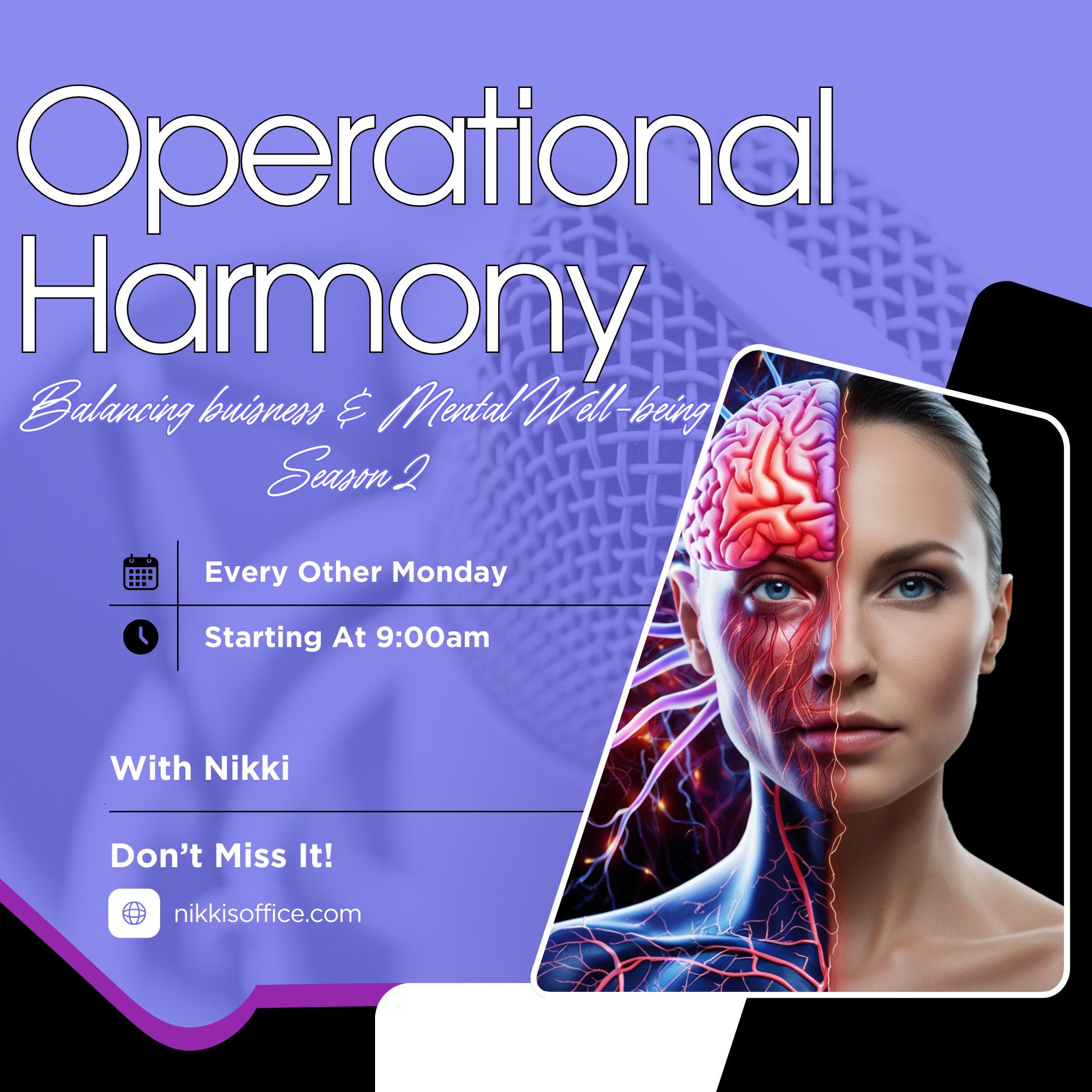
Operational Harmony: Balancing Business & Mental Wellbeing
| Nikki Walton / Cisco | Rating 0 (0) (0) |
| http://nikkisoffice.com | Launched: Jun 30, 2025 |
| waltonnikki@gmail.com | Season: 2 Episode: 29 |
📋 Timestamped Show Notes
[00:00:00] Meet Hillary Cisco – from glass artist to web design expert for wellness-driven brands
[00:01:00] Why she left corporate tech & networking: spiders, walls, and “no thanks!”
[00:03:00] Yoga, tech, and teaching: bridging heart and systems
[00:05:00] How Hillary uses NLP to create emotional connections in web design
[00:07:00] The role of colors, images, and language in conversions
[00:08:00] The problem with "just throwing words" on a website
[00:10:00] Websites as a living tool – why you shouldn’t wait for perfect
[00:11:00] Using sensory language to match how people process information
[00:12:00] Chunking: why breaking content into small bites matters
[00:14:00] Conflicting website feedback & pricing transparency debates
[00:17:00] Customization and collaboration: helping clients shape solutions
[00:18:00] Hillary’s tech background: support, automation, integration, and coaching
[00:20:00] Yoga, wellness, and building websites that feel human
[00:22:00] SEO basics: Search Console, keywords, and using real-world language
[00:24:00] Why networking matters more for SEO than you might think
[00:25:00] Local SEO tips and examples from movers and neighborhood keywords
[00:27:00] Engaging, entertaining, educational: Hillary’s 3 E’s of content
[00:28:00] Nikki and Hillary talk networking groups like BNI—what works, what doesn’t
[00:32:00] Finding groups that fit you, not just your industry
[00:35:00] Nikki breaks down early signs of burnout (physical, emotional, behavioral)
[00:37:00] Dark humor and mental health: how laughter helps with regulation
[00:40:00] Balancing business needs with personal limits in high-demand settings
[00:42:00] Self-care and support systems—don’t do this alone
[00:45:00] What happens when burnout gets too far and how therapy can help
[00:47:00] Creative space as healing: audio books, fantasy, meditation, gaming
[00:50:00] Nikki’s take: escaping through books vs. gaming with friends
[00:52:00] Rage weeding, outdoor healing, and the importance of breaks
[00:54:00] Allergies, smells, and sensory overload in the real world
[00:56:00] Why listening to your body isn't optional—especially with chronic illness
SUBSCRIBE

Episode Chapters
📋 Timestamped Show Notes
[00:00:00] Meet Hillary Cisco – from glass artist to web design expert for wellness-driven brands
[00:01:00] Why she left corporate tech & networking: spiders, walls, and “no thanks!”
[00:03:00] Yoga, tech, and teaching: bridging heart and systems
[00:05:00] How Hillary uses NLP to create emotional connections in web design
[00:07:00] The role of colors, images, and language in conversions
[00:08:00] The problem with "just throwing words" on a website
[00:10:00] Websites as a living tool – why you shouldn’t wait for perfect
[00:11:00] Using sensory language to match how people process information
[00:12:00] Chunking: why breaking content into small bites matters
[00:14:00] Conflicting website feedback & pricing transparency debates
[00:17:00] Customization and collaboration: helping clients shape solutions
[00:18:00] Hillary’s tech background: support, automation, integration, and coaching
[00:20:00] Yoga, wellness, and building websites that feel human
[00:22:00] SEO basics: Search Console, keywords, and using real-world language
[00:24:00] Why networking matters more for SEO than you might think
[00:25:00] Local SEO tips and examples from movers and neighborhood keywords
[00:27:00] Engaging, entertaining, educational: Hillary’s 3 E’s of content
[00:28:00] Nikki and Hillary talk networking groups like BNI—what works, what doesn’t
[00:32:00] Finding groups that fit you, not just your industry
[00:35:00] Nikki breaks down early signs of burnout (physical, emotional, behavioral)
[00:37:00] Dark humor and mental health: how laughter helps with regulation
[00:40:00] Balancing business needs with personal limits in high-demand settings
[00:42:00] Self-care and support systems—don’t do this alone
[00:45:00] What happens when burnout gets too far and how therapy can help
[00:47:00] Creative space as healing: audio books, fantasy, meditation, gaming
[00:50:00] Nikki’s take: escaping through books vs. gaming with friends
[00:52:00] Rage weeding, outdoor healing, and the importance of breaks
[00:54:00] Allergies, smells, and sensory overload in the real world
[00:56:00] Why listening to your body isn't optional—especially with chronic illness
What do spiders, burnout, and websites have in common? In this episode, Nikki chats with Hillary Cisco of River Song Web Design about everything from avoiding crawlspaces to building emotionally intelligent websites. Hillary blends NLP, creativity, and tech strategy to help businesses connect better with their audience. They also explore burnout, boundaries, and finding your healing escape—whether it’s through gaming, gardening, or rage-pulling weeds. It’s equal parts honest, practical, and unexpectedly hilarious.
Find Hillary here:
https://www.facebook.com/hiansc/ linkedin.com/in/hsciscoe/
nikkis-lounge-2025-03-141632
===
[00:00:00] Hi. I am Hillary Cisco with River Song Web Design, and I partner with passion driven business owners, health and wellness brands and spiritual leaders who are frustrated with their outdated and hard to navigate websites that are not getting the results they need. And they wanna do a better job of showcasing their value and guiding their visitors to take that first step to connect.
And we work together so they can attract the right people, build trust, and grow their client list. And I can help them do that. I got into web design when I was creating my own artwork. It was glass, I did a lot of sewing. I made a lot of different things and went to festivals. And I decided that I wanted to.
Try to make a website. This was around the year 2000, so it's been a little while and I honestly, looking back, I don't have any idea how I knew any of the words that were on there [00:01:00] for the FTP uploads and all this. And somehow I created a website and I decided to go to school for it. And I really enjoy the design aspect of it.
I enjoyed learning how to code and then my parents told me that web design was not a real job and in the year 2000, it really wasn't a real job. So I believed them and I got my degree in Microsoft networking to help corporations with their network. And I decided that really wasn't for me either.
I'm not a corporate sort of person. I really enjoy connections and good communication and a lot of corporate level things lack those, right?
But, I went to school in, 2006 for it. And the one class dude, I did very [00:02:00] well in all of it. I put together the computer real easy. I got compliments on how fast I would just give me the part it goes into part B. Okay, fine. Do it. There's not a whole lot of where does this go? It's just do it.
And with firm force, like one of the guys in the room is like, I'm gonna prank it. I have to do it gently. And then everybody's laughing at him 'cause he can't get the part to go in where it's supposed to go.
But, the networking classes. The one I only went to, one of them, the dude was like, yeah, you're gonna have a lot of crawling in walls, in between walls and, in the attic and in the basements. And I went, awe hell no. Absolutely not. Yeah, I have waist length hair. Mm-hmm. Okay.
Waist length hair. I've had long hair forever. Do you really believe that? Me being terrified of spiders wants to get in the shower one day and find out that I [00:03:00] had a whole family of them in my hair from doing work inside? No. Absolutely not.
So when the second class came around, they were like, okay, so you have to take this class, or there's this other obscure thing that we don't actually ever do because nobody ever wants it. And I went, yeah, no, I am way more interested in helping somebody, like with the stuff over the phone than I am to be willing to go into walls.
I don't want that part. You can do that part. I'm not doing that part. Yeah. I that right At the college level, I was like, no. Yeah. They spend a lot of time in closets and all kinds of stuff. Yep. For my networking the most. Saying I remember is one of my teachers said, networking has seven levels.
It's like an onion and it will make you cry. And Yeah, more or less. Fair. Fair. Yeah. And so, I did go a [00:04:00] little bit deeper in tech. And also at the same time I was teaching yoga and other exercise, a lot of meditation. I worked for YMCAs. And so it, I've always wanted to help people.
I've always had that softer touch with people and I like to bring that to my web design. My tech ranges quite a bit. I worked at a software company for over a decade and raised it from five people to a whole lot of people. And after that, and we got so big, I really wanted to come back. To helping people at a closer level, making better connections and helping them create better connections.
I know a lot of people really st struggle to connect with their audience and people treat websites like a online brochure. Just dump all that on there and there you go. And that's not all it is. You can do so much more, by using the right [00:05:00] words. And I'm A-N-L-P-A neurolinguistic programming Master Coach and certified trainer, and NLP is all about the power of language and censoring and helping people understand things on their level.
So using that and web design really helps. Bring the content to the visitor using specific words, whether it's like how something feels to you or something looks to you. People resonate with those things differently. So using colors and fonts and images and the wording to create specific emotions, I can help people open up their audience online and drive that emotional connection that is, crucial for [00:06:00] conversions for their business.
So what does that look like? On the building side, to applying it to a website experience. You have your branding, of course, right? If you don't have branding, then you need to take a step back, because you should use a couple specific colors to you. And those colors need to be used in a certain way.
You have your fonts. A lot of people go a little crazy on their fonts. You wanna make sure they're readable. And I'm big on images. I love people's faces on websites because no, you can't make real eye contact with them. But still allowing them to make eye contact with someone on your website does spark a bit of connection.
So when you add the layout aspect to the messaging where you [00:07:00] know who you're talking to and you open that up so it touches more people, by speaking to their needs, their desires. Their pain points, things they need to fix. And when you bring all that together with the connection aspect of the colors and the images, it really sparks that connection.
It makes much more difference than just throwing all the words up there and having a stock image of a computer and someone working at it, right? It's being very intentional with what you put on your website because people look at websites before they give you a call or before they buy something from you or visit your store.
So it's very important to ensure that they feel who you are and know what you do as soon as you get, as soon as they get on your website. And also another way to do that in the website itself is with the call to actions. So the words you use on the [00:08:00] buttons, right? Making them more motivational or aligning with the action they wanna do.
So there's a lot of ways to apply a more intentional and emotional marketing into your website.
I can, I keep remembering as we're talking, that I have to update my website. Everybody needs to update their website. That's totally normal. I need to update my website because, as I. A person that's always growing and into my personal development as well as my professional, skill development, I'm always evolving.
So I look at my website every couple months and give it some adjustments. And if you haven't done that this year yet, it's definitely time. Time. No, I just started a new service on Monday and I haven't added it to my [00:09:00] site yet, which is, oh, that was stupid. I still have to do that. Yeah.
But yeah, definitely. And no better time than the present. Right? I can't do that because once it's up and out there, it's up and out there, it's not waiting for you to be done anymore, but it's out there in the world of the internet making its impact. So it's better to put it up there.
And go touch it up later than to wait until it's perfect. Yeah, no, it's more, I realized I think yesterday that I hadn't put it up yet, but I realized it at 11:30 PM so I was not about to just go to the computer and start working on that uhhuh. No, I agree. This is not the time to do that. And then us talking about this, just kind of flip that like, oh yeah.
Remember? You have to do that. So, Yeah. Is there anything holding you back or you have a good feel of what you're looking for? You wanna do No, I just [00:10:00] have to do it. Well, I have to remember when I'm not about to fall asleep and when I'm not in the middle of a podcast that I need to do it so that I can do it there because I was not quite so busy this morning and could have updated it, but I didn't remember until we started talking about a website again.
So, yeah. One of those things. Yeah, absolutely. All right, so we can talk a little bit more about, the using NLP in websites. As I mentioned earlier, people are more sensitive to different senses, so. If someone's gonna sell you a car, for instance, and you really wanna be comfortable in that car because you're driving an hour every day, one way to get to work and an hour to drive back.
You want it to be comfortable and have great gas mileage. [00:11:00] And if the salesman only is talking about how good a stereo system it is and how awesome you're gonna look in it, it's not gonna connect with you because that's not what you are looking for, right? So it's more about comfort and the comfort of your wallet versus how you look in it and how the engine sounds.
So understanding how different words affect people is really important in emotional marketing. And, colors have a good bit to do with that too. Different colors spark different emotions. So as you are deciding how your language is going to affect your readers of your website, you can also look into color theory as well and how those play in to the different emotions.
Something else I wanna talk [00:12:00] about is something called chunking in web design. So it's where you're using sections in smaller pieces of information. So some people, the wall of text, the giant wall of text. Oh gosh, yeah. I just scroll on you going next night. It's fine. Yeah. It information overload and we already have so much information overload, right?
So making sure that you use your headers and you break things down, kind of do some nesting so that you know these topics, you can break 'em into smaller bite-sized information. And it really helps people take in the information on your website. Again, you use that with the colors and the images that help people connect to you, and that helps them scroll down the [00:13:00] site, not in a fast way, that's too many words, I gotta keep going, but in a way that they're taking in all the small pieces together.
It all connects together. It's telling a story. And it's talking about how you can help them with, the solution they need. So always using digestible pieces, those bite size pieces instead of, the walls of text are really helpful when you are redoing your website or just updating your website in general.
Don't be scared to ask people what they think too. Send it to all your cousins, your friends, and have them take a look, get that bad feedback. And the bad feedback's good too. I say cousins 'cause they're poor, more likely, or siblings to be like, this makes no sense to me, or this is just too much.
Or, taking that in and being able to improve. What you're working [00:14:00] on is, a process. So, like I said earlier, you don't try to make it all perfect at first because everything is a, is an evolution. Yeah. So one of the things that I have come across, with my website is conflicting advice where you've got people who are in the field because I work with a bunch of people who are run, agencies and stuff.
So if I ask a couple of them to look at my website, one of them will be like, oh, it looks great. You're doing awesome. Just keep it up. And then the other one's going, you should take the prices off of this. You should, make this look this way, this look that way. And then the other one is that all of your prices or is there more that you're not saying in your prices?
Because you should probably want the more, you're not saying in [00:15:00] your, so three different people, three different people over the place. Super helpful. In case you didn't know that. So how do you Yeah. That kind of thing, because yeah, fine. I go, you know what, it's fine. It isn't, different perspectives are always great because there's something you can take from each person, right.
And see if you can find a middle ground. I like to see some prices on websites. It helps me understand. Where the people are coming from. It helps me know that they like to be more transparent instead of kinda hiding it for later. So that's, it is really a personal preference. I do have pricing on my website, and that's not all it is, it's not that you have to sign up for exactly what's on my website because everybody's different and has different needs.
Some people need me to coach them on [00:16:00] copywriting more than others. Some people want to pick out all their pictures and some people are like, you can do that. Yeah. So some people want to spend time reviewing every single word on the page, and some people are like. Oh, that looks great. I could have never have made it look nice.
Thank you. And that's all there is. That's all the feedback I get, is That's awesome. I love it. Thank you. And with each thing, everything is a personal preference and I feel like the more that you do tell people, the more they understand who you are. And that doesn't mean that's all that you are.
So if you note that, everything is customizable depending on what you need. Yeah. That, yeah. All of my stuff is like that because Yeah, I've broken it down so that each of my services have different [00:17:00] chunks of different prices, and so you can mix and match across the board. I'm a little, I do a lot of different things because if I only did one thing.
So you obviously are very happy doing websites. If all I did was websites, I wouldn't have any hair left. I do love doing websites. I mean, doing websites is fine. I have no problem doing them. But if that's all I was doing and my brain would turn it into, this is boring, I don't wanna do it anymore.
And then I just wouldn't be able to keep forcing myself to do it. So I have a lot of different services. So that I'm helping my clients in a lot of different ways, and that keeps me, on my toes and involved, as much as they need me to be. No, I myself have three or four different websites.
So I don't just do websites either. My history is based a lot in tech support and [00:18:00] client services or customer success. And also feedback. I used to gather large amounts of feedback and analyze it. I do a lot, I do coaching. So I love working through ideas with clients and help them design their offerings.
I do automation and, email automation, email marketing, a lot of different automation. I've done a lot of integration work, on a very large scale level. I also like variety. I always come back to web design because it's something that's technical and creative and people need a lot of help with it.
And I love helping people. So it's a spot that I really enjoy and I do like spending most of my time there. And in doing that, I also get to, work out. Business solutions for my clients and coach them through it. And yeah, so it all really does resolve, revolve around websites.
Just pretty much anything that touches a website, which is a lot because it [00:19:00] takes a lot to, to make a good intentional website. So I have to say though, that, I've known a bunch of techie type people in my life. Mm-hmm. They don't usually turn around and start doing yoga though. Yeah. And actually my chiropractor suggested that I do yoga, and this was right around the time that I started doing websites too.
It all happened about the same time. So I taught yoga for years and meditation and I still love it. I still use it to get my body aligned. Yeah, so I enjoy, I used to work at A-Y-M-C-A and I did, I had, you've heard of that song in my head. Thank you very much. No, but I had many, I was the tech person and the software administrator, the system, like membership coordinator and I taught yoga and Pilates and circuit training and was a cardiac [00:20:00] rehab assistant.
I've done the soft and the tech side. So that's I think why websites work so well for me. 'cause I understand that human connection and allowing my brain to slow down. And Is your cat okay that, what's it, what's that? Is your cat okay? Oh, my dogs seem to think that they chase imaginary mice.
So they think that there's something hidden behind the table. I promise them that there's nothing back there.
But yeah, I was hoping you couldn't hear it. They were starting to, he kind of went at it for a second there and I was like, yeah, a cat, to be quite honest, which is very rare for a cat to be that like spastic. So I was like, this is waking hours. Cats are usually sleeping now, not spastic. What's [00:21:00] happening?
Yeah. So let's see. Any other questions? About website development or, let's see here.
I think this is one of those places where I know so much to myself that my brain is like, no, we know how to do it, but like, I wanna ask questions. I'm not trying to be that person, but a lot of people don't, so, you know. Yeah. No, and I understand that's why I was saying, I'm like, I'm trying to come up with questions that like, I don't feel stupid asking.
Okay, great. Yeah, so something else that's really important with your website is having a baseline understanding. If you already have a website, does it show up in the search for anybody? So I use Google Search Console quite a bit, and Google Analytics. And the search console's nice because it tells you the keywords that your website is actually showing up [00:22:00] for.
So if you don't do any SEO right now, that is a great place to start. If you are doing SEO, you can check there and make sure that you are using words that. Your website is showing up for, an important part about SEO is one, your messaging, of course, knowing those pain points, understanding what people are searching for and using those words on your website, because if you don't use the words that people are searching for, if you use, like your business jargon, then people that don't know the business are not gonna search for that online.
So really understanding who you're talking to and how they word what they need. But that's not just what SEO is. SEO in a broad term, is really like Google's health score for you, for example. Mm-hmm. Or for your website. How healthy is your website? So yes, you have the keywords. [00:23:00] You wanna know what people are using to search for your site.
You use those in the headings, in your meta description for each page, and then you have your content, right? So planning your and scheduling content to go out. Different types of content. People like, tips, checklists, insights, Hey,
they have their noses in the corner of the wall. Like I know something's in this corner. No,
I should have brought a water bottle, aquir bottle. So anyway, you know when you are planning your content. You also wanna be using the topics that people are searching for. Blog posts and articles are great, along with little checklists or your tip on social media for the week. Ensuring that they are the words that you're showing [00:24:00] up for.
Now, besides all of that, what some people don't understand is one of the best things you can do for SEO is get out and talk to people. So whether that's networking events or, podcasts or, just going out and meeting people that could be good networking and power partners for you.
Finding those power partners and collaborating, doing guests, guest blog posts on their website, for example, that is going to show Google that people trust you because they're going to your website from different areas. And that's a part that I feel like a lot of people miss out on when they talk about SEO.
Yes, keywords are important and you have to show that you're trusted by more people than yourself. So you know, that's where the networking comes in and is really, really an important [00:25:00] part of SEO. Now, if you're local and you have a business that you focus on just locally, that is even more important to do content that talks about your local area.
What else are people looking for when they are, googling your services or services like yours? For example, I work with a moving company. And so they don't just talk about, how to find the best moving company or how to package your goods. What packaging tape is the best to use.
But they are also talking about the different neighborhoods, the different school systems, the electric company for this area versus, this, the utilities over here. So they are naming different neighborhoods, different suburbs, different services that people need. [00:26:00] And those are going into blogs and website pages for their company, which broadens them.
So when people are looking for what services or what utility company do I need to reach out for this area, their website is more likely to come up. Because it's showing that they are very knowledgeable. And when you're talking about content, I like to talk about my three E's, which is engaging, entertaining, and educational.
So when you're making content and you're being educational, people appreciate that. When you're being entertaining, people laugh. They enjoy that. And when they're engaging, they're making that connection with you, which leads to them, seeing how else you can help them. SEO has a widespread that, coming down to it, it's all about that engagement and connection in the long [00:27:00] run.
But there's a lot of different ways you can make that happen. So SEO some people are like, I don't wanna touch SEOI find it really boring. And it can be, I kind of like it, because I understand the purpose solves. And I like seeing, where your website was when we started and where it is six months later in terms of how much more traffic it's getting, where the traffic is coming from.
You can see which pages are, getting more clicks and more views. So it, it really is a tool that, that people that run their own business and do their own website or make decisions for the company need to be aware of. Mm-hmm. Yeah. So it all come, SEO comes down to knowing the keywords and networking more or less.
And then [00:28:00] using those keywords within your website. Yeah, it has to be networking. Oh, yeah. But that, there's other ways to get out in front of people's audience just like this, right? A podcast, you get on somebody's podcast and talk about your services that allows them to, see who you are, click on your link from that podcast page, or doing a guest blog.
They see it on a website. You have other people sharing your services to their audience. So that is a way of networking and growing your network as well. I only dislike it. Because it's so many people, but do it and I'm fine doing it. I just did, so I just did some networking in person with a bunch of people, so I'm not ready to do another one yet.
Yeah, I actually host an online, once a month networking group [00:29:00] myself. I go to other people's networking groups. Some of 'em, a lot of women's networking groups are once a month. And then there's bigger ones like BNI and a few other things. And those are more weekly, right? So you get to know if you're a local business, you know, stuff like that's really important.
Or the Chamber of Commerce, for example. BNI, because I have roofers that I work with that. Standby BNI because they get all the recommendations, 'cause they got the realtors and the insurance people and mm-hmm. So it's real good business for them. Absolutely. Let me qualify that it's really good business for a roofer, an insurance person or a realtor to be in those groups because they all share them.
And I think also the people who do some of the paperwork for the buying and selling of houses too, right? Mm-hmm. Now, if you are not somebody who can regularly give them, recommends you, you're not constantly [00:30:00] sending people to somebody to get a new house or whatever. You're gonna find just a little bit less value out of it because
they're not gonna be looking out for you either. Not in a selfish way, but just a, I don't remember what that dude does because my business is booming from what I am doing. Right. Yeah. Out of sight outta mind. And when it's right in front of him and, you do water restoration and this guy does roofing, obviously, they're gonna work together.
And then you need the carpenter to fix everything back up after the roof gets done, you know? So yes, there are certain industries that really come together there. And that's why even printers can, yeah, even printers can get it. But if you do something off the wall, I don't know, yoga.
And you're going there to get recommends for your classes. Probably not gonna happen as much because I don't know a roofer yet that does yoga. [00:31:00] They probably should. A lot of them at this point. They probably should no doubt. But like they don't, and they would probably laugh in your face if you ask them to maybe.
So there's that. Yeah. But the point being, they're just like, I know that there was, in a group, one of the guys was like an essential oils person, uhhuh. And while I'm not saying there's any look, not my opinion on whether or not that's a good idea, but he didn't get barely any feedback because what was he gonna give a roofer or an insert?
He wa he couldn't give to any of them. And like they're not thinking about essential oils on a daily basis. Now I do, I know in essential oils, lady in BNI and. She always brings samples and all kinds of things, and she actually does really well. It depends on every, like b and i, it's such a big organization and every chapter is different.
They have like their own personalities. So it's interesting [00:32:00] to see. And like I said, I really like the small ones that meet monthly. We have several around here that meet monthly, but they're different groups. So as long as they're on different weeks, different people can go to different events.
And it's really about finding people that are like-minded and that work with the same people you do. Yeah. So the other caveat is BNI costs, anywhere between 1000 and like $2,000 a month or a year. Not quite that much. Depends on your location. Yeah, no, I, the one here was 1200. Oh, okay. I know in not Nashville it was a little bit bigger.
Okay. So I guess it can be a little bit lower, so you wanna make sure that if you do invest that amount of money in, you're getting something back in return. So maybe make sure that visit some first. Yes, definitely. You can visit a BNI meeting twice before you have to decide if you [00:33:00] want to become a member.
Mm-hmm. And then move on to the, to a different one in the area. Bounce around so you find one that seems to fit you better, and then go all in on that one. Yeah. Ours are like six or 700 bucks a year, but you have like a. Joining membership or a membership, like a startup fee like the YMCA. And then, there's smaller ones that are free just 'cause people wanna gather and talk and make connections.
So the BNI ones cost? Yes, definitely. There's other ones. Any of the other ones, it depends on the group. So I can't speak to those. I just know BNI. Yeah, yeah. Some other ones. There are other national groups that just aren't as big and they do cost. What state are you in? I'm in Indiana. I'm in southern Indiana.
Okay. I'm in Arkansas. The roofers I know are in the Nashville area, so that might give you a bit of, yeah. And like I said, a lot of it's sharing [00:34:00] information and just making sure people know what you do. So even if your networking is deciding to go to small businesses that work with the same people you are and are reducing yourself to the people in those businesses and working on some sort of collaboration, that's super helpful too.
Anything that, where you're making a connection, creating the communication and just getting in front of people and sharing.
Hey everyone. Thanks for sticking with us. Before we dive into our next topic, I just wanna take a quick moment to remind you two who like this video, subscribe to our channel and hit that notification bell. That way you'll always be the first to know when a new episode drops, and we want to hear from you.
What topics are you most excited about? Drop your thoughts in. The comments below. Your feedback helps us create content that you love. We've got some exciting stuff coming your way, so don't miss out. Now let's switch gears and jump into our [00:35:00] next discussion.
So, the early signs of burnout actually sound like, depression. So we need to, if we already have depression, we need to make sure that like we're not taking those worsening symptoms as it being our depression flaring up, but actually identifying as the correct thing, paying attention to your body and how your body reacts to stress and long-term stress is important.
Because you wanna be able to listen to your body and not be caught off guard when it decides to take a vacation. So early sound signs of burnout are fatigue, lack of energy, headaches and muscle tension, sleep disturbances, stomach problems, your emotional signs. Again, same as people with depression and anxiety.
So you have irritability and mood swings, anxiety and [00:36:00] cynicism, and detachment and apathy. So now you're going, okay, I'm not a part of this, and they're all idiots. Anyway, just make sure that you realize when you're saying they're all idiots anyway. It's not just a natural thought because you've had one too many stupid questions today.
And don't start attributing that to burn out because. Us being sarcastic, dark humored people is just a thing that happens.
Some behavioral signs are withdrawing to decreased productivity and escape from fantasies. So daydreaming about leaving work or responsibilities behind, that kind of thing. So what you wanna do is if you're, I don't know, I know my body because I have [00:37:00] a bunch of, autoimmune disorders and so I have to listen to my body because if I don't, I'm going to regret it.
My body has proven that to me in all sorts of situations. I do one too many things today. My body will not be able to move tomorrow type deals. And so just making sure that we are, paying attention, monitoring ourselves, maybe do that yoga thing. I don't do yoga. I don't, I can't move like that.
My body has given up moving like that. But maybe that's something that, that you can do. Okay. Now, when it comes to recognizing it and managing it, first of all, your dark humor that you get from your mental health or wherever it comes from for you, is going to help you tremendously. 'cause the more you can laugh at yourself, the more you can laugh at others.[00:38:00]
When they do the stupid thing, the better off you are because you're releasing that tension in a healthy way. Even if the thought that caused the happy thought, the happy smile and laugh is not quite so clouds and butterflies. So I have come to say because of the company, I keep in the dark thoughts that get said out loud.
It is okay to say the bad thing. It is not okay to do the bad thing. So I can talk about punching people in the throat and it'd be okay as long as I don't actually go stupid and do it. It's a release of attention, because you're frustrated or whatever, you know, or you're just angry because somebody made you stay after work for 45 minutes because they didn't tell you they unplugged their computer and are now trying to get you to figure out why their computer's off when they want it back on, [00:39:00] because that's helpful.
We all love those calls.
So we want to monitor our stress levels, which again, having the dark humor helps way more than we realize, because we may be laughing at some pretty morbid stuff, but we're laughing it and laughter , what's laughter is the best medicine. So it helps you regulate. It helps you figure out what emotion you're actually trying to process.
It helps you through things. Believe me, if I didn't have my sense of dark humor, I would not have gotten through half the stuff I've gone through in my life because I would've done the bad thing instead of just saying the bad thing. This thing says to track your physical symptoms. I wouldn't go writing crap down just because that's a diary of something that we don't need to have out there.
But if you [00:40:00] have one of those journals where you pay attention to how much you're drinking water and sleeping and all that, then yes, put it on that. But just be able to know what's happening in your own body. Track it. I know that sitting here right now, my right hip is screaming at me for some reason.
Probably no reason. It just does that for some reason. And today is one of those days, but I have tracked it. I do know that it's happening and I'm fine with it because I know why it's, well, I know why, but maybe not why, if that makes any sense. Other people with autoimmunes will know what I mean.
This says to set boundaries, says to learn to say no to, excessive work demands. I don't know how many of you work in corporate because, sorry about your luck, but [00:41:00] if you say no to your work demands, I'm quite sure that there's a lovely pink slip for you at the end of the week. I don't know if it's pink anymore.
It used to be whatever. Basically, if you start saying no to a lot of stuff, you're probably gonna get fired. And while that's not fair and it shouldn't be happening. We all know that it does happen and we need to be careful. So do be careful with what you say no to and how you say no to it. Their sarcastic humor will not serve us in this place.
Being sarcastic and dark to your boss saying, no, I'm not doing your work for you today. Probably not the best way to go about that unless you want that pink slip at the end of the week or that day, whichever comes fastest. We want to pay attention to ourselves, but not selfishly. Obviously, we still have to monitor our friends and families and all that stuff,[00:42:00]
but we wanna, practice self-care. Do the things that make that bring you joy, relaxation. If that's meditation, go for it. If that is reading or sewing or gaming, do it. And if you have a partner who doesn't game with you, why did you pick that partner? I really don't understand people sometimes. Oh, yes, I'm a real big gamer.
Let me pick the person who hates games the most to be a partner with. You're creating problems for yourself. I don't know, what kind of person needs that advice, but maybe you do. And, okay. So for all my people who have their own businesses, somehow we're supposed to maintain a work-life balance. If you have your own business and it's a small business where it's just you doing a lot of it, or you only have one or two [00:43:00] people who do stuff, you probably have way more work to do than there are hours in a day or week.
So monitor what you're doing, make sure you're still enjoying it, and if it comes to a time where you're starting to get tired of it. Step away, go take a day's rest or something and come back with fresh eyes. Mm-hmm. You should also have support systems. If you are not, if you have mental health problems, I am going to offend some people.
But if you have mental health problems, you should be seeing a therapist. If you are not, why?
Because they can help you work through the problems that you have. They can help you identify things. They can be faster to identify something. When you come in and say everything's wrong, being, you know, your dramatic self. They can say, not everything. Let's go through it and help you figure out what you're supposed to do.
I have two [00:44:00] therapists because I have people that like me apparently, and, it's great. I recommend anyone who has any sort of mental health problem, even if it's just anxiety, be talking to a therapist. Things can be overcome and you should also build a support network. You should have friends, family, other people, so that you can, identify problems, talk with them, have shared experiences, go to dinner with people.
I don't know, I don't go out much, but do things with other people. Be social or as much as you can. Be social introverts. Go find an extrovert to be friends with. They will tell you what you need to do, and that should help your
early signs of burnout. If it gets bad enough, that therapist is going to be there to try to [00:45:00] help you. Figure out what you need to do after that. Once the early signs have come into the middle ground, you, have royally screwed yourself up because you didn't pay attention. And, now you really need that therapist to help you and your situation try to beat back the burnout because that stuff, once it's fully set in, takes years to get rid of.
So let's not do that to ourselves.
You have a very expressive face, and I saw some stuff while I was talking to you.
Oh yeah. I've been there. And I am still working out of it. It's an ongoing process. I. Definitely had some serious burnout. And it wasn't necessarily that I said no to my boss about what to do, but I definitely had to lessen what I paid attention to in the company. [00:46:00] Now, this company was five people.
When I started, we grew it to well over a hundred, over a decade. Very little investment until I was there for at least eight years. So it was all bootstrapped and we wore many hats, and it was a stressful environment. And so I, instead of saying, no, I won't do that, I definitely put on my blinders to help minimize that overflow of things coming at me.
I changed positions while I was there. And eventually left the company. But it took me a long time to find passion, what I was doing afterwards. Allowing yourself creative space is important. And I wanna say, yoga is not about flexibility or moving. It's often a place to go to, to understand where you [00:47:00] are.
Not necessarily, you don't have to push yourself further. 'cause a lot of times sitting with yourself and meditating, and that doesn't mean just sitting in one place and staring at a wall. But, I meditate while I paint. People meditate while they ride bikes. And it's time to allow your own brain to move through your thoughts.
And I. Think through the things that maybe you don't want to think through. I did become quite addicted to fantasy books on audio for several years, and I knew I was starting to get outta my burnout because I quit listening to as many. I wasn't like, I gotta have my book in my ear. I gotta have my book in my ear, you know?
When I quit being so obsessed with having something in my ear, taking up my thoughts, I realized that I was in a better place. I had healed quite a bit. So sometime, you need to be able to shut your brain off, but you also need time to allow your [00:48:00] brain to think for itself,
So I think that's really important and that's something that, that yoga and meditating does. And like I said, meditating doesn't just have to mean sitting in one spot. So you can get a lot out of. Just doing things that you love by yourself, taking time for yourself. And some people say self-care, some people just say, I wanna do some stuff that I like to do and make sure you do it because that is a healing practice on its own.
Yeah, very much so. I know that, for me, when I'm gaming and I'm outside, again, I'm still, or reading is my total escape because if I'm reading something and I'm looking, I'm not looking at words on a piece of paper, that stuff is in my head happening and like it's a whole thing. So, I like get [00:49:00] sucked right on into it.
Getting me to come out of it. Yeah. Fights with people about it like you're ignoring me. No, you idiot. For the 50th time, I didn't hear you because you didn't say my name first. Like I told you to. Not my fault. Listen me. So that's a total escape that gets me completely out of my head. That means I don't want to be where I'm at anymore.
I need to get away. Then I come, once I'm done reading, I'm not, it's not like, oh, I'm still in the book. No, I am back here and going, oh man, maybe I could start another one or whatever. But, when I'm gaming, I have a group of friends that I'm with and we only do stuff. It's not like that.
They may irritate me sometimes because I have sensory issues and, they just kind of start all talking at [00:50:00] once and or interrupting me when I'm talking, which just ticks me off. So I end up, okay, I'm done. Yeah, I'll go do you, I'm just gonna sit back here and do nothing. I'll be good. But it's with friends and usually on a good night, we go and we do fun things and it's great.
Mm-hmm. Not a complete out of my head thing because obviously I have to click you the buttons and apparently the right order to heal people.
Apparently that's needed. So no matter what your escape is, no matter if it's books, if it's gaming, it's crocheting or whatever, like that's your escape. Go do, but just remember to come back to the real world every once in a while and check on yourself. Mm-hmm.[00:51:00]
Absolutely.
Do you have anything else to add here to the burnout part?
I could talk forever on this type of stuff too,
I find outdoors really healing, to being able to go outside and. Just take a nice breath of fresh air. This week has been a great example of being able to take a break and go outside. I really like to garden as well, I might take a break, especially if I'm frustrated with work and go pull some weeds, rip them things out of the ground, throw 'em, and, that can really, you know, make me feel better too.
So sometimes destruction in a helpful way can also get a lot of frustration out, or, you know, you got a punching bag, something like that. A mine hangs outside of my back porch. Getting out, taking a breath, rip some weeds outta the ground. [00:52:00] Only if you know what is a weed and what is a flower.
Absolutely been told to pull weeds. And I go out there and I'm like, well, if it's don't got a flower on it, I'm gonna pull it. And then I get yelled at, because I done pulled half the flower bed. Yeah, don't do that. I do. I'm also an herbalist, so I do, I grow a lot of herbs and flowers and food.
So yeah, you definitely need to know what's in the area before you just start ripping. The fact that I was out there pulling anything was a miracle because I'm allergic to grass, and so being outside is not my favorite place. Mm-hmm. Mm-hmm. Because, you know, breathing is required. Yeah, definitely full stop.
It's just rewired and pulling all that stuff had my sinuses going nuts and so, yeah, no, I was pissed off and I was rage pulling. So yeah, get what you get when you send me [00:53:00] outside to pull weeds when I can't kneel comfortably because of my needs, having arthritis and you know, the yard just being mowed.
So now I can't breathe from that either. So like mm-hmm. Mm-hmm. I went back inside and my face was swollen and they were like, wow, what's wrong with you? And I'm like, yeah, normal, normal stuff. See, we don't have much grass. I live very much in the woods, but I've. Replaced a lot of grass with, things that I grow, so we don't have much mowing around here.
So yeah, I get that. Definitely. My daughter has a lot of sinus things as well. Yeah. Being an asthmatic when you're allergic to the grass and your asthma is triggered by smells, it's just the trashiest thing on the planet. Oh yeah. That's rough. Fun stuff. Yeah. Life.
It's bad because it's not even [00:54:00] my choice when my asthma flares up. Oh yeah. I don't put smells on myself. Who puts smells on themselves? Other people. Mm-hmm. Oh yeah. And other people seem to think that, oh one or two, I just did one or two sprays. Chica, it is never about the one or two sprays, but you have shampoo and conditioner that smells, you have body wash that smells, you have lotion that smells, you have hair products that smell.
You have deodorant that smells. What about one or two sprays should I be worried about? Mm-hmm. Because I don't know what's making you smell like a chemical flower bed, but you need to knock it off. Yeah. Oh yeah. Yeah. There's some people that like to pour it on. And, I used to, when I taught yoga at one of the YMCAs I worked for, there was a guy in a yo in a yoga class, and he always complained about the class before, because all the ladies smelled [00:55:00] like.
Baby powder, they'd use so much powder that he'd walk in that room and be like, oh, every time, every, every day. It was so much for him, and a lot of people don't even notice they're doing it, so, yeah. Yeah. No, I've had an asthma attack and then somebody's going, but I'm not even wearing that much.
Mm-hmm. That doesn't, your opinion of how much you smell has no effect on my asthma at all. Oh, how much you actually smell that has an effect on my asthma. Oh, yeah. Yeah. Your thoughts on the matter are irrelevant. And tell me bonkers, because I'm just sitting there going, do you not hear the wheezing? And they probably don't smell it at all.
'cause they're so used to it that they don't smell it at all. So, and then there's some people with dead noses, like, my therapist can't smell for nothing. And then I walk into her room and I'm like, oh, the last person had perfume on. [00:56:00] And she's like, I didn't even smell it. Yeah. Why couldn't I be one of those people?
But no, I have to smell everything and then get triggered by it. Like, oh, it's not even my trigger. It's my asthma's trigger, not my fault. Oh, yeah. Yeah. It's rough.