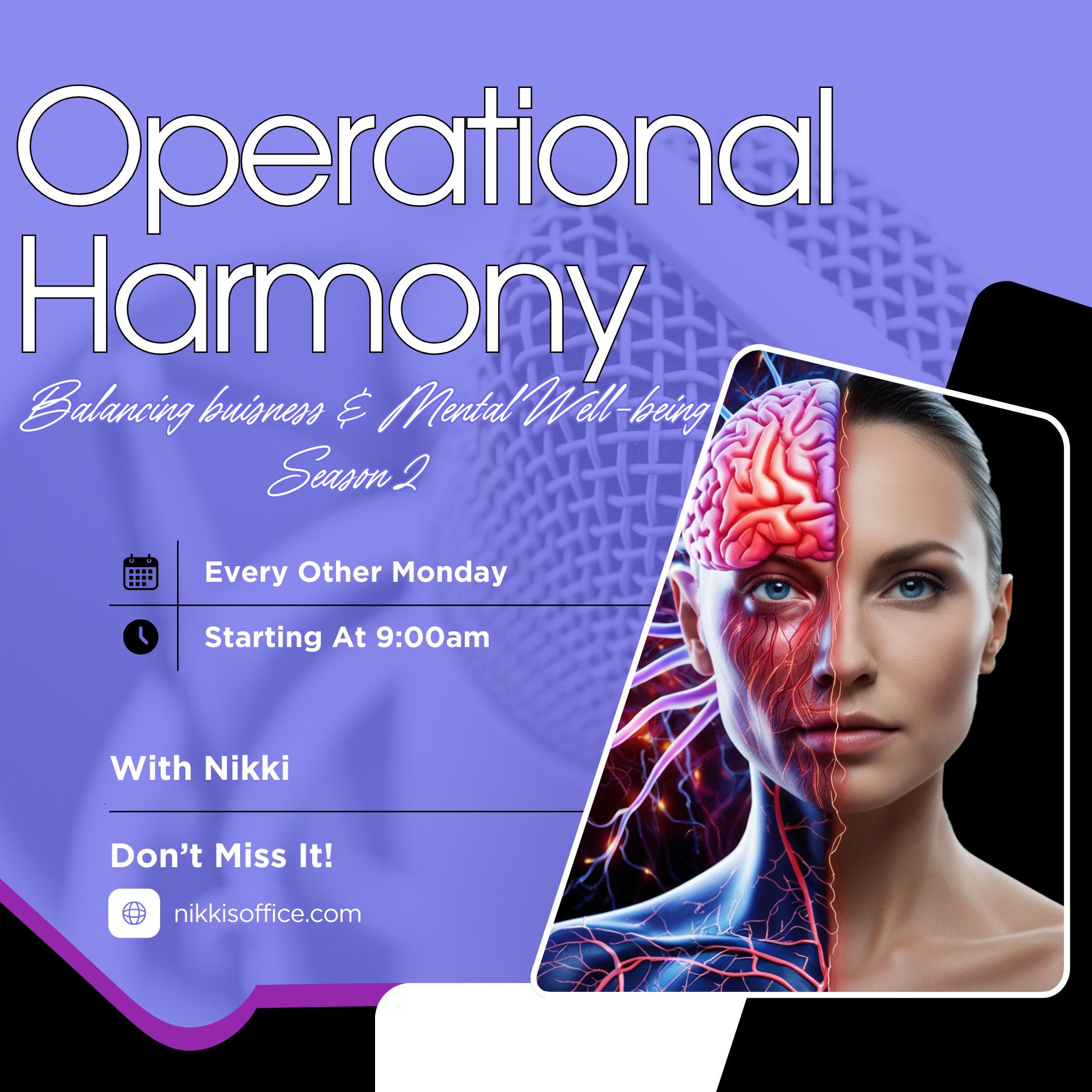

Boundaries, Burnout, and the Business You Actually Want
Operational Harmony: Balancing Business & Mental Wellbeing
| Nikki Walton / Dr. Jamie G Raygoza | Rating 0 (0) (0) |
| http://nikkisoffice.com | Launched: Sep 29, 2025 |
| waltonnikki@gmail.com | Season: 2 Episode: 44 |
Show Notes (fully timestamped)
00:00 — Meet Dr. Jaime Reza, career and stress coach helping people navigate transitions without burning out.
01:00 — Fifteen years in mental health, the burnout formula, and the car accident wake-up call that led to a three-day coma and a hard reset on work.
03:00 — Why “I’ll just pull one all-nighter” is a trap, and how to design systems that don’t rely on heroics.
04:30 — Boundaries that hold: start with call windows, project scope, and saying “no” when capacity is full.
05:30 — Corporate boundaries: don’t check email after hours, and know your on-call rights and pay structure; advocacy starts with knowing the law in your state.
07:00 — HR reality check: HR protects the company first; document everything and escalate with clarity.
09:00 — On-call vs emergency time: what counts, what to ask for, and how to ensure you’re paid fairly.
11:30 — Delegation as stress relief: when repetitive clicks steal your focus, hire task help so you can think.
14:00 — Procrastination as a signal of overwhelm, not a character flaw; lighten the load to reduce avoidance.
15:30 — Audit your task list: what’s truly necessary vs “past me promised future me.”
17:30 — If you have an assistant, talk daily; boredom means misalignment, overwhelm means you need more support.
19:30 — Owner mindset: you’re the iron that fuses the pegs, not a peg yourself; stay at the macro level.
21:00 — Work on the business: your time belongs to vision, partnerships, and strategy, not inbox triage.
24:00 — Seeing the system: connect marketing, sales, and ops so information and priorities flow.
26:00 — What’s under perfectionism: fear of letting go, and the next, scarier role after you delegate.
27:30 — When to bring in help: coaches, ops partners, and consultants to make the pivot less scary.
28:00 — Jaime’s CRM story: drowning at 900 contacts, hiring help, building automations, and getting time back.
29:30 — Health is data: headaches, stomach pain, or numbness are signals; ignoring them raises the cost later.
32:00 — Listening to your body: advocate for care, even when others minimize your pain or symptoms.
36:00 — Panic, seizures, and stress responses: why early attention matters and how to de-escalate your life load.
40:00 — Weekly reset blocks: two to six hours just for you; decompress, offload, then do something you enjoy.
42:00 — Jaime’s Rule of Threes: every 3 hours move, every 3 days change your environment, every 3 weeks leave your city, every 3 months leave your county, every 3 years leave the country if you can.
43:30 — Travel builds perspective; you don’t need international flights to expand your world.
48:00 — Coping toolbelt: therapy, routines, and trusted people for the hard days.
50:00 — Final takeaways: trust your signals, act on them, follow through, and build a business that protects your health.
SUBSCRIBE

Episode Chapters
Show Notes (fully timestamped)
00:00 — Meet Dr. Jaime Reza, career and stress coach helping people navigate transitions without burning out.
01:00 — Fifteen years in mental health, the burnout formula, and the car accident wake-up call that led to a three-day coma and a hard reset on work.
03:00 — Why “I’ll just pull one all-nighter” is a trap, and how to design systems that don’t rely on heroics.
04:30 — Boundaries that hold: start with call windows, project scope, and saying “no” when capacity is full.
05:30 — Corporate boundaries: don’t check email after hours, and know your on-call rights and pay structure; advocacy starts with knowing the law in your state.
07:00 — HR reality check: HR protects the company first; document everything and escalate with clarity.
09:00 — On-call vs emergency time: what counts, what to ask for, and how to ensure you’re paid fairly.
11:30 — Delegation as stress relief: when repetitive clicks steal your focus, hire task help so you can think.
14:00 — Procrastination as a signal of overwhelm, not a character flaw; lighten the load to reduce avoidance.
15:30 — Audit your task list: what’s truly necessary vs “past me promised future me.”
17:30 — If you have an assistant, talk daily; boredom means misalignment, overwhelm means you need more support.
19:30 — Owner mindset: you’re the iron that fuses the pegs, not a peg yourself; stay at the macro level.
21:00 — Work on the business: your time belongs to vision, partnerships, and strategy, not inbox triage.
24:00 — Seeing the system: connect marketing, sales, and ops so information and priorities flow.
26:00 — What’s under perfectionism: fear of letting go, and the next, scarier role after you delegate.
27:30 — When to bring in help: coaches, ops partners, and consultants to make the pivot less scary.
28:00 — Jaime’s CRM story: drowning at 900 contacts, hiring help, building automations, and getting time back.
29:30 — Health is data: headaches, stomach pain, or numbness are signals; ignoring them raises the cost later.
32:00 — Listening to your body: advocate for care, even when others minimize your pain or symptoms.
36:00 — Panic, seizures, and stress responses: why early attention matters and how to de-escalate your life load.
40:00 — Weekly reset blocks: two to six hours just for you; decompress, offload, then do something you enjoy.
42:00 — Jaime’s Rule of Threes: every 3 hours move, every 3 days change your environment, every 3 weeks leave your city, every 3 months leave your county, every 3 years leave the country if you can.
43:30 — Travel builds perspective; you don’t need international flights to expand your world.
48:00 — Coping toolbelt: therapy, routines, and trusted people for the hard days.
50:00 — Final takeaways: trust your signals, act on them, follow through, and build a business that protects your health.
Burnout isn’t a badge. Career and stress coach Dr. Jaime Reza joins Nikki to talk boundaries that hold, why procrastination is a stress signal, and how to delegate so you can work on your business, not in it. We cover HR realities, on-call pay, weekly reset blocks, and Jaime’s Rule of Threes for movement and travel. Listen for practical ways to protect your energy and grow sustainably.
Website: www.rainbowcareercoaching.com Podcast: https://creators.spotify.com/pod/show/findingtheunicorninyou Facebook: https://www.facebook.com/profile.php?id=100089604794211 LinkedIn: https://www.linkedin.com/in/jaime-gabriel-raygoza/ YouTube: https://www.youtube.com/@rainbowcareercoaching Instagram: https://www.instagram.com/rainbowcareercoaching Google Scholar: https://scholar.google.com/citations?user=4WVhQGkAAAAJ&hl=en&authuser=1&oi=ao
nikkis-lounge-2025-05-022001 Dr Jamie G
===
Speaker 2: [00:00:00] So, hi everyone. My name is Dr. Jaime Reza. I am a career coach and stress coach, and I focus on helping people find their next transition in life without burning themselves out in the process.
Speaker 3: How did you get started doing what you're doing?
Speaker 2: That's such a long story, but to keep it short, so I. Started, I've been working in the mental health field for 15 years and I started off as a case manager, went into social work, and just really, really was passionate about helping people.
One of the problems with social work, as you may know, is that it's a lot of work for very little pay. And it's like a formula. It's like a perfect formula to get burnt out. Like, I don't know anybody who's in the mental health field, in the service field that is not feeling some sense of burnout.
And to make a long story short, I ended up going to really bad car accident because I was going to school doing like 80 hours a week, putting in all this effort into this [00:01:00] work. And when I went into like a three day coma because I've like woke up from this car accident not knowing who the heck I was.
I was marked as a John Doe in the hospital. And when I woke up, the doctor was like, you should have been dead. Like there's no reason, like how looking at the pictures and the scene, like you should have, like, I'm surprised you left with a few scratches. So I was like, wow, I need to take this as like a wake up call to change my life and do something different.
Later that day went to work and told my boss, Hey, this is what happened. And they're like, we fired you. I was like, you were MIA for four days. We called you, you didn't leave anything, so we just thought it was job abandonment and we let you go. And I was like, well, now you know the story. Like, bring me back.
And they're like, nah. So it was just like a really, really like a double slap in the face. Like, why sacrifice yourself? Why kill yourself? When at the end of the day they really don't care about you and you're just killing yourself for no reason, really.
Speaker 3: For me, I think the boundaries are important.
Yes. Whether you're working [00:02:00] corporate or for yourself, because I know that there are days that I myself go, okay, I have 10 things that I need to get done and I'm gonna do every single one of them before I go to bed, which means maybe that night I don't go to bed because I'm an idiot like that. Right.
But obviously you can't do that. That's not sustainable.
Speaker: No. You
Speaker 3: even, I know that and I. It's a rarity that I do that. But if I get a backlog and I have to catch up, I might do it. But I have started setting more boundaries for myself where I'm not taking phone calls as late, I'm not taking on like projects that once I do them, somebody's going, oh yeah, we decided not to use that.
Oh yeah, well you should have told me sooner 'cause you're still paying for it.
Speaker: Mm-hmm.
Speaker 3: Nope. That's not how this works. And the people I work with are great and they understand and they're like, just do make sure you get it done, but [00:03:00] you working on your timeline, not ours. And so that's great. And I think that's kind of the first step in being able to not burn out in your business.
You have room to make boundaries because if you don't have room in your job. To make boundaries and have them be maybe not appreciated, but at least understood and accepted. And it's probably not the best working situation to be in. And maybe you do need to be with a coach who can help you switch jobs and get somewhere that is better.
Speaker 2: And that's like the common like narrative that I hear. Like I need to do everything all at once and keep this chaotic mess of like, it's just for today, I'm only gonna do an all-nighter today. I promise tomorrow I'm gonna catch up and I'm gonna do all these things. But wake up, there is no catching up.
The work is never gonna slow down. It's always gonna be one thing after another. When you solve one fire, another one pops up. It's [00:04:00] a rollercoaster of emotions of a ride. And if that, if you have that in mind that the work is never gonna slow down, then your system is at faulty and you need to fix your system so that you can then have the right energy and sanity.
You know, because after a certain amount of time, you're gonna end up like having lack of sleep and you're gonna get in a situation like me, where you just, something happens like an accident.
So you have to set up proper boundaries, like you said, in order to create a lifestyle that's sustainable and your business doesn't crash.
Speaker 3: The boundaries aren't just, if you own your own business, be because yes, you have them for yourself and you make the people you work with, follow them and that's fine. That's your business. You are putting the energy into that. You get to say that because you work with others.
But they are still for people who work in corporate, there are boundaries you can put, around yourself. Where I'm not gonna read my business email when I'm at home. I'm not [00:05:00] answering my phone at night because, if it's a business call because it's an inappropriate time to be calling somebody or, that kind of thing.
And that can, and sometimes people kick back at that. Well, we gave you a company phone. You're supposed to be on call all the time. I would check your laws because if you're on call and you're not getting paid overtime for being on call, then you should not be on call. Most states in the US say that you have to be, it's a lowered amount.
Obviously, you're not, say you're getting paid $10 an hour regularly. Obviously these amounts should be way higher. But I'm using $10 'cause that's what my brain can do on the math.
Speaker: Like half of that would be $5 an hour and it would be like three to $5 is what you would get per hour. If there's nothing that's happening, but you have a phone and you have to not drink because you could be [00:06:00] called to go in or you can't be doing anything that could, it's Halloween night or on call.
You can't go get dressed up and go do something because you might have to go into the office if something happens.
Speaker 3: So obviously in those times that, that's why that money is there. And I do believe in most states it is illegal to have somebody on call all the time. Yeah. Twenty four seven, three sixty five.
Because of that, like people are supposed to be allowed to have fun. And you're supposed to get paid for it.
Speaker 2: And it's really like figuring out, like you said, doing the research, finding out what are the state laws because some of these employers think that you're dumb. Or they'll try to take advantage of you or if you just like that Yes man or yes woman that always says yes to everything.
They're like, we're gonna get this sucker over here to be able to like state overtime and get seven days in a row of on-call time just to get it done. And I've seen it happen left and right and I've been in situations in the mental health field where I was working homeless services and they said, you have to be on [00:07:00] call like two weeks at a time.
And I'm like, that's too much. I was like, I can't do that. Are you gonna pay me overtime? I'm an hourly salary. So I was at any given time I was like, you're not paying me what I do during, like outside of these hours. And I fought back and I talked to HR and all of a sudden I was only on call for three days out of the week.
And everybody else had like other things and then they will take advantage of you as much as you. They say, no, my employer would never do that. If it comes in a pinch, it's between you and them and they're always gonna pick you.
Speaker 3: Also, a lot of people think that HR is their very best of friends. I'm so sorry to tell you that that is a lie.
You know, we can do the Maori povich thing. You are 100% wrong. HR will come in and they will step in certain situations because if they let the situation keep happening, there could be a lawsuit. Exactly. So they will stop that kind of a thing. Right. There's certain things they will do, but [00:08:00] they're there for the company.
They're covering the company's but not yours. Yeah. So they could very easily say, yeah, that didn't happen. I'm not sure what you mean. There's no evidence of that. Even if there is video or whatever, if you can't get the video, you can't prove that what you said is true. And so they will back the company instead of you.
Speaker 2: Yeah. HR is there just for a liability purpose on behalf of the company. That's their sole purpose. That's the whole purpose. They're getting paid as much as they're there to connect, uphold that the company stays within legal rights. It really just, at the end of the day, they are gonna lean, they're gonna sway towards the company.
So it is your job to make sure that you ha are knowledgeable, you know your rights, you know exactly what you gotta do, and this is how you set proper boundaries by educating yourself in these things.
Speaker 3: Yes. Education on your rights. So you said you are hourly. So one thing with hourly people, if you [00:09:00] have the phones or whatever, however they.
Just call it. Okay. Basically you have a phone where you have to answer to. There is the lowered hourly rate because you are covering something and you can't do what you want to do. You have to be ready and stuff for anything. There is also, if something happens, so say you're, I'm going to use this as an example.
'cause it's easy for anybody to picture, you know those, volunteer firefighters, right?
Speaker: Mm-hmm.
Speaker 3: They're on call all the time because fires can happen at any time. They're volunteer, not the same category as what we're talking about, but what they do is a big example of what I mean. So say there's a fire, okay?
They cut up, roll out, they get to the fire, they get out there, right? Why do you have that phone? What is the emergency you're waiting for?
Speaker: Mm-hmm. And
Speaker 3: if that emergency [00:10:00] happens, what are you supposed to, what are the actions you're supposed to do? How are you getting paid for this time? Mm-hmm. Because this time is not the on-call time, there's an emergency time and there should be either an overtime or an emergency pay for that.
Yeah.
Speaker: No. Yeah.
Speaker 3: I don't work in those kind of situations. I am an office person. I do office management and other stuff like it, virtually because people I'm perfectly fine around people as long as they're on the other side of a computer screen. But, for me. When I go to hire somebody to help me, because sometimes I do, because guess what?
Those little monotonous tasks that you sometimes have to do to get a project done, I am not the one to ask to do them.
Because all I'm gonna do is go hire somebody else to do them, because I'll get pissed off after two minutes of doing it and just like, I ain't doing this. And [00:11:00] so I have people that I can call and be like, are you free?
Do you have time? Can you do this thing? Because I'm not clicking six different windows to complete this thing. Like not happening. So recently, obviously I have a podcast. I didn't know anymore when people were scheduled their episode was supposed to be scheduled to go live. No idea.
Too many people that I have interviewed and I was just kind of like, I'm in trouble. Let's fix this. So I asked somebody that, I got a, good recommend for her because my normal person didn't have the time and so I worked with her and it only took her like a couple hours to do what I needed, make a spreadsheet with all the people's names that I have a podcast with and schedule them for a day in the, in this [00:12:00] year to go live.
Pretty simple. And so it only took her a couple hours to do it? Do you know how long it would've taken me?
Speaker 4: Oh, probably the same as, not as me a long time.
Speaker 3: Like I know how to do it. It's not that I don't know how to do it, but like the way you had to do it. Do you know where that information is? In my calendar.
You know what that means? You have to open each one of the calendar things that say podcast and get the information out of that. Put it into the spreadsheet. I'm done. Gimme week two. I'm hitting somebody because like what? And I created it myself. It's my own.
So like I can't blame anybody else. This is a me thing. This isn't even a customer thing that I got pissy about. No, this is a me thing and I didn't wanna have to keep clicking. Okay, we're on a new week. Okay, let's go. We have this [00:13:00] podcast, this podcast, this one, and this one and this one. And I'm not clicking that many times just to get the information I want into a fricking spreadsheet.
And then I had to remember the people who canceled, or the people who didn't show up. Or the people who showed up who were buttheads. Mm-hmm. Because I got yelled at once. I had somebody else, her internet connection was so bad that it was, we weren't communicating. I was sitting here waiting. I would hear something from her and I'd say a question, like, it was like a three minute delay.
Mm-hmm.
Speaker: And I was like, okay, we just need to reschedule. And I think she got pissy because she never rescheduled. Perfectly fine. You do you. But like, it's not my fault. Your internet connection with garbage.
Speaker 3: So, yeah, just whew. It's been a thing, but that lady was able to go in and it didn't piss her off to click on everything and get the information I was asking for.
I would much [00:14:00] rather someone not get pissed off and do the information. Because what happens is I click a couple, get pissed off that I've had to click so many. It's just nitpicky little things that irritating like that. Right? Yeah. And so. I do a couple and then I'm like, okay, I'll do this again some other time.
And I postpone it, which is how we got to May. And all of a sudden I don't, or actually we were in April, so all of a sudden I get to the middle of April and I don't know who my last three, when they were going, when the shows were gonna be live.
Speaker: Yeah, there's
Speaker 3: this problem now because I ke I will.
There was a song, I think, Amanda by sung it. The procrastination song.
Speaker: I don't think I've heard of that. Captain
Speaker 3: Procrastinate or something. Oh, I am that I procrastinate the crap outta everything. No, please Don't irritate me with little itty bitty things to do.[00:15:00]
Speaker 2: Yeah. And this is actually a really good transition to, another thing that you can do to help with the stress and all of that management, is delegate what you can. Mm-hmm. And then if you are working a nine to five in corporate and you are able to delegate the tasks, because if you're already procrastinating, that is a big sign that you are overwhelmed and that you are stressed out because that's your brain's like fight or flight response of this is causing literal pain in my brain right now.
I'm going to avoid it so that I don't need to feel that pain. That's all procrastination is. So that is a telltale sign of okay, let me sit down and see what, how can I light in my workload? Now, if you're a business owner, that's a little bit difficult because you are doing your own thing. So what you need to do is do an assessment of all the tasks you have for yourself, and which of those are absolutely necessary, and which ones are you doing just because you want to do.
There's this concept that I get mad at myself all the time for this because past Hymen has the audacity of thinking that future hymen can handle all these [00:16:00] tasks. And then when time catches up, I'm like, what were you thinking, man? There's no way I can do 10 meetings in a day.
Speaker 3: I was having a conversation with a friend I think yesterday, so timely, right? And she's like, so what do you have to do this weekend? And I'm like, A whole lot of stuff. And she's like, why do you have so much to do? And I'm like, because past me hates me.
Speaker: Yes,
Speaker 3: present me, hates future me. Like it's a thing, like pass the buck.
But, mostly for me, like I said, it's the digitally tasks. And as a business owner, I have now two different people I can go to pay them.
Per hour and say, please do this annoying thing, because I will punch a wall if I have to do it. Mm-hmm. With my head. So please do this before my head gets a concussion. And they'll do it. The one who really knows me, she'll laugh at me and just [00:17:00] go, I got you.
Because she knows I'm a little overly traumatic. I'm not lying. I will bust my head up beside a wall if I get irritated enough, because I'm like, oh, you're gonna stop doing this to myself. But then again, I do it with the Nest task, but delegating. So there are leaders out there
Speaker: mm-hmm.
Speaker 3: Who have no idea.
What it means to delegate. Oh yeah. And they are running on the treadmill. You ever see those really fast people on the, in the gym videos? Somebody's just like,
Speaker: mm-hmm.
Speaker 3: And they're going and everybody else is going.
Speaker 2: My thought is like, all it takes is one misstep and then mm-hmm.
Speaker 3: And then you're gonna go flying off a thing and hit the wall behind and yada, yada yada. But yeah, that one misstep is that one [00:18:00] task that you don't really like to do. And maybe you decide, oh, I could do that tomorrow, this time. Mm-hmm. And then tomorrow comes, and now your foot's outta sync because you have an extra thing to do and now you end up missing teeth.
'cause you smashed it into the calm section of the runner thing.
Speaker 2: Oh yeah.
Speaker 3: Runner thing. Holy crap. Words. Treadmill is the right word.
But very simply, if you have an assistant and you're not talking to them daily, you're screwing up.
Speaker 2: Oh yeah. They're literally there to help you. And there's this sense of control and like perfectionism that we get, and rightly so, you know, it's our little babies or it's like whatever, whether you're working on a nine to five or your business, whatever your project you're working on, it's an extension of you.
But just because you can do everything doesn't mean you need, you should. Exactly. Exactly.
Speaker 3: [00:19:00] Just because you can doesn't mean you should. Just because you can doesn't mean you should. There's all these people out there doing things and they've never asked themselves if they should be doing those things.
Mm-hmm. Or so here's the other point that I run across and I talk to people about. Being kind of a coach myself, kind of. 'cause I'm not in the whole woo woo stuff with everybody's like, I am a health coach. No. Look at me. Do I really think I do you think I know anything about health? No. I would be the wrong person for that job.
But if you have a coach that you're talking to and you have an assistant and you're not talking to them, here's the thing. That assistant is bored.
Speaker: Mm-hmm.
Speaker 3: You are paying them to twiddle their fricking thumbs.
Speaker: Yeah.
Speaker 3: Or maybe you have one assistant and she's pulling all her hair out because you need a second one, or you need [00:20:00] another employee of a different type.
Speaker: Mm-hmm.
Speaker 3: To take some stuff off of them. Your business, if you are going at it and you are doing things and you're getting more and more clients and you're doing all the things your clients need. At some point you are going to need employees.
Speaker 2: Yeah. And that's what you really need to do because you're, the one thing that you're never gonna get back is your time.
And the more time you have, the more you can invest and keep growing. So that's the bottleneck that's stopping you.
Speaker 3: Not only that, but you should be working on your business, not in your business. Yes. If you're working in your business, you're doing the wrong thing. I don't care what it is. Should you be checking your email if you are the CEO?
No, absolutely not. There should be somebody else going through, combing through it and then making sure you see the ones that are absolutely something you should be seeing.
Speaker 2: Exactly. Like they should be filtering all of those [00:21:00] things so you have the right thing. And the thing is that we're so ingrained to be in the weeds.
That like you need to be in a macro level to see the whole landscape. You can't just be in there 'cause you ha you have such a tunnel vision. Mm-hmm.
Speaker 3: So you know those little plastic squares that we used to make as kids? Did you see those? There's a little peg board and you have to put all these little Oh yeah, yeah, yeah.
Pegs on them and then you have to iron it so they all stay together.
Speaker 4: Yes. Yes.
Speaker 3: Okay. If you are the peg, you can't see where the other pegs go.
Speaker 4: Yeah.
Speaker 3: You're supposed to be the iron that fuses all the pegs together. Mm-hmm. That is like the weirdest
look, my for instances have taken wild turns in the past. This is nothing new for me.
Speaker 2: I love it. I don't be the peg. [00:22:00] Got it.
Speaker 3: You shouldn't have to do all of the tasks for your business as the owner. You should be maybe if you're far enough at along, you're not even doing the sales. You are talking to other businesses that want to partner with you and you're doing that kind of thing to keep on your business.
You are supposed to stay at a level. So you remember glimpses that used to be above like football stadiums?
Speaker: Yeah. I don't
Speaker 3: know if they are anymore. I absolutely do not watch football. Totally puts me to sleep. To be honest, so does golf. So I mean, I think it's just more this point, but them being in that, balloon.
They could look down and see everything that was happening on the field. All the people, even if they were flying too high and [00:23:00] everybody was a little pinpoint, right. They could see all that. Murder boy boards, boy. Yep. Whatever they're called. Voter boards.
Speaker 4: Yes.
Speaker 3: You know, they have the strings that connect A to B and B2C and this to that thing and that thing to this thing.
The string that goes along. Everything though, both of those, if you combine them, are what you should be doing for your business.
Speaker 4: Yeah. You should
Speaker 3: be taking that bird's eye view of your company and going, Hey, marketing needs to talk to this section more often. So maybe we should, make them a little more connected, or maybe it should come out of the basement and be some kind of other thing that you're doing with them because let's stop putting people in basements.
Not comfortable. Nobody's ever comfortable in the basement.
Speaker 4: No.
Speaker 3: But that's how you're supposed to view your business. You're supposed to see the connections [00:24:00] and things like that. And then you're going out and you're networking and you are building your business by bringing in more partners, bringing in connecting people to your sales team for them to talk to, so that your business can grow.
There are a ton of things that a CEO entrepreneur, whatever needs to do that has nothing to do with email or Right. Returning. Messages or answering phones or drawing anything? No. The CEO is there to bring new ideas to the entire company and say, look, this is an idea I've been thinking of. I want I it to connect with the sales team and like really make sure that everybody understands how what we do connects with [00:25:00] it and what we can do there.
I keep saying it. I don't know why it's the same. It's another, for instance, that's going off the wall. I don't know. My brain works in mysterious ways. Okay.
You are not the only one who don't know what's coming out of my mouth. Neither do I.
But by having that. Eagle view and being the creative person that came up with the company in the first place. Yes, at first you have real stuff you have to do because you have to do all of those ideas and bring them to pass all by yourself. But there is a point, there comes a point when you have to pivot because if you don't pivot, you're gonna end up crashing your business because you're not focusing on the things that you actually need to focus on.
You're trying to hoard all of the resources and not let your business and the people you've hired help you [00:26:00] with those resources.
Speaker 2: Yeah. And you really need to ask yourself why you're doing these things. Mm-hmm. We think we tell ourselves a certain, a very superficial lie, and it may be have some truth to it where we say, well, things are not gonna come out the same way if I don't do them.
Which, and there is some truth to that, but I don't think that's the whole truth. A lot of the truth is. We're afraid to let go because we don't wanna do the scary thing that comes after that.
Speaker: Mm-hmm. We don't
Speaker 2: want to do the macro level stuff, because what if I'm not good enough? What if I mess it up? What if like, you know, I was only meant to do that, the stuff in the weeds.
But you have to have the confidence in yourself. If you've gotten this far in life, you have the skills to do it.
Speaker: Mm-hmm.
Speaker 2: Give yourself the grace and the confidence that you have the skillset. Do it, delegate it out. Get the assistant, do whatever you can and think bigger because you deserve bigger.
Speaker 3: Mm-hmm.
And you don't have to even do the pivot part [00:27:00] yourself. No. There are coaches, there are operations people, there are people that can help you with the pivot part to make it less scary. To make the pivot.
Speaker 2: Exactly. This is where you get help. I had the same situation where I was starting my business and I didn't.
I was doing, I didn't have a management system, like a crm mm-hmm. To be able to track all of the people that I was contacting. And at first I was like, oh, it's like 50 people I can handle that I can track. But then months later I'm like, oh, my, my li my client list now is like 300 people. How am I gonna keep track of that?
And I wasn't, clients were falling through the cracks, I was missing deals. And by the time I realized it, by the time I actually sought at help, I was at 900 like contacts and I was drowning. And I was like, I don't know how I'm gonna do it. So I hired a consultant, she helped me set up all of my stuff within like a month, and she made all these automations and made it look pretty.
And now it's just like, wow. Like I'm saving so much [00:28:00] time, I have less stress and my business is thriving. But I would've never done that if I didn't admit that I needed the help.
Speaker 3: Mm-hmm. That's exactly, I mean, there's just.
Mental health and business. There comes a point where if you don't reach out for help, you're gonna do something stupid.
Speaker: Mm-hmm.
Speaker 3: You have to, and I understand, look, especially for the mental health part. Okay. Business part, you have to reach out for help. You're gonna start sinking and like, dude, get help.
Mental health. I understand coming from a family who didn't listen, who thought I was faking every time I said something was wrong, I have yet to have something actually not be wrong when I said something was wrong. So, I don't know how that came to be, but you know, there's family that will be against you.
Mm-hmm. There's friends that will say, you're the problem. [00:29:00] What you do is you find one person, whether it's a sister, a brother, a friend, your mother, whatever it is. You find one person who will listen to you and stand by you, and you reach out to them for help because you're not alone and you shouldn't be fighting with your demons alone.
No.
Speaker 2: And the thing is that your body's gonna tell you these things. Your truth is law for yourself. No one can tell you what you're feeling is not what you're feeling. And if somebody's trying to do that, then maybe that's not the right person to talk to. You have to listen to, like if you are having migraines, if you're having stomach aches, if you're just feeling out of sync with yourself.
Take that as like a calling that, okay, I need to really do something. Mm-hmm. To go, like, go seek a doctor, go seek a therapist. Go seek a coach, someone to be able to help you through the, to figure out what [00:30:00] exactly it is. Because once you name that demon, that problem, that issue, whether it be anxiety like you know, or a physical illness or something, then you can take the steps to fixing it and avoiding it in the future.
Like avoiding it from repeating in the future.
Speaker 3: So, interesting story in, may of 2019, I got a headache and you would think just like every other headache, no big deal. Who remembers the last time like that specifically that I had a headache and I remember it because that is the last time I didn't have a headache.
I have had a headache every day since it started in May of 2019. It sucks. Guaranteed. I gotta tell you, it sucks, right? I went to a neurologist and the one I went to was one of those people who were just like, yeah, you're, it's a headache go away. Right. Except [00:31:00] she did do an MRI and then she just dismissed me.
There's nothing wrong with you except I have something inside of my brain that is supposed to not have cerebral fluid in it that has cerebral fluid in it. So that kind of is an indicator that, oh, there's a problem.
Speaker: Mm-hmm.
Speaker 3: So, we moved in 2020 after going, I had the headache for like eight months before we went to a doctor.
Speaker: Oh, wow. So,
Speaker 3: because I was just kind of like, it's just a headache, it's fine, it's just whatever. I had an MRI in Maryland. And when I moved to Texas, they decided to do another MRI.
Speaker: Mm-hmm.
Speaker 3: And these people actually paid attention because they also did a spinal tap.
Speaker: Mm. You
Speaker 3: have to warn you if you don't need a spinal tap, I do not recommend you getting one.
'cause it sucks.
Speaker 4: Oh my gosh.
Speaker 3: Sucks. It doesn't hurt particularly, but it doesn't feel good either. [00:32:00]
Speaker: Mm-hmm.
Speaker 3: It's just, it's very weird to feel a tiny little needle pass through your spine. Okay. It is evil. Awful. I don't recommend it the same, but, that showed that I had a ton of cerebral fluid and no reason.
Still don't know a reason, but it means that I have, my headaches aren't just Oh, you're fine. No, my headaches will bleed into a migraine some days.
Speaker 4: Oh.
Speaker 3: But if I'd have just kept dismissing it, I mean, I did, I dismissed it for eight months. How much longer would it have taken for me to figure out what was going on?
So you don't ignore things. My stomach, I had bleeding ulcers when I was a teenager. I'm not allowed to take ibuprofen anymore.
Speaker 4: Wow.
Speaker 3: So, they went in, they did the one that goes in your mouth and down into your stomach and I had over [00:33:00] 200 bleeding ulcers in my stomach.
Speaker 4: Oh my gosh.
Speaker 3: And now I can't eat spicy food.
It's very painful for my stomach. It still hurts. Even though the ulcers aren't there still. They're just, it's sensitive. It doesn't want the spice.
Speaker 4: Yeah.
Speaker 3: So I have to be careful with what I eat because I can't eat even something that's just been too much peppered. I can't eat 'cause it will hurt my stomach.
Which is the stupidest thing and totally a white person thing to say. Not gonna lie. Okay. I completely get the irony of a white person saying, I can't eat spice. Like that's on point, okay.
Speaker: But
because my stomach has screwed up by ibuprofen.
Yeah.
Speaker 3: So, there are a lot of things physically and mentally wrong with me.
None of them are particularly fun to have the spicy, I used to love, jalapeno dip and stuff like that. I can't eat the stuff now. [00:34:00] I used to like the white queso dip, can't eat that stuff now.
Speaker 4: Oh wow.
Speaker 3: Because it's too, like I said, it's too spicy and it's like stupid, not spicy. I know that 'cause I've had it before, but my stomach can't handle it.
It cramps down real hard and all that other good stuff. Not a good time, not doing it. Good luck with somebody else. But my point is if you're not paying attention to your body, your mind, your business, you're not doing yourself any favor. I know when something's wrong. I listen to my body, and I have been conditioned over the years very well to listen to my body because delaying it only means that the problem gets worse.
Speaker 2: Yeah. I'll share one story with you. When I was younger, I was put in, I started working when I was 15 years old. My parents, are first generation, I'm first generation Hispanic. My parents immigrated over here when they were [00:35:00] younger. So we didn't, I didn't live very lavish life.
I wouldn't say I was poor, but I wasn't rich. I was like middle class, you know? Mm-hmm. Um, but it was during like, great depression happened, all that stuff, and like it just. My family was struggling financially, so I had to work at a young age. So I think it's great.
Speaker 3: Depression was in 19, not Great
Speaker 2: Depression, forties
Speaker 3: or something.
I don't think you said that right?
Speaker 2: No, I totally said it and I didn't. No, it was, the housing boom. What it was in the early 2000.
Speaker 3: It was 2008.
Speaker 2: Yes. That's what I'm talking about. Sorry.
Speaker 3: I said it, I'm looking at my head going, you didn't look that old. What the,
Speaker 2: as soon as I said it, I was like, I don't think that's right.
Oh gosh, the housing boom market, that thing where a lot of people ended up like investing in it didn't go so well. Mm-hmm. So my parents were affected a little bit. They had high interest rates. It was just insane. And they had, they asked me like, once you [00:36:00] can work, you need to start working.
Mm-hmm. So I was doing AP classes, I was in sports, I was working full time as a lifeguard at the time, and it was just, I noticed that once I started working, my right eye started twitching like a lot throughout the day. And I was like, that's kind of weird, but whatever. It went from my right eye twitching to my left cheek, to my arm, to my thighs, and it was just like these random muscle spasms all over my body.
I failed to mention it to anyone because I was just like, oh, it's probably nothing because it would happen for a couple seconds and then go away until one day my whole arm got numb. And then I couldn't feel it anymore. And now I couldn't move it. It was just like stiff. And I was like, okay, this is, something's going on going wrong.
But at that point, I had waited too long, my face got numb, my other got arm got numb. I ended up collapsing and I started having a seizure. Well, it mimicked the seizure, turned out it was a panic attack [00:37:00] and my body just crumpled up, tensed up, and I just started seizing like crazy, trying to release all that stress.
This was in, I wanna say 2009, and that was my junior year of high school and entering my senior year, I had 30 anxiety attacks. And then to this day, my father says, it's all in my head and I'm being dramatic. But point of the story is you have to kind of, like you said, you have to pay attention to these little signs that your body's telling you.
Don't just ignore it. You're thinking like, oh, it's nothing. It's just a toothache. It's just a headache. It's just a muscle spasm, but you shouldn't be experiencing that to begin with.
Speaker 3: No. An emergency case for me, ended up being an emergency case. It didn't start off that way. I sat down at a friend's house, right?
I just sat down and I felt something thrum [00:38:00] inside my body, and I went, I need to go to the emergency room now. Like, I wasn't in pain, no idea what was going on, but that thrum was not a good thing. Like mm-hmm. I knew something was wrong, like my body thread out just screamed at me. Problem. I ended up getting my appendix removed.
Speaker 4: Oh,
oh my gosh.
Speaker 3: That obviously would've tried to kill me if it kept spreading.
Right? Yeah. They were able to get all of it, and I never had to do any testing after that. But I listened to my body.
Speaker: Mm-hmm.
Speaker 3: Right. I could have went, huh. That was weird and just kept going on with my life, and either died from cancer
and I wouldn't have known why. I just would've been dead.
Speaker 2: And this is why you need to get checked. Like you need to seek out [00:39:00] help and you need to do something to like consistently be checking yourself. Take yourself seriously.
Speaker 3: Mm-hmm. Make sure that you have time off each week.
Speaker: Mm-hmm.
Speaker 3: Don't care what your normal hours are if you're a mom or a dad or whatever.
And you have to spend time with family. You need to have four to six hours set aside for just you on your days off so that you can make sure you're listening to your body so you can decompress from all of the stress and anxiety that has to come with business and so that you can breathe and then.
Sometimes you take two hours to just do the meditate thing. Look, I'm not woowoo, I don't care how you do it. Just sit on your bed and say, and like go through everything and make sure that you're okay with everything and you have released the tension from your body. You [00:40:00] know, make sure your shoulders go down and you unlock your chin.
I hate those stupid videos that come across Facebook every once in a while that are like, yeah, lower your shoulders. Is your tongue on the top of your mouth? Just stop telling on me.
So just kind of relax and do that kind of thing, and make sure that you think over the last couple days and make sure that you are okay. Check in with yourself. Do that then with some of your other time. Because once somebody relaxes and goes, okay, I have no more anxiety about my business, but I do know about, I wanna do this, and this.
Write that down. But don't start that now. Yeah. You can write it down with a couple of notes. You should spend 10 minutes on this. Okay. Write down the things you have real quick. That way you don't lose them. Then go [00:41:00] do something you enjoy. If you're a gamer, go game for an hour or two. If you're a reader, go read for an hour or two.
Escape out of your own mind for that little bit so that you, when you come back to it, once you're done, you're not as stressed. You are just as relaxed and thankful, and now you can go take care of your kids. You can do the other things without taking out any stress on the kid or the dog or the other thing.
Speaker 2: Exactly. Just doing little things to be able to reset yourself and like you said, not everything. Like video, gaming, basketball, whatever it is like, it's not all gonna be, you do whatever brings you pleasure.
Speaker: Mm-hmm.
Speaker 2: And allows you to kind of ground yourself, whether it be the woo woo stuff and the meditating or the, or just going out for a walk.
Speaker: Mm-hmm.
Speaker 2: Just do something to do it. There's a, this concept that I mentioned to a lot of my clients called the rule of three, which [00:42:00] is every three hours you should be getting your ass, out of your seat. Walking around, stretching for five minutes. Just grab a glass of water, go to the restroom, go eat whatever you want.
Every three hours. Mm-hmm. Every three days you should be getting out of your apartment or your regular regime from work home. Do something different. Go to a park, go do something Around every three weeks you should be leaving the city. Expose yourself to something new. Go to a museum, go to a different park.
Go visit a friend. Every three months you should be leaving the county. And then just doing like a more extended weekend trip. And then every three years they try to leave the country so that you can immerse yourself in different culture to get those creative juices flowing and bring more things into your business and into yourself.
Speaker 3: I'm a military brat. I was raised all over the us. I have been to or lived in every state in the US except for Alaska and Hawaii. Okay. I have been [00:43:00] asked what my hometown is on more occasions than I would like to admit. I have gotten into arguments with old people because they will ask me where my hometown is and when I say I don't have one dude, I went to 20 elementary schools.
Do you really think I have a hometown? Really?
Speaker 4: Mm-hmm.
Speaker 3: I've also met people who were born, lived and died in the same county. Okay. They don't understand how I went to all these states, Luke, I don't understand how you're trapped in the same county for the whole life.
Speaker: Yeah.
Speaker 3: So we're on the same footing there.
We each don't know what the heck the other one is doing. Even if you can't get out of the US because it's too expensive, get out of your state.
Speaker 2: Yeah.
Speaker 3: You do not have to live, breathe, die Mississippi for your entire life.
Speaker: Mm-hmm.
Speaker 3: Or Texas or wherever. Right. [00:44:00] Texas is a little harder to leave. I am not gonna lie, that drive is gonna take a couple hours,
Speaker: a couple
Speaker 3: days maybe.
So I do get it. But go to another state, go to a museum in another state. There's. Tourist activities. Wherever you go try to do something there. Even if you can never afford to go to Italy or wherever, or if you are afraid of flying and you don't wanna go that way, then travel the US going to Canada if you can
Speaker 4: Exactly. Do
Speaker 3: something. Because coming up to somebody who's been all over the US and saying, oh, but you don't travel all that much. You just traveled in the us, not out of it. Do you realize that with the amount of hours that I have spent on the road or living in different states, if I was in Europe, people would call me a world traveler because I'd have been to other [00:45:00] countries instead of just other states.
Speaker 2: But even then, like the United States, each state has its own little subculture. Like I've been, I've only been to 18 states out of like the 51 and I'm not including the territories, whatever, the 50 ones. And yeah, each one has its own unique culture, its own food, its own like subset that you just like learned different things.
Like when I went to New Orleans and I tried like their occasion and their like type of, oh my gosh, the beignets, oh my gosh, it is like a whole different thing, you know? Mm-hmm. Like California could never mm-hmm. And it was just trying to, I went to Texas and tried their version of like TexMex and things like that.
It's like everything has so much rich culture because each state is a melting pot of its own people living there. So give credit where credit's due. I think traveling even within the states is a wonderful thing to do.
Speaker 3: Well, if you think about it, England is like the size of Boston or something.
Mm-hmm. That may be a little wrong, but it's [00:46:00] pretty close, right?
Speaker: Mm-hmm.
Speaker 3: So basically if you've traveled through New England, you could have traveled to like seven different countries if you were in Europe.
Speaker 2: Yeah.
Speaker 3: Instead we're in the US where we just go state by state and then everybody's like, well you've only been to the States.
Yeah. A lot of them, they're different. I live in Arkansas. The banjo music is playing in the background. Okay. Just look, I know my last name and this state do not get along.
My last name is Walton. And I live in the home of Walmart.
Speaker 4: Mm-hmm.
Speaker 3: That was owned by Sam Walton and his Okay. So, mm-hmm. Lemme tell you, I do not appreciate the questions that I get some days. Hmm. Are you one of them Walton's? Do you, do I look like I have [00:47:00] that kind of money?
Speaker 4: Oh my gosh.
Speaker 3: I am quite sure that I could do a heck of a lot more with my hair if I had that kind of money.
Okay. Let's just be real. Second of all, then they go, there was an old TV show that some people forget about called Walton's Mountain, and if I had a fricking penny for every time I've been asked where John boy is, I'd be a billionaire.
Speaker 4: Oh my gosh.
Speaker 3: And um, so we drove in and then like, after we figured out that I can't go outside 'cause I'm about to die, we, we drove back out without me leaving the truck again.
Speaker: Mm.
Speaker 3: But, the second time I did better 'cause there was no fire happening. But I can't breathe. I don't breathe easy either. So this podcast has become a list of everything that's wrong with Nikki,
which [00:48:00] is fine, except, and it's because I listen to my body.
Speaker 4: Yeah.
Speaker 3: Obviously somebody mows their grass, I'm gonna know it 'cause I'm not gonna be able to breathe.
Speaker: Mm-hmm.
Speaker 3: You'll hear me wheezing. So, listen to your body and my body. I listen to it when I'm stressed out. If I start ranting and raving, I know I'm stressed and I need to probably chill the crap out before somebody thinks I actually am insane.
And then I calm myself down. There are coping mechanisms. There are things you should be seeing a therapist if you're having trouble with anxiety and depression. There are different ways to. Come back to life again. And you need to, at every step of the way, even if you have physical problems or if it's just the mental problems, or maybe you're like me and you have both.[00:49:00]
Trust someone and stay even on the hard days when you don't want to.
Speaker 2: Yeah. And it's just you really do have to, just, if there's anything that you're gonna leave out of this conversation is just make sure that you are trusting yourself. You listen to your body and do something about it. Don't just like listen and then okay, well I did what he said and that's it.
No, like, put action steps to be able to alleviate all the things that you recognize about yourself and the things that are hurting you.
Speaker 3: Follow through is a thing.
Speaker 2: Very big.
Speaker 3: Do you have any final thoughts?
Speaker 2: I think it was a really great conversation. It, I really loved, like hearing a little bit more about you and then also just like really emphasizing this because I think like mental health is really important to me.
Like I've suffered through so many anxiety attacks, so many different migraines because of the [00:50:00] stress I've had ailments where I am. I'm also not, I'm, there was a moment where like the nurses in the ER room knew me by name. They're like, oh, hi Ms. Back. So it was bad. So just make sure you listen to yourself, put yourself first, then just really listen to, pay attention to how your body is.
Speaker 3: Mm-hmm. And not just listen, take the action stepss necessary to understand, because then you could have a funky kink in your elbow today that turns out to be nothing. Right. Because you're just learning how to listen to your body. But eventually, if you listen strong enough and you get that thrum, you'll know, ha, I'm not in pain, but I'm probably gonna be if I don't listen to this.
Right. And then you go and you do, you go to the doctors, you figure out what's happening, and you get the help you need, whether it's physically or mentally. You are not stupid for needing a therapist. You are not [00:51:00] stupid for needing physical care, anybody telling you that you don't need it because you're fine and you're normal.
Obviously they don't live in your head because their opinion doesn't matter.
Speaker 4: Mm-hmm.
Speaker 3: It's if you need that person.
Speaker 4: Exactly.
Speaker 3: And maybe cut the red flag out. But that's a whole different kettle of fish.
Okay. I
Speaker 2: completely
Speaker 4: agree.